
The Enlightenment Thinkers The Age of Reason Copyright
- Slides: 14
The Enlightenment Thinkers The Age of Reason Copyright © 2011 Instructomania Pavlovich
The Enlightenment l Scholars began to challenge long held beliefs about: l Science l Religion l Government l New scholars based their ideas on: l l Observation of people Rational thought Reason Understanding
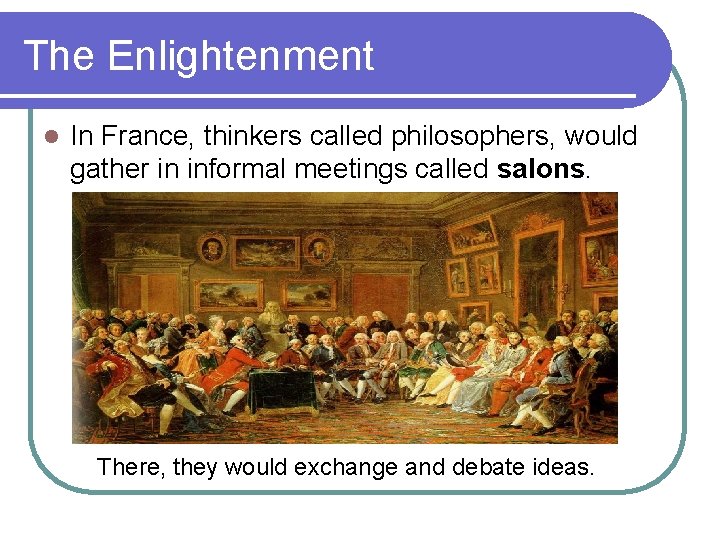
The Enlightenment l In France, thinkers called philosophers, would gather in informal meetings called salons. There, they would exchange and debate ideas.
Philosophers did not always agree! l Some supported absolute rule by the king. l Some said that the people should have a say in their own government. l Humans have natural rights and should be treated fairly. l What is the best form of government?
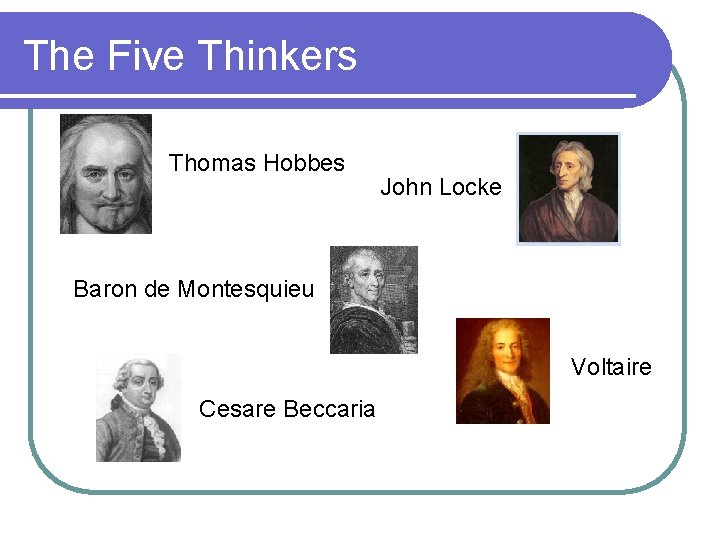
The Five Thinkers Thomas Hobbes John Locke Baron de Montesquieu Voltaire Cesare Beccaria
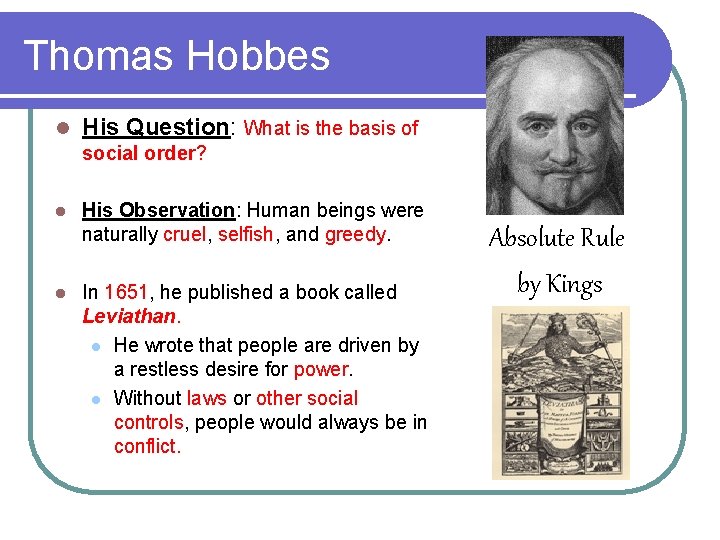
Thomas Hobbes l His Question: What is the basis of social order? l l His Observation: Human beings were naturally cruel, selfish, and greedy. In 1651, he published a book called Leviathan. l He wrote that people are driven by a restless desire for power. l Without laws or other social controls, people would always be in conflict. Absolute Rule by Kings
Thomas Hobbes l Governments were created to protect people from their own selfishness. l People are selfish by nature and can not be trusted to make decisions that were good for society as a whole.
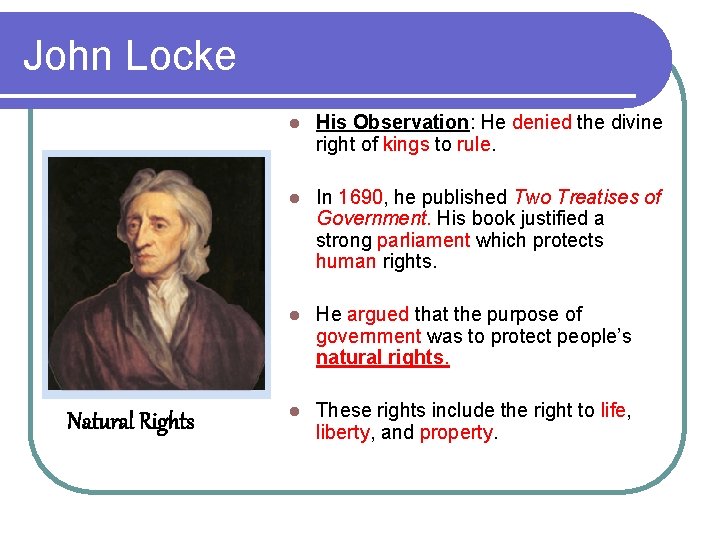
John Locke Natural Rights l His Observation: He denied the divine right of kings to rule. l In 1690, he published Two Treatises of Government. His book justified a strong parliament which protects human rights. l He argued that the purpose of government was to protect people’s natural rights. l These rights include the right to life, liberty, and property.
John Locke l In exchange for rights, people give the government the power to make and enforce laws. l The true basis of government was a social contract (or agreement), among free people. l His theory is that a government’s authority is based on the consent of the people. If the government fails to respect people’s rights, it can be overthrown.
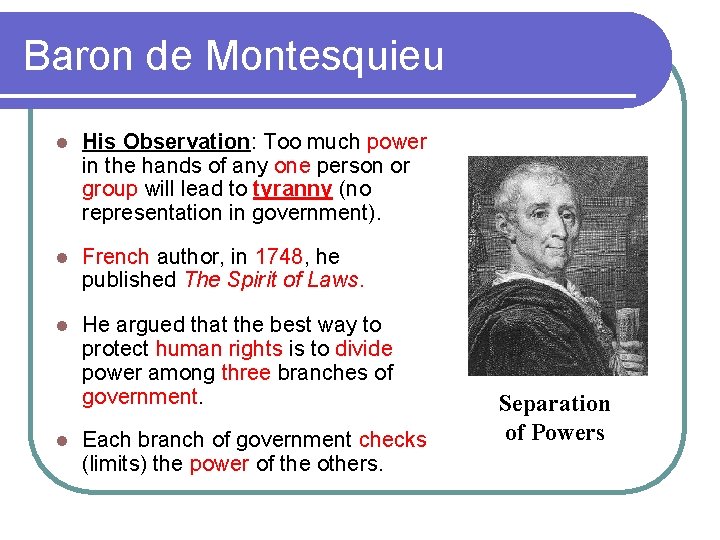
Baron de Montesquieu l His Observation: Too much power in the hands of any one person or group will lead to tyranny (no representation in government). l French author, in 1748, he published The Spirit of Laws. l He argued that the best way to protect human rights is to divide power among three branches of government. l Each branch of government checks (limits) the power of the others. Separation of Powers
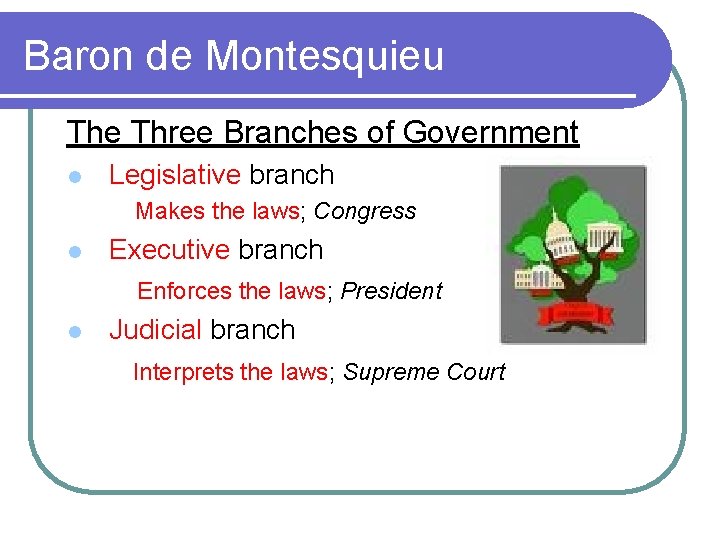
Baron de Montesquieu The Three Branches of Government l Legislative branch Makes the laws; Congress l Executive branch Enforces the laws; President l Judicial branch Interprets the laws; Supreme Court
Voltaire l His Observation: Freedom of thought and expression is the only way to fight oppression. l He was a French writer and participant in Paris salons l He supported religious tolerance l l Allowing people to believe in religion in their own way. Strong supporter of free speech. “I disapprove of what you say, but I will defend to the death your right to say it” Free Speech
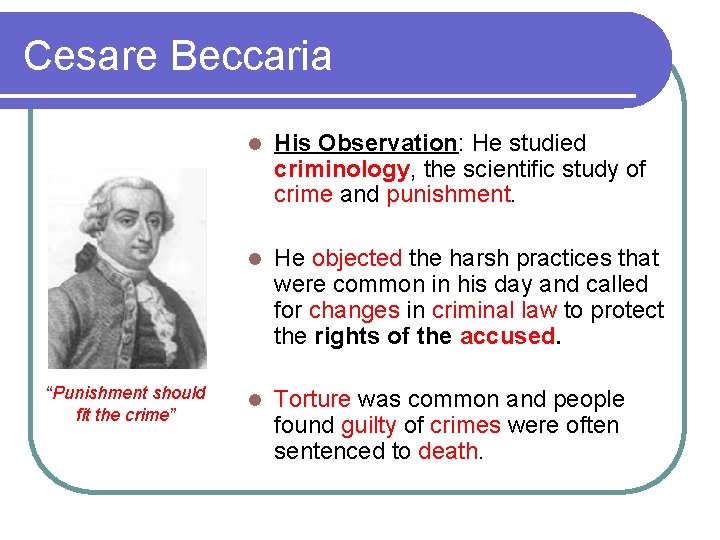
Cesare Beccaria “Punishment should fit the crime” l His Observation: He studied criminology, the scientific study of crime and punishment. l He objected the harsh practices that were common in his day and called for changes in criminal law to protect the rights of the accused. l Torture was common and people found guilty of crimes were often sentenced to death.
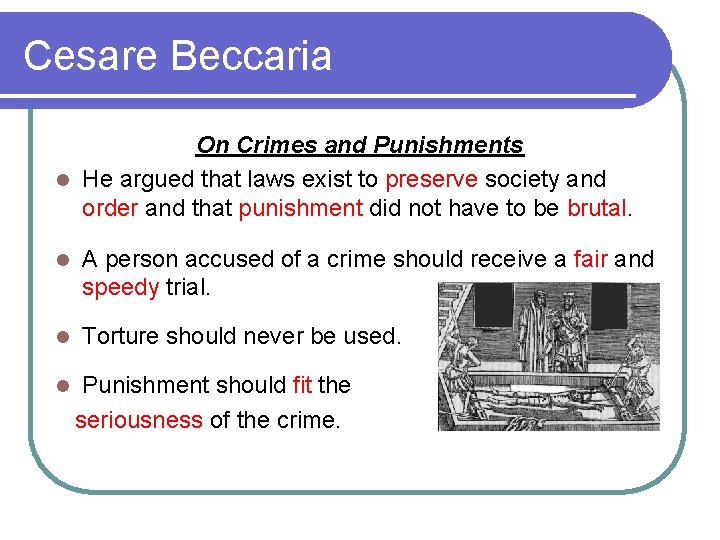
Cesare Beccaria On Crimes and Punishments l He argued that laws exist to preserve society and order and that punishment did not have to be brutal. l A person accused of a crime should receive a fair and speedy trial. l Torture should never be used. l Punishment should fit the seriousness of the crime.