
The Enlightenment People and Ideas of The Age
- Slides: 28
The Enlightenment People and Ideas of “The Age of Reason”
What is the Enlightenment? 18 th century intellectual movement applying the ideas of the Scientific Revolution to the reform of human society Political Economic Social
Catalysts Change does not occur in a vacuum!! Revocation of the Edict of Nantes in France, 1685 Demonstrated the arbitrary, unreasonableness of rule by absolute monarchy Publication of Newton’s Theory of Gravitation, 1687 (Principia) Demonstrated reasonableness of nature and great possibility of human understanding Glorious Revolution in England, 1688 Demonstrated the possibilities of constitutional government and orderly change of government
Applying the Knowledge With the Scientific Revolution, many people felt that all events were governed by "natural laws“ This led many to believe in the existence of other natural laws governing all political, economic, and social affairs of humans Suggests that the human mind is capable of understanding these laws and bring human society into harmony with natural law. Creating better societies and People
Scientific Method Using reason and scientific method scholars attempted to improve life Examine the problem Formulate questions and formulate hypotheses Try solutions difficulty resulted because the experimental solutions had to be used in the real world
Problems Natural Science should be used to understand the world Can’t accept items on faith Caused conflict with the church
Main Concepts Nature/Natural Made by God, Therefore perfect Imperfection was unnatural Reason and Rationalism People could understand Emotion clouded reason Irrational behavior caused pain and suffering Empiricism Use the scientific method to solve problems Observation & Experimentation
Main Concepts Individualism Basis for society, not insignificant part Progress Possible, society can improve As individuals became educated and enlightened, society would improve Relativism Challenged the superiority of Christian European Society Noble Savage/ Classical Societies
Where? Focus in Paris Not all Enlightenment thinkers are French, but it is the center of the movement. Writers /Thinkers – Philosophes Circulated ideas of the enlightenment Wrote of societies flaws, and possible solutions Saw people as basically good, and capable of reason. Progress through Reason
Deism Emphasized an impersonal deity, natural religion and the common morality of all human beings. There was a universal natural religion.
Enlightened Despots Monarchs who embraced Enlightenment ideas and worked to implement them in their countries. Catherine the Great Fredrick the Great Joseph II
Physiocrats They believed in applying “physiocracy”, "the rule of nature", to solve all economic problems François Quesnay (1694‑ 1774) Dupont de Nemours (1739‑ 1817) (founder of American family of chemical fame) Anne‑Robert Turgot Agriculture was considered the source of all wealth – free circulation of wealth Physiocrats vigorously attacked the mercantilist policies of government because of their restrictive economic controls
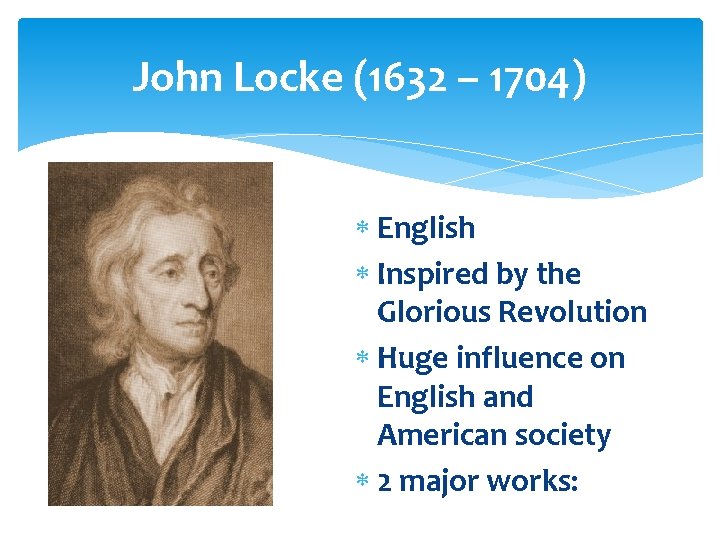
John Locke (1632 – 1704) English Inspired by the Glorious Revolution Huge influence on English and American society 2 major works:
Two Treatises of Government 1690 Government existed as part of the political contract between government and governed Government was created by the people to protect their God Given - “natural rights” of life liberty and property People owed government obedience to just laws as their obligation under the contract If government infringed on or failed to protect “natural” rights, people were justified in revolution to overthrow an unjust government
Essay Concerning Human Understanding (1690) Locke Insisted that humans were born with a perfectly blank mind ("tabula rasa", i. e. , blank slate) lacking any innate tendencies or preconceived notions All human knowledge was the result of experience and experience was composed of these sensation Therefore man could be improved by improving his powers of reason; environment and society could be improved by reforms conforming to natural laws (when they were discovered)
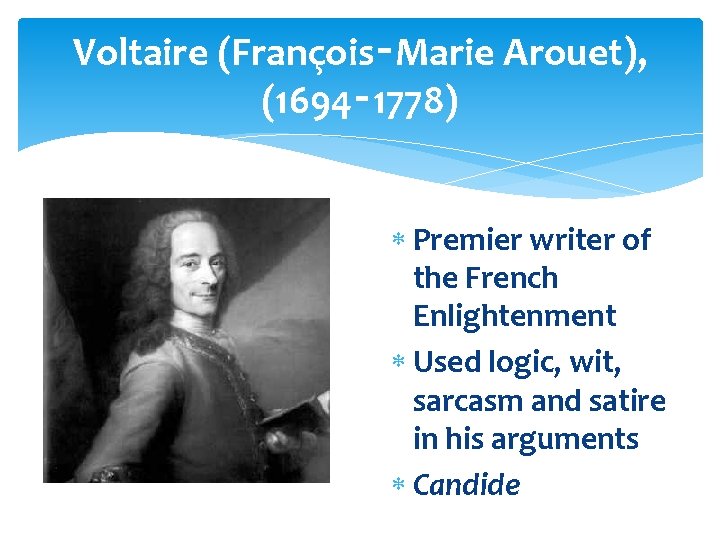
Voltaire (François‑Marie Arouet), (1694‑ 1778) Premier writer of the French Enlightenment Used logic, wit, sarcasm and satire in his arguments Candide
Ideas Freedom of expression (speech, press, religion) The form of government was not important to Voltaire as long as it was "enlightened" and fostered reason and progress promote the arts and sciences and advance the material and technical progress of society enforce free speech, religious toleration, and have no state church best government immediately possible would be by an "enlightened despot" surrounded by enlightened advisors under whose control enlightened policies would filter down to the unenlightened masses
“Crush The Infamous Thing” Quote above is how Voltaire referred to the Roman Catholic Church He was a Deist who attacked religious dogma Human reason could tell good from evil Felt the church in France restricted personal behavior.
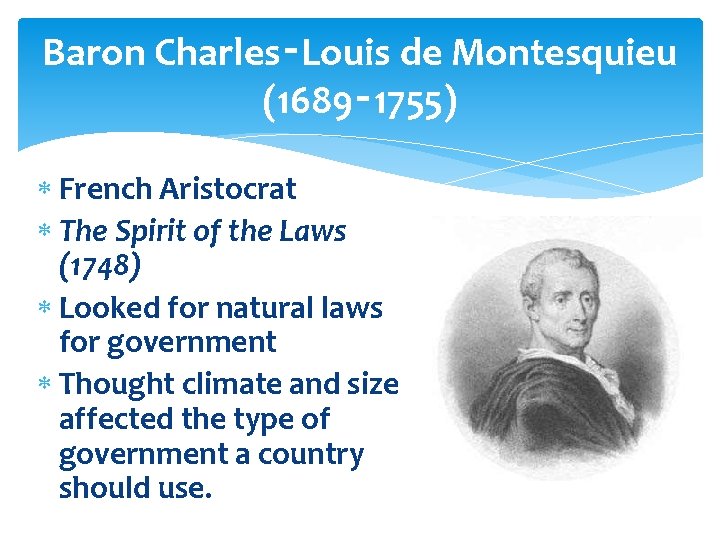
Baron Charles‑Louis de Montesquieu (1689‑ 1755) French Aristocrat The Spirit of the Laws (1748) Looked for natural laws for government Thought climate and size affected the type of government a country should use.
Main Ideas Separation of Powers Sharing power could avoid tyranny Checks and Balances Both major influences on US Constitution NOT DEMOCRATIC! Personally was anti-democratic and against freedom of expression.
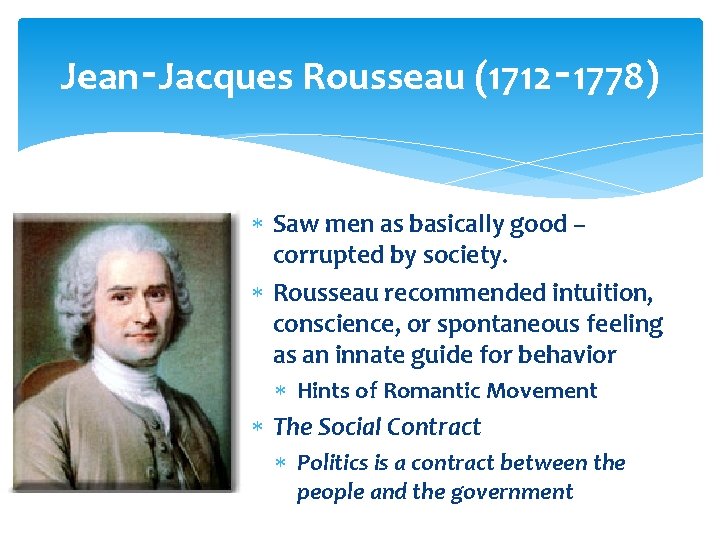
Jean‑Jacques Rousseau (1712‑ 1778) Saw men as basically good – corrupted by society. Rousseau recommended intuition, conscience, or spontaneous feeling as an innate guide for behavior Hints of Romantic Movement The Social Contract Politics is a contract between the people and the government
General Will The concept of the "General Will" was never fully defined and it has remained controversial amongst enlightenment figures Some believe it means pure democracy The concept of the “general will” has also been used by absolutists: i. e. , Napoleon, Lenin, Hitler. Idea of what is “best for society” – individuals submitted their natural Liberty to the general will.
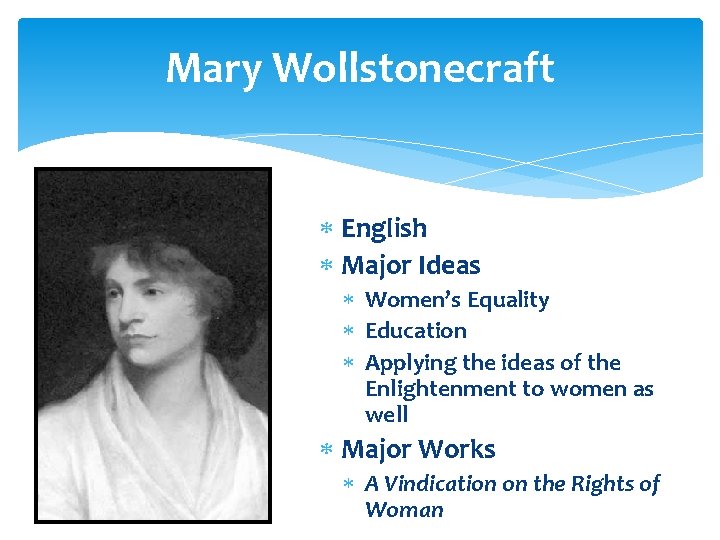
Mary Wollstonecraft English Major Ideas Women’s Equality Education Applying the ideas of the Enlightenment to women as well Major Works A Vindication on the Rights of Woman
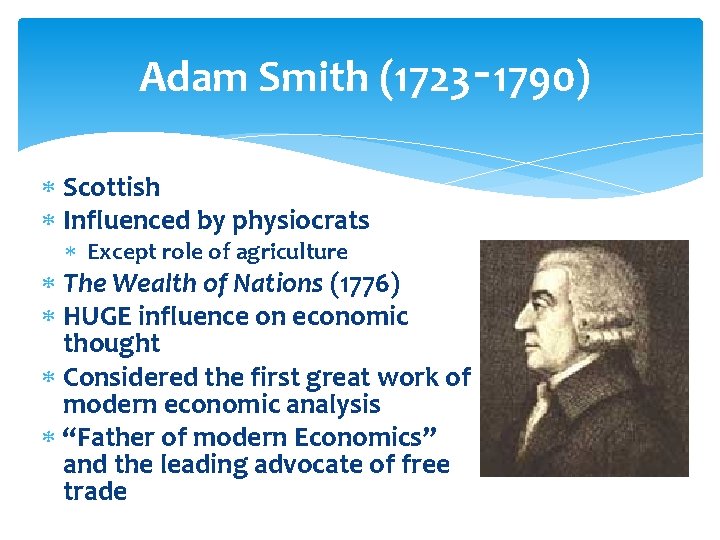
Adam Smith (1723‑ 1790) Scottish Influenced by physiocrats Except role of agriculture The Wealth of Nations (1776) HUGE influence on economic thought Considered the first great work of modern economic analysis “Father of modern Economics” and the leading advocate of free trade
Ideas Law of Supply and Demand Law of Diminishing Returns described Asserted that the best economic policy of a government was "laissez faire", to let do or leave it alone Competition ("The Invisible Hand") would serve as the great regulator, not government Argued for as little government interference as possible with private enterprise Attacked the prevailing mercantilist policies of the day as interference with the natural laws of economics
Crime and Punishment Prior to the Enlightenment, crime was seen as caused by external evil in the world and justice was to punish or eliminate the individual that fell victim The Enlightenment saw laws as the creation of humans and therefore not perfect Role of environment Old system (severe punishment) didn’t work
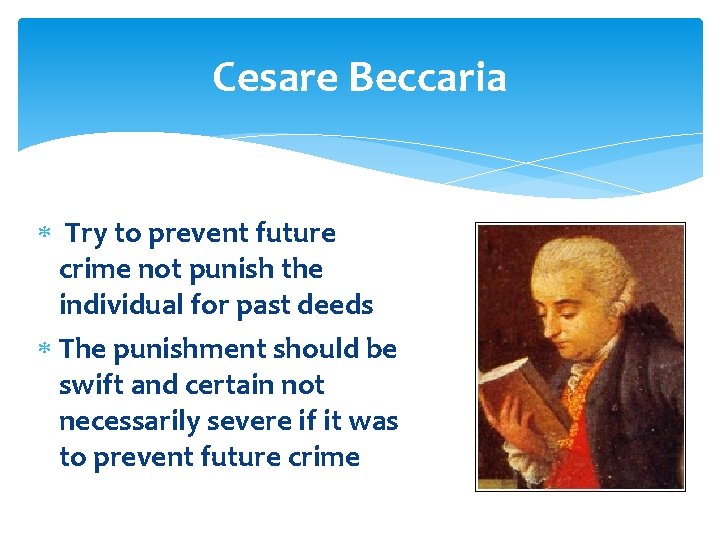
Cesare Beccaria Try to prevent future crime not punish the individual for past deeds The punishment should be swift and certain not necessarily severe if it was to prevent future crime
Denis Diderot (1713‑ 1784) Edited the Encyclopedie (vol. 1, published 1751) was intended to collect all human knowledge of the time Articles of the Encyclopedie reflect rationalism and materialism of Enlightenment Attempts by French government at censorship failed to limit sales; the final work, 33 volumes (22 of text, 11 of illustrations), enjoyed popular success