
The Enlightenment Characteristics of the Enlightenment Rationalism Reason
- Slides: 12
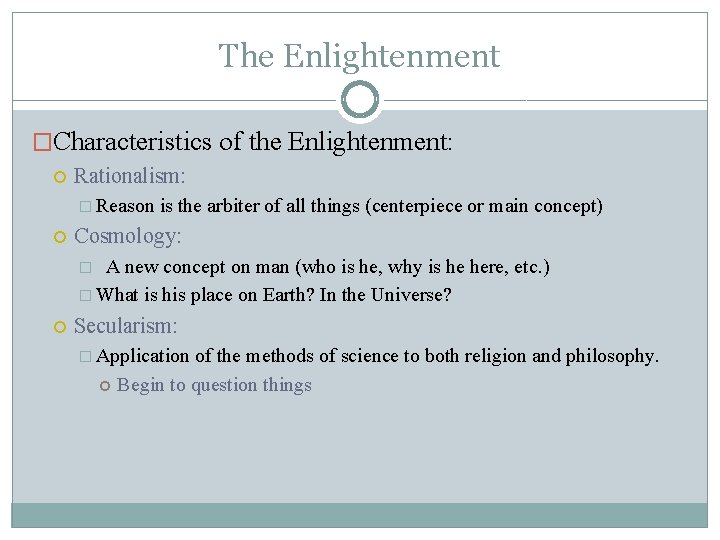
The Enlightenment �Characteristics of the Enlightenment: Rationalism: � Reason is the arbiter of all things (centerpiece or main concept) Cosmology: A new concept on man (who is he, why is he here, etc. ) � What is his place on Earth? In the Universe? � Secularism: � Application of the methods of science to both religion and philosophy. Begin to question things
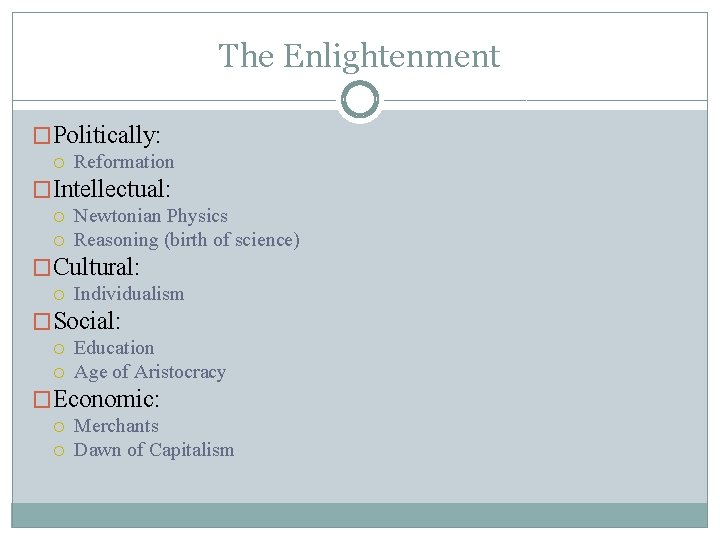
The Enlightenment �Politically: Reformation �Intellectual: Newtonian Physics Reasoning (birth of science) �Cultural: Individualism �Social: Education Age of Aristocracy �Economic: Merchants Dawn of Capitalism
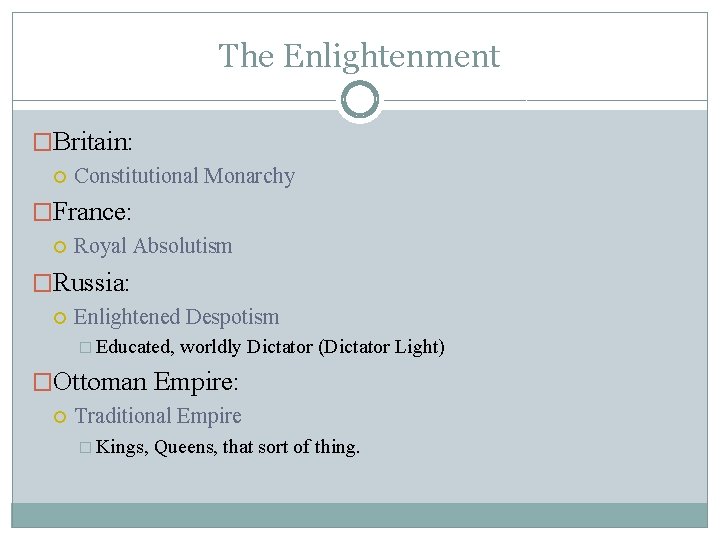
The Enlightenment �Britain: Constitutional Monarchy �France: Royal Absolutism �Russia: Enlightened Despotism � Educated, worldly Dictator (Dictator Light) �Ottoman Empire: Traditional Empire � Kings, Queens, that sort of thing.
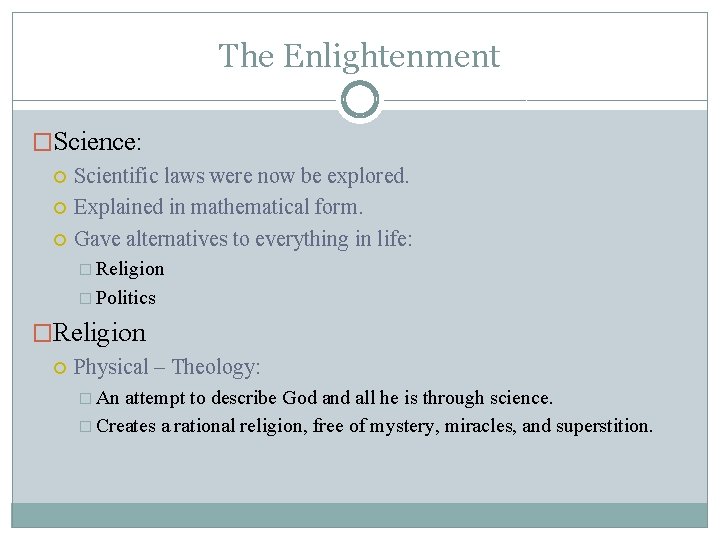
The Enlightenment �Science: Scientific laws were now be explored. Explained in mathematical form. Gave alternatives to everything in life: � Religion � Politics �Religion Physical – Theology: � An attempt to describe God and all he is through science. � Creates a rational religion, free of mystery, miracles, and superstition.
The Enlightenment �Religion: Deism: � Belief in God, but for the first time, doing so while at the same time renouncing organized religion. � They recognized a God, but one that was distant, and uninvolved with man. Pantheism: � Belief that God and nature are one (birth of tree huggers)! � Born from Protestants and Catholics who began to belief in God’s works more through science than scripture.
The Enlightenment �Science: Mathematical analysis Inductive (hypothesis, or educated guessing) reasoning Experimentation �Utilitarianism: Greatest good, for the greatest number of people (common good). �Tolerance: No opinion or thought, is worth burning someone over.
The Enlightenment �Optimism & Self Confidence Belief that man is inherently good. Social progress �Freedoms: Of thought and expression Bring liberty to ALL men (revolt against Absolutism) � This would lead to movements such as the American Revolution, and the French Revolution. �Mass public Education
The Enlightenment �Legal Reforms No torture Justice Due process of Law (meaning those in charge had a standard of rules to abide by as they prosecuted you). �Constitutionalism: A set of civil rights guaranteed every man in your country.
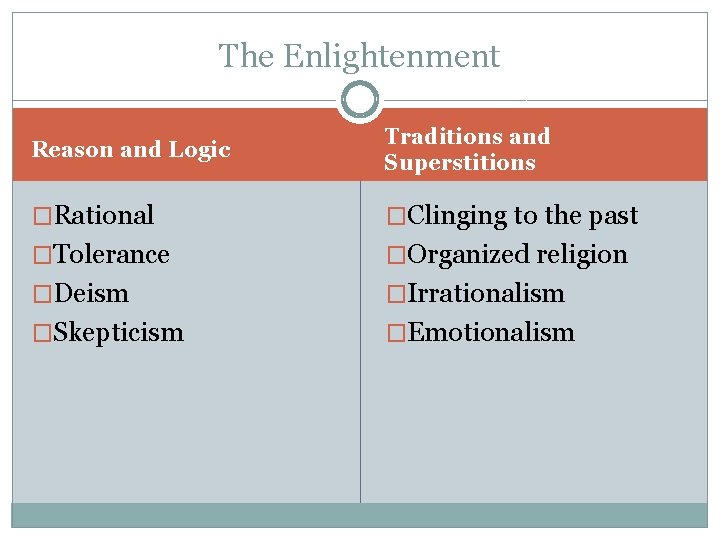
The Enlightenment Reason and Logic Traditions and Superstitions �Rational �Clinging to the past �Tolerance �Organized religion �Deism �Irrationalism �Skepticism �Emotionalism
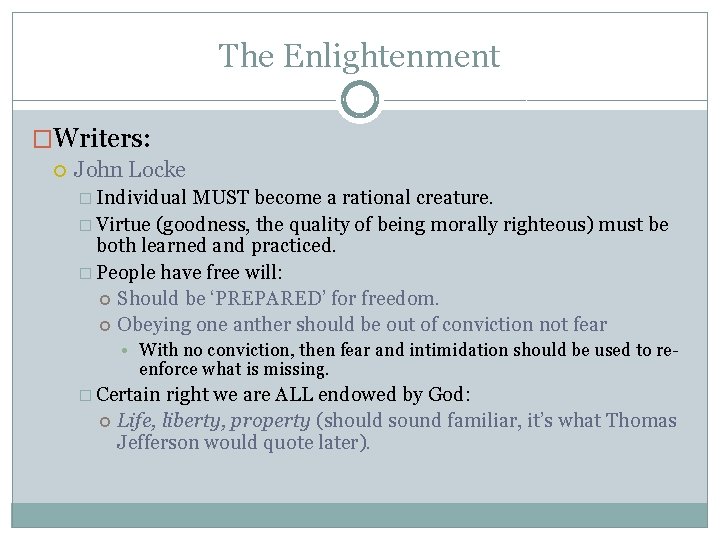
The Enlightenment �Writers: John Locke � Individual MUST become a rational creature. � Virtue (goodness, the quality of being morally righteous) must be both learned and practiced. � People have free will: Should be ‘PREPARED’ for freedom. Obeying one anther should be out of conviction not fear • With no conviction, then fear and intimidation should be used to reenforce what is missing. � Certain right we are ALL endowed by God: Life, liberty, property (should sound familiar, it’s what Thomas Jefferson would quote later).
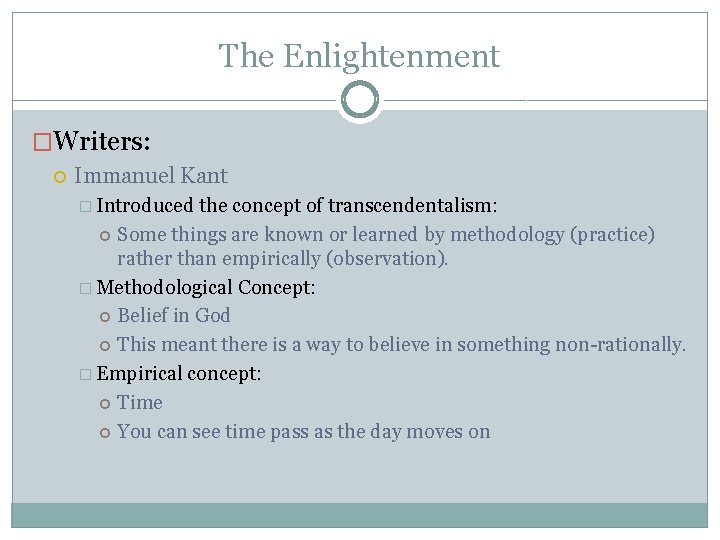
The Enlightenment �Writers: Immanuel Kant � Introduced the concept of transcendentalism: Some things are known or learned by methodology (practice) rather than empirically (observation). � Methodological Concept: Belief in God This meant there is a way to believe in something non-rationally. � Empirical concept: Time You can see time pass as the day moves on
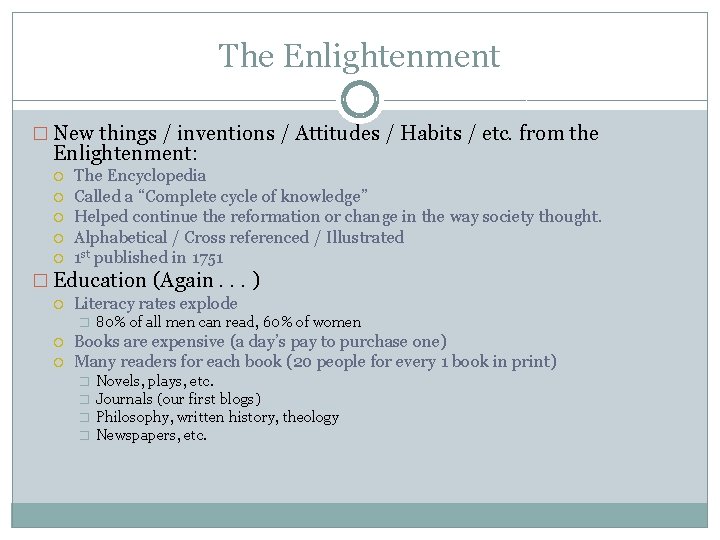
The Enlightenment � New things / inventions / Attitudes / Habits / etc. from the Enlightenment: The Encyclopedia Called a “Complete cycle of knowledge” Helped continue the reformation or change in the way society thought. Alphabetical / Cross referenced / Illustrated 1 st published in 1751 � Education (Again. . . ) Literacy rates explode � 80% of all men can read, 60% of women Books are expensive (a day’s pay to purchase one) Many readers for each book (20 people for every 1 book in print) � � Novels, plays, etc. Journals (our first blogs) Philosophy, written history, theology Newspapers, etc.