
The Enlightenment and the Great Awakening The Enlightenment
- Slides: 16
The Enlightenment and the Great Awakening
The Enlightenment and the Great Awakening • Late 1600 s-1700 s: An intellectual movement known as the Enlightenment began in Europe. Later a religious movement known as the Great Awakening started in the Colonies • The Enlightenment emphasized reason, science, and observation and led to the discovery of natural laws • Copernicus, Galileo, Locke, and Newton were key figures
Enlightenment • In the late 1600 -1700’s many Europeans began to believe that the light of human reason and science could be applied to society. Western Europe and the New World went from a God- centered way of life to a man-centered view of life.
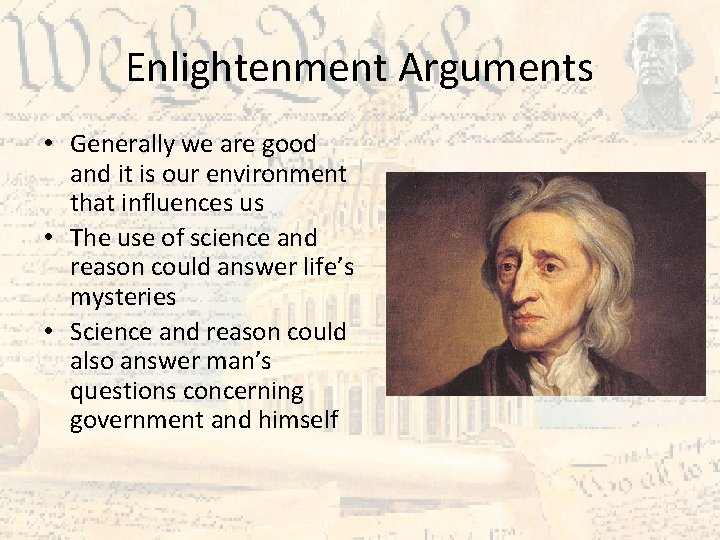
Enlightenment Arguments • Generally we are good and it is our environment that influences us • The use of science and reason could answer life’s mysteries • Science and reason could also answer man’s questions concerning government and himself
Enlightenment • The Enlightenment caused people to think differently about religion • Using the Enlightenment in Europe, People began to take “control” of their own faith and religion. • Many argued that they could find God on their own without the church/pastor and their “requirements” from getting in the way • This questioning of the church leadership led to questioning of other leaders
Deism • The Enlightenment resulted in a philosophy known as Deism, which was loosely based upon Christianity. Many of the founding fathers were Deists, including Benjamin Franklin. • Deists believed that after the natural laws were put in place, God stepped back and let the universe function according to those laws and God did not take part in the lives of individuals or in the history of the world
Results of Deism • Contributed to questioning the idea of “divine right”-the people could revolt because he was not put their by God • Locke’s Social Contract Theory • Inspiration for the American Revolution
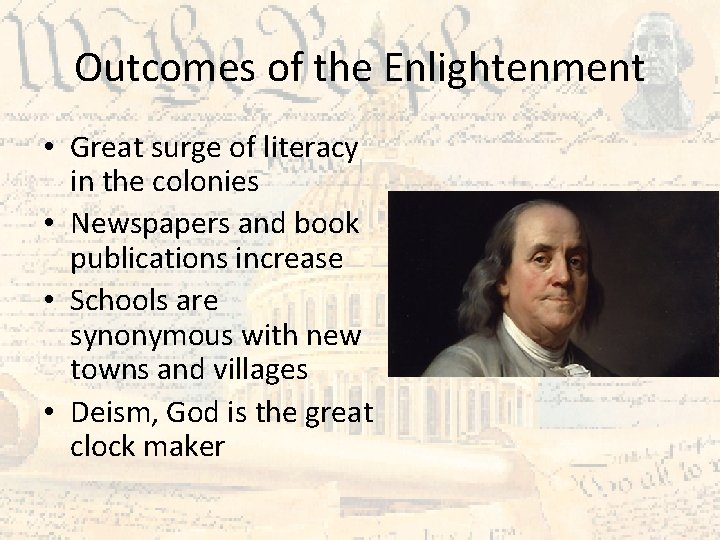
Outcomes of the Enlightenment • Great surge of literacy in the colonies • Newspapers and book publications increase • Schools are synonymous with new towns and villages • Deism, God is the great clock maker
Outcomes of the Enlightenment • People are born with natural rights • Government has an obligation to protect those natural rights • Kings have no right to govern people, people empower government
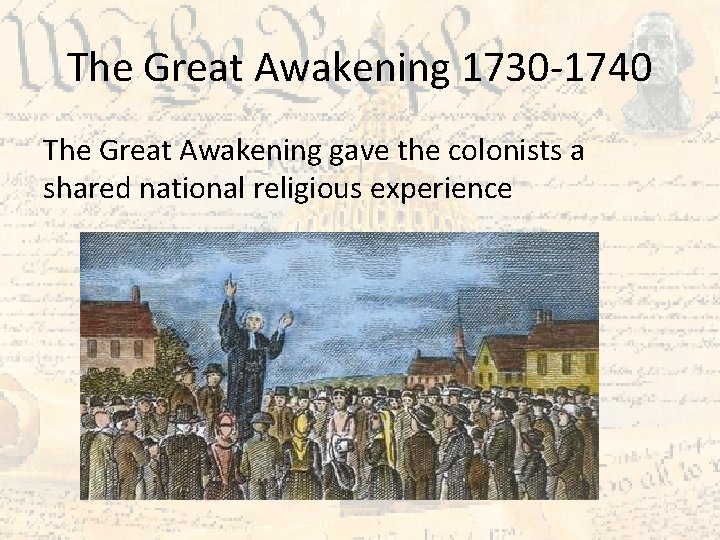
The Great Awakening 1730 -1740 The Great Awakening gave the colonists a shared national religious experience
Great Awakening • Revival of religion and an attempt to turn people back to God. • For the most part it was a reaction to the Enlightenment.
Reasons for the Great Awakening • People felt that religion was dry, dull and distant • Preachers felt that people needed to be concerned with inner emotions as opposed to outward religious behavior • People in New England can read and interpret the Bible on their own
Religious Revival: The Great Awakening • A series of religious revivals aimed at restoring devotion & piety swept through the colonies in the mid-1700 s • Fire and Brimstone style worship; large, emotionally charged crowds • Like the Enlightenment the movement stressed the importance of the individual
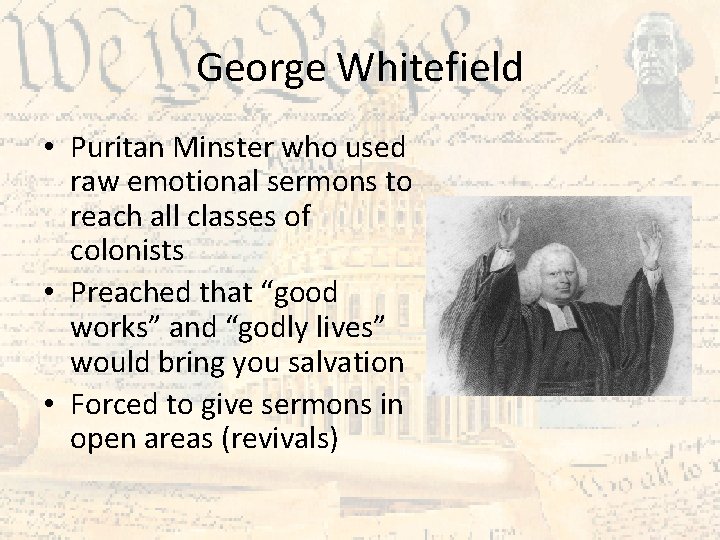
George Whitefield • Puritan Minster who used raw emotional sermons to reach all classes of colonists • Preached that “good works” and “godly lives” would bring you salvation • Forced to give sermons in open areas (revivals)
Outcomes of the Great Awakening • Birth of deep religious convictions in the colonies • New churches built to accommodate new members • Colleges founded found to train new ministers • Encouraged ideas of equality and right to challenge authority • Birth of charity and charitable organizations
Impact of the Great Awakening • The movement brought independence from the clergy. • The movement pushed people to “shop” around for preachers that suited them • Encouraged a democratic split in religion which spilled into government