
THE ENLIGHTENMENT AND THE AMERICAN REVOLUTION THE SCIENTIFIC

- Slides: 31
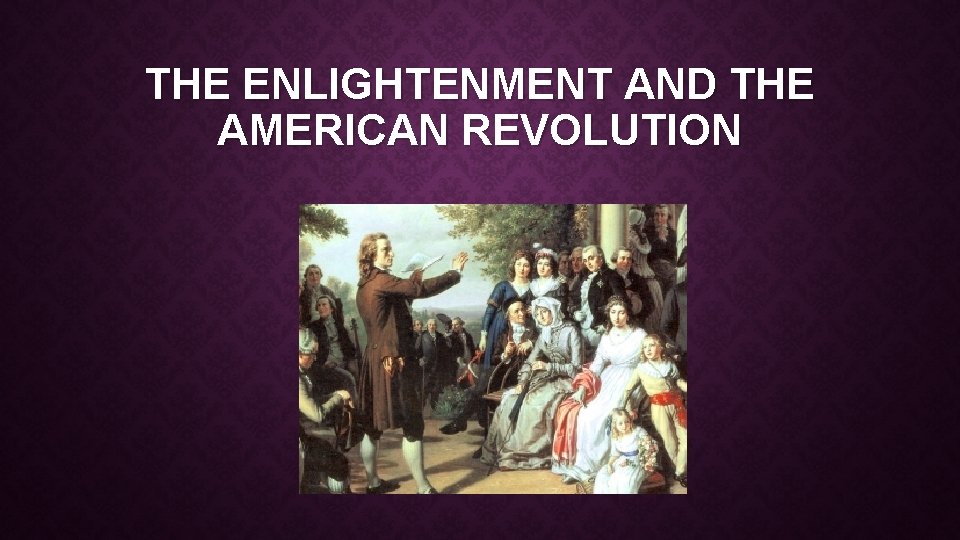
THE ENLIGHTENMENT AND THE AMERICAN REVOLUTION
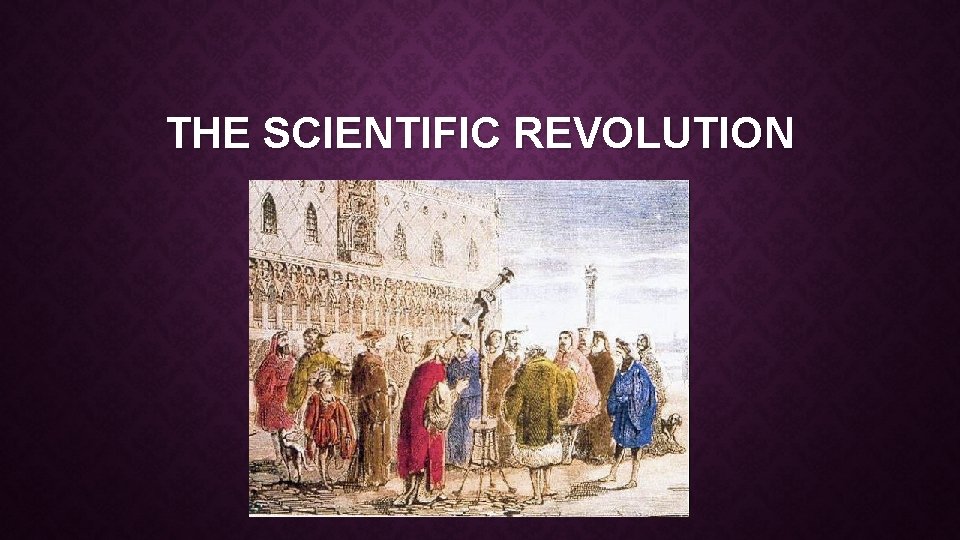
THE SCIENTIFIC REVOLUTION
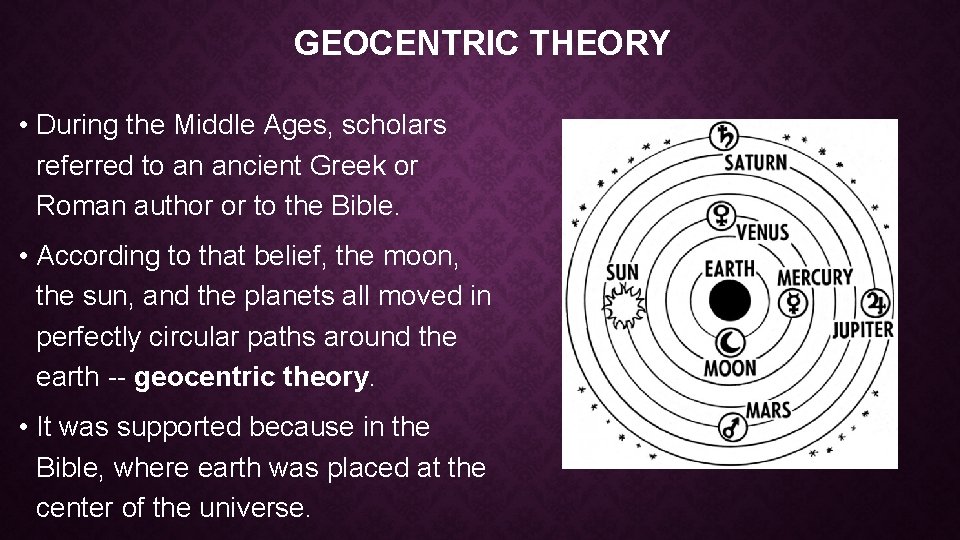
GEOCENTRIC THEORY • During the Middle Ages, scholars referred to an ancient Greek or Roman author or to the Bible. • According to that belief, the moon, the sun, and the planets all moved in perfectly circular paths around the earth -- geocentric theory. • It was supported because in the Bible, where earth was placed at the center of the universe.
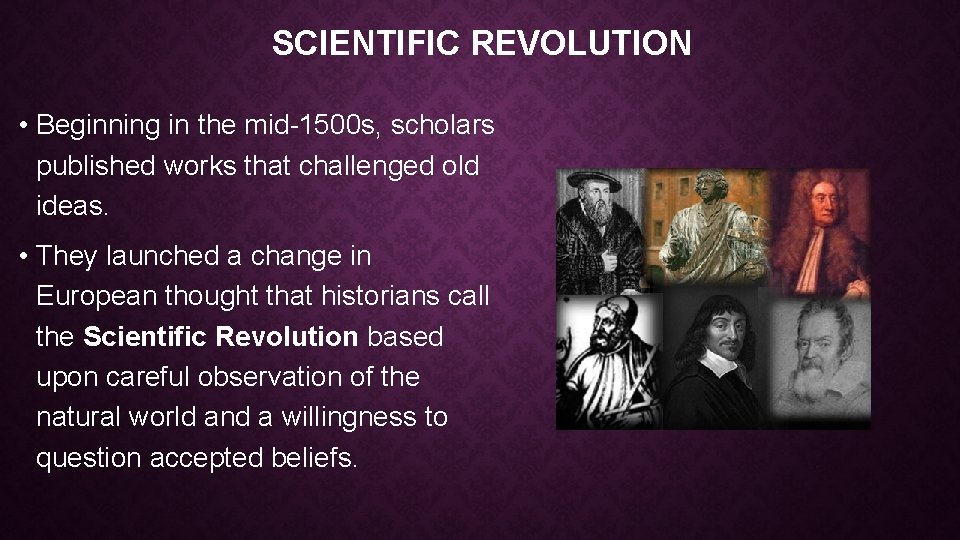
SCIENTIFIC REVOLUTION • Beginning in the mid-1500 s, scholars published works that challenged old ideas. • They launched a change in European thought that historians call the Scientific Revolution based upon careful observation of the natural world and a willingness to question accepted beliefs.
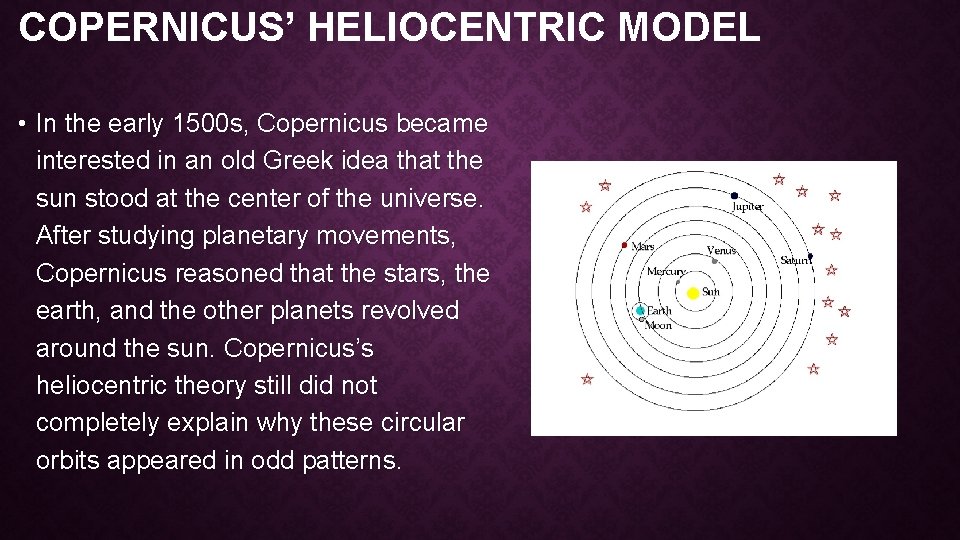
COPERNICUS’ HELIOCENTRIC MODEL • In the early 1500 s, Copernicus became interested in an old Greek idea that the sun stood at the center of the universe. After studying planetary movements, Copernicus reasoned that the stars, the earth, and the other planets revolved around the sun. Copernicus’s heliocentric theory still did not completely explain why these circular orbits appeared in odd patterns.
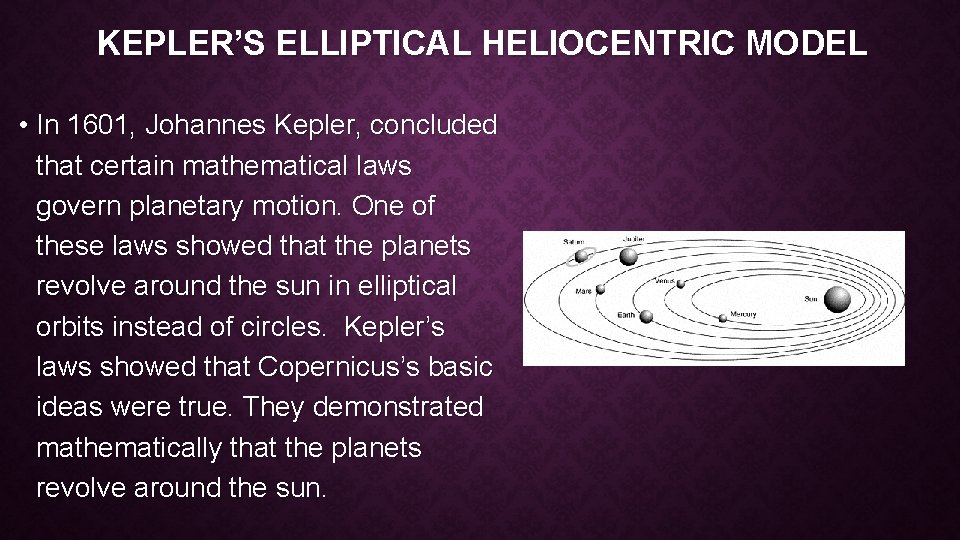
KEPLER’S ELLIPTICAL HELIOCENTRIC MODEL • In 1601, Johannes Kepler, concluded that certain mathematical laws govern planetary motion. One of these laws showed that the planets revolve around the sun in elliptical orbits instead of circles. Kepler’s laws showed that Copernicus’s basic ideas were true. They demonstrated mathematically that the planets revolve around the sun.
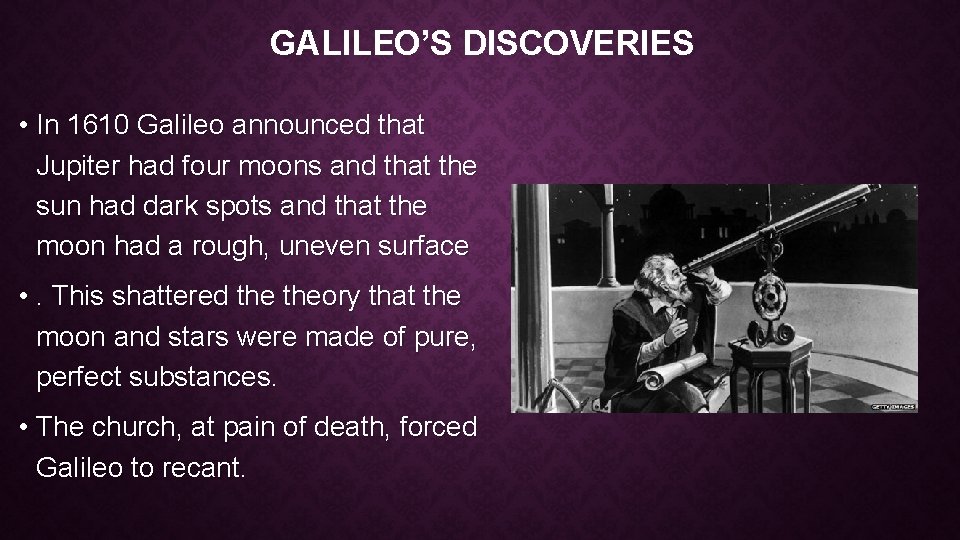
GALILEO’S DISCOVERIES • In 1610 Galileo announced that Jupiter had four moons and that the sun had dark spots and that the moon had a rough, uneven surface • . This shattered theory that the moon and stars were made of pure, perfect substances. • The church, at pain of death, forced Galileo to recant.
BACON’S EMPIRICISM • Francis Bacon believed that by better understanding the world, scientists would generate practical knowledge that would improve people’s lives. • Instead of reasoning from abstract theories, he urged scientists to experiment and then draw conclusions. This approach is called empiricism.
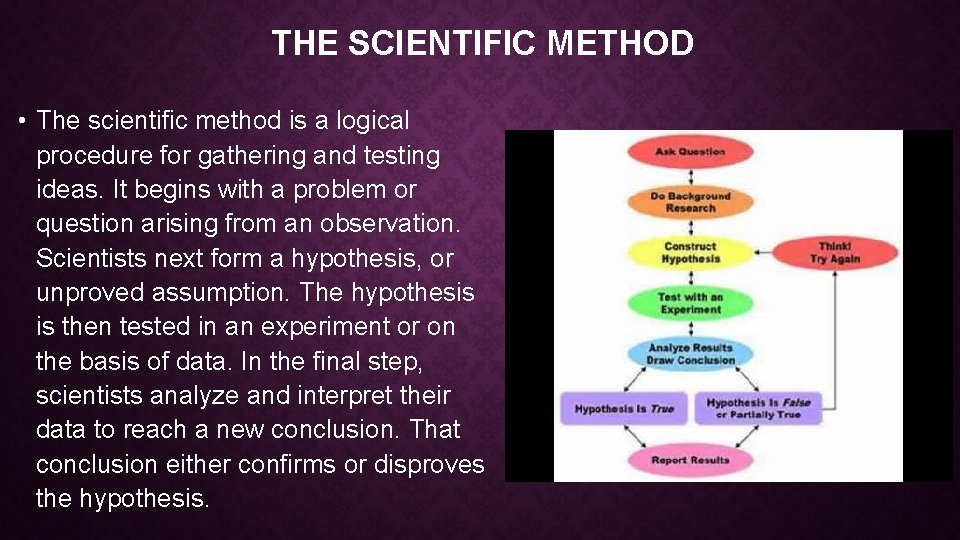
THE SCIENTIFIC METHOD • The scientific method is a logical procedure for gathering and testing ideas. It begins with a problem or question arising from an observation. Scientists next form a hypothesis, or unproved assumption. The hypothesis is then tested in an experiment or on the basis of data. In the final step, scientists analyze and interpret their data to reach a new conclusion. That conclusion either confirms or disproves the hypothesis.
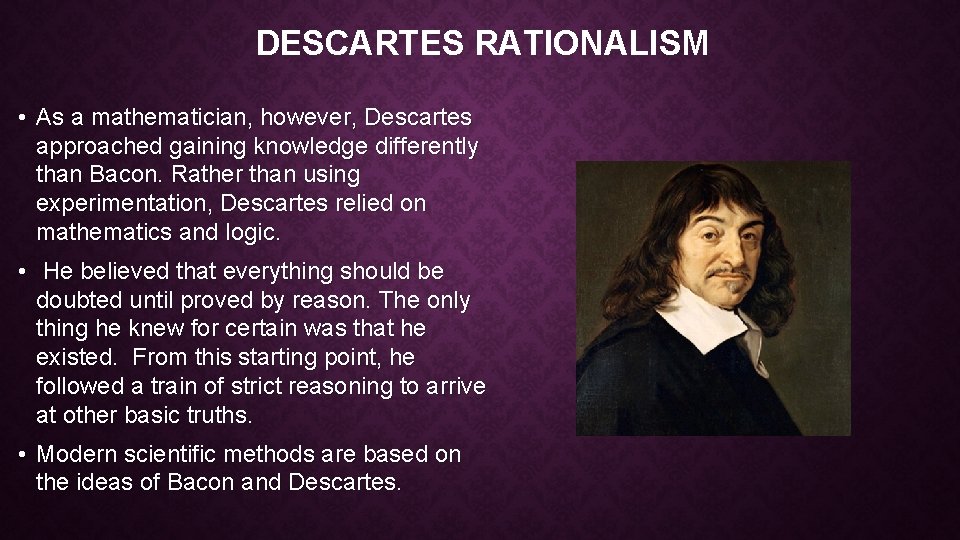
DESCARTES RATIONALISM • As a mathematician, however, Descartes approached gaining knowledge differently than Bacon. Rather than using experimentation, Descartes relied on mathematics and logic. • He believed that everything should be doubted until proved by reason. The only thing he knew for certain was that he existed. From this starting point, he followed a train of strict reasoning to arrive at other basic truths. • Modern scientific methods are based on the ideas of Bacon and Descartes.
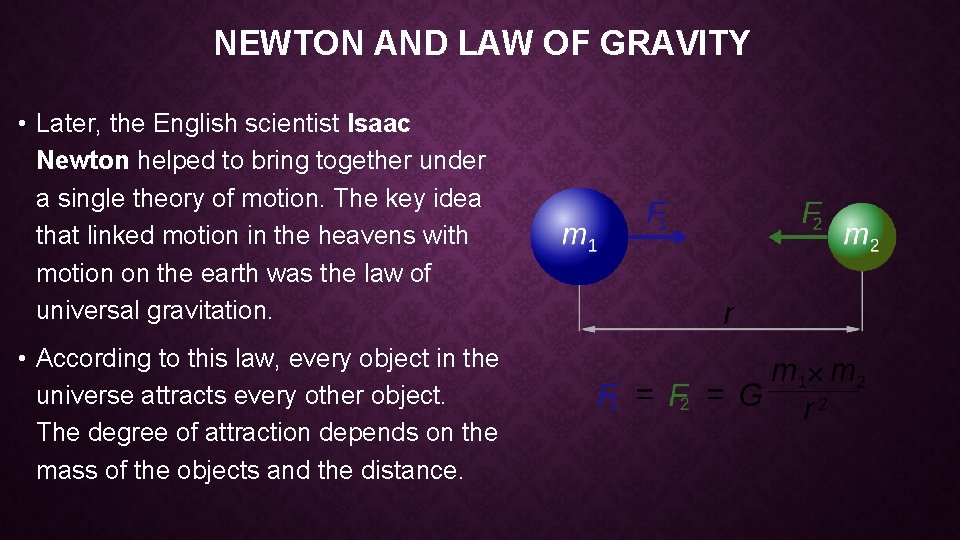
NEWTON AND LAW OF GRAVITY • Later, the English scientist Isaac Newton helped to bring together under a single theory of motion. The key idea that linked motion in the heavens with motion on the earth was the law of universal gravitation. • According to this law, every object in the universe attracts every other object. The degree of attraction depends on the mass of the objects and the distance.
THE ENLIGHTENMENT
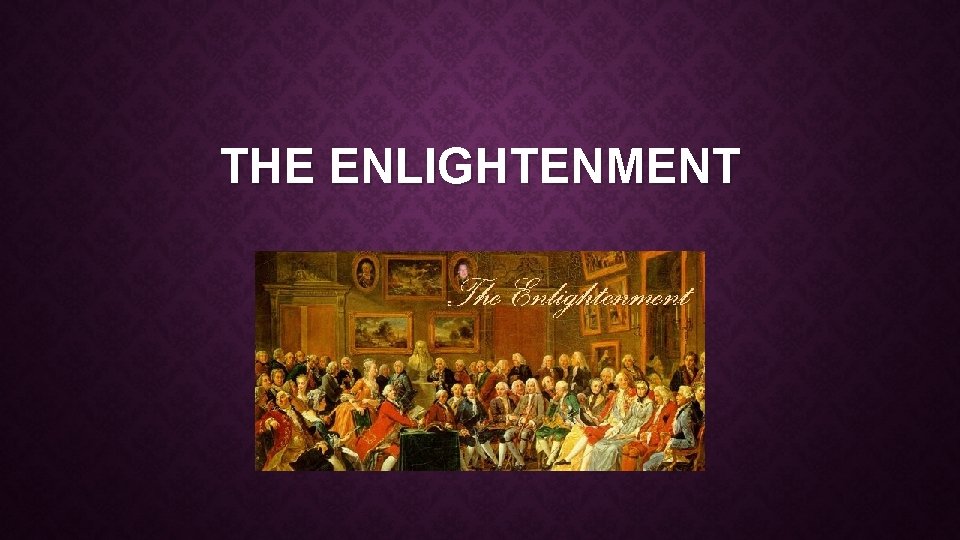
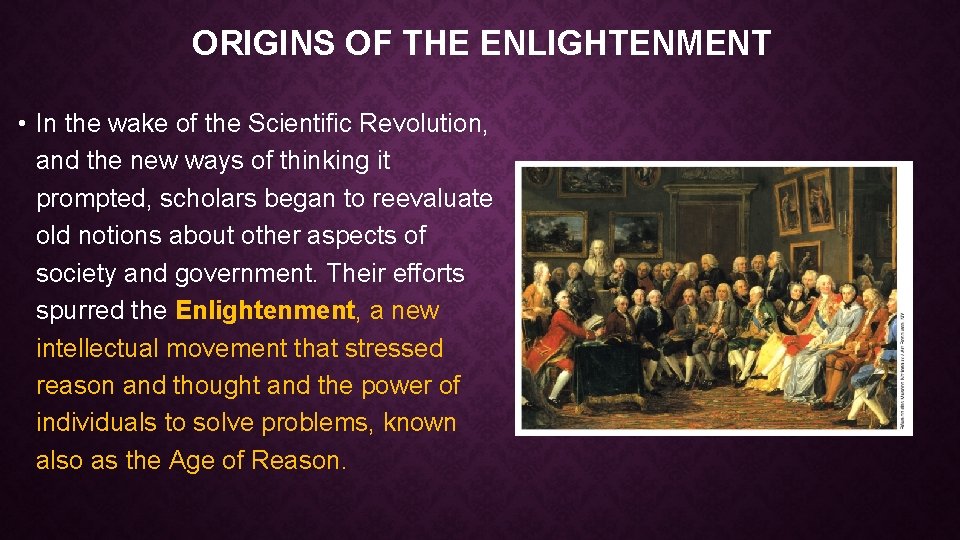
ORIGINS OF THE ENLIGHTENMENT • In the wake of the Scientific Revolution, and the new ways of thinking it prompted, scholars began to reevaluate old notions about other aspects of society and government. Their efforts spurred the Enlightenment, a new intellectual movement that stressed reason and thought and the power of individuals to solve problems, known also as the Age of Reason.
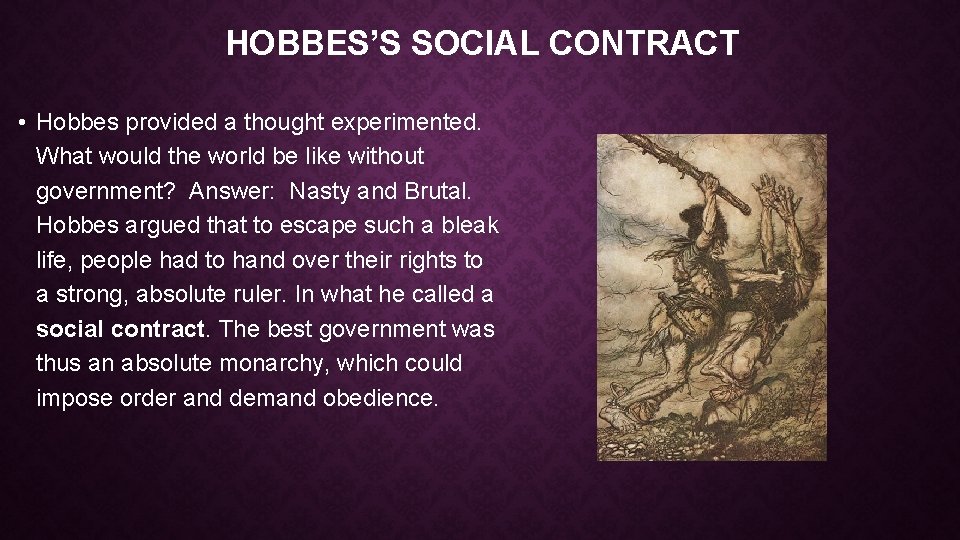
HOBBES’S SOCIAL CONTRACT • Hobbes provided a thought experimented. What would the world be like without government? Answer: Nasty and Brutal. Hobbes argued that to escape such a bleak life, people had to hand over their rights to a strong, absolute ruler. In what he called a social contract. The best government was thus an absolute monarchy, which could impose order and demand obedience.
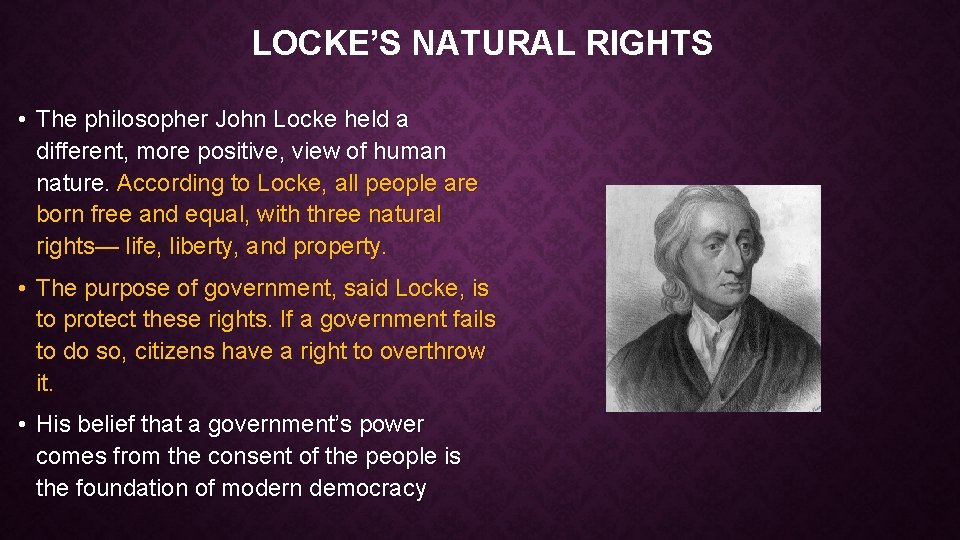
LOCKE’S NATURAL RIGHTS • The philosopher John Locke held a different, more positive, view of human nature. According to Locke, all people are born free and equal, with three natural rights— life, liberty, and property. • The purpose of government, said Locke, is to protect these rights. If a government fails to do so, citizens have a right to overthrow it. • His belief that a government’s power comes from the consent of the people is the foundation of modern democracy
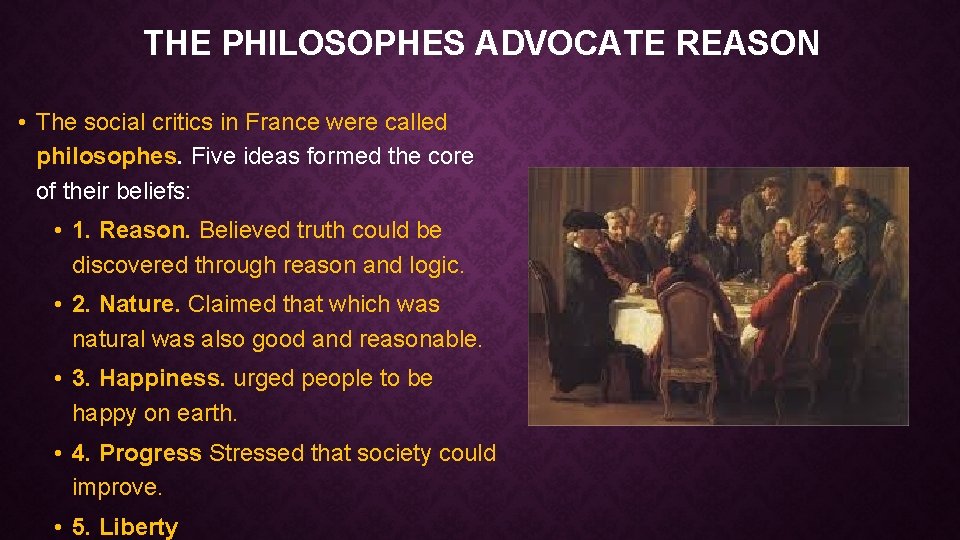
THE PHILOSOPHES ADVOCATE REASON • The social critics in France were called philosophes. Five ideas formed the core of their beliefs: • 1. Reason. Believed truth could be discovered through reason and logic. • 2. Nature. Claimed that which was natural was also good and reasonable. • 3. Happiness. urged people to be happy on earth. • 4. Progress Stressed that society could improve. • 5. Liberty
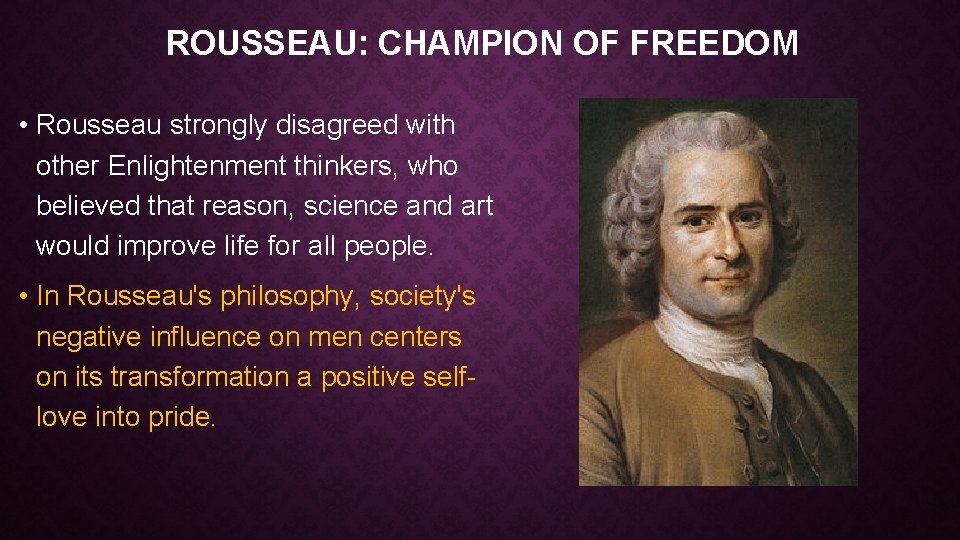
ROUSSEAU: CHAMPION OF FREEDOM • Rousseau strongly disagreed with other Enlightenment thinkers, who believed that reason, science and art would improve life for all people. • In Rousseau's philosophy, society's negative influence on men centers on its transformation a positive selflove into pride.
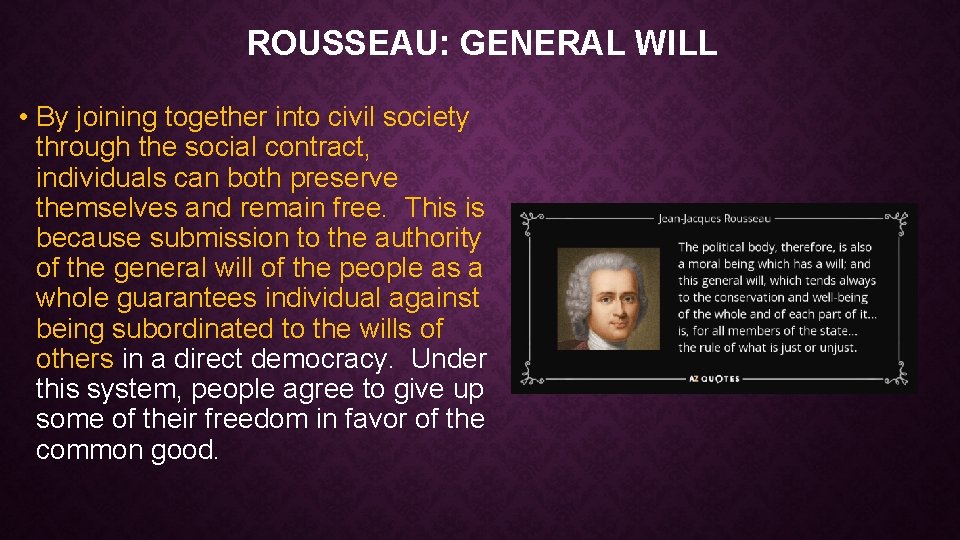
ROUSSEAU: GENERAL WILL • By joining together into civil society through the social contract, individuals can both preserve themselves and remain free. This is because submission to the authority of the general will of the people as a whole guarantees individual against being subordinated to the wills of others in a direct democracy. Under this system, people agree to give up some of their freedom in favor of the common good.
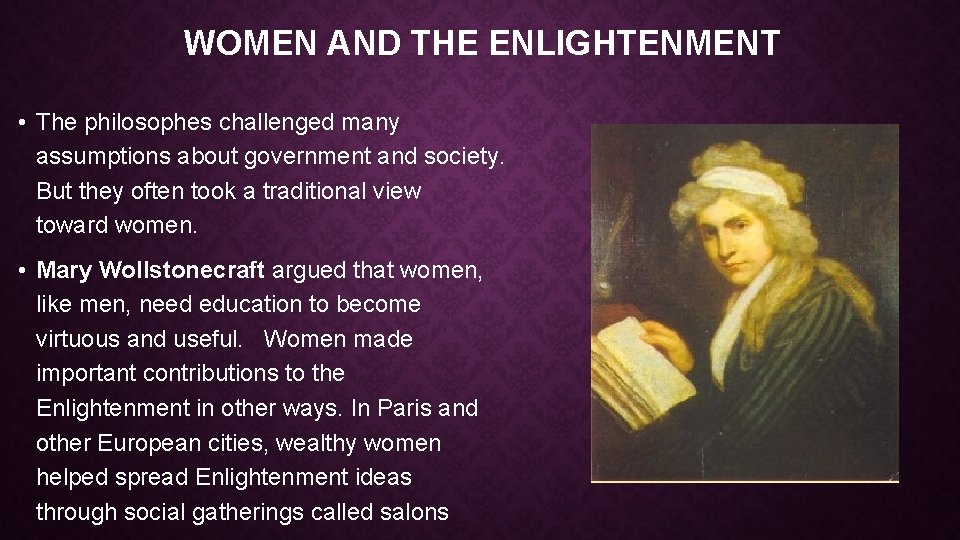
WOMEN AND THE ENLIGHTENMENT • The philosophes challenged many assumptions about government and society. But they often took a traditional view toward women. • Mary Wollstonecraft argued that women, like men, need education to become virtuous and useful. Women made important contributions to the Enlightenment in other ways. In Paris and other European cities, wealthy women helped spread Enlightenment ideas through social gatherings called salons
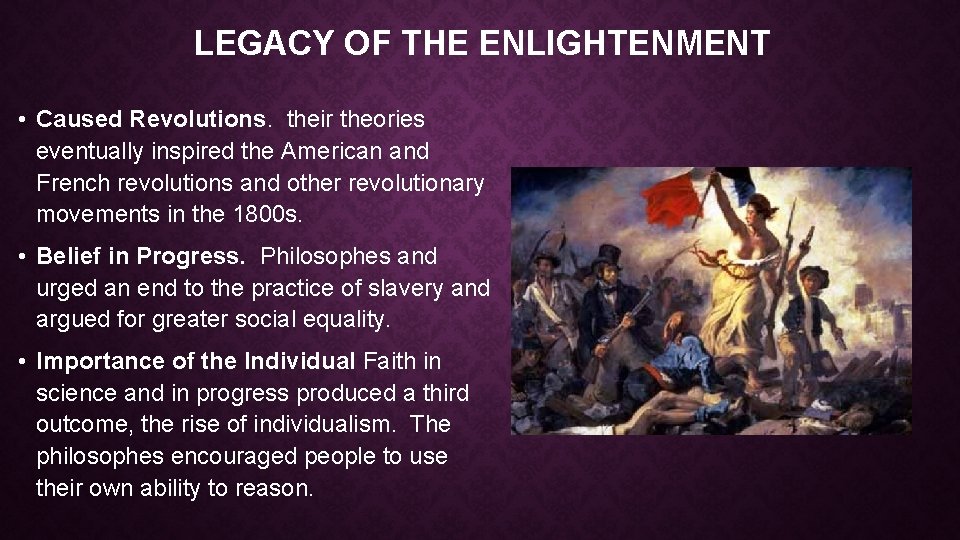
LEGACY OF THE ENLIGHTENMENT • Caused Revolutions. their theories eventually inspired the American and French revolutions and other revolutionary movements in the 1800 s. • Belief in Progress. Philosophes and urged an end to the practice of slavery and argued for greater social equality. • Importance of the Individual Faith in science and in progress produced a third outcome, the rise of individualism. The philosophes encouraged people to use their own ability to reason.
THE AMERICAN REVOLUTION
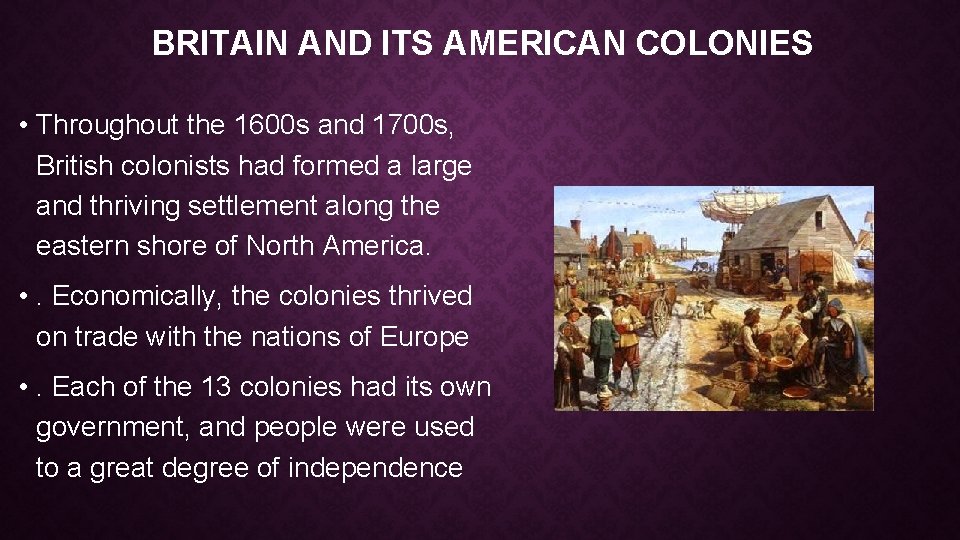
BRITAIN AND ITS AMERICAN COLONIES • Throughout the 1600 s and 1700 s, British colonists had formed a large and thriving settlement along the eastern shore of North America. • . Economically, the colonies thrived on trade with the nations of Europe • . Each of the 13 colonies had its own government, and people were used to a great degree of independence
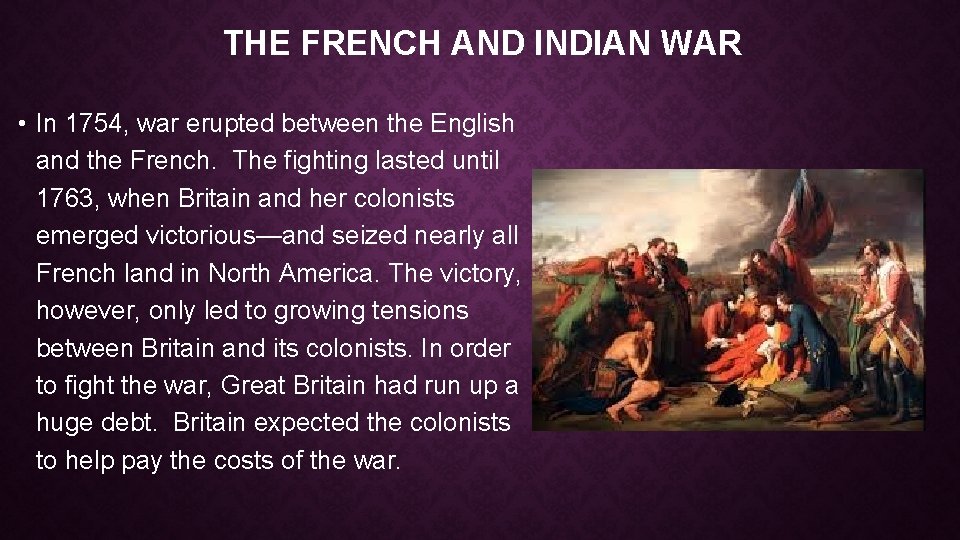
THE FRENCH AND INDIAN WAR • In 1754, war erupted between the English and the French. The fighting lasted until 1763, when Britain and her colonists emerged victorious—and seized nearly all French land in North America. The victory, however, only led to growing tensions between Britain and its colonists. In order to fight the war, Great Britain had run up a huge debt. Britain expected the colonists to help pay the costs of the war.
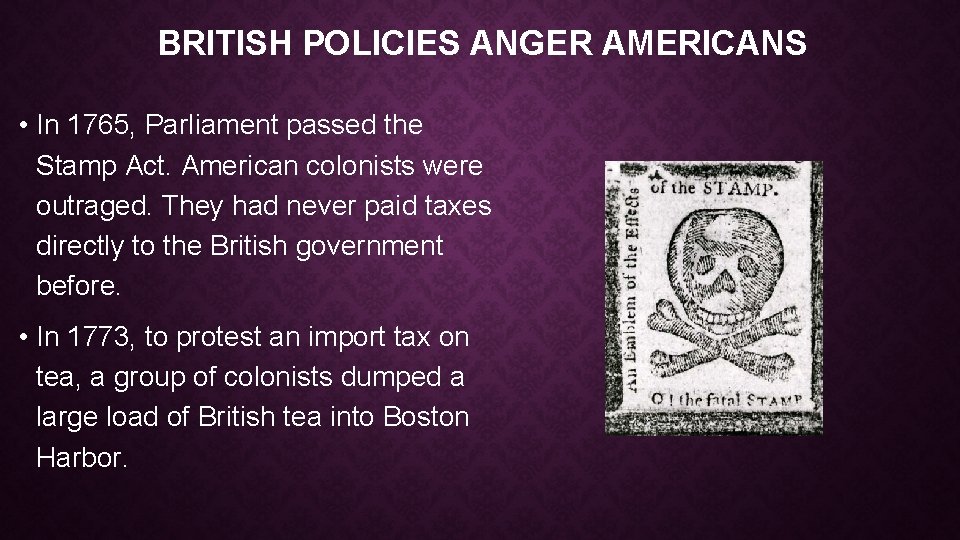
BRITISH POLICIES ANGER AMERICANS • In 1765, Parliament passed the Stamp Act. American colonists were outraged. They had never paid taxes directly to the British government before. • In 1773, to protest an import tax on tea, a group of colonists dumped a large load of British tea into Boston Harbor.
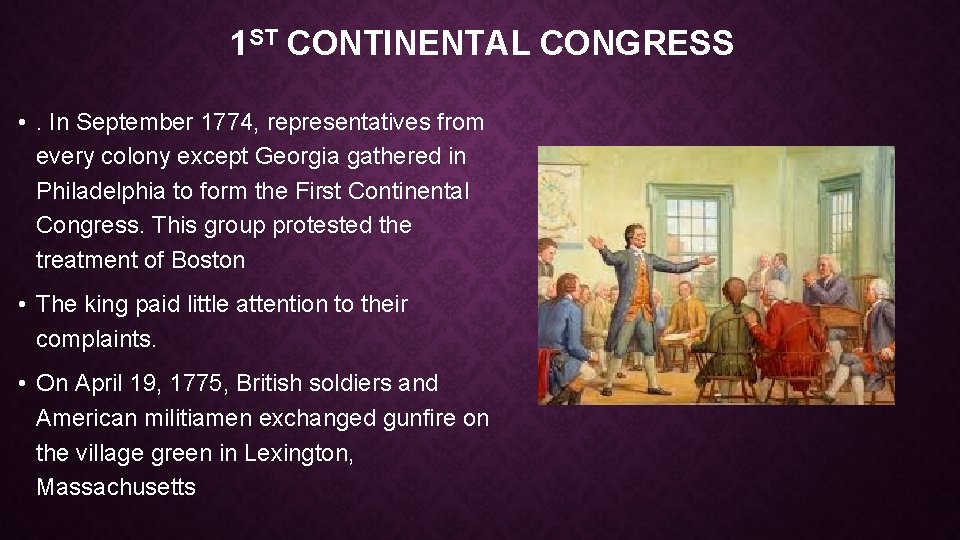
1 ST CONTINENTAL CONGRESS • . In September 1774, representatives from every colony except Georgia gathered in Philadelphia to form the First Continental Congress. This group protested the treatment of Boston • The king paid little attention to their complaints. • On April 19, 1775, British soldiers and American militiamen exchanged gunfire on the village green in Lexington, Massachusetts
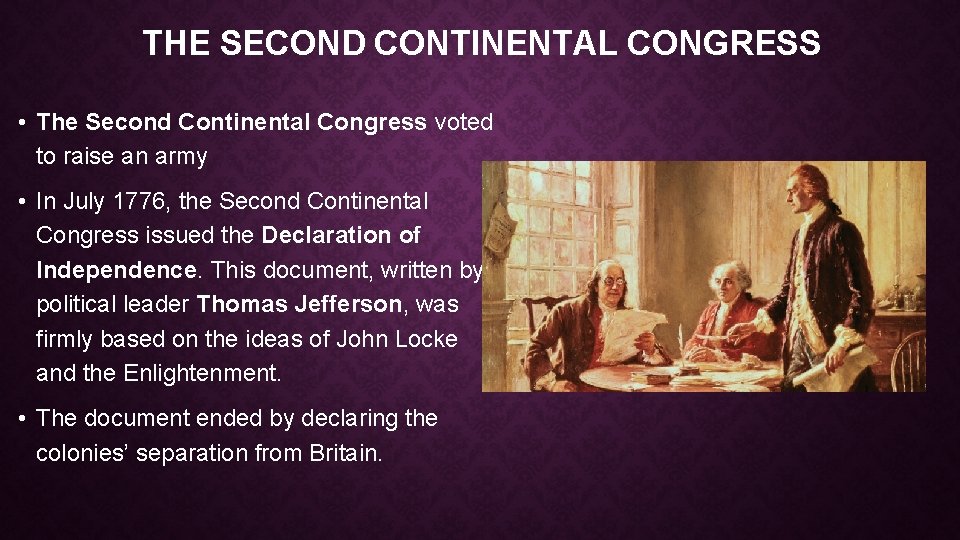
THE SECOND CONTINENTAL CONGRESS • The Second Continental Congress voted to raise an army • In July 1776, the Second Continental Congress issued the Declaration of Independence. This document, written by political leader Thomas Jefferson, was firmly based on the ideas of John Locke and the Enlightenment. • The document ended by declaring the colonies’ separation from Britain.
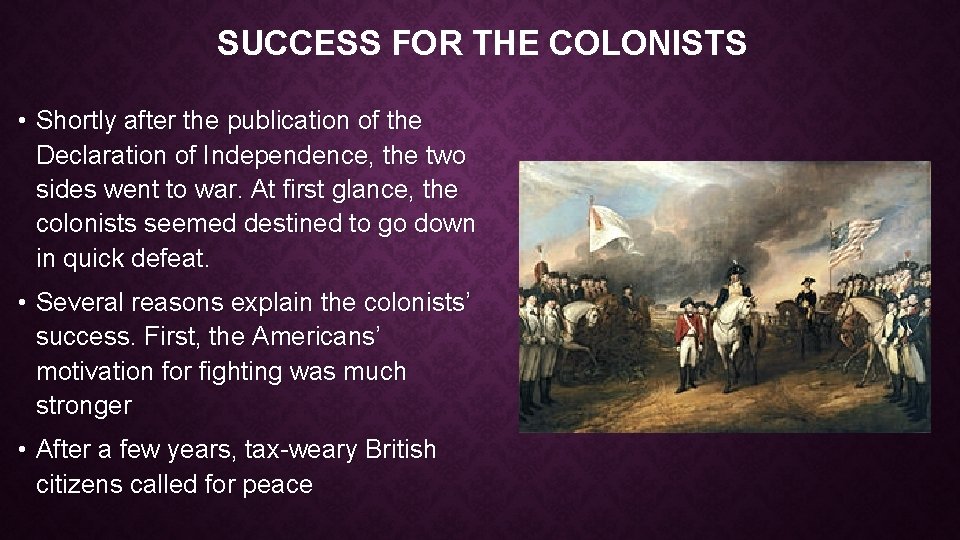
SUCCESS FOR THE COLONISTS • Shortly after the publication of the Declaration of Independence, the two sides went to war. At first glance, the colonists seemed destined to go down in quick defeat. • Several reasons explain the colonists’ success. First, the Americans’ motivation for fighting was much stronger • After a few years, tax-weary British citizens called for peace
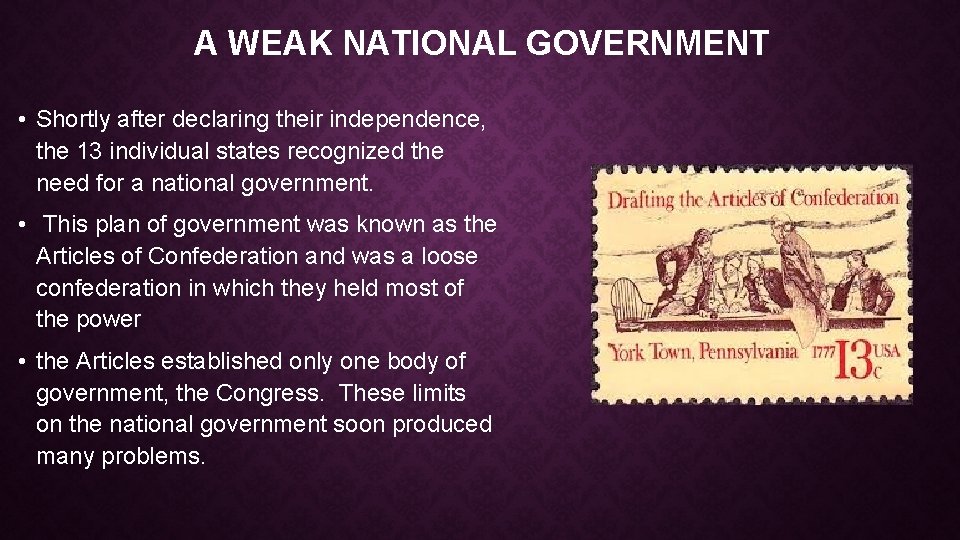
A WEAK NATIONAL GOVERNMENT • Shortly after declaring their independence, the 13 individual states recognized the need for a national government. • This plan of government was known as the Articles of Confederation and was a loose confederation in which they held most of the power • the Articles established only one body of government, the Congress. These limits on the national government soon produced many problems.
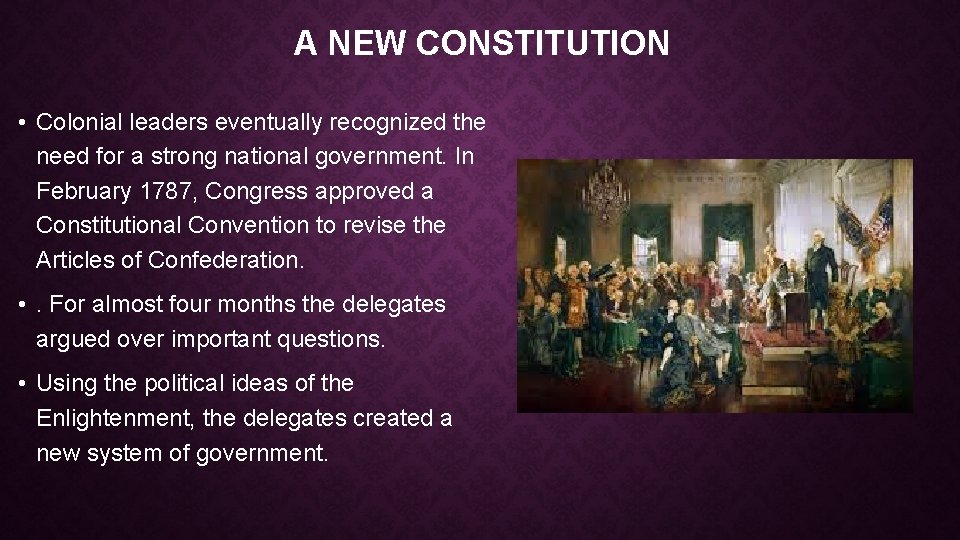
A NEW CONSTITUTION • Colonial leaders eventually recognized the need for a strong national government. In February 1787, Congress approved a Constitutional Convention to revise the Articles of Confederation. • . For almost four months the delegates argued over important questions. • Using the political ideas of the Enlightenment, the delegates created a new system of government.
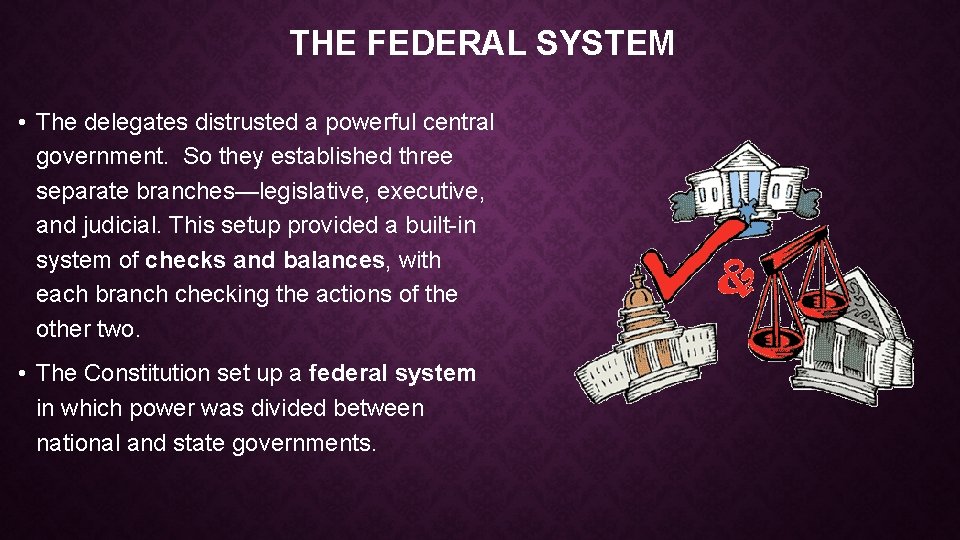
THE FEDERAL SYSTEM • The delegates distrusted a powerful central government. So they established three separate branches—legislative, executive, and judicial. This setup provided a built-in system of checks and balances, with each branch checking the actions of the other two. • The Constitution set up a federal system in which power was divided between national and state governments.
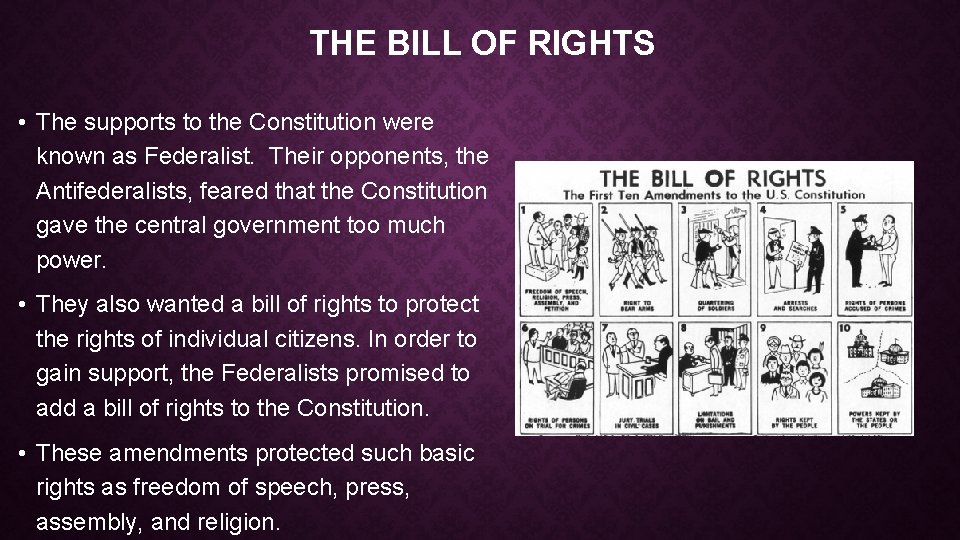
THE BILL OF RIGHTS • The supports to the Constitution were known as Federalist. Their opponents, the Antifederalists, feared that the Constitution gave the central government too much power. • They also wanted a bill of rights to protect the rights of individual citizens. In order to gain support, the Federalists promised to add a bill of rights to the Constitution. • These amendments protected such basic rights as freedom of speech, press, assembly, and religion.