
The Enlightenment 1700 s Europe The English Civil




- Slides: 33
The Enlightenment 1700 s Europe
The English Civil War & Glorious Revolution in England • The ideas of the Enlightenment spurred from two wars in England. • The horrors of the English Civil War created new ideas. • Following the Glorious Revolution in 1689, England developed a Constitutional Monarchy • Included a Bill of Rights
History-1/27 • If a ruler unjustly rules your country for a long time, what do you do as the people? • What rules do you think are unjust at this school? • How could you go about doing away with this leader peacefully? • How could you go about doing away with this leader violently? • Name 3 time periods from last semester that people questioned long-standing beliefs.
What movements challenged these established beliefs? • The Catholic Church is the holiest church in the world. • The earth is flat. • The earth is the center of the universe. • People should not express emotions in their art and writing.
History-10/26 • Why did the Enlightenment begin? • What was the main institution being challenged during the Enlightenment? • Which thinker was counter-Enlightenment when it came to power? • What was the Social Contract? • Locke believed in 3 natural rights. What were they?
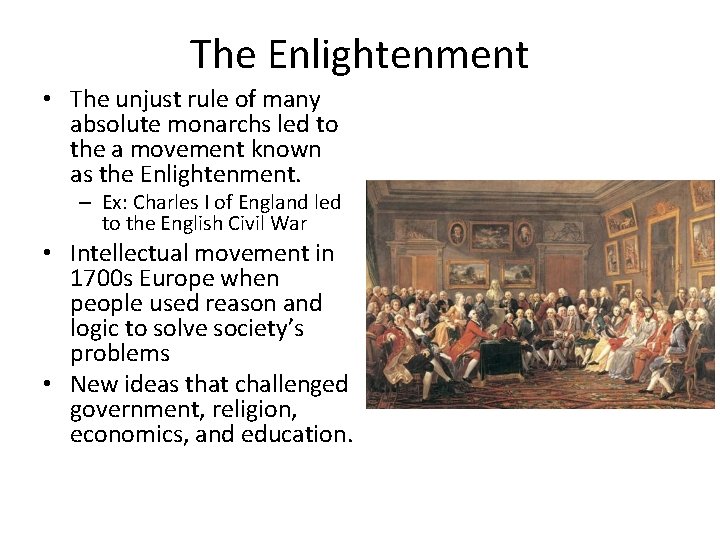
The Enlightenment • The unjust rule of many absolute monarchs led to the a movement known as the Enlightenment. – Ex: Charles I of England led to the English Civil War • Intellectual movement in 1700 s Europe when people used reason and logic to solve society’s problems • New ideas that challenged government, religion, economics, and education.
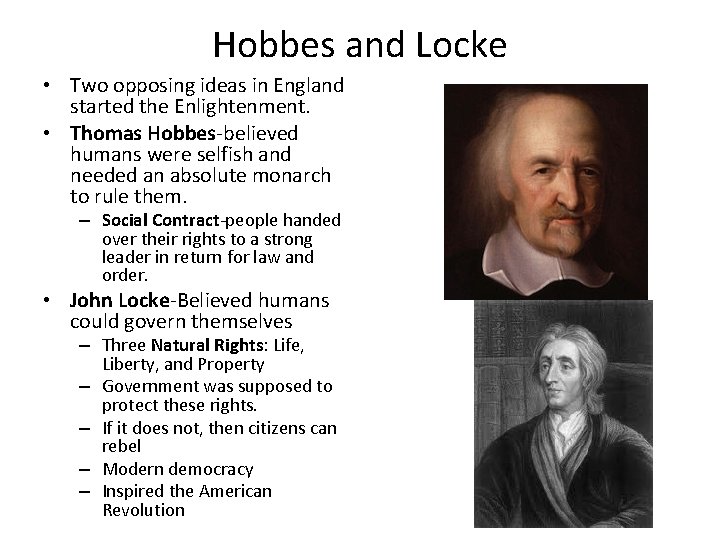
Hobbes and Locke • Two opposing ideas in England started the Enlightenment. • Thomas Hobbes-believed humans were selfish and needed an absolute monarch to rule them. – Social Contract-people handed over their rights to a strong leader in return for law and order. • John Locke-Believed humans could govern themselves – Three Natural Rights: Life, Liberty, and Property – Government was supposed to protect these rights. – If it does not, then citizens can rebel – Modern democracy – Inspired the American Revolution
Enlightenment Philosophers • • Hobbes Locke Voltaire Montesquieu Beccaria Rousseau Wollstonecraft
Books • Beccaria– On Crimes and Punishments • Hobbes – Leviathon • Locke – Two Treatises of Government
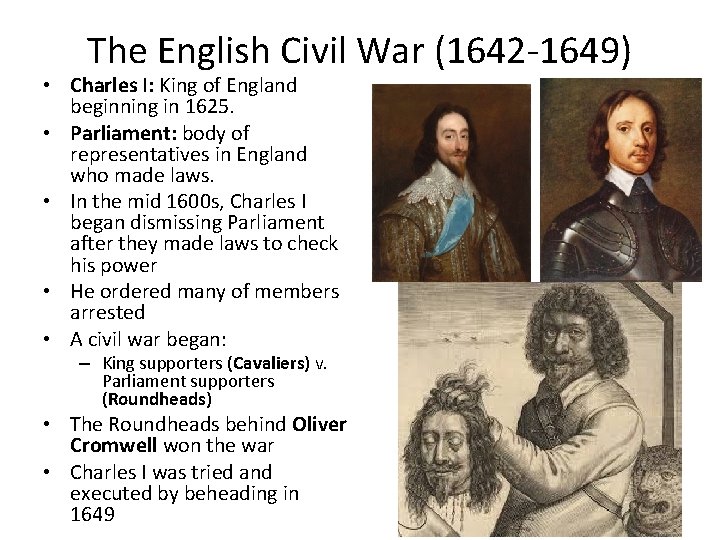
The English Civil War (1642 -1649) • Charles I: King of England beginning in 1625. • Parliament: body of representatives in England who made laws. • In the mid 1600 s, Charles I began dismissing Parliament after they made laws to check his power • He ordered many of members arrested • A civil war began: – King supporters (Cavaliers) v. Parliament supporters (Roundheads) • The Roundheads behind Oliver Cromwell won the war • Charles I was tried and executed by beheading in 1649
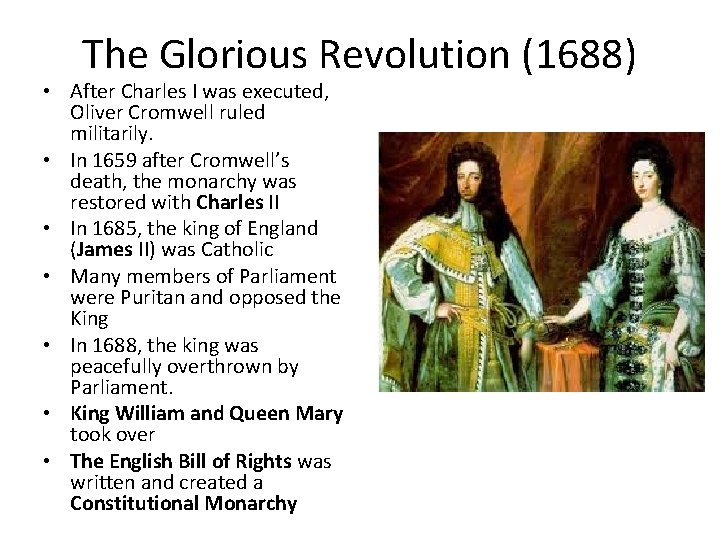
The Glorious Revolution (1688) • After Charles I was executed, Oliver Cromwell ruled militarily. • In 1659 after Cromwell’s death, the monarchy was restored with Charles II • In 1685, the king of England (James II) was Catholic • Many members of Parliament were Puritan and opposed the King • In 1688, the king was peacefully overthrown by Parliament. • King William and Queen Mary took over • The English Bill of Rights was written and created a Constitutional Monarchy
Unit 5 Test Today!! (East Asia) • Get out your reviews and study before lunch. • If you have any questions about the review ask before lunch.
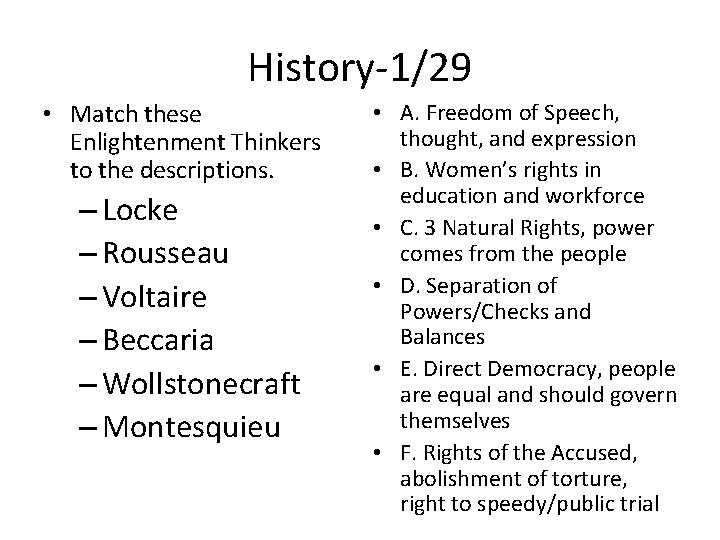
History-1/29 • Match these Enlightenment Thinkers to the descriptions. – Locke – Rousseau – Voltaire – Beccaria – Wollstonecraft – Montesquieu • A. Freedom of Speech, thought, and expression • B. Women’s rights in education and workforce • C. 3 Natural Rights, power comes from the people • D. Separation of Powers/Checks and Balances • E. Direct Democracy, people are equal and should govern themselves • F. Rights of the Accused, abolishment of torture, right to speedy/public trial
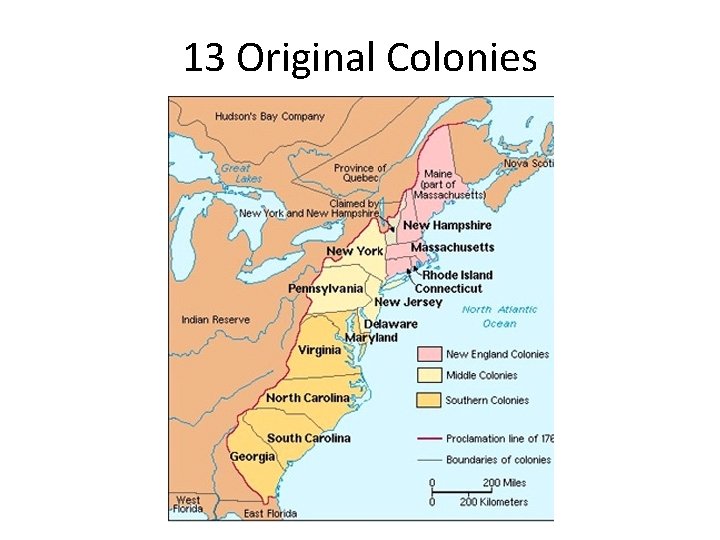
13 Original Colonies
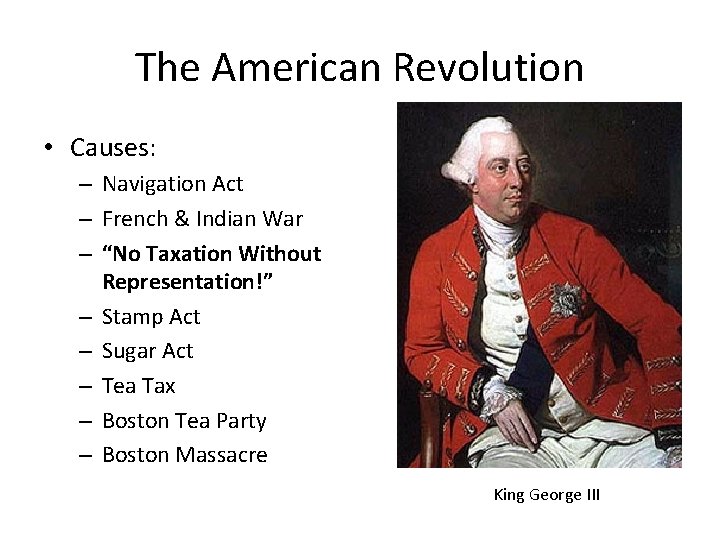
The American Revolution • Causes: – Navigation Act – French & Indian War – “No Taxation Without Representation!” – Stamp Act – Sugar Act – Tea Tax – Boston Tea Party – Boston Massacre King George III
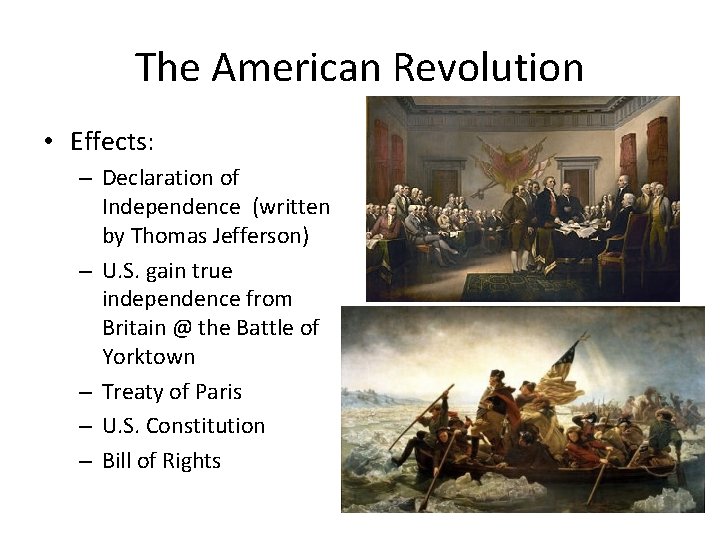
The American Revolution • Effects: – Declaration of Independence (written by Thomas Jefferson) – U. S. gain true independence from Britain @ the Battle of Yorktown – Treaty of Paris – U. S. Constitution – Bill of Rights
The American Revolution (1775 -1783) • Great Britain (mainly England) controlled the American colonies since the 1600 s. • In 1775, King George III continued to mistreat the Americans. • Heavy taxes (Sugar Act, Stamp Act, Townshend Act, Intolerable Acts, Quartering Act etc. ) • These were implemented to help pay off war debts from the French and Indian War • Americans were outraged: – “No taxation without representation!”
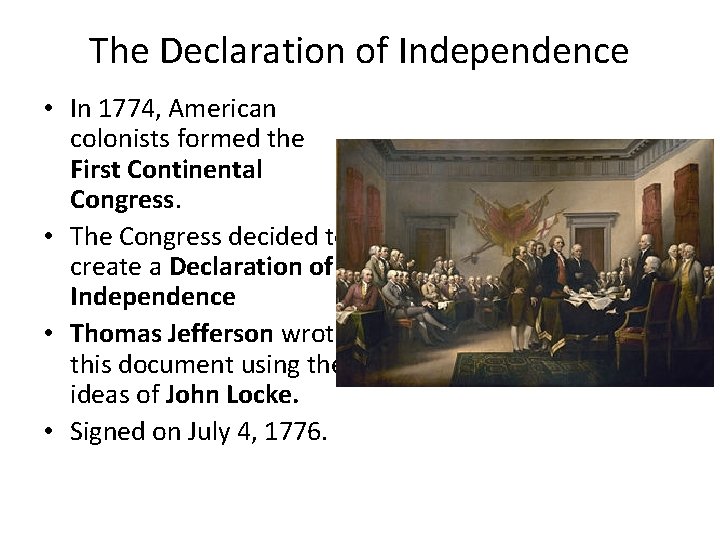
The Declaration of Independence • In 1774, American colonists formed the First Continental Congress. • The Congress decided to create a Declaration of Independence • Thomas Jefferson wrote this document using the ideas of John Locke. • Signed on July 4, 1776.
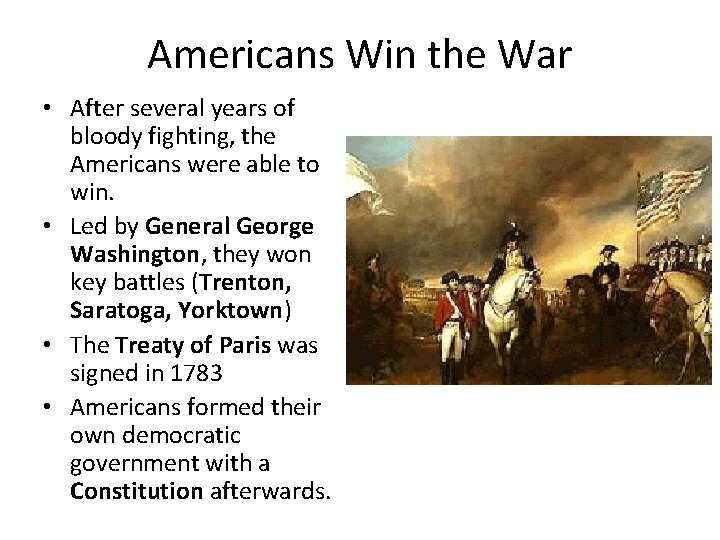
Americans Win the War • After several years of bloody fighting, the Americans were able to win. • Led by General George Washington, they won key battles (Trenton, Saratoga, Yorktown) • The Treaty of Paris was signed in 1783 • Americans formed their own democratic government with a Constitution afterwards.
• • • 1 -Sugar Act 2 -Boston Port Act 3 -Massachusetts Government Act 4 -Quartering Act 5 -The Administration of Justice Act 6 -Townshend Acts 7 -Stamp Act 8 -Tea Act 9 -Navigation Acts
Scenario 1 • Poor little Madelyn dreams of getting a great education and becoming a lawyer. However, she cannot do either because the King has forbidden it.
Scenario 2 • The King of England needs more money from taxes to rage a war with France, but the Parliament decides against this. • The King dismisses Parliament and makes the decision himself to increase taxes.
Scenario 3 • The King has decided to imprison Betsy for worshipping as a Hindu instead of a Catholic. • Poor old Richie was executed last week for implying that the King made a mistake with his tax reforms.
Scenario 4 • Big Bob was arrested the other day by the King’s soldiers for stealing and was held in prison for several weeks before he was tried. • He was interrogated by the King’s soldiers constantly to get information from him. • He was eventually found guilty behind closed doors and was sentenced to death.
Scenario 5 • The King has decided that people in the poor class of society don’t have the right to vote. • The poor class must also pay the majority of the taxes in society while the wealthy pay little to no taxes.
Scenario 6 • The King’s cousin enters a commoners house, takes that person’s valuables, and then kicks the owners out. • When the commoner complains to the King, the King throws the commoner in jail.
History-1/27 • What was the Enlightenment & why did it begin? • How was Hobbes different from Locke? • Create a Chain Reaction using this Subject – 1. Kings Treat the People Badly – 2. _____________ – 3. _____________ – 4. _____________
History-1/29 • Look up these words in the glossary: – Salons – Enlightened Despots – Name 3 Enlightened Despots and the Country they ruled
1 • (AKS 42 b; 2) European monarchs of the 1600 s believed that they should have absolute power because they – A. needed to defend their nations against threats from the Western Hemisphere. – B. had been given their power to govern from God. – C. thought that communism was the superior political system. – D. thought that all people should have the right to a good ruler.
2 • (AKS 42 b; 2) Which of the following best describes Russia before the rise of Peter the Great? – A. Russia had a powerful military and strong trade relationships with Italian merchants. – B. Russia was the most advanced nation in all of Western Europe. – C. Russia was a Catholic nation with many overseas colonies like Spain and Portugal. – D. Russia was a nation of mostly poor farmers and had little modern industry.
3 • (AKS 42 b; 2) Louis XIV’s palace at Versailles is a good example that the king – A. used the nation’s wealth to glorify himself and not the French people. – B. was interested in saving France money. – C. relied on the advice of noble lords to make decisions in France. – D. built a modern Western city much like Florence, Italy.
4 • (AKS 41 a; 2) What is an important similarity between the Byzantine Empire and the Ottoman Empire? – A. Both empires developed important law codes. – B. Both empires were influenced by the Mongols. – C. Both were Roman Catholic Christians. – D. Both empires conquered Persia.
5