
The English Renaissance Latin and to a lesser
- Slides: 19
The English Renaissance
Latin (and to a lesser extent Greek and French) was still very much considered the language of education and scholarship at this time, and the great enthusiasm for the classical languages during the English Renaissance brought thousands of new words into the language, peaking around 1600. A huge number of classical works were being translated into English during the 16 th Century, and many new terms were introduced where a satisfactory English equivalent did not exist.
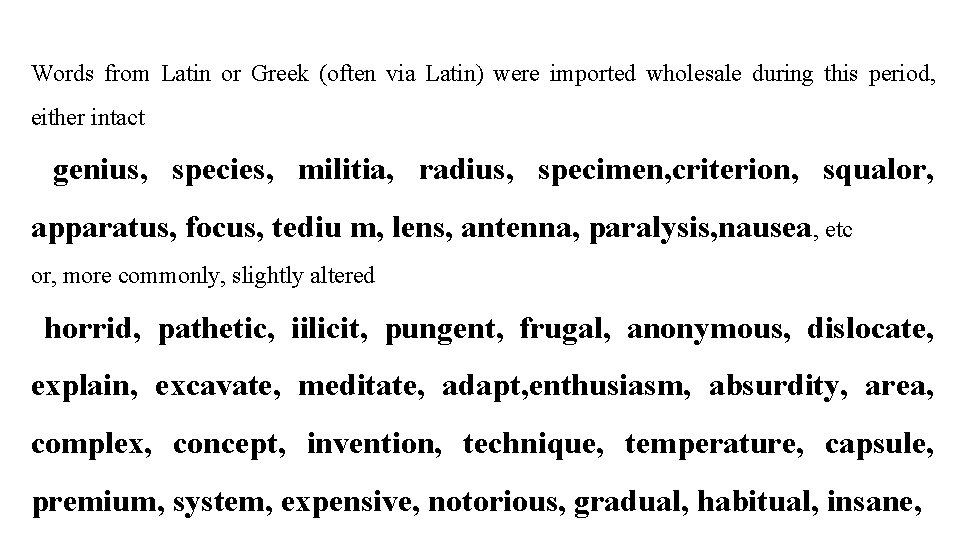
Words from Latin or Greek (often via Latin) were imported wholesale during this period, either intact genius, species, militia, radius, specimen, criterion, squalor, apparatus, focus, tediu m, lens, antenna, paralysis, nausea, etc or, more commonly, slightly altered horrid, pathetic, iilicit, pungent, frugal, anonymous, dislocate, explain, excavate, meditate, adapt, enthusiasm, absurdity, area, complex, concept, invention, technique, temperature, capsule, premium, system, expensive, notorious, gradual, habitual, insane,
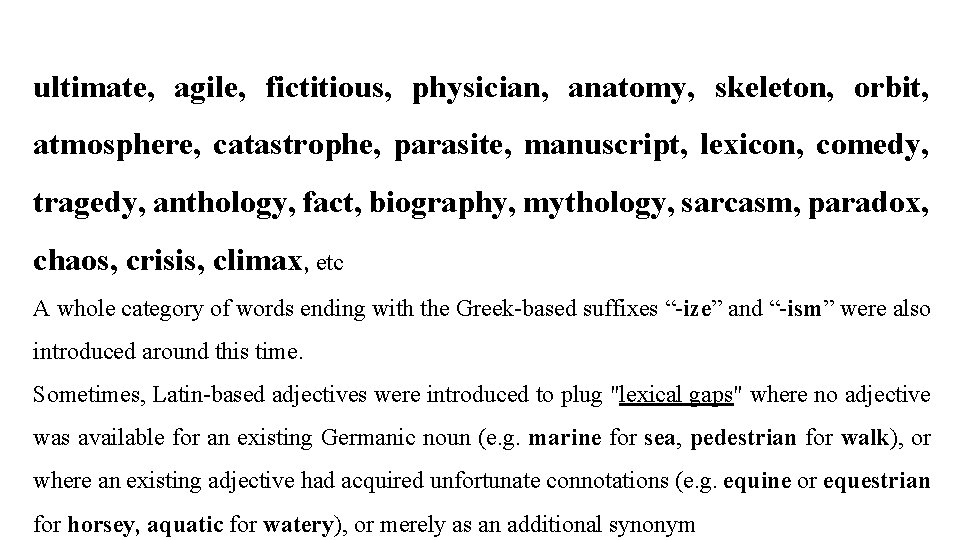
ultimate, agile, fictitious, physician, anatomy, skeleton, orbit, atmosphere, catastrophe, parasite, manuscript, lexicon, comedy, tragedy, anthology, fact, biography, mythology, sarcasm, paradox, chaos, crisis, climax, etc A whole category of words ending with the Greek-based suffixes “-ize” and “-ism” were also introduced around this time. Sometimes, Latin-based adjectives were introduced to plug "lexical gaps" where no adjective was available for an existing Germanic noun (e. g. marine for sea, pedestrian for walk), or where an existing adjective had acquired unfortunate connotations (e. g. equine or equestrian for horsey, aquatic for watery), or merely as an additional synonym
e. g. masculine and feminine in addition to manly and womanly, paternal in addition to fatherly, etc. Several rather ostentatious French phrases also became naturalized in English at this juncture, including soi-disant, vis-а-vis, sang-froid, etc, as well as more mundane French borrowings such as crepe, etiquette, etc. Some scholars adopted Latin terms so excessively and awkwardly at this time that the derogatory term “inkhorn” was coined to describe pedantic writers who borrowed the classics to create obscure and opulent terms, many of which have not survived.
Examples of inkhorn terms include revoluting, ingent, devulgate, attemptate, obtestate, fatigat e, deruncinate, subsecive, nidulate, abstergify, arreption, suppeditate, eximious, illecebrous, c ohibit, dispraise and other such inventions. The so-called Inkhorn Controversy was the first of several such ongoing arguments over language use which began to erupt in the salons of England (and, later, America). Among those strongly in favour of the use of such "foreign" terms in English were Thomas Elyot and George Pettie; just as strongly opposed were Thomas Wilson and John Cheke.
However, it is interesting to note that some words initially branded as inkhorn terms have stayed in the language and now remain in common use dismiss, disagree, celebrate, encyclopaedia, commit, industrial, affability, dexterity, superiority, external, exaggerate, extol, necessitate, expectation, mundane, capacity and ingenious An indication of the arbitrariness of this process is that impede survived while its opposite, expede, did not; commit and transmit were allowed to continue, while demit was not; and disabuse and disagree survived, while disaccustom and disacquaint, which were coined around the same time, did not. It is also sobering to realize that some of the greatest writers in the language have suffered from the same vagaries of fashion and fate. Not all of Shakespeare’s many creations have stood the test of time, including
barky, brisky, conflux, exsufflicate, ungenitured, unhair, questrist, cadent, peris ive, abruption, appertainments, implausive, vastidity and tortive Likewise, Ben Jonson’s ventositous and obstufact died a premature death, and John Milton’s impressive inquisiturient has likewise not lasted. There was even a self-conscious reaction to this perceived foreign incursion into the English language, and some writers tried to deliberately resurrect older English words gleeman for musician, sicker for certainly, inwit for conscience, yblent for confused, etc, or to create wholly new words from Germanic roots endsay for conclusion, yeartide for anniversary, foresayer for prophet, forewitr for prudence, loreless for ignorant, gainrising for resurrection, starlore for astronomy,
fleshstrings for muscles, grosswitted for stupid, speechcraft for grammar, birdlore for ornithology, etc The 17 th c. penchant for classical language also influenced the spelling of words like debt and doubt, which had a silent “b” added at this time out of deference to their Latin roots (debitum and dubitare respectively). For the same reason, island gained its silent “s”, scissors its “c”, anchor, school and herb their “h”, people its “o” and victuals gained both a “c” and a “u”. In the same way, Middle English perfet and verdit became perfect and verdict (the added “c” at least being pronounced in these cases), faute and assaut became fault and assault, and aventure became adventure.
However, this perhaps laudable attempt to bring logic and reason into the apparent chaos of the language has actually had the effect of just adding to the chaos. Its cause was not helped by examples such the “p” which was added to the start of ptarmigan with no etymological justification whatsoever other than the fact that the Greek word for feather, ptera, started with a "p". Whichever side of the debate one favours, however, it is fair to say that, by the end of the 16 th c. , English had finally become widely accepted as a language of learning, equal if not superior to the classical languages. Vernacular language, once scorned as suitable for popular literature and little else - and still criticized throughout much of Europe as crude, limited and immature had become recognized for its inherent qualities.
William Shakespeare
Shakespeare took advantage of the relative freedom and flexibility and the protean nature of English at the time, and played free and easy with the already liberal grammatical rules, for example in his use nouns as verbs, adjectives and substantives - an early instance of the “verbification” of nouns which modern language purists often decry - in phrases such as “he pageants us”, “it out-herods Herod”, dog them at the heels, the good Brutus ghosted, “Lord Angelo dukes it well”, “uncle me no uncle”, etc. He had a vast vocabulary (34, 000 words by some counts) and he personally coined an estimated 2, 000 neologisms or new words in his many works, including, but by no means limited to,
barefaced, critical, leapfrog, monumental, castigate, majestic, obscene, frugal, aerial, gnarled , homicide, brittle, radiance, dwindle, puking, countless, submerged, vast, lacklustre, premeditated, assassination, courtship, eyeballs, ill-tuned, hotblooded, laughable, dislocate, accommodation, eventful, pellmell, aggravate, excellent, fretful, fragrant, gust, hint, hurry, lonely, summit, pedant, gloo my, and hundreds of other terms still commonly used today.
He also introduced countless phrases in common use today, such as one fell swoop, vanish into thin air, brave new world, in my mind’s eye, laughing stock, love is blind, star-crossed lovers, as luck would have it, fast and loose, once more into the breach, sea change, there’s the rub, to the manner born, a foregone conclusion, beggars all description, it's Greek to me, a tower of strength, make a virtue of necessity, brevity is the soul of wit, with bated breath, more in sorrow than in anger, truth will out, cold comfort, cruel only to be kind, fool’s paradise and flesh and blood, among many others.
By the time of Shakespeare, word order had become more fixed in a subject-verb-object pattern, and English had developed a complex auxiliary verb system, although to be was still commonly used as the auxiliary rather than the more modern to have I am come rather than I have come. Do was sometimes used as an auxiliary verb and sometimes not say you so? or do you say so? Past tenses were likewise still in a state of flux, and it was still acceptable to use clomb as well as climbed, clew as well as clawed, shove as well as shaved, digged as well as dug, etc. Plural noun endings had shrunk from the six of OE to just two, “-s” and “-en”, and again Shakespeare sometimes used one and sometimes the other. The old verb ending “-en” had in general been gradually replaced by “-eth”
loveth, doth, hath, etc, although this was itself in the process of being replaced by the northern English verb ending “es”, and Shakespeare used both loves and loveth, but not the old loven. Even over the period of Shakespeare’s output there was a noticeable change, with “-eth” endings outnumbering “-es” by over 3 to 1 during the early period from 1591 -1599, and “-es” outnumbering “-eth” by over 6 to 1 during 1600 -1613.
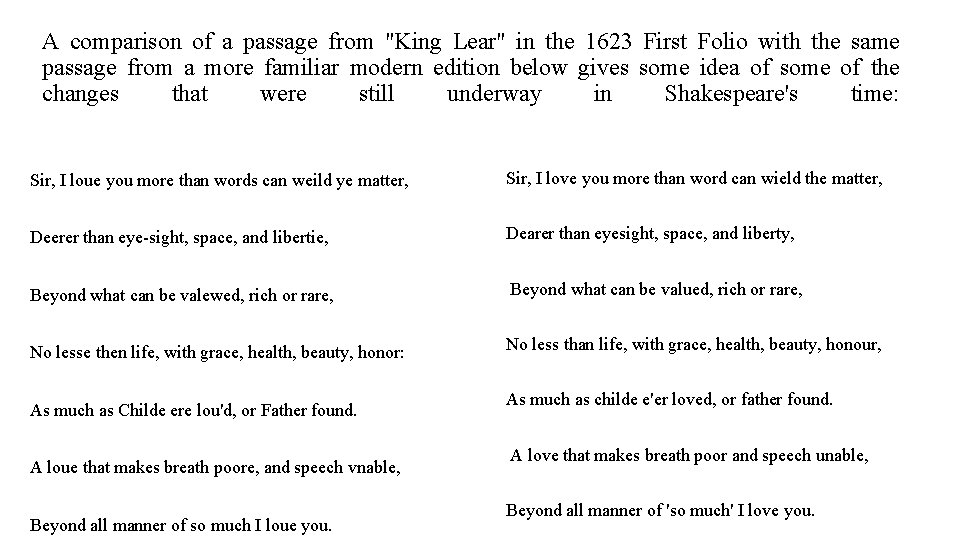
A comparison of a passage from "King Lear" in the 1623 First Folio with the same passage from a more familiar modern edition below gives some idea of some of the changes that were still underway in Shakespeare's time: Sir, I loue you more than words can weild ye matter, Sir, I love you more than word can wield the matter, Deerer than eye-sight, space, and libertie, Dearer than eyesight, space, and liberty, Beyond what can be valewed, rich or rare, Beyond what can be valued, rich or rare, No lesse then life, with grace, health, beauty, honor: No less than life, with grace, health, beauty, honour, As much as Childe ere lou'd, or Father found. A loue that makes breath poore, and speech vnable, Beyond all manner of so much I loue you. As much as childe e'er loved, or father found. A love that makes breath poor and speech unable, Beyond all manner of 'so much' I love you.
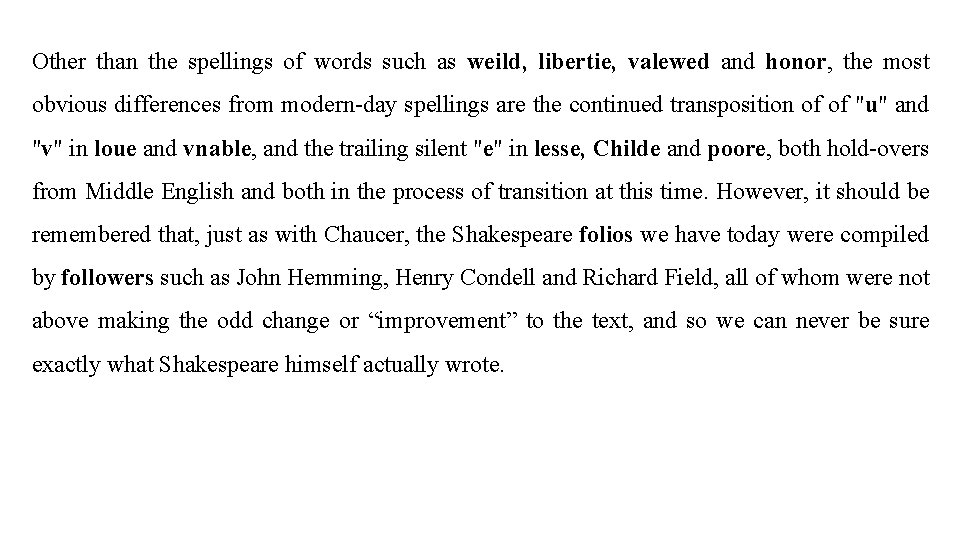
Other than the spellings of words such as weild, libertie, valewed and honor, the most obvious differences from modern-day spellings are the continued transposition of of "u" and "v" in loue and vnable, and the trailing silent "e" in lesse, Childe and poore, both hold-overs from Middle English and both in the process of transition at this time. However, it should be remembered that, just as with Chaucer, the Shakespeare folios we have today were compiled by followers such as John Hemming, Henry Condell and Richard Field, all of whom were not above making the odd change or “improvement” to the text, and so we can never be sure exactly what Shakespeare himself actually wrote.
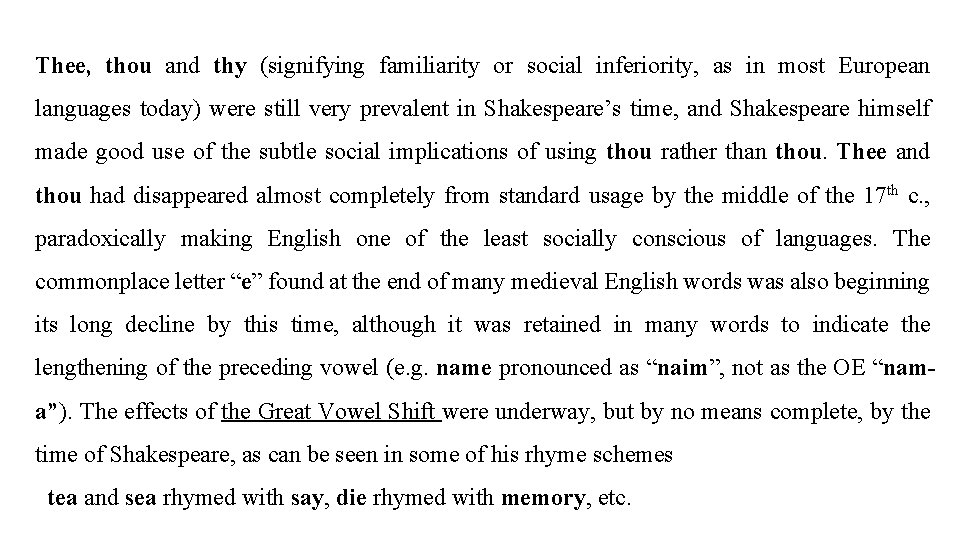
Thee, thou and thy (signifying familiarity or social inferiority, as in most European languages today) were still very prevalent in Shakespeare’s time, and Shakespeare himself made good use of the subtle social implications of using thou rather than thou. Thee and thou had disappeared almost completely from standard usage by the middle of the 17 th c. , paradoxically making English one of the least socially conscious of languages. The commonplace letter “e” found at the end of many medieval English words was also beginning its long decline by this time, although it was retained in many words to indicate the lengthening of the preceding vowel (e. g. name pronounced as “naim”, not as the OE “nama”). The effects of the Great Vowel Shift were underway, but by no means complete, by the time of Shakespeare, as can be seen in some of his rhyme schemes tea and sea rhymed with say, die rhymed with memory, etc.