
The English Language An International Medium of Communication

![Some English Words borrowed from Chinese • tea and its variant char [茶] --](https://slidetodoc.com/presentation_image_h2/b56392ddabdda5be777597827aaf56b5/image-14.jpg "Some English Words borrowed from Chinese • tea and its variant char [茶] --")
- Slides: 20
The English Language: An International Medium of Communication Patrick Hanks (Oxford Dictionaries) Now at: Faculty of Informatics, Masaryk University, Brno
Language Size by Number of Native Speakers 2
Native Speakers and Secondary Speakers 3
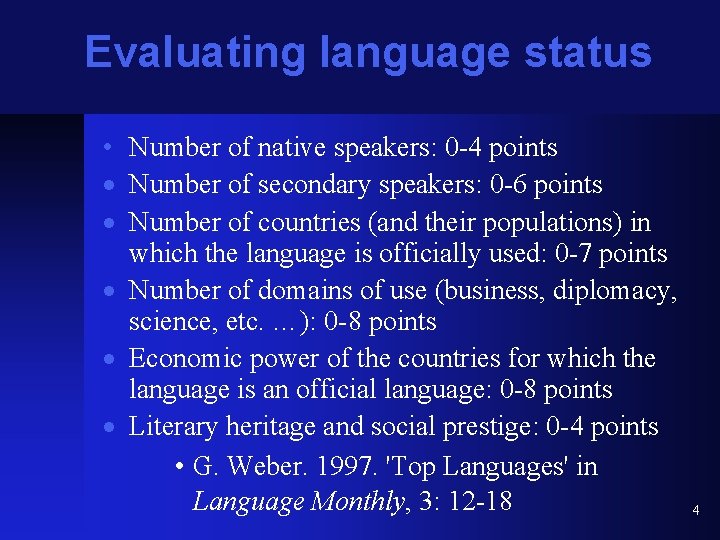
Evaluating language status • Number of native speakers: 0 -4 points Number of secondary speakers: 0 -6 points Number of countries (and their populations) in which the language is officially used: 0 -7 points Number of domains of use (business, diplomacy, science, etc. …): 0 -8 points Economic power of the countries for which the language is an official language: 0 -8 points Literary heritage and social prestige: 0 -4 points • G. Weber. 1997. 'Top Languages' in Language Monthly, 3: 12 -18 4
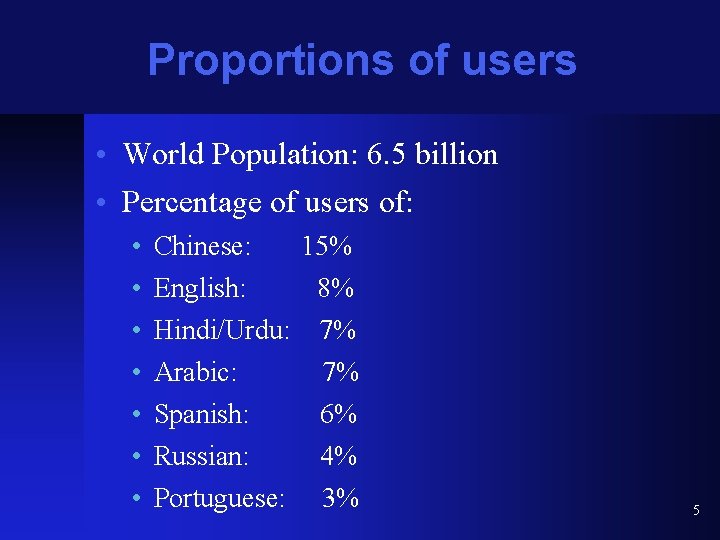
Proportions of users • World Population: 6. 5 billion • Percentage of users of: • • Chinese: 15% English: 8% Hindi/Urdu: 7% Arabic: 7% Spanish: 6% Russian: 4% Portuguese: 3% 5
Relative Importance of Languages, according to Weber’s points system (1997) 6
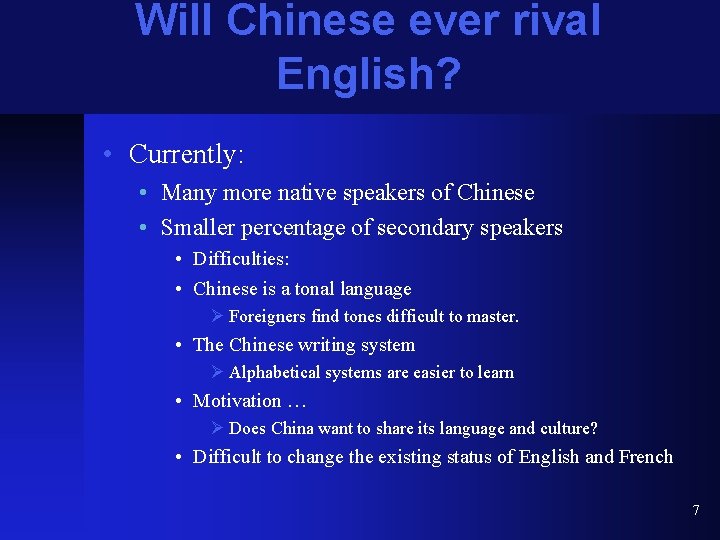
Will Chinese ever rival English? • Currently: • Many more native speakers of Chinese • Smaller percentage of secondary speakers • Difficulties: • Chinese is a tonal language Foreigners find tones difficult to master. • The Chinese writing system Alphabetical systems are easier to learn • Motivation … Does China want to share its language and culture? • Difficult to change the existing status of English and French 7
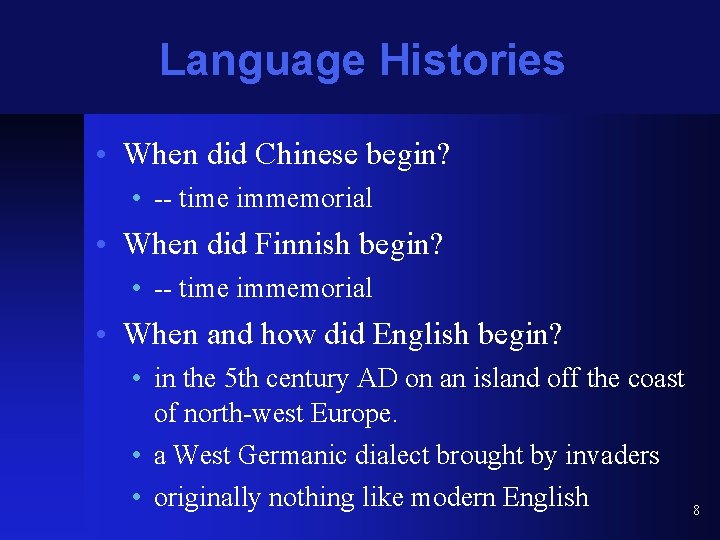
Language Histories • When did Chinese begin? • -- time immemorial • When did Finnish begin? • -- time immemorial • When and how did English begin? • in the 5 th century AD on an island off the coast of north-west Europe. • a West Germanic dialect brought by invaders • originally nothing like modern English 8
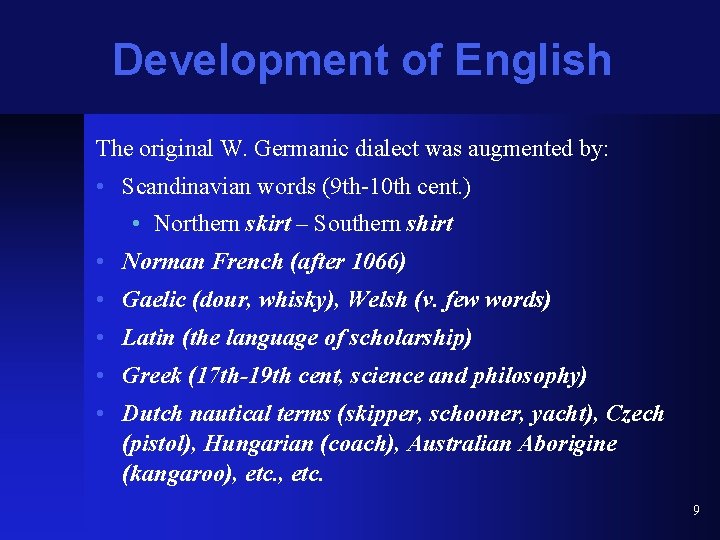
Development of English The original W. Germanic dialect was augmented by: • Scandinavian words (9 th-10 th cent. ) • Northern skirt – Southern shirt • Norman French (after 1066) • Gaelic (dour, whisky), Welsh (v. few words) • Latin (the language of scholarship) • Greek (17 th-19 th cent, science and philosophy) • Dutch nautical terms (skipper, schooner, yacht), Czech (pistol), Hungarian (coach), Australian Aborigine (kangaroo), etc. 9
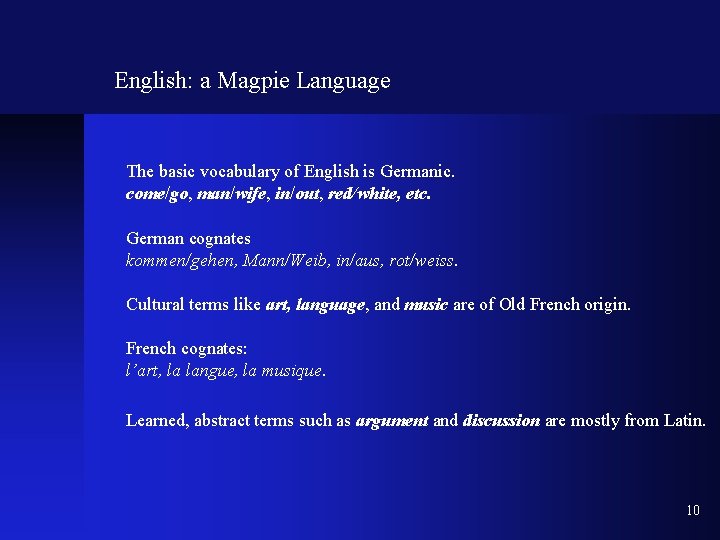
English: a Magpie Language The basic vocabulary of English is Germanic. come/go, man/wife, in/out, red/white, etc. German cognates kommen/gehen, Mann/Weib, in/aus, rot/weiss. Cultural terms like art, language, and music are of Old French origin. French cognates: l’art, la langue, la musique. Learned, abstract terms such as argument and discussion are mostly from Latin. 10
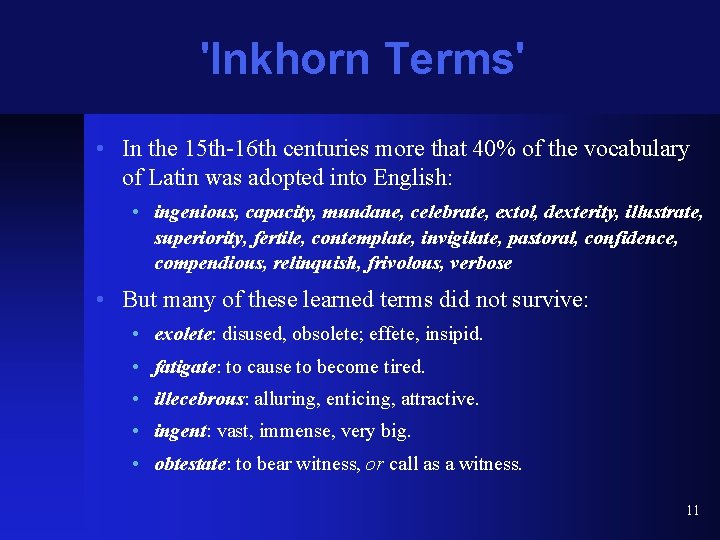
'Inkhorn Terms' • In the 15 th-16 th centuries more that 40% of the vocabulary of Latin was adopted into English: • ingenious, capacity, mundane, celebrate, extol, dexterity, illustrate, superiority, fertile, contemplate, invigilate, pastoral, confidence, compendious, relinquish, frivolous, verbose • But many of these learned terms did not survive: • exolete: disused, obsolete; effete, insipid. • fatigate: to cause to become tired. • illecebrous: alluring, enticing, attractive. • ingent: vast, immense, very big. • obtestate: to bear witness, or call as a witness. 11
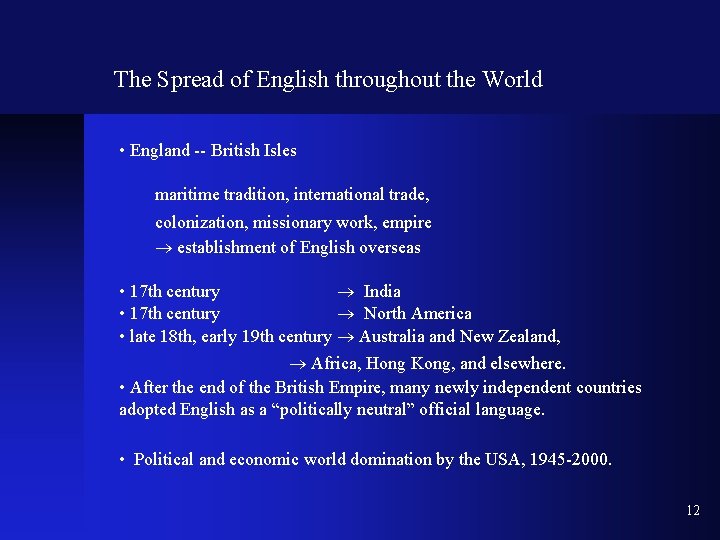
The Spread of English throughout the World • England -- British Isles maritime tradition, international trade, colonization, missionary work, empire establishment of English overseas • 17 th century India • 17 th century North America • late 18 th, early 19 th century Australia and New Zealand, Africa, Hong Kong, and elsewhere. • After the end of the British Empire, many newly independent countries adopted English as a “politically neutral” official language. • Political and economic world domination by the USA, 1945 -2000. 12
The Spread of English throughout the World Reasons for the adoption of English as an official language in the post-colonial world: • administrative continuity and efficiency • linguistic and political neutrality • economic self-interest 13
Some English Words borrowed from Chinese • tea and its variant char [茶] -- an old borrowing (16 th century) • • • feng shui 风水 gung-ho 功夫 mah-jong 麻将 wok 锅 yin and yang 阴阳 kiasu -- from Southern Chinese dialect, “ a person who is perceived as greedy or grasping and anxious not to miss any opportunity” from Chinese words [怕输] meaning ‘scared to lose’ 14
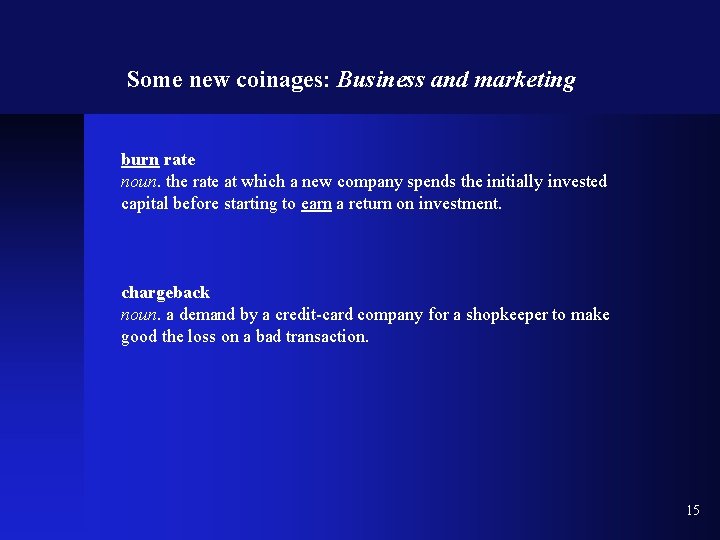
Some new coinages: Business and marketing burn rate noun. the rate at which a new company spends the initially invested capital before starting to earn a return on investment. chargeback noun. a demand by a credit-card company for a shopkeeper to make good the loss on a bad transaction. 15
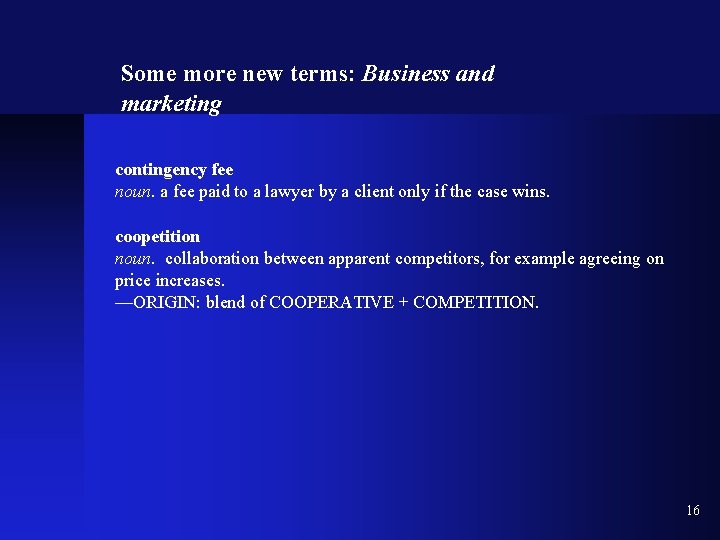
Some more new terms: Business and marketing contingency fee noun. a fee paid to a lawyer by a client only if the case wins. coopetition noun. collaboration between apparent competitors, for example agreeing on price increases. —ORIGIN: blend of COOPERATIVE + COMPETITION. 16
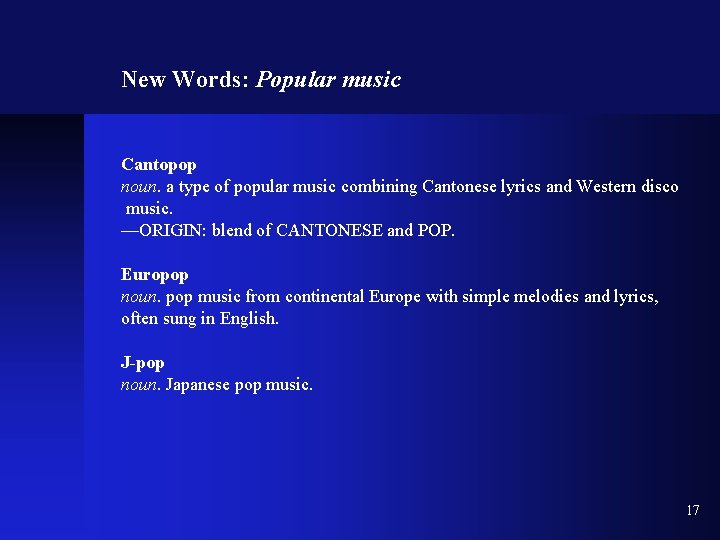
New Words: Popular music Cantopop noun. a type of popular music combining Cantonese lyrics and Western disco music. —ORIGIN: blend of CANTONESE and POP. Europop noun. pop music from continental Europe with simple melodies and lyrics, often sung in English. J-pop noun. Japanese pop music. 17
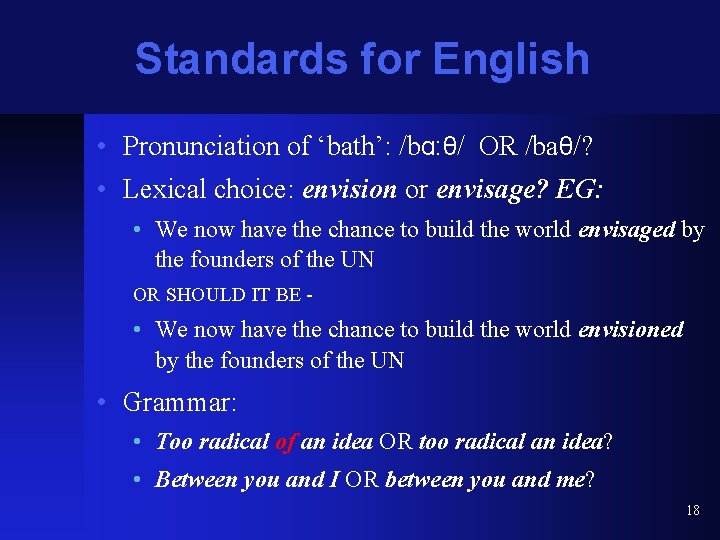
Standards for English • Pronunciation of ‘bath’: /bɑ: θ/ OR /baθ/? • Lexical choice: envision or envisage? EG: • We now have the chance to build the world envisaged by the founders of the UN OR SHOULD IT BE - • We now have the chance to build the world envisioned by the founders of the UN • Grammar: • Too radical of an idea OR too radical an idea? • Between you and I OR between you and me? 18
Conclusions (1) • English today is a plural phenomenon: • • Plurality of origins Plurality of purposes and uses Plurality of nations and users Flexible and pragmatic • The arcahic spelling system is a comparatively minor drawback, compared with German word order and inflections, Czech inflections, Chinese tones 19
Conclusions (2) • English today is not the language of any one nation. • It does not belong to anybody. • English has become the mutual property of the whole world. It is an international, interdisciplinary medium of communication. 20