
The Engineering of Foundations Lecture 2 Soil Explorations

- Slides: 14
The Engineering of Foundations Lecture 2 Soil Explorations Continue q Sampling q In-Situ Tests 1. Standard Penetration Test 2/14/2022 Eng. of Foundations 1
Sampling The objective of soil sampling is to obtain soils of satisfactory size with minimum disturbance for observation and laboratory tests the samples are classified into: 1. Disturbed samples which are useful for conducting the following tests: a) specific gravity b) water content c) Atterberg limits d) grain size analysis e) sulphate and organic content 2/14/2022 Eng. of Foundations 2
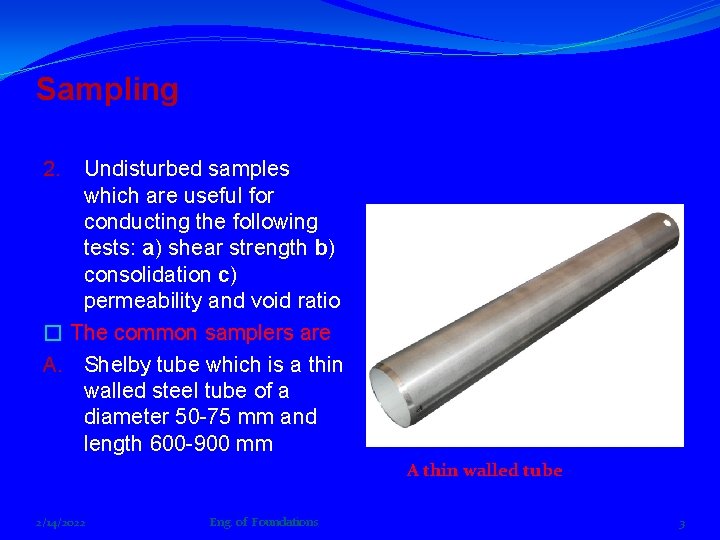
Sampling Undisturbed samples which are useful for conducting the following tests: a) shear strength b) consolidation c) permeability and void ratio � The common samplers are A. Shelby tube which is a thin walled steel tube of a diameter 50 -75 mm and length 600 -900 mm 2. A thin walled tube 2/14/2022 Eng. of Foundations 3
Sampling B. Split spoon which has an inside diameter of 35 mm and outside diameter of 51 mm. split spoon samples are disturbed A split spoon 2/14/2022 Eng. of Foundations 4
Sampling Several factors make obtaining undisturbed samples hard: Ø Friction between soil and sampling tube Ø Wall thickness of the sampling tube Ø Sharpness of the cutting edge Ø Care and handling during transportation Ground water condition It is important not only to identify the ground water level and any special condition (e. g. artesian condition) but also the possible range of ground water fluctuation. 2/14/2022 Eng. of Foundations 5
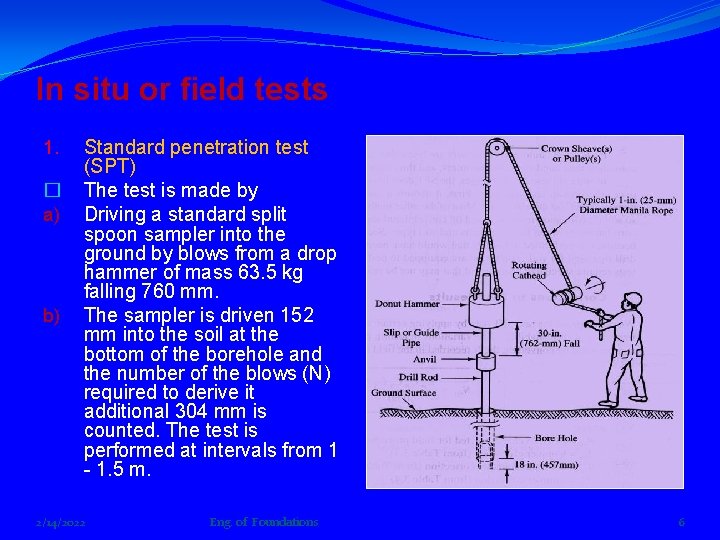
In situ or field tests 1. � a) b) Standard penetration test (SPT) The test is made by Driving a standard split spoon sampler into the ground by blows from a drop hammer of mass 63. 5 kg falling 760 mm. The sampler is driven 152 mm into the soil at the bottom of the borehole and the number of the blows (N) required to derive it additional 304 mm is counted. The test is performed at intervals from 1 - 1. 5 m. 2/14/2022 Eng. of Foundations 6
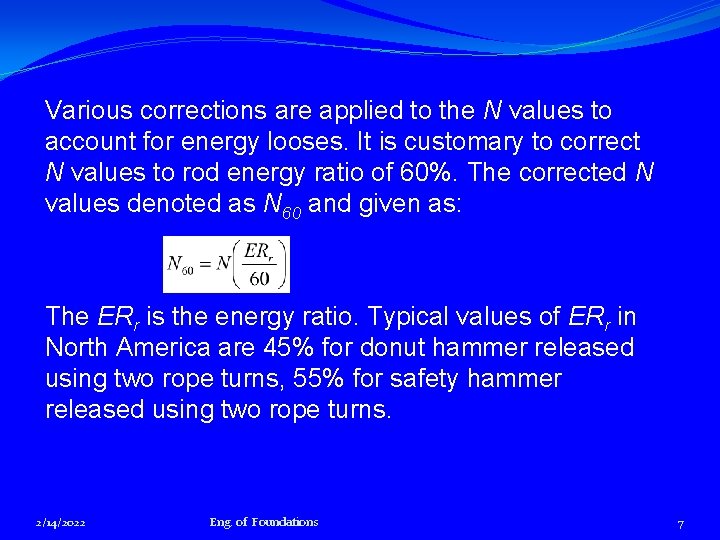
Various corrections are applied to the N values to account for energy looses. It is customary to correct N values to rod energy ratio of 60%. The corrected N values denoted as N 60 and given as: The ERr is the energy ratio. Typical values of ERr in North America are 45% for donut hammer released using two rope turns, 55% for safety hammer released using two rope turns. 2/14/2022 Eng. of Foundations 7
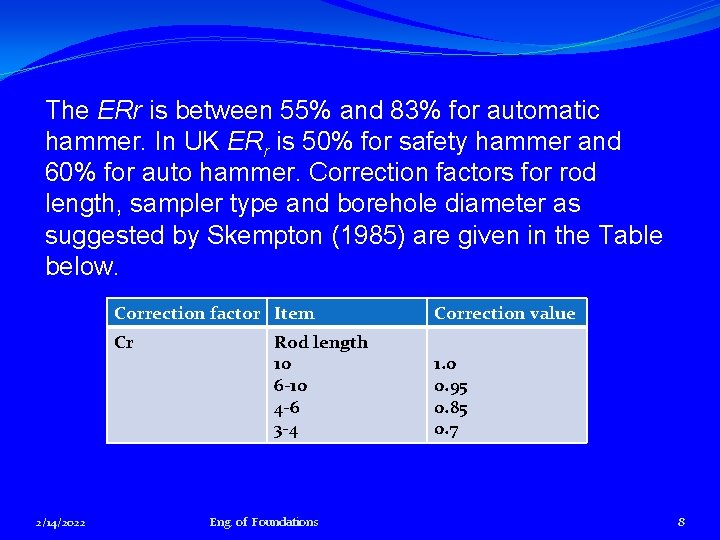
The ERr is between 55% and 83% for automatic hammer. In UK ERr is 50% for safety hammer and 60% for auto hammer. Correction factors for rod length, sampler type and borehole diameter as suggested by Skempton (1985) are given in the Table below. Correction factor Item Cr 2/14/2022 Rod length 10 6 -10 4 -6 3 -4 Eng. of Foundations Correction value 1. 0 0. 95 0. 85 0. 7 8
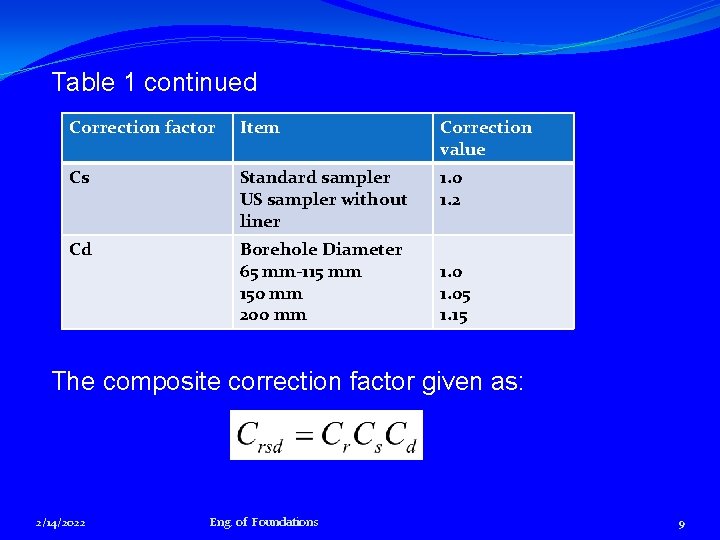
Table 1 continued Correction factor Item Correction value Cs Standard sampler US sampler without liner 1. 0 1. 2 Cd Borehole Diameter 65 mm-115 mm 150 mm 200 mm 1. 05 1. 15 The composite correction factor given as: 2/14/2022 Eng. of Foundations 9
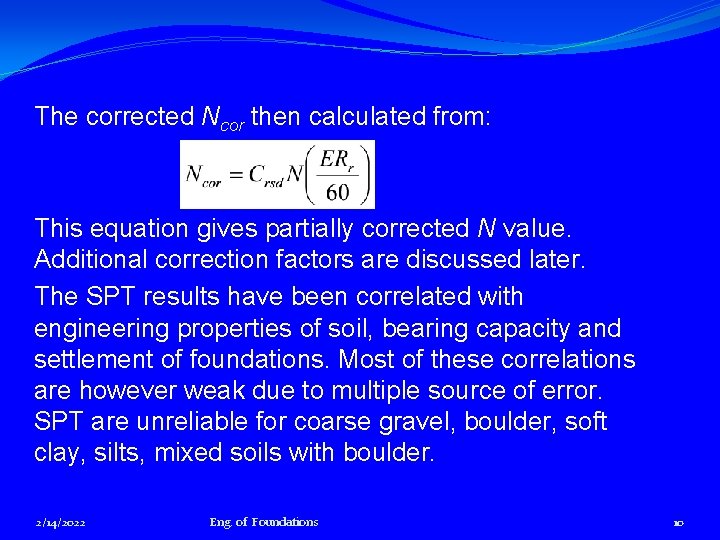
The corrected Ncor then calculated from: This equation gives partially corrected N value. Additional correction factors are discussed later. The SPT results have been correlated with engineering properties of soil, bearing capacity and settlement of foundations. Most of these correlations are however weak due to multiple source of error. SPT are unreliable for coarse gravel, boulder, soft clay, silts, mixed soils with boulder. 2/14/2022 Eng. of Foundations 10
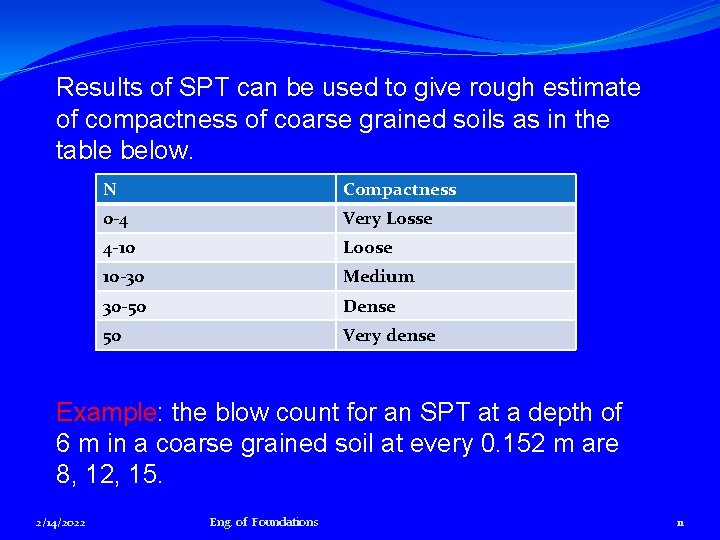
Results of SPT can be used to give rough estimate of compactness of coarse grained soils as in the table below. N Compactness 0 -4 Very Losse 4 -10 Loose 10 -30 Medium 30 -50 Dense 50 Very dense Example: the blow count for an SPT at a depth of 6 m in a coarse grained soil at every 0. 152 m are 8, 12, 15. 2/14/2022 Eng. of Foundations 11
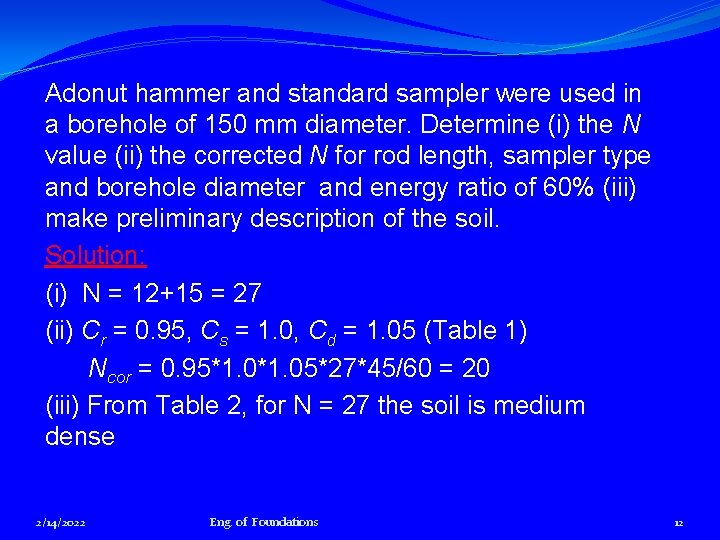
Adonut hammer and standard sampler were used in a borehole of 150 mm diameter. Determine (i) the N value (ii) the corrected N for rod length, sampler type and borehole diameter and energy ratio of 60% (iii) make preliminary description of the soil. Solution: (i) N = 12+15 = 27 (ii) Cr = 0. 95, Cs = 1. 0, Cd = 1. 05 (Table 1) Ncor = 0. 95*1. 05*27*45/60 = 20 (iii) From Table 2, for N = 27 the soil is medium dense 2/14/2022 Eng. of Foundations 12
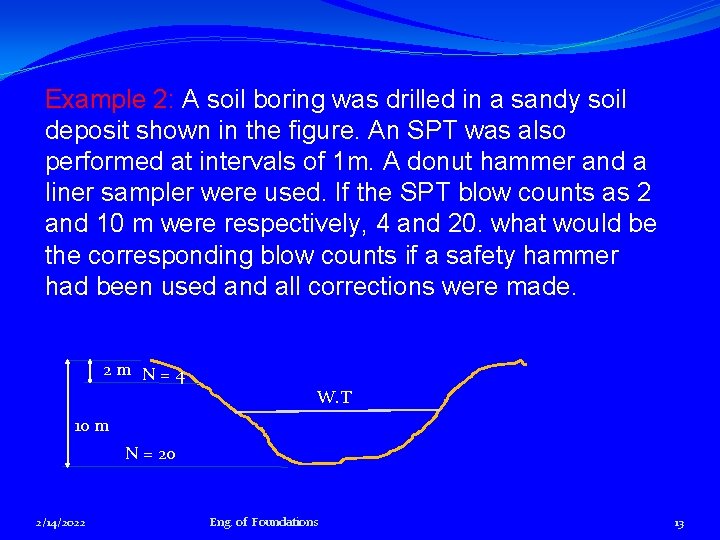
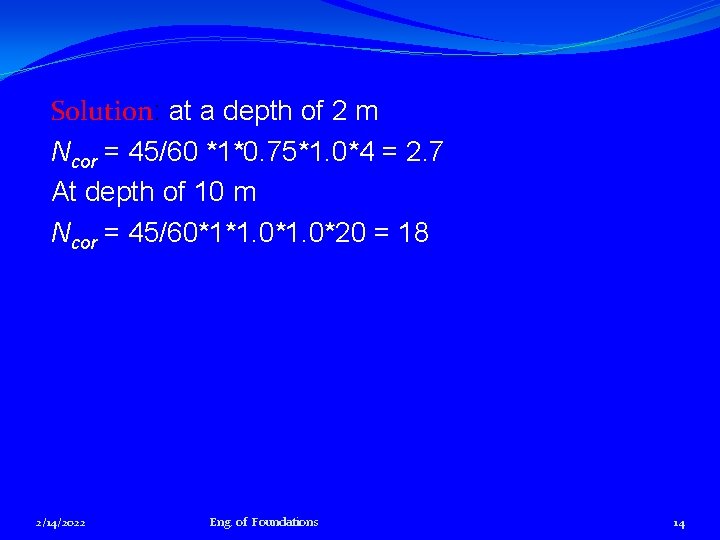
Example 2: A soil boring was drilled in a sandy soil deposit shown in the figure. An SPT was also performed at intervals of 1 m. A donut hammer and a liner sampler were used. If the SPT blow counts as 2 and 10 m were respectively, 4 and 20. what would be the corresponding blow counts if a safety hammer had been used and all corrections were made. 2 m N=4 W. T 10 m N = 20 2/14/2022 Eng. of Foundations 13
Solution: at a depth of 2 m Ncor = 45/60 *1*0. 75*1. 0*4 = 2. 7 At depth of 10 m Ncor = 45/60*1*1. 0*20 = 18 2/14/2022 Eng. of Foundations 14