
The Engineering Design Process Creative process Problem solving
The Engineering Design Process Ø Creative process Ø Problem solving – the big picture Ø No single "correct" solution Ø Technical aspects only small part 1
Elements of Design the Process Ø Ø Ø Ø Problem Identification Research Phase Requirements Specification Concept Generation Design Phase Prototyping Phase System Integration Maintenance Phase 2
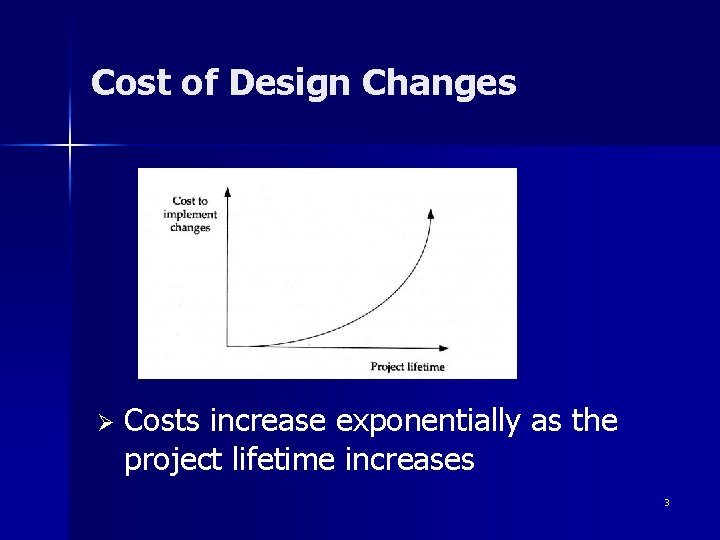
Cost of Design Changes Ø Costs increase exponentially as the project lifetime increases 3
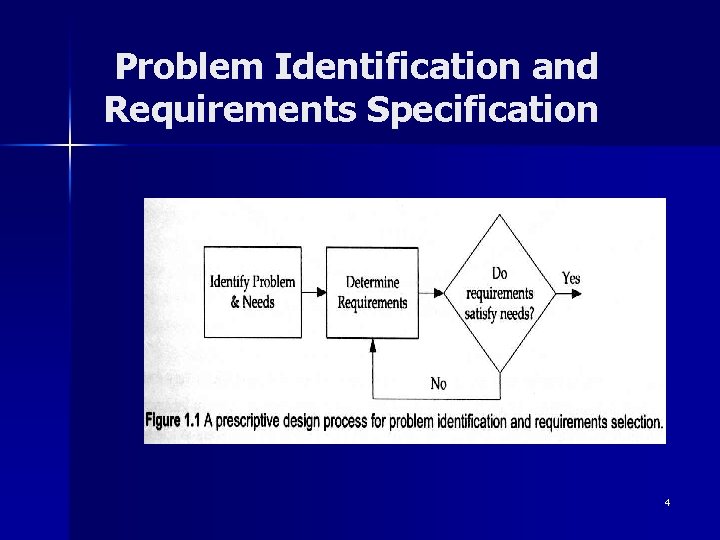
Problem Identification and Requirements Specification 4
Needs Identification Ø What is the Problem? 1. 2. 3. 4. 5. Collect information Interpret information Organize needs hierarchy Determine relative importance of needs Review outcomes and process 5
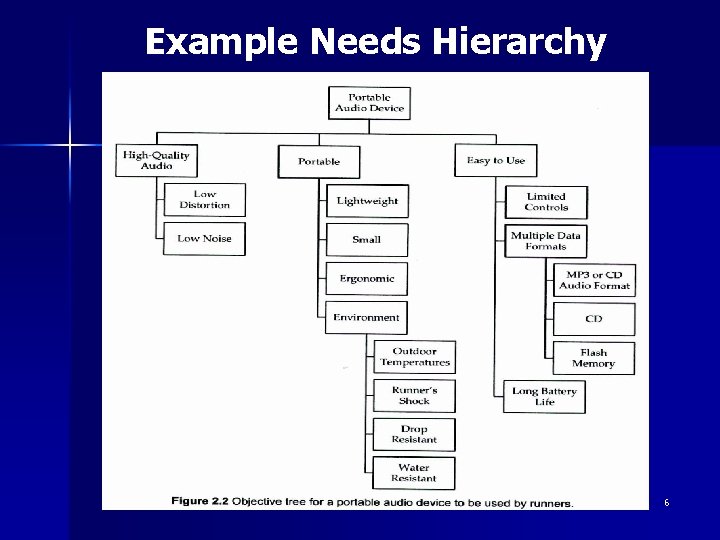
Example Needs Hierarchy 6
Problem Statement n Example 2. 1 Ø Need: Drivers have difficulty seeing obstructions in all directions Ø Objective: design system to avoid accidents 7
Requirements Specification Ø Identifies requirements design must satisfy for success 1. Marketing requirements § Customer needs 2. Engineering requirements § § Applies to technical aspects Performance requirements 8
Properties of Engineering Requirements 1. Abstract – what, not how 2. Unambiguous – unique and specific Ø Unlike marketing requirements 3. Traceable – satisfy need? 4. Verifiable – test/measure 9
Example Engineering Requirements v Performance and Functionality 1. 2. v Reliability 1. 2. v Will identify skin lesions with a 90% accuracy Should be able to measure within 1 mm Operational 99. 9% of the time MTBF of 10 years Energy 1. 2. Average power consumption of 2 watts Peak current draw of 1 amp 10
Constraints Economic Ø Environmental Ø Ethical and Legal Ø Health and Safety Ø Manufacturability Ø Political and Social – FDA, language? Ø Sustainability Ø 11
Standards Examples – RS-232, TCP/IP, USB n Types n Ø Safety Ø Testing Ø Reliability Ø Communications Ø Documentation Ø Programming Languages 12
Concept Generation and Evaluation Ø Explore many solutions § Ø Select the best solution § Ø Based on needs and constraints Creativity § Ø Brainstorm Development of new ideas Innovation § Bringing creative ideas to reality 13
Barriers to Creativity Ø Perceptual blocks • Limiting problem space Ø Emotional blocks • Fear of failure – “fail early and often” Ø Environmental blocks • Engineering cultural bias Ø Intellectual and expressive blocks • Understand tools 14
Strategies to Enhance Creativity Ø Lateral thinking Ø Question Ø Practice Ø Suspend judgment Ø Allow time Ø Think like a beginner 15
Concept Generation Substitute – new elements Ø Combine – existing elements Ø Adapt – different operation Ø Modify – size, shape, function Ø Put to other use – other app domains Ø Eliminate – parts or whole Ø Rearrange or reverse – work better Ø 16
Design Considerations 1) WORST CASE DESIGN Ø Component variation Ø Environmental conditions Ø Use computer simulations 17
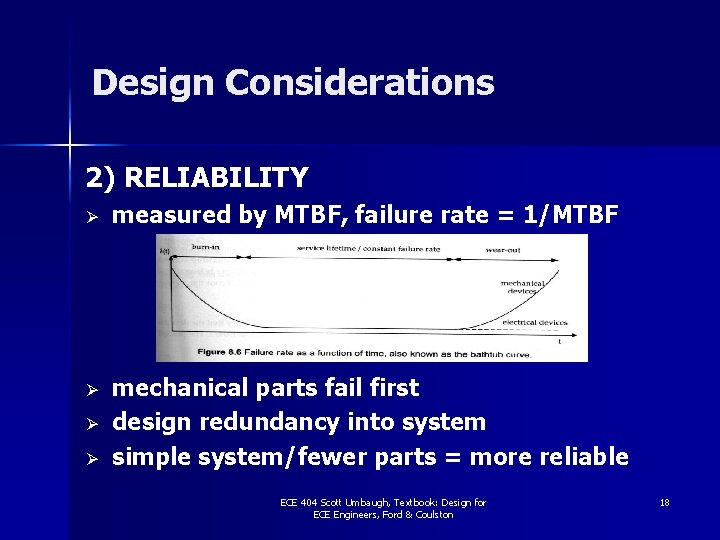
Design Considerations 2) RELIABILITY Ø measured by MTBF, failure rate = 1/MTBF Ø mechanical parts fail first design redundancy into system simple system/fewer parts = more reliable Ø Ø ECE 404 Scott Umbaugh, Textbook: Design for ECE Engineers, Ford & Coulston 18
Design Considerations 3) SAFETY Øidentify failure modes Øprovide protection 4) TEST Ødesign for ease of test 5) PRODUCTION/MANUFACTURING Øconsider ease of assembly ECE 404 Scott Umbaugh, Textbook: Design for ECE Engineers, Ford & Coulston 19
Design Methodologies CASE‑BASED: Ø Ø Research a specific, similar design case study Model your process on that INCREMENTAL REDESIGN: Ø Ø Ø Find an existing design and "unravel" the design from the bottom up Modify as required Detailed and least global aspects of the design are explored and redesigned, if necessary, first 20
Design Methodologies ITERATIVE REFINEMENT: Ø An iterative top‑down approach Ø First a rough, approximate and general design is completed Ø Then we do it finer, more exact and more specific Ø This process continues iteratively until the complete detail design in done 21
Design Methodologies BOTTOM‑UP DESIGN: Ø Opposite of top‑down Ø Start at the bottom with detail design Ø To do this, you must have some idea of where you are going. So, often this becomes. . . HYBRID DESIGN: Ø Combines aspects of both top‑down and bottom‑up Ø More practical design approach then pure top‑down Ø Start with a top‑down approach, but have feedback from the bottom 22
Design Methodologies "EXPLORER" METHOD: Ø Typically used for new design ideas or research. It is useful in initial design and specification stages, and is often used when in "unfamiliar territory": 1) Move in some direction; e. g. toward the library, telephone, domain expert's office, etc. 2) Look at what you find there. 3) Record what you find in your notebook. 4) Analyze findings in terms of where you want to be. 5) Use results of analysis to choose next direction. 6) Back to 1) and continue exploring 23
Design Group (Team) Ø Engineering projects require diverse skills This creates a need for group (team) work Ø Select members based on skills Ø 1. 2. 3. Technical Problem-solving Interpersonal 24
Design Group (Team) Ø Develop decision making guidelines 1. 2. 3. 4. 5. Decision by authority (leader) Expert Member Average member opinion Majority Consensus 25
Design Group (Team) Ø Ø Teams that spend time together tend to be successful teams Respect each other 1. 2. 3. 4. 5. 6. Listen actively Consider your response to others Constructively criticize ideas, not people Respect those not present Communicate your ideas effectively Manage conflict constructively 26
Design Group (Team) Ø Hold effective meetings 1. 2. 3. 4. 5. Have an agenda Show up prepared Pay attention Schedule time and place of next meeting Summarize Ø Assign tasks and responsibilities 27
Project Management Ø Work breakdown structure ü Ø Hierarchical breakdown of tasks and deliverables need to complete project Activity 1. Task – action to accomplish job 2. Deliverable – e. g. circuit or report 28
Project Management Ø Define for each activity 1. 2. 3. 4. 5. 6. Work to be done Timeframe Resources needed Responsible person(s) Previous dependent activities Checkpoints/deliverables for monitoring progress 29
Project Management n Guidelines Ø Project plan after design plan complete Ø Double time estimates and add 10% Ø Assign a lot of integration and test time Ø Remember lead times for parts ordering Ø Assign tasks based on skills and interests Ø Track progress versus plan Ø Plans change 30
Project Communication Focus on needs of specific audience Who? level of knowledge Ø their motivation – needs Why? to persuade to inform 31
Project Proposal • One goal is to sell idea, be persuasive Ø In industry the proposal will show: 1. 2. 3. Product is useful for someone for something The design will work, it will solve the problem Will meet the specified constraints Ø Additionally, in Senior Design, the proposal should show: 1. 2. 3. You are learning something new Sufficiently complex Apply previously learned ECE knowledge 32
- Slides: 32