
The Energy Transition Model A fresh perspective on





- Slides: 14
The Energy Transition Model A fresh perspective on modelling the future of energy Directorate-General Energy and Transport, European Commission March 2009 Quintel Strategy Consulting Atrium - Strawinskylaan 3051 1077 ZX Amsterdam The Netherlands www. arthurdlittle. com
Introduction Quintel developed the Energy Transition Model to mitigate the risk of being precisely wrong when making decisions on the transition to new sources of energy • Society is entering unchartered waters as it is working towards a sustainable energy economy through Energy Transition • Many decision-/policymakers are not aware of the risks of being precisely wrong when predicting Energy Transition and the impact of their decisions – Current models on energy systems (e. g. fuel prices) often fall prey to false precision – Predictions give the impression of being very accurate, when in reality only a low degree of accuracy exists • Decision-makers can no longer afford a modelling approach based on conventional wisdom when dealing with the complex topic of Energy Transition – They must learn to make intelligent decisions based on an understanding of the underlying principles and assumptions • Quintel developed an alternative approach that helps governments and companies make decisions on the future of energy – This approach reveals relations between different energy (transition) issues and stimulates the debate on implicit assumptions and missing information 1
Content 1 The issues with current modelling aids 2 A new approach for evaluating energy transition scenario’s 3 ETM as a complementary aid to the Primes Energy Model 2
The issues with current modelling aids 1 It is has become evident that renowned energy institutes are no longer able to provide reliable forecasts despite their precise modelling approaches Example oil price: Actuals vs. forecasts Generic pitfalls of forecasting • Unknown factors - independent of classic supply-and -demand calculations account for spotty forecasting record (for example geopolitical events, economic crises, uncertainties in reserves) • While prognoses may be accurate during periods of stability, track record is doubtful in periods of change • For example: Assumptions of infinite supplies and rational economic behaviour no longer hold as supplies become finite and behaviour more ‘erratic’ • Governments are still relying on this imperfect science for policy making Typically, complexity is added to forecasting models to capture previously ‘unpredictable’ mechanisms, making it more difficult to understand the results and underlying logic Source: De nieuwe oliecrisis en overheidsbeleid, International Energy Agency, Peakoil Nederland 3
The issues with current modelling aids 1 As models become less transparent, users tend to make decisions based on trial and error rather than on causal reflection and systemic learning Black Box Model Energy Transport Transparent Box Model Energy Transport Input Economic growth ‘Trial and error’ decision making Modelling continuously required to predict effect of changing conditions Economic growth ‘Systemic learning’ decision making Modelling only initially required to understand principles/discuss effects 4
The issues with current modelling aids 1 It is questionable whether current modelling aids will be helpful in supporting decision making on Energy Transition Adoption of new technologies difficult to estimate Pricing of fossil fuels less predictable as supplies become finite and demand unstable Demand Q curve Supply curve Q Today Time P ‘New energy’ difficult to model due to immature supply market and unknown switching behaviour of users Q Demand curve Supply curve ? ? P 5
Content 1 The risk of being precisely wrong 2 scenarios A new approach for evaluating energy transition scenario’s 3 ETM as a complementary aid to the Primes Energy Model 6
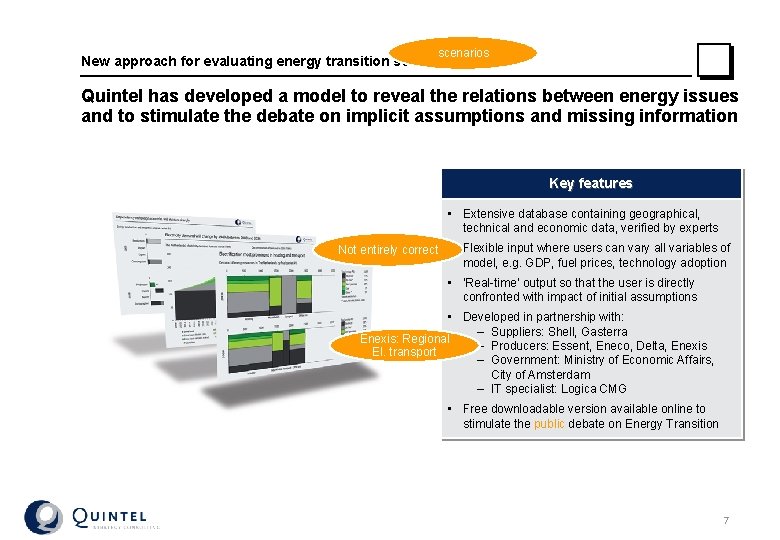
scenarios New approach for evaluating energy transition scenario’s 2 Quintel has developed a model to reveal the relations between energy issues and to stimulate the debate on implicit assumptions and missing information Key features • Extensive database containing geographical, technical and economic data, verified by experts Not entirely correct • Flexible input where users can vary all variables of model, e. g. GDP, fuel prices, technology adoption • ‘Real-time’ output so that the user is directly confronted with impact of initial assumptions • Developed in partnership with: – Suppliers: Shell, Gasterra Enexis: Regional – Producers: Essent, Eneco, Delta, Enexis El. transport – Government: Ministry of Economic Affairs, City of Amsterdam – IT specialist: Logica CMG • Free downloadable version available online to stimulate the public debate on Energy Transition 7
scenarios New approach for evaluating energy transition scenario’s 2 Due to its unique interactive features, it helps decision makers gain insight on the challenges of energy transition and confirm/negate key assumptions Initial output of ETM model User input on key assumptions Output of ETM model with new assumptions Pijltjes maken sliders minder goed zichtbaar 8
scenarios New approach for evaluating energy transition scenario’s 2 Despite differences in underlying assumptions, experts from participating companies and government agree on a number of key points • The model has been tested numerous times in scenario planning sessions with energy experts across industry and government 1 e bullet was • eitelijk juist, tot blicatie van CBS die gisteren uitkwam: duurzaam % eemt weer toe Although opinions on some key assumptions vary greatly, experts from participating companies and government agree that: – Dutch energy supply is becoming less sustainable and increasingly dependent on import from other countries at the moment – The Netherlands should invest in smart energy conservation, more wind energy and biomass and the right mix of fossil fuels – Focus should be on developing long term relationships and mutual dependency between the Netherlands and energy-exporting countries – Investing in new energy infrastructures seems a good way to ease the current economic crisis and will help to keep energy supply in the Netherlands both sustainable and affordable in the long run 9
Content 1 The risk of being precisely wrong 2 A new approach for evaluating energy transition scenario’s 3 Introduce ‘ETM’ phrase ETM as a complementary aid to the Primes Energy Model 10
ETM as a complementary aid to the Primes Energy Model 3 In the past the Commission has relied on the state of the art PRIMES energy system model to support decision making on key energy policies Initial view on pros and cons to be validated with European Commission • An energy policy markets analysis tool including relationships between policy and technology • Behavioural, price driven model assuming that producers and consumers respond to changes in price influenced by policy and technology changes Input: + Detailed scenario’s incl. price projections, policies, . . – Small number of pre-defined scenario’s + Data comprises EU, candidates and selected neighbouring countries • Built by the National Technical University of Athens with help of EU subcontractors/service providers Model: – Black box model for decision maker • Started in 1993 and continuously improving Output: -+ + Precise prediction on impact of policy instruments on energy market, but is it correct? – Less helpful for determining preferred mix of energy sources • Examples of applications: – 1997: Evaluation of EC policies for Kyoto 1999: EU Energy & Emissions Outlook – 2003/5/7: European energy & transport trends to 2030 11
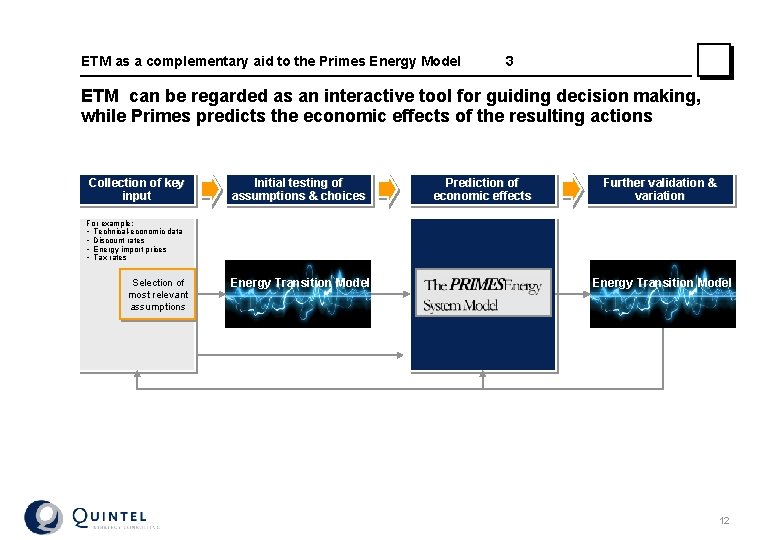
ETM as a complementary aid to the Primes Energy Model 3 ETM can be regarded as an interactive tool for guiding decision making, while Primes predicts the economic effects of the resulting actions Collection of key input Initial testing of assumptions & choices Prediction of economic effects Further validation & variation For example: • Technical-economic data • Discount rates • Energy import prices • Tax rates Selection of most relevant assumptions Energy Transition Model 12
ETM as a complementary aid to the Primes Energy Model 3 Suggested next steps • Incorporate all EU countries and neighbouring countries in ETM model • Modify ETM and Primes models to ensure consistency • Conduct pilot project (probably on a subset of EU countries) • . . 13