
The Energy of Waves Section 1 The Nature

- Slides: 20
The Energy of Waves Section 1: The Nature of Waves
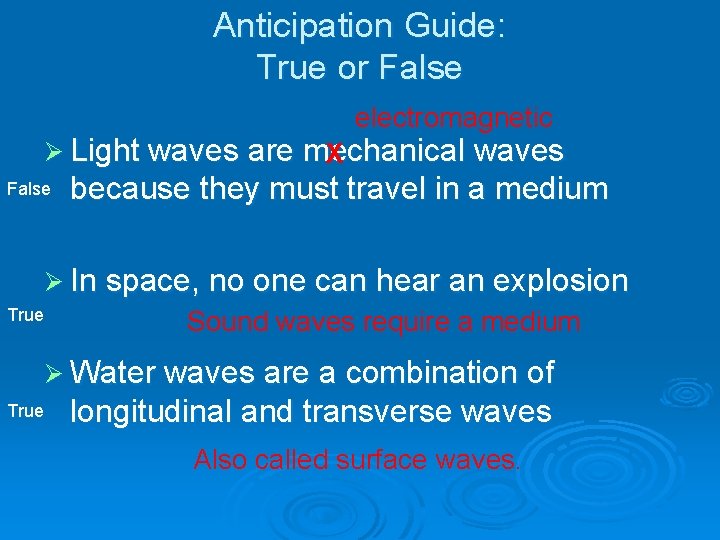
Anticipation Guide: True or False Ø Light waves are mechanical waves because they must travel in a medium Ø In space, no one can hear an explosion Ø Water waves are a combination of longitudinal and transverse waves
What is a wave? Ø Definition: A wave is any disturbance that transmits energy through matter or space.
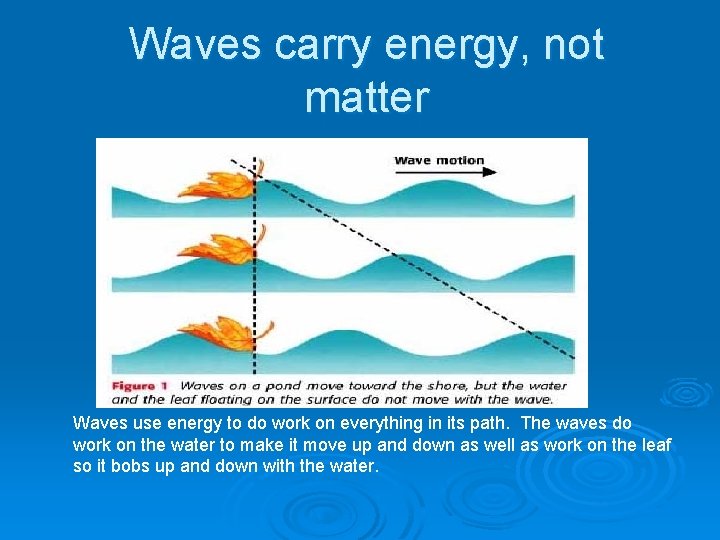
Waves carry energy, not matter Waves use energy to do work on everything in its path. The waves do work on the water to make it move up and down as well as work on the leaf so it bobs up and down with the water.
Energy transfer through a medium Ø a wave can be described as a disturbance that travels through a medium, transporting energy from one location to another location. Ø The medium is simply the material through which the disturbance is moving; it can be thought of as a series of interacting particles.
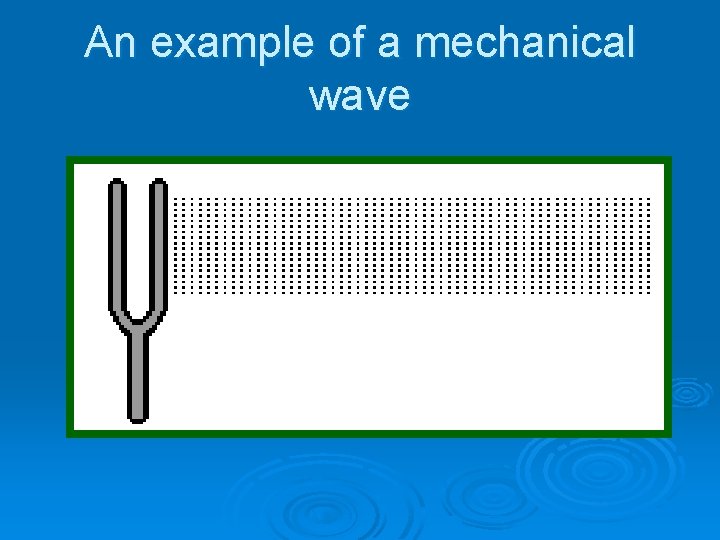
Mechanical waves require a medium Ø Sound waves require a medium Ø Ocean waves require a medium Ø Waves medium on a string instrument require a Ø A mechanical wave is a wave which is not capable of transmitting its energy through a vacuum. In other words, it requires a medium
An example of a mechanical wave
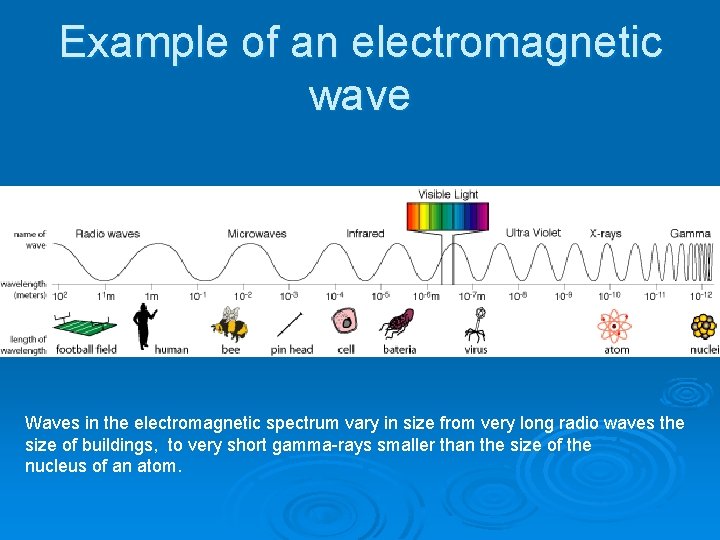
Energy transfer without a medium Ø Electromagnetic waves are waves that do not require a medium to transmit energy Ø Examples of these are microwaves, TV, xrays, and radio signals Ø While these types of waves can travel through a medium, they travel faster through empty space
Example of an electromagnetic wave Waves in the electromagnetic spectrum vary in size from very long radio waves the size of buildings, to very short gamma-rays smaller than the size of the nucleus of an atom.
Types of Waves Ø Waves can be classified based on the direction that the particles of the medium vibrate compared to the direction in which the waves travel. Ø The two main types of these waves are transverse and longitudinal. If found in combination is called a surface wave.
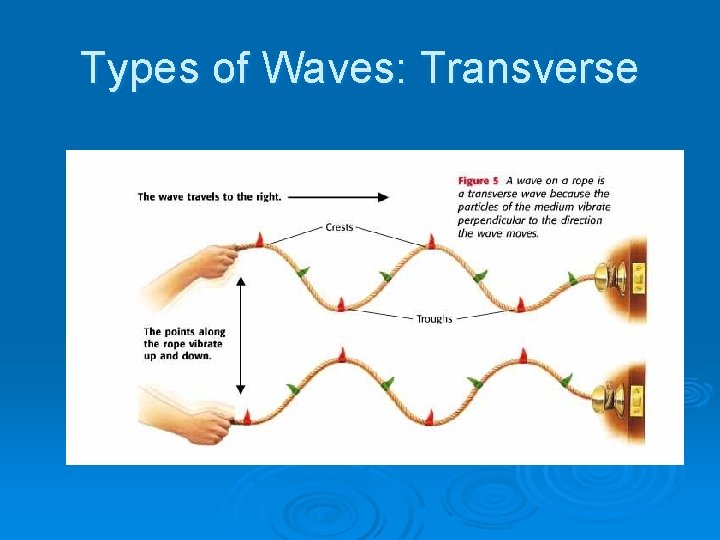
Types of Waves: Transverse Ø Transverse waves have particles that vibrate in an up and down motion moving the waves across in a perpendicular manner to which the wave is traveling Ø Remember that perpendicular means to be at right angles Ø A rope is an example of a transverse wave.
Types of Waves: Transverse
Types of Waves: Transverse Demonstration
Types of Waves: Longitudinal Ø A longitudinal wave has particles that vibrate back and forth along the same path that the wave travels. Ø A spring (or slinky) is an example of a longitudinal wave
Types of Waves: Longitudinal Ø Compression is when the spring is (particles are) tightly pushed together Ø Refraction is when the coils (particles) are spread farther apart. Ø A sound wave is an example.
Types of Waves: Longitudinal Demonstration
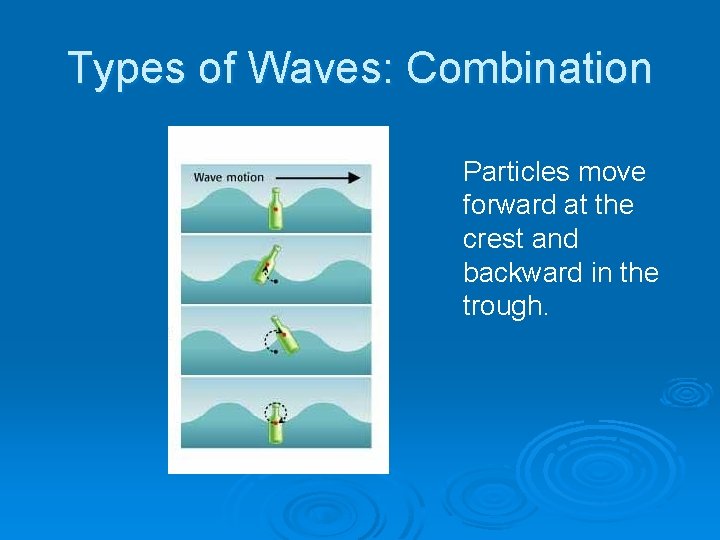
Types of Waves: Combination Ø When waves occur at or near the boundary between two media (air and water for example) transverse wave and a longitudinal wave can combine to form a surface wave. Ø Surface waves look like transverse waves but the particles in the medium move in circles rather than up and down.
Types of Waves: Combination Particles move forward at the crest and backward in the trough.
Anticipation Guide: True or False electromagnetic Ø Light waves are mechanical waves X False because they must travel in a medium Ø In space, no one can hear an explosion True Sound waves require a medium Ø Water waves are a combination of True longitudinal and transverse waves Also called surface waves.