
THE ENERGY OF WAVES REVIEW 1 A wave
- Slides: 14
THE ENERGY OF WAVES REVIEW
1. A wave can make a leaf bob up and down on the water, but it cannot move the leaf toward the shore. This is because waves only transfer a. matter. b. energy. c. media. d. crests.
2. Which of these waves do NOT require a medium? a. ocean waves b. seismic waves c. sound waves d. radio waves
3. Which of the following is NOT a property of a wave? a. refraction b. amplitude c. frequency d. wavelength
4. When two objects, such as marimba bars and columns, vibrate at the same frequency, this occurs. a. refraction b. reflection c. resonance d. amplitude
5. If a wave is traveling at a certain speed and you cut its frequency in half, what would happen to its wavelength? a. The wavelength would be halved. b. The wavelength would produce a standing wave. c. The wavelength would remain the same. d. The wavelength would be doubled.
6. How do waves transfer energy? a. through ocean waves b. by the vibration of particles in a medium c. through compression d. by a combination of waves
7. A section of a longitudinal wave where the particles are crowded together is called a a. rarefaction. b. compression. c. vibration d. surface wave.
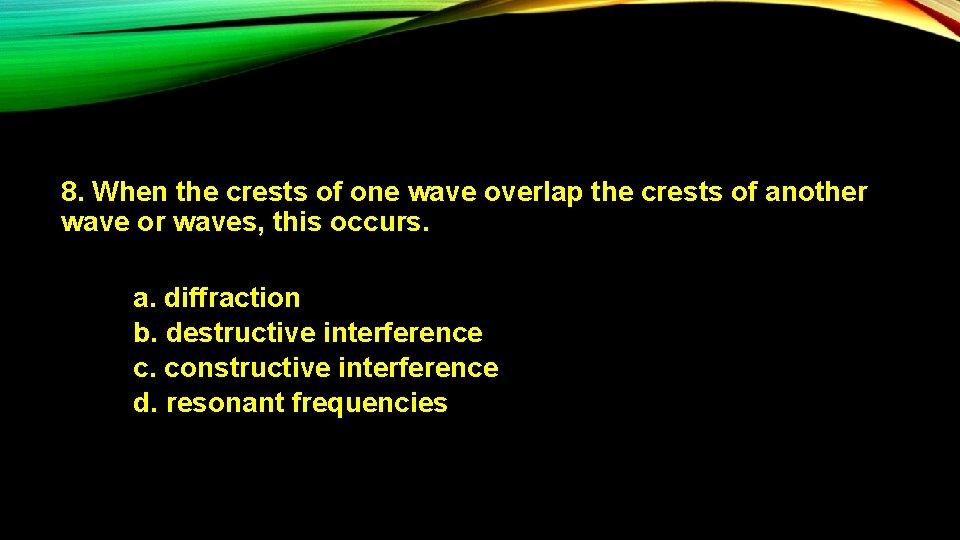
8. When the crests of one wave overlap the crests of another wave or waves, this occurs. a. diffraction b. destructive interference c. constructive interference d. resonant frequencies
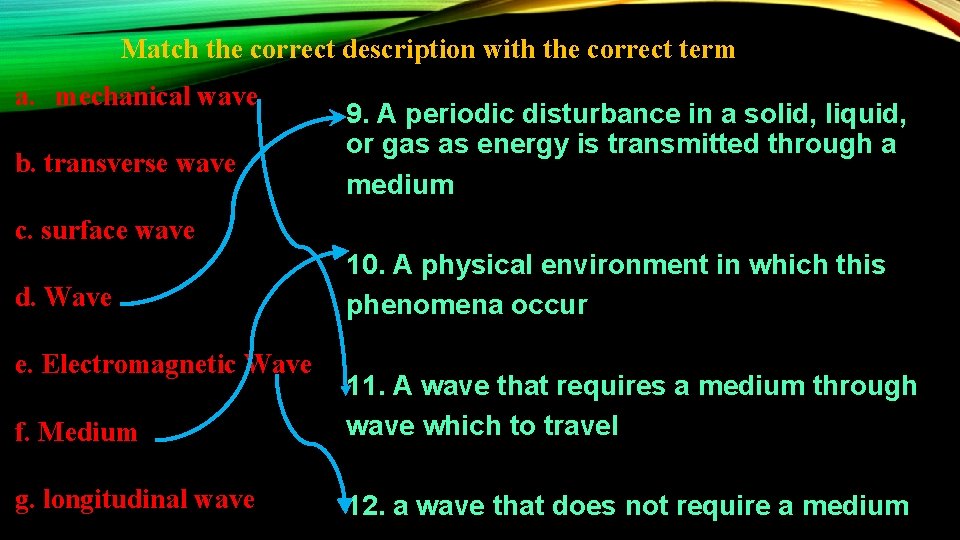
Match the correct description with the correct term a. mechanical wave b. transverse wave 9. A periodic disturbance in a solid, liquid, or gas as energy is transmitted through a medium c. surface wave d. Wave e. Electromagnetic Wave 10. A physical environment in which this phenomena occur f. Medium 11. A wave that requires a medium through wave which to travel g. longitudinal wave 12. a wave that does not require a medium
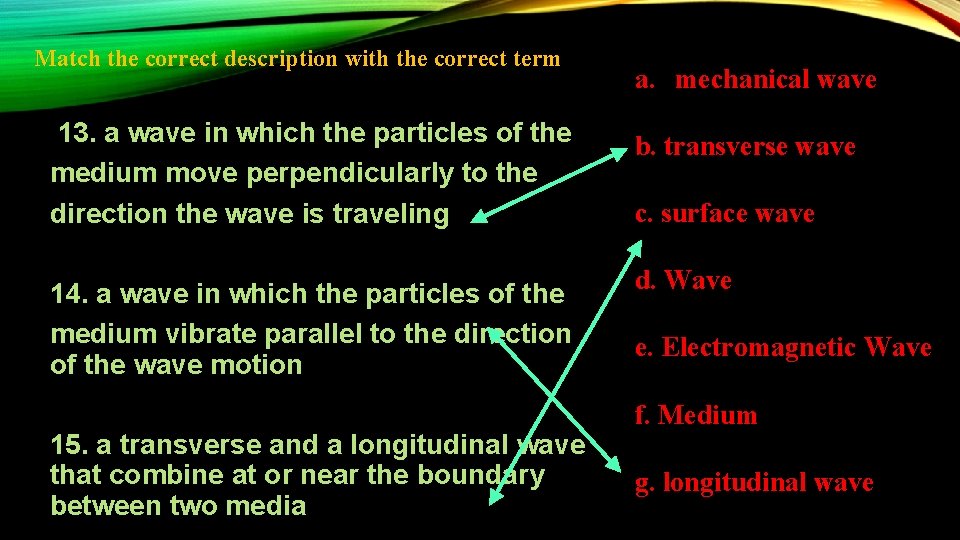
Match the correct description with the correct term a. mechanical wave 13. a wave in which the particles of the medium move perpendicularly to the direction the wave is traveling b. transverse wave 14. a wave in which the particles of the medium vibrate parallel to the direction of the wave motion d. Wave 15. a transverse and a longitudinal wave that combine at or near the boundary between two media c. surface wave e. Electromagnetic Wave f. Medium g. longitudinal wave
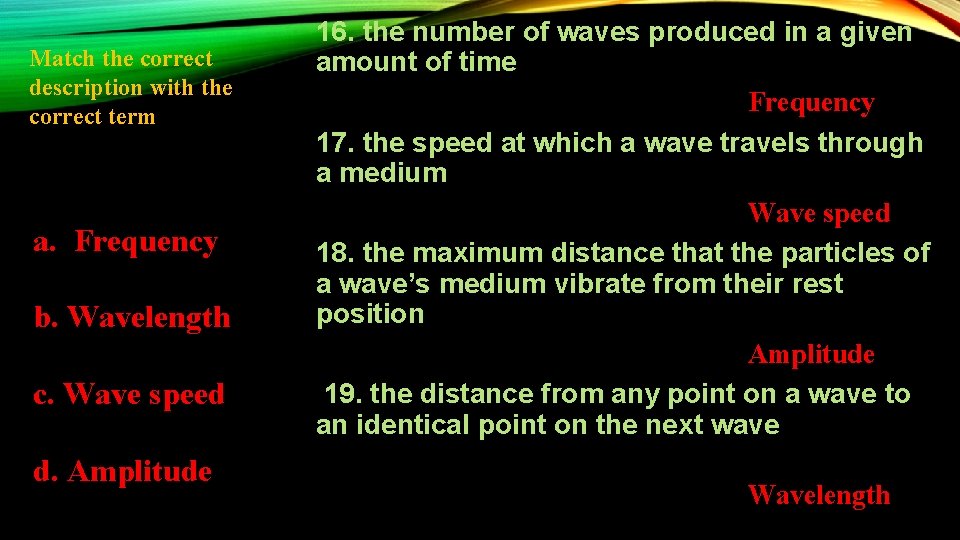
Match the correct description with the correct term a. Frequency b. Wavelength c. Wave speed d. Amplitude 16. the number of waves produced in a given amount of time Frequency 17. the speed at which a wave travels through a medium Wave speed 18. the maximum distance that the particles of a wave’s medium vibrate from their rest position Amplitude 19. the distance from any point on a wave to an identical point on the next wave Wavelength
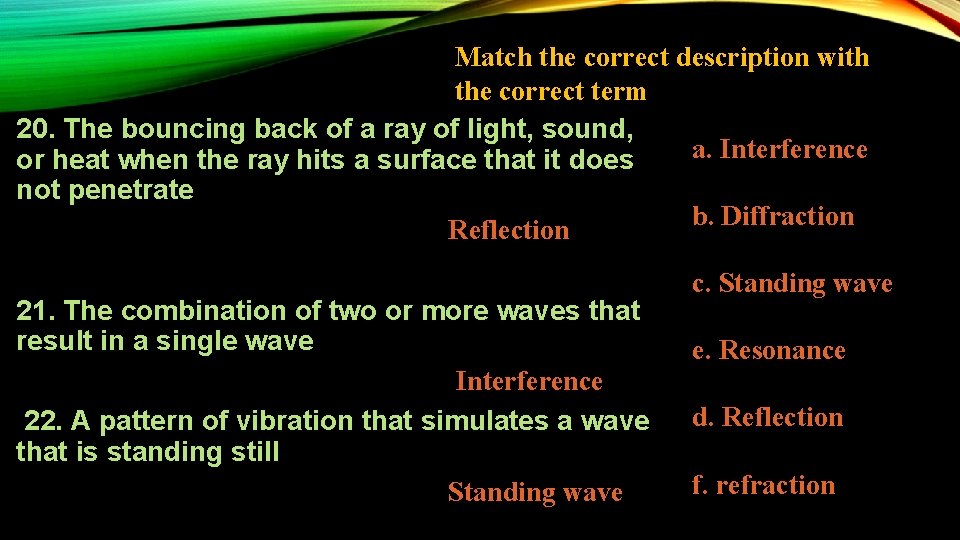
Match the correct description with the correct term 20. The bouncing back of a ray of light, sound, a. Interference or heat when the ray hits a surface that it does not penetrate b. Diffraction Reflection 21. The combination of two or more waves that result in a single wave Interference 22. A pattern of vibration that simulates a wave that is standing still Standing wave c. Standing wave e. Resonance d. Reflection f. refraction
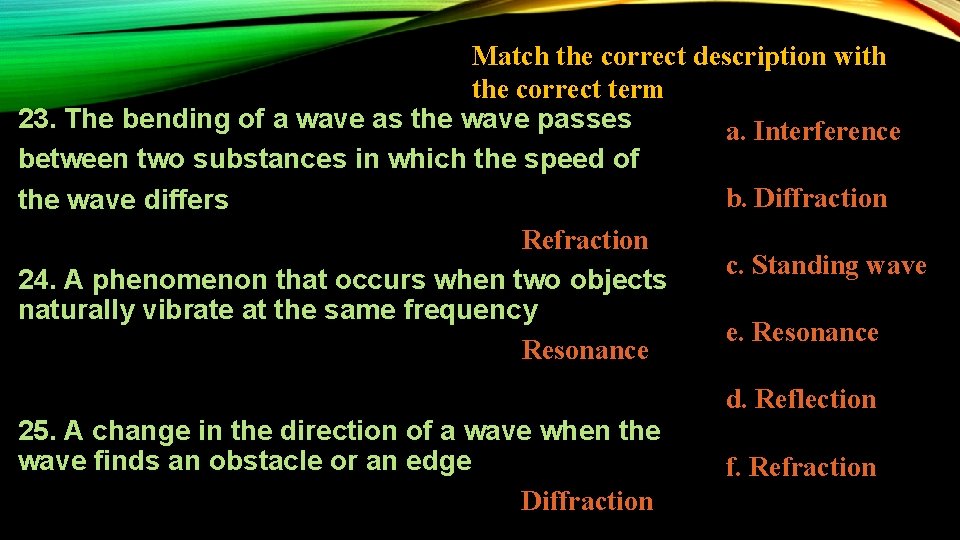
Match the correct description with the correct term 23. The bending of a wave as the wave passes a. Interference between two substances in which the speed of b. Diffraction the wave differs Refraction c. Standing wave 24. A phenomenon that occurs when two objects naturally vibrate at the same frequency e. Resonance d. Reflection 25. A change in the direction of a wave when the wave finds an obstacle or an edge Diffraction f. Refraction