
The Energy Conversion Process of Photosynthesis Chloroplasts The

- Slides: 53
The Energy Conversion Process of Photosynthesis
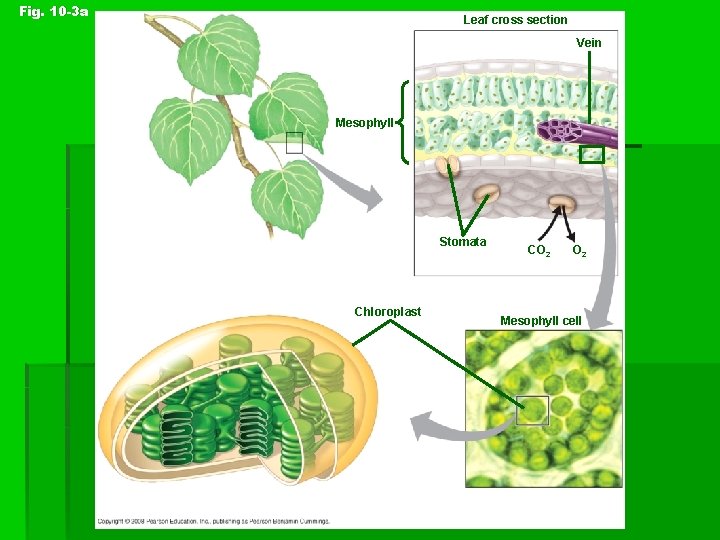
Chloroplasts: The Sites of Photosynthesis in Plants § Leaves are the major locations of photosynthesis § Their green color is from chlorophyll, the green pigment within chloroplasts § Light energy absorbed by chlorophyll drives the synthesis of organic molecules in the chloroplast § CO 2 enters and O 2 exits the leaf through microscopic pores called stomata Copyright © 2008 Pearson Education, Inc. , publishing as Pearson Benjamin Cummings
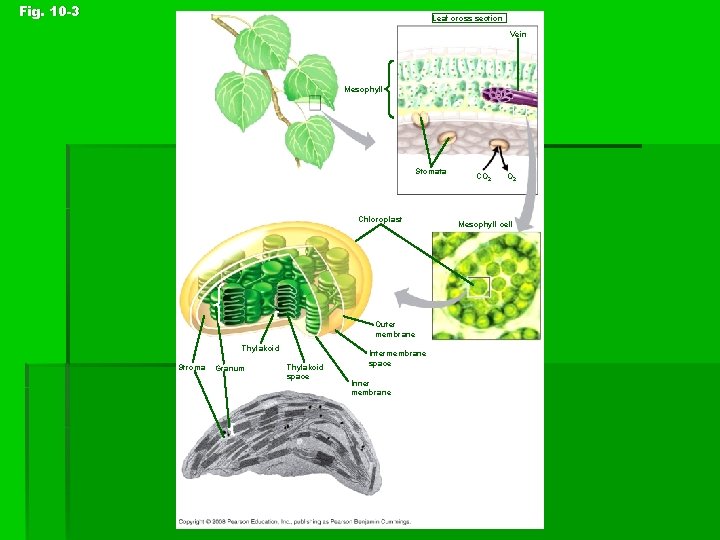
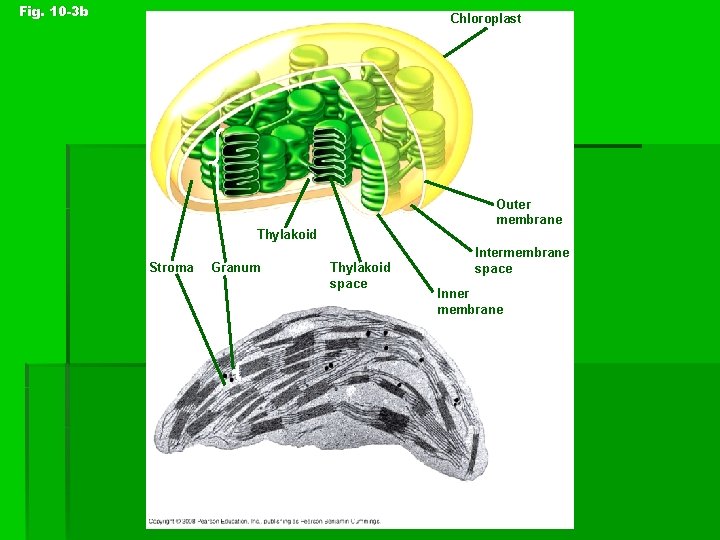
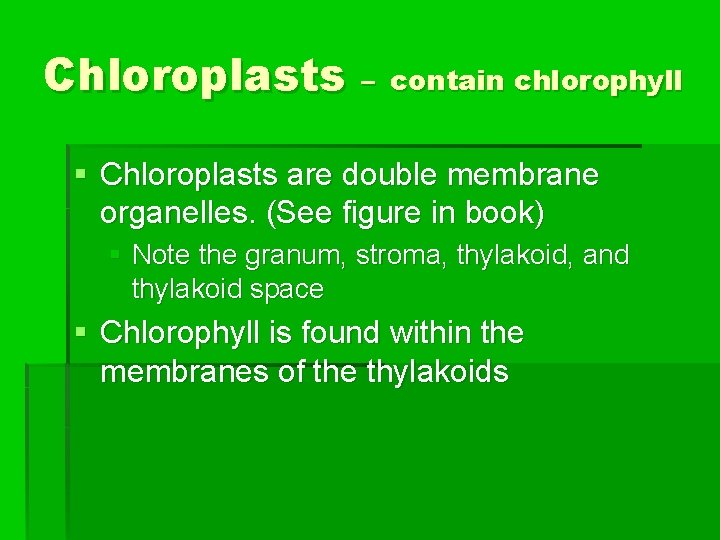
§ Chloroplasts are found mainly in cells of the mesophyll, the interior tissue of the leaf § A typical mesophyll cell has 30– 40 chloroplasts § The chlorophyll is in the membranes of thylakoids (connected sacs in the chloroplast); thylakoids may be stacked in columns called grana § Chloroplasts also contain stroma, a dense fluid Copyright © 2008 Pearson Education, Inc. , publishing as Pearson Benjamin Cummings
Fig. 10 -3 Leaf cross section Vein Mesophyll Stomata Chloroplast CO 2 Mesophyll cell Outer membrane Thylakoid Stroma Granum Thylakoid space Intermembrane space Inner membrane 1 µm 5 µm
Fig. 10 -3 a Leaf cross section Vein Mesophyll Stomata Chloroplast CO 2 Mesophyll cell 5 µm
Fig. 10 -3 b Chloroplast Outer membrane Thylakoid Stroma Granum Thylakoid space Intermembrane space Inner membrane 1 µm
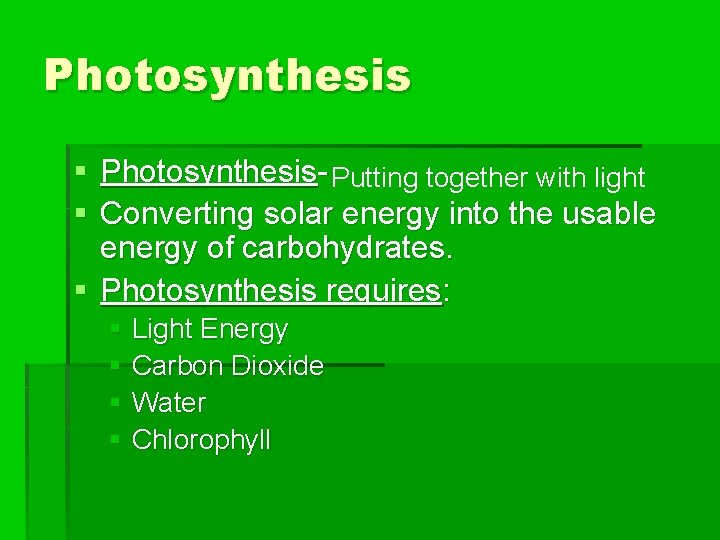
Photosynthesis § Photosynthesis- Putting together with light § Converting solar energy into the usable energy of carbohydrates. § Photosynthesis requires: § Light Energy § Carbon Dioxide § Water § Chlorophyll
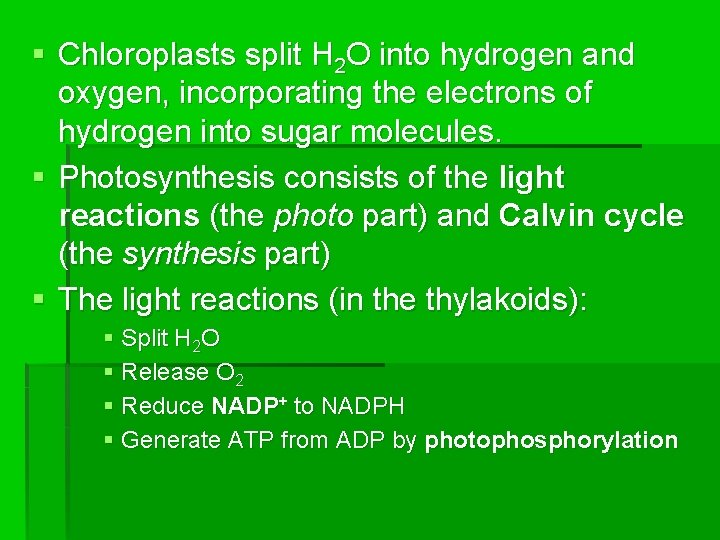
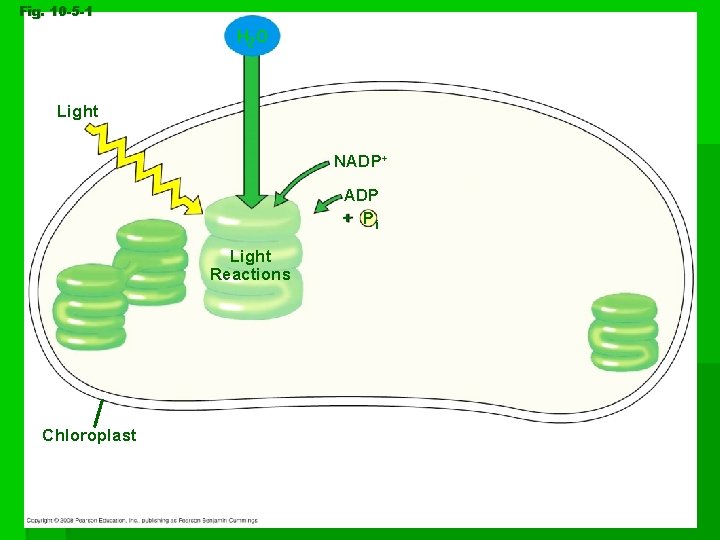
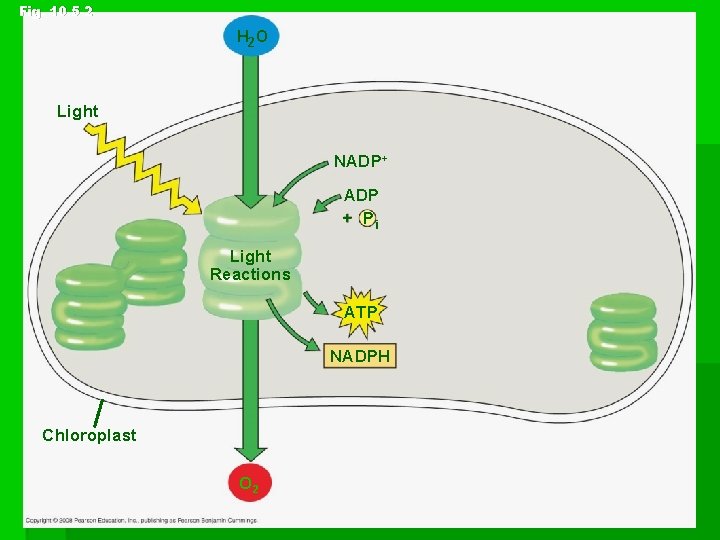
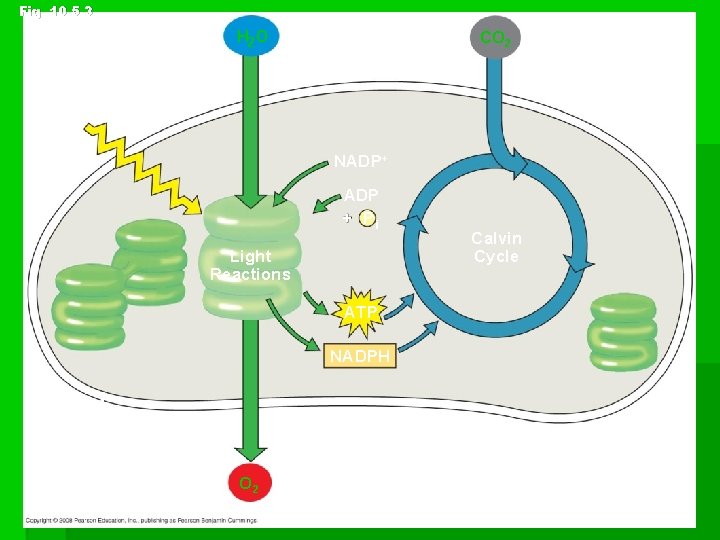
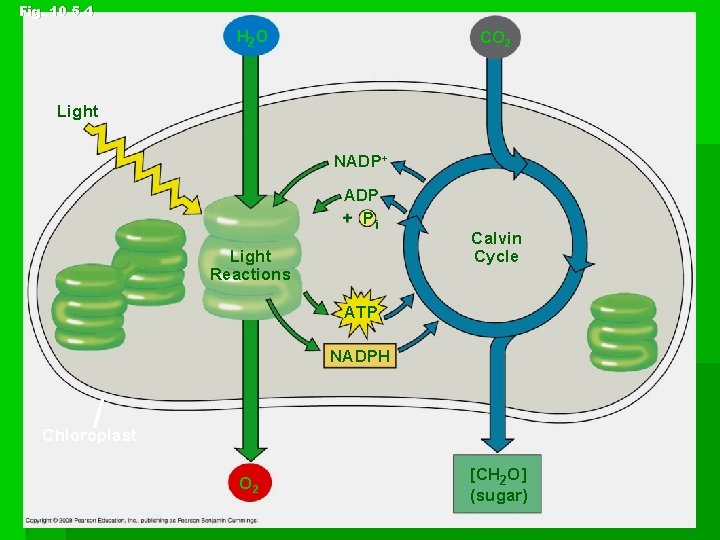
§ Chloroplasts split H 2 O into hydrogen and oxygen, incorporating the electrons of hydrogen into sugar molecules. § Photosynthesis consists of the light reactions (the photo part) and Calvin cycle (the synthesis part) § The light reactions (in the thylakoids): § Split H 2 O § Release O 2 § Reduce NADP+ to NADPH § Generate ATP from ADP by photophosphorylation
Light Energy § Photon- packets of Energy § Light travels in waves and is a type of radiation § Short wave length radiation has high energy photons § Long wave length radiation has lower energy photons
Light Energy § Photons of visible light have enough energy to raise electrons to higher levels of energy which is needed for photosynthesis. § Visible light energy is absorbed by plants to produce sugar. (C 6 H 12 O 6) § Chlorophyll is the substance that absorbs light energy.
Pop Quiz § 1. In your own words, define photosynthesis § 2. In your own words, define cellular respiration. § 3. What is ATP § 4. How is ATP generated or made? § 5. Which bond in ATP is loaded with energy?
Chlorophyll (borophyll) § Two Types of Chlorophyll § Chlorophyll A § Chlorophyll B } Both absorb violet, blue, and red light. Because green is only minimally absorbed, the leaf appears green. The green light is reflected off of the leaf. § Carotenoids § Other pigments that are yellow-orange in plants which absorb violets, blues, and greens. As chlorophyll A and B breakdown they become more noticeable, especially during the fall.
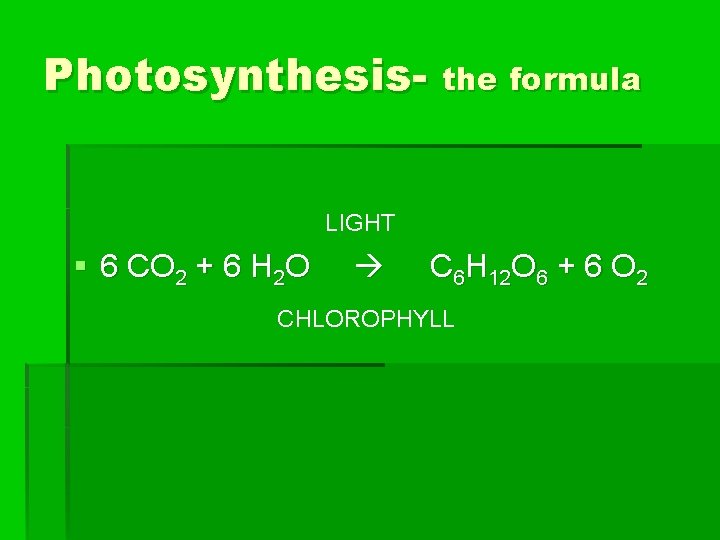
Photosynthesis- the formula LIGHT § 6 CO 2 + 6 H 2 O C 6 H 12 O 6 + 6 O 2 CHLOROPHYLL
Fig. 10 -5 -1 H 2 O Light NADP+ ADP + Pi Light Reactions Chloroplast
Fig. 10 -5 -2 H 2 O Light NADP+ ADP + Pi Light Reactions ATP NADPH Chloroplast O 2
Fig. 10 -5 -3 CO 2 H 2 O Light NADP+ ADP + Pi Light Reactions ATP NADPH Chloroplast O 2 Calvin Cycle
Chloroplasts – contain chlorophyll § Chloroplasts are double membrane organelles. (See figure in book) § Note the granum, stroma, thylakoid, and thylakoid space § Chlorophyll is found within the membranes of the thylakoids
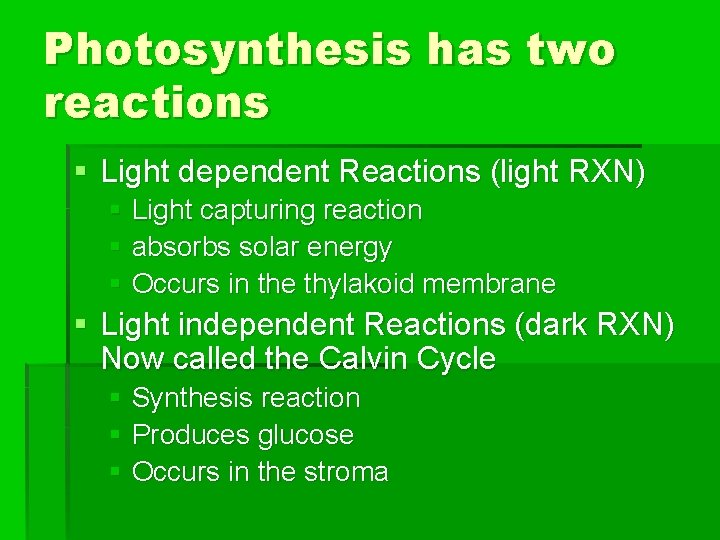
Photosynthesis has two reactions § Light dependent Reactions (light RXN) § Light capturing reaction § absorbs solar energy § Occurs in the thylakoid membrane § Light independent Reactions (dark RXN) Now called the Calvin Cycle § Synthesis reaction § Produces glucose § Occurs in the stroma
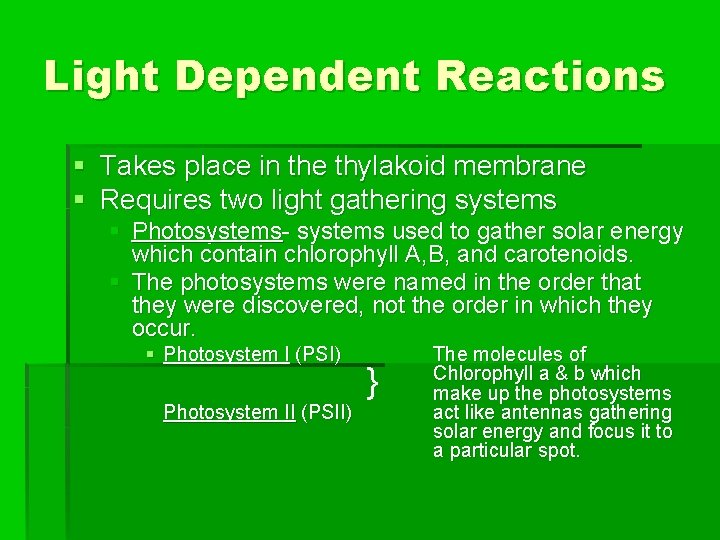
Light Dependent Reactions § Takes place in the thylakoid membrane § Requires two light gathering systems § Photosystems- systems used to gather solar energy which contain chlorophyll A, B, and carotenoids. § The photosystems were named in the order that they were discovered, not the order in which they occur. § Photosystem I (PSI) Photosystem II (PSII) } The molecules of Chlorophyll a & b which make up the photosystems act like antennas gathering solar energy and focus it to a particular spot.
Fig. 10 -5 -4 CO 2 H 2 O Light NADP+ ADP + Pi Light Reactions Calvin Cycle ATP NADPH Chloroplast O 2 [CH 2 O] (sugar)
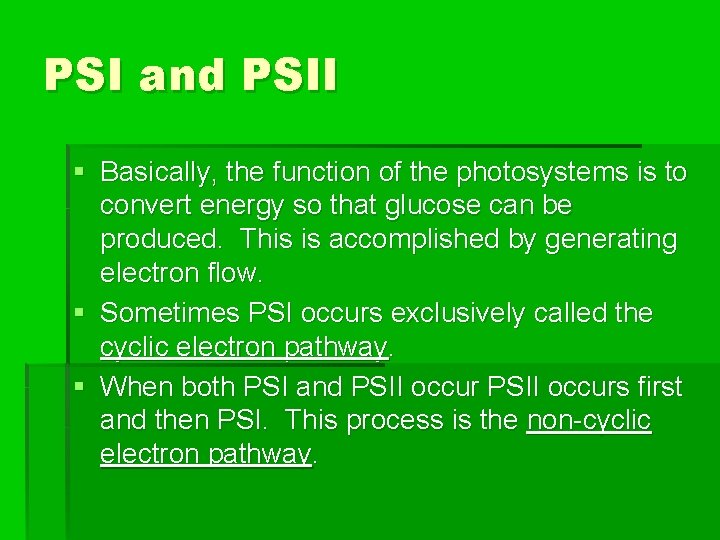
PSI and PSII § Basically, the function of the photosystems is to convert energy so that glucose can be produced. This is accomplished by generating electron flow. § Sometimes PSI occurs exclusively called the cyclic electron pathway. § When both PSI and PSII occurs first and then PSI. This process is the non-cyclic electron pathway.
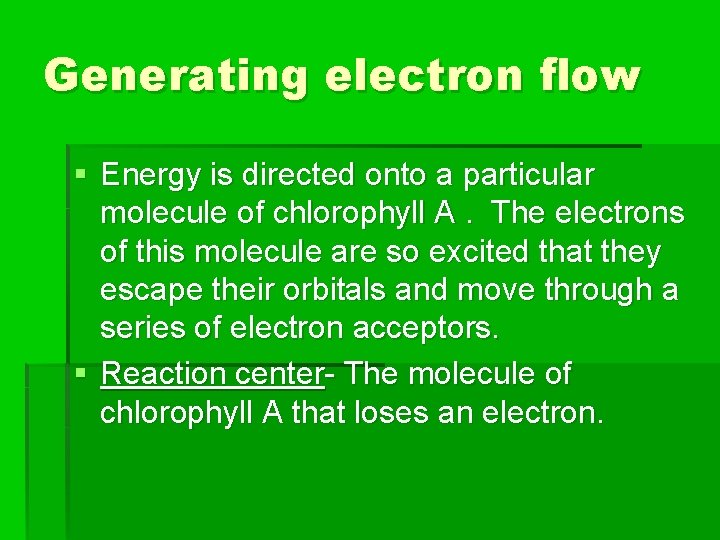
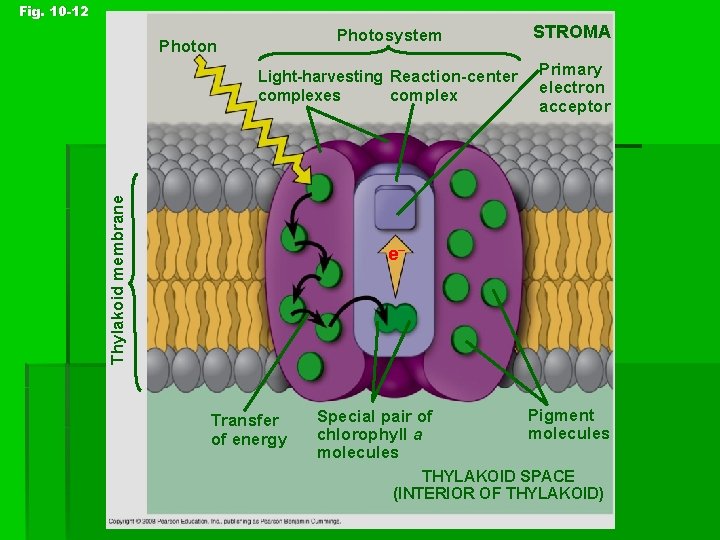
Generating electron flow § Energy is directed onto a particular molecule of chlorophyll A. The electrons of this molecule are so excited that they escape their orbitals and move through a series of electron acceptors. § Reaction center- The molecule of chlorophyll A that loses an electron.
Fig. 10 -12 Photosystem STROMA Light-harvesting Reaction-center complexes Primary electron acceptor Thylakoid membrane Photon e– Transfer of energy Special pair of chlorophyll a molecules Pigment molecules THYLAKOID SPACE (INTERIOR OF THYLAKOID)
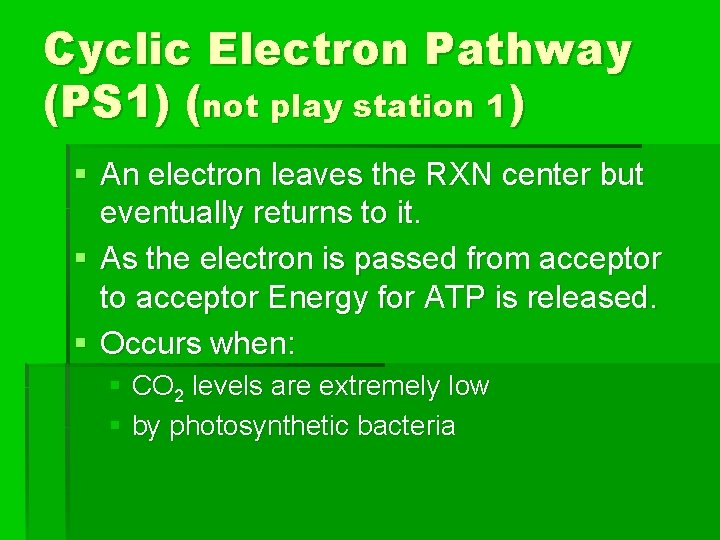
Cyclic Electron Pathway (PS 1) (not play station 1) § An electron leaves the RXN center but eventually returns to it. § As the electron is passed from acceptor to acceptor Energy for ATP is released. § Occurs when: § CO 2 levels are extremely low § by photosynthetic bacteria
Cyclic pathway – PS 1 (cont. ) § § Does not produce NADPH Produces ONLY ATP Probably first to evolve, Because CO 2 levels are low no glucose is produced and the organism must survive on the small amount of ATP that is generated
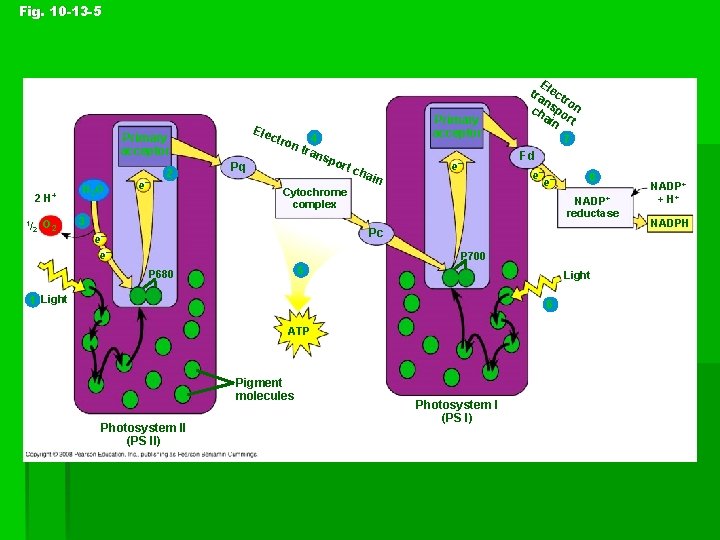
Non-cyclic Pathway (PS 2) (not play station 2) § Water is split and an electron enters PSII § Causes the reaction center to lose an electron and travel through a series of electron acceptors. § As the electron is passed along ATP is generated. This ATP will be used in the Light independent reactions § The electron then enters PSI which during the non-cyclic pathway produces the molecule NADPH instead of ATP.
Non-cyclic (cont. ) § The products of the non-cyclic pathway, NADPH and ATP, enter the Stroma § NADP is one of several biological molecules that act as an electron carrier. § In the stroma, the light independent reactions occur. § The splitting of water results in a H ion (which is basically an electron) and O which is released from the leaf as a waste product.
Fig. 10 -13 -5 Ele c Primary acceptor 2 H+ + 1/ O 2 2 H 2 O e– 2 tron Pq Primary acceptor 4 tran spo rt c hai e– n Cytochrome complex 3 E tra lect n ro ch spo n ain rt 7 Fd e– e– 8 NADP+ reductase Pc e– e– P 700 5 P 680 Light 1 Light 6 ATP Pigment molecules Photosystem II (PS II) Photosystem I (PS I) NADP+ + H+ NADPH
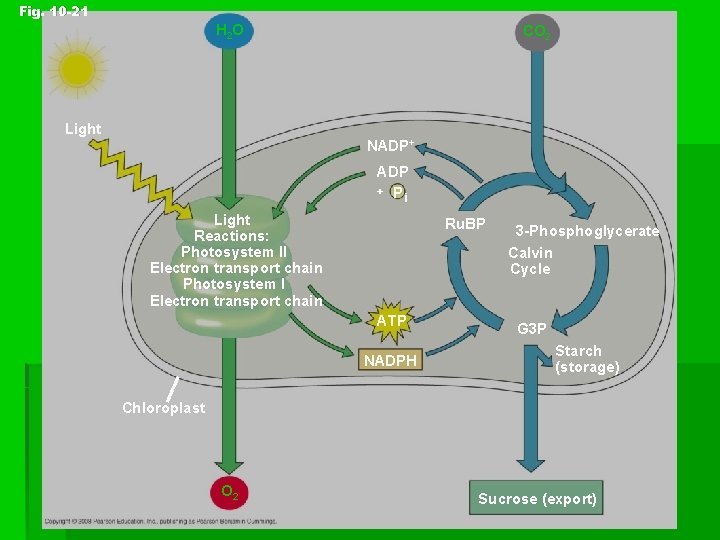
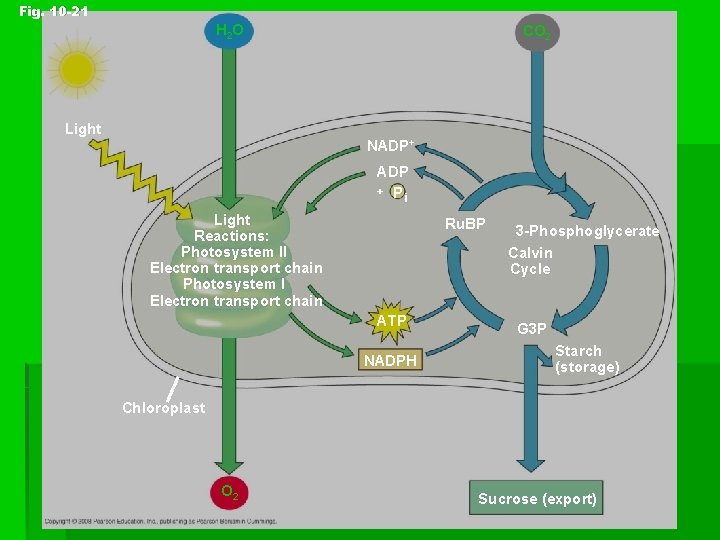
Fig. 10 -21 H 2 O CO 2 Light NADP+ ADP + P i Light Reactions: Photosystem II Electron transport chain Photosystem I Electron transport chain Ru. BP ATP NADPH 3 -Phosphoglycerate Calvin Cycle G 3 P Starch (storage) Chloroplast O 2 Sucrose (export)
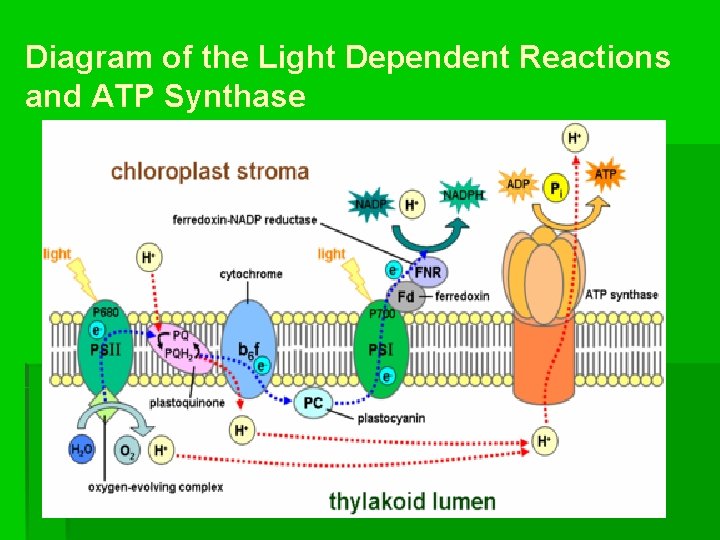
Photophosphorylation § Occurs when ATP is generated using photosynthesis. § Photophosphorylation occurs because of severe differences in the concentration of H+ ions inside thylakoid space compared to the stroma. § The movement of ions allows for a phosphate to be added to ADP.
Diagram of the Light Dependent Reactions and ATP Synthase
Quiz 1. How is the cyclic pathway different than the non-cyclic pathway? 2. In the non-cyclic pathway, what produces ATP? 3. In the non-cyclic pathway, what produces NADPH? 4. What is the role of NADPH?
Light Independent Reactions AKA- Calvin Cycle (The Dark RXN) § The products of the light dependent reactions are NADPH and ATP. § Both are used in the light independent reactions. § The actual process of producing glucose during the light independent RXN is called the Calvin Cycle.
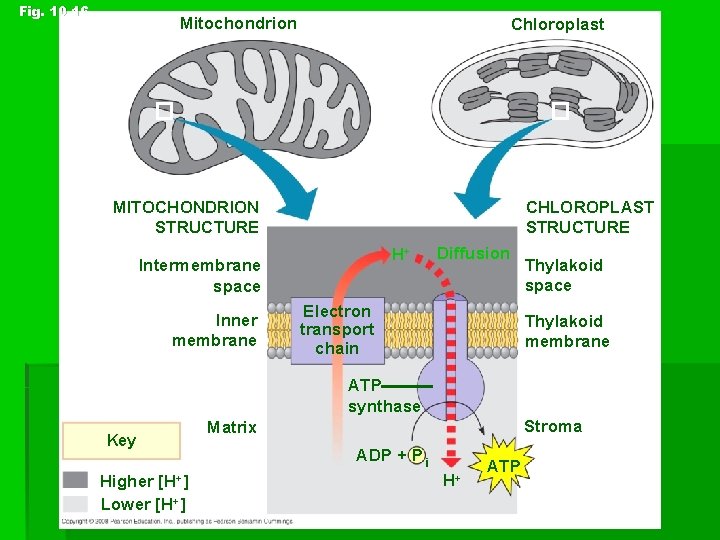
A Comparison of Chemiosmosis in Chloroplasts and Mitochondria § Chloroplasts and mitochondria generate ATP by chemiosmosis, but use different sources of energy § Mitochondria transfer chemical energy from food to ATP; chloroplasts transform light energy into the chemical energy of ATP § Spatial organization of chemiosmosis differs between chloroplasts and mitochondria but also shows similarities
§ In mitochondria, protons are pumped to the intermembrane space and drive ATP synthesis as they diffuse back into the mitochondrial matrix § In chloroplasts, protons are pumped into the thylakoid space and drive ATP synthesis as they diffuse back into the stroma
Fig. 10 -16 Mitochondrion Chloroplast MITOCHONDRION STRUCTURE CHLOROPLAST STRUCTURE H+ Intermembrane space Inner membrane Diffusion Electron transport chain Thylakoid space Thylakoid membrane ATP synthase Stroma Matrix Key ADP + P i [H+] Higher Lower [H+] H+ ATP
§ In summary, light reactions generate ATP and increase the potential energy of electrons by moving them from H 2 O to NADPH Copyright © 2008 Pearson Education, Inc. , publishing as Pearson Benjamin Cummings
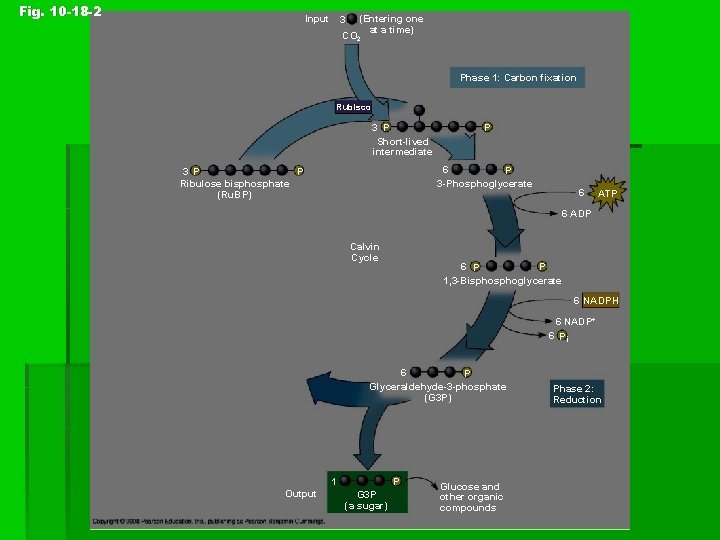
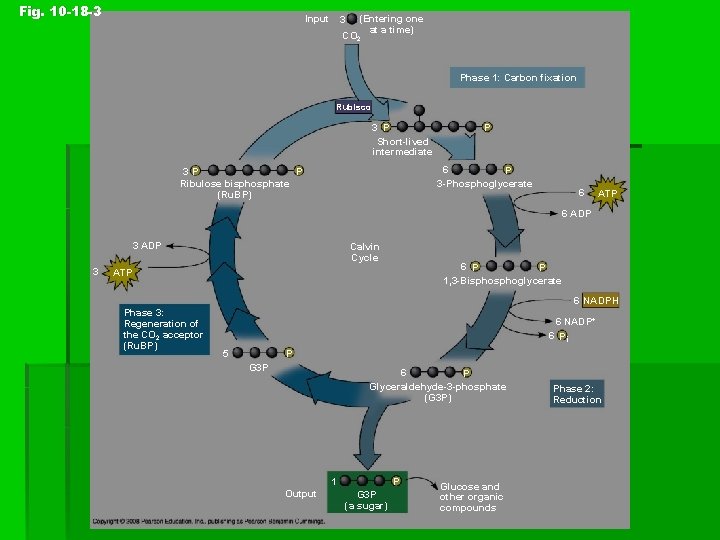
The Calvin Cycle (light independent reactions) § Has three steps/parts (see fig) 1. CO 2 fixation 2. CO 2 reduction 3. Regeneration of Ru. BP § Ru. BP is a 5 carbon compound that will combine with CO 2 to form a 6 Carbon Compound. Remember, glucose is a 6 C compound
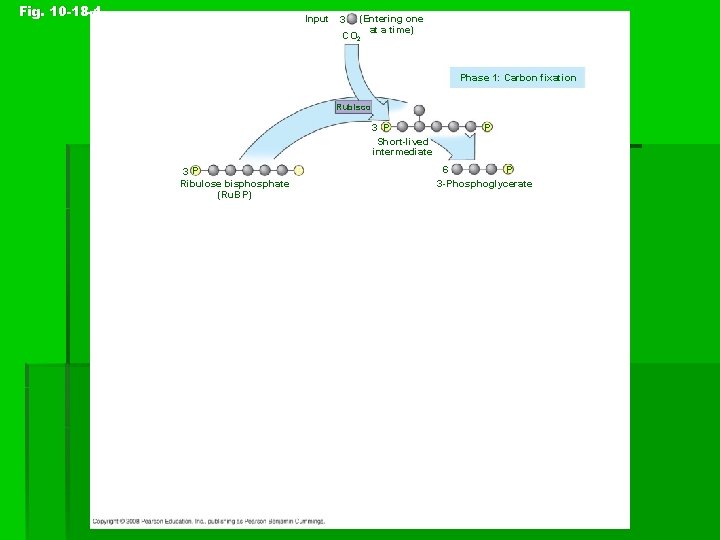
Step 1 - CO 2 Fixation § Refers to the attachment of CO 2 to an organic compound. § 3 CO 2 bind with 3 Ru. BP molecules. § Results in 3 six Carbon compounds § which change to 6 three carbon compounds § The three Carbon compound is called PGA § The Calvin Cycle is sometimes called the C-3 cycle because of PGA.
Fig. 10 -18 -1 Input 3 (Entering one at a time) CO 2 Phase 1: Carbon fixation Rubisco 3 P Short-lived intermediate P 3 P Ribulose bisphosphate (Ru. BP) P 6 P 3 -Phosphoglycerate
Step 2 - CO 2 Reduction § Requires ATP and NADPH (from light RXN) § PGA gets converted to G 3 P (PGAL) using ATP and NADPH. § ATP ADP + P § NADPH NADP § PGA G 3 P (PGAL) § The reduction of CO 2 to CH 2 O results in 6 total PGAL molecules. § 5 molecules of G 3 P (PGAL) will be used to regenerate Ru. BP. § It takes 3 turns of the Calvin Cycle to have a net gain of 1 G 3 P (PGAL)
Fig. 10 -18 -2 Input 3 (Entering one at a time) CO 2 Phase 1: Carbon fixation Rubisco 3 P Short-lived intermediate P 6 P 3 -Phosphoglycerate 3 P P Ribulose bisphosphate (Ru. BP) 6 ATP 6 ADP Calvin Cycle 6 P P 1, 3 -Bisphoglycerate 6 NADPH 6 NADP+ 6 Pi 6 P Glyceraldehyde-3 -phosphate (G 3 P) 1 Output P G 3 P (a sugar) Glucose and other organic compounds Phase 2: Reduction
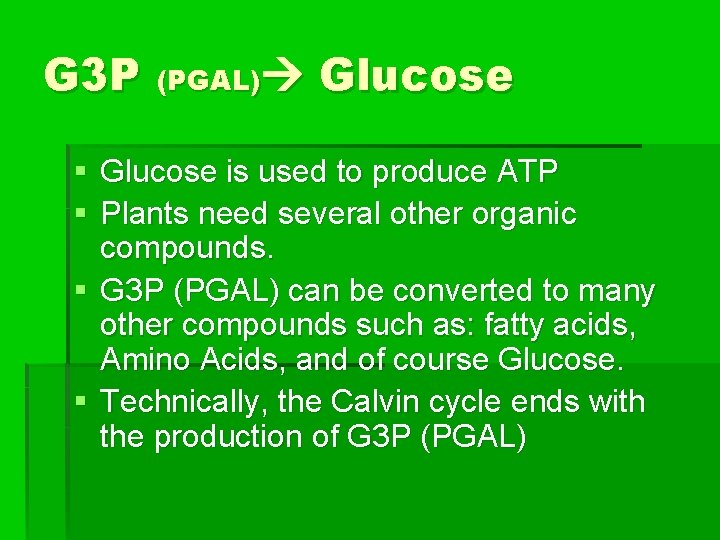
G 3 P (PGAL) Glucose § Glucose is used to produce ATP § Plants need several other organic compounds. § G 3 P (PGAL) can be converted to many other compounds such as: fatty acids, Amino Acids, and of course Glucose. § Technically, the Calvin cycle ends with the production of G 3 P (PGAL)
Step 3 - Ru. BP Regeneration § § § 5 (PGAL) G 3 P 3 Ru. BP 3 ATP 3 ADP + P ATP comes from the light dependent reactions
Fig. 10 -18 -3 Input 3 (Entering one at a time) CO 2 Phase 1: Carbon fixation Rubisco 3 P Short-lived intermediate P 6 P 3 -Phosphoglycerate 3 P P Ribulose bisphosphate (Ru. BP) 6 ATP 6 ADP 3 Calvin Cycle 6 P P 1, 3 -Bisphoglycerate ATP 6 NADPH Phase 3: Regeneration of the CO 2 acceptor (Ru. BP) 6 NADP+ 6 Pi P 5 G 3 P 6 P Glyceraldehyde-3 -phosphate (G 3 P) 1 Output P G 3 P (a sugar) Glucose and other organic compounds Phase 2: Reduction
Fig. 10 -21 H 2 O CO 2 Light NADP+ ADP + P i Light Reactions: Photosystem II Electron transport chain Photosystem I Electron transport chain Ru. BP ATP NADPH 3 -Phosphoglycerate Calvin Cycle G 3 P Starch (storage) Chloroplast O 2 Sucrose (export)
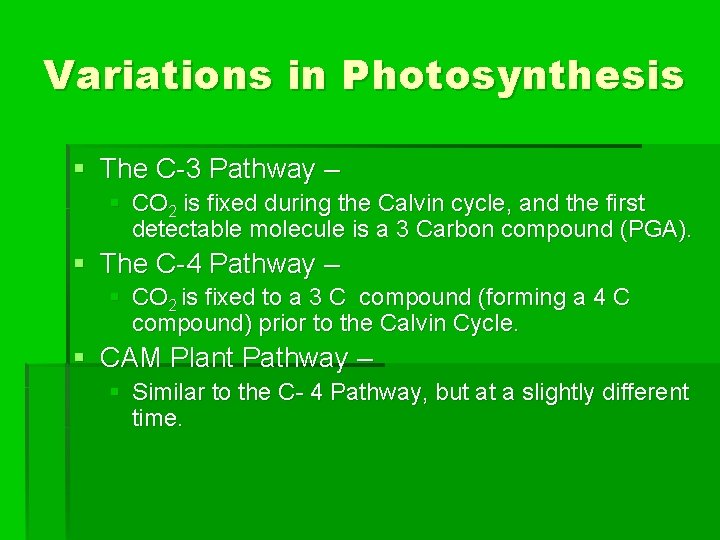
Variations in Photosynthesis § The C-3 Pathway – § CO 2 is fixed during the Calvin cycle, and the first detectable molecule is a 3 Carbon compound (PGA). § The C-4 Pathway – § CO 2 is fixed to a 3 C compound (forming a 4 C compound) prior to the Calvin Cycle. § CAM Plant Pathway – § Similar to the C- 4 Pathway, but at a slightly different time.
C-3 Pathway § § § Occurs in the mesophyll of the leaf Ru. BP PGA P 3 G (PGAL) See Figure 10 -18.
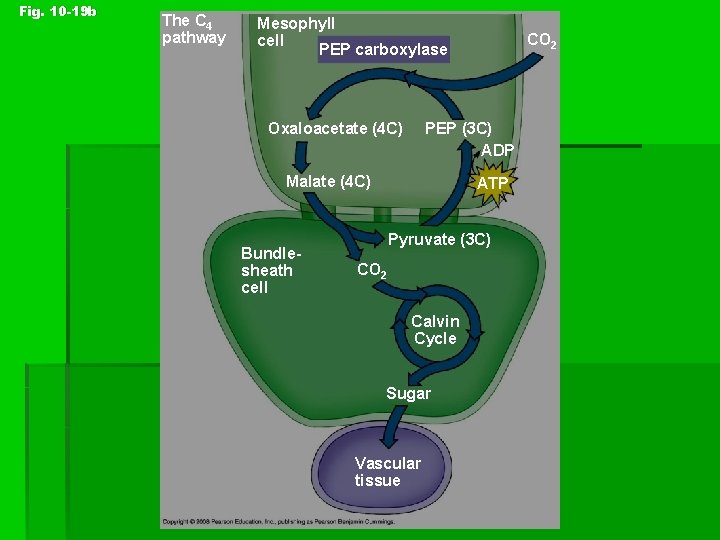
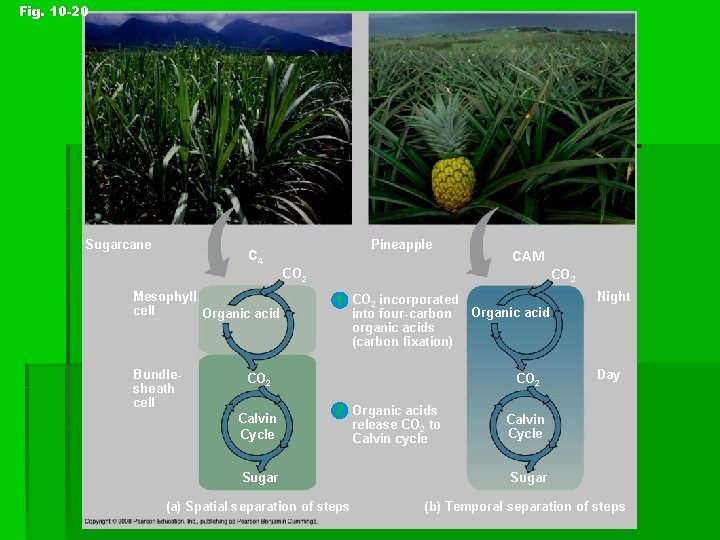
C-4 Pathway § CO 2 is attached to a 3 C compound called PEP with an enzyme called PEP-carboxylase. § This process forms oxaloacetate and occurs in the mesophyll. § Oxaloacetate enters the bundle sheath cells where the Calvin Cycle takes place § Occurs in warm dry climates § Partition PSS in space § See Figure 10. 14
Fig. 10 -19 b The C 4 pathway Mesophyll cell PEP carboxylase Oxaloacetate (4 C) PEP (3 C) ADP Malate (4 C) Bundlesheath cell CO 2 ATP Pyruvate (3 C) CO 2 Calvin Cycle Sugar Vascular tissue
CAM plant Pathway § A C 4 compound is produced similar to the C-4 pathway. § That compound is produced during the night, and stored in the vacuole until day. § Occurs in the mesophyll § Occurs in hot, dry and stressful environments § Allows Stomates to open at night when it is cooler and less water is lost to evaporation.
Fig. 10 -20 Sugarcane Pineapple C 4 CAM CO 2 Mesophyll cell Organic acid Bundlesheath cell CO 2 1 CO 2 incorporated into four-carbon Organic acid organic acids (carbon fixation) CO 2 Calvin Cycle CO 2 2 Organic acids release CO 2 to Calvin cycle Night Day Calvin Cycle Sugar (a) Spatial separation of steps (b) Temporal separation of steps
The Importance of Photosynthesis: A Review § The energy entering chloroplasts as sunlight gets stored as chemical energy in organic compounds § Sugar made in the chloroplasts supplies chemical energy and carbon skeletons to synthesize the organic molecules of cells § Plants store excess sugar as starch in structures such as roots, tubers, seeds, and fruits § In addition to food production, photosynthesis produces the O 2 in our atmosphere