
The Endo Predict Score Identifies Late Distant Metastases
- Slides: 10
The Endo. Predict Score Identifies Late Distant Metastases in ER+/HER 2 - Breast Cancer Patients Dubsky P et al. Proc SABCS 2012; Abstract S 4 -3.
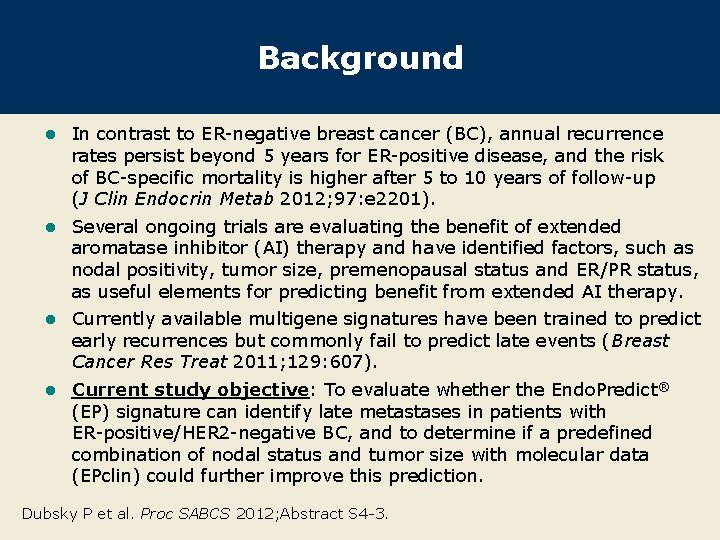
Background l In contrast to ER-negative breast cancer (BC), annual recurrence rates persist beyond 5 years for ER-positive disease, and the risk of BC-specific mortality is higher after 5 to 10 years of follow-up (J Clin Endocrin Metab 2012; 97: e 2201). l Several ongoing trials are evaluating the benefit of extended aromatase inhibitor (AI) therapy and have identified factors, such as nodal positivity, tumor size, premenopausal status and ER/PR status, as useful elements for predicting benefit from extended AI therapy. l Currently available multigene signatures have been trained to predict early recurrences but commonly fail to predict late events (Breast Cancer Res Treat 2011; 129: 607). l Current study objective: To evaluate whether the Endo. Predict® (EP) signature can identify late metastases in patients with ER-positive/HER 2 -negative BC, and to determine if a predefined combination of nodal status and tumor size with molecular data (EPclin) could further improve this prediction. Dubsky P et al. Proc SABCS 2012; Abstract S 4 -3.
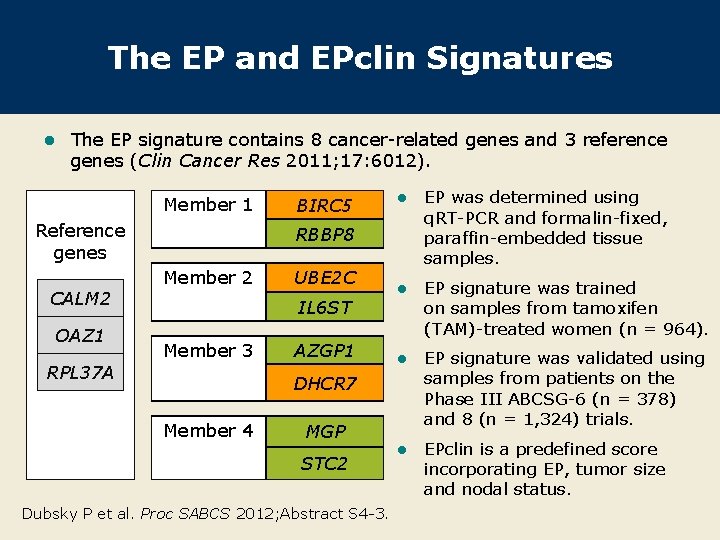
The EP and EPclin Signatures l The EP signature contains 8 cancer-related genes and 3 reference genes (Clin Cancer Res 2011; 17: 6012). Member 1 Reference genes CALM 2 OAZ 1 BIRC 5 l EP was determined using q. RT-PCR and formalin-fixed, paraffin-embedded tissue samples. l EP signature was trained on samples from tamoxifen (TAM)-treated women (n = 964). l EP signature was validated using samples from patients on the Phase III ABCSG-6 (n = 378) and 8 (n = 1, 324) trials. l EPclin is a predefined score incorporating EP, tumor size and nodal status. RBBP 8 Member 2 UBE 2 C IL 6 ST Member 3 RPL 37 A AZGP 1 DHCR 7 Member 4 MGP STC 2 Dubsky P et al. Proc SABCS 2012; Abstract S 4 -3.
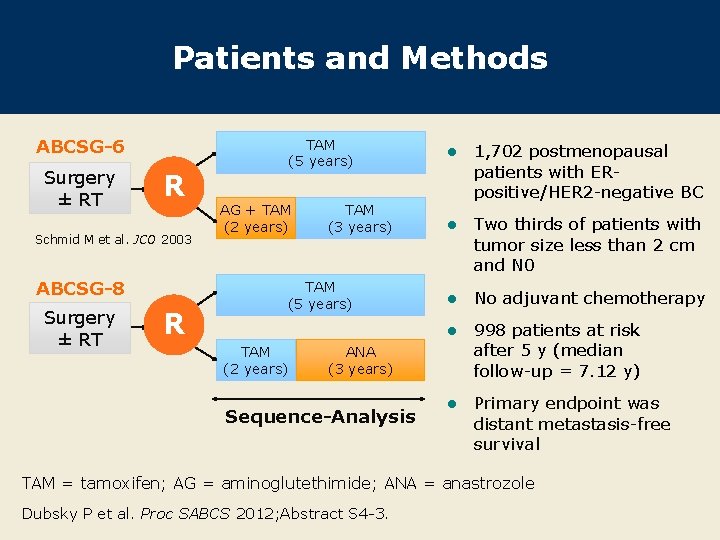
Patients and Methods ABCSG-6 Surgery ± RT R Schmid M et al. JCO 2003 ABCSG-8 Surgery ± RT R TAM (5 years) AG + TAM (2 years) TAM (3 years) TAM (5 years) TAM (2 years) l 1, 702 postmenopausal patients with ERpositive/HER 2 -negative BC l Two thirds of patients with tumor size less than 2 cm and N 0 l No adjuvant chemotherapy l 998 patients at risk after 5 y (median follow-up = 7. 12 y) l Primary endpoint was distant metastasis-free survival ANA (3 years) Sequence-Analysis TAM = tamoxifen; AG = aminoglutethimide; ANA = anastrozole Dubsky P et al. Proc SABCS 2012; Abstract S 4 -3.
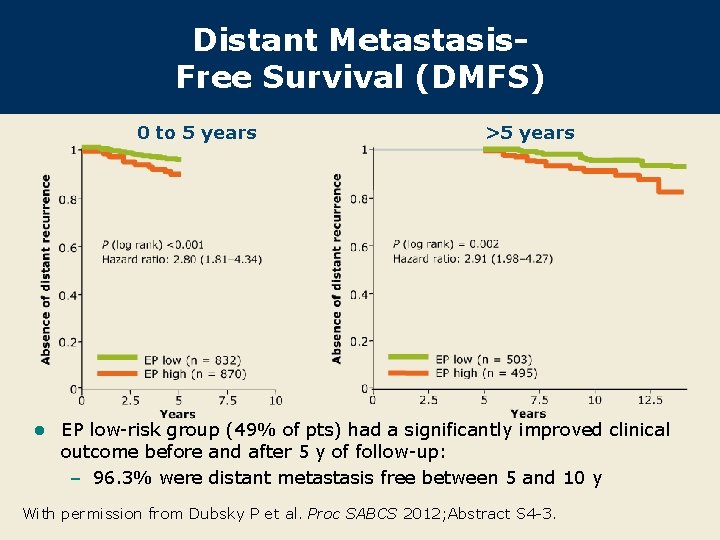
Distant Metastasis. Free Survival (DMFS) 0 to 5 years l >5 years EP low-risk group (49% of pts) had a significantly improved clinical outcome before and after 5 y of follow-up: – 96. 3% were distant metastasis free between 5 and 10 y With permission from Dubsky P et al. Proc SABCS 2012; Abstract S 4 -3.
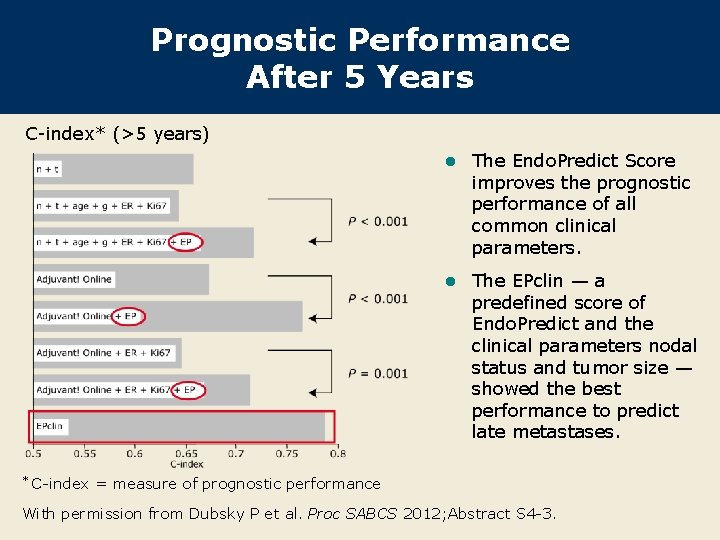
Prognostic Performance After 5 Years C-index* (>5 years) * l The Endo. Predict Score improves the prognostic performance of all common clinical parameters. l The EPclin — a predefined score of Endo. Predict and the clinical parameters nodal status and tumor size — showed the best performance to predict late metastases. C-index = measure of prognostic performance With permission from Dubsky P et al. Proc SABCS 2012; Abstract S 4 -3.
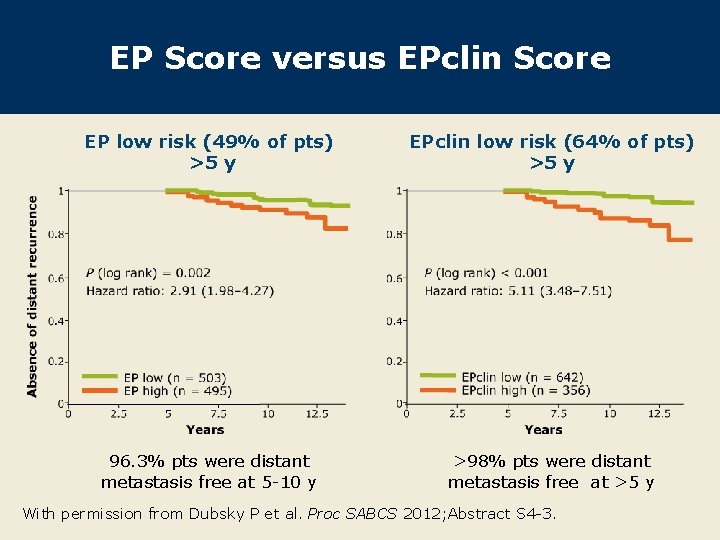
EP Score versus EPclin Score EP low risk (49% of pts) >5 y EPclin low risk (64% of pts) >5 y 96. 3% pts were distant metastasis free at 5 -10 y >98% pts were distant metastasis free at >5 y With permission from Dubsky P et al. Proc SABCS 2012; Abstract S 4 -3.
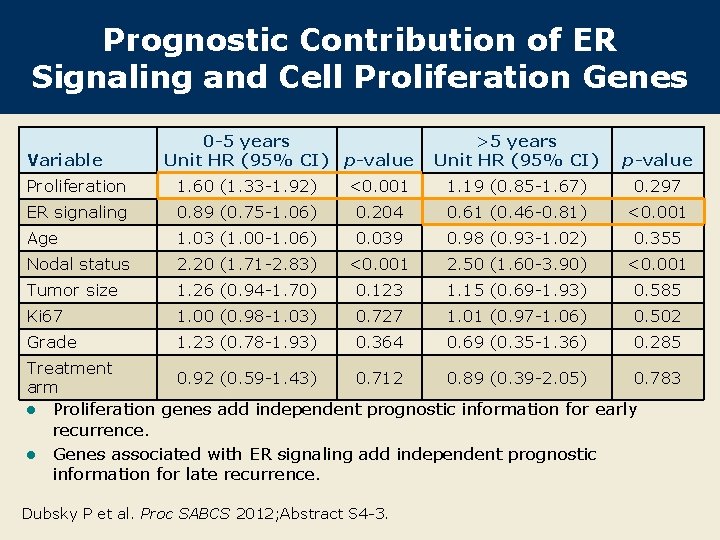
Prognostic Contribution of ER Signaling and Cell Proliferation Genes Variable 0 -5 years Unit HR (95% CI) p-value >5 years Unit HR (95% CI) p-value Proliferation 1. 60 (1. 33 -1. 92) <0. 001 1. 19 (0. 85 -1. 67) 0. 297 ER signaling 0. 89 (0. 75 -1. 06) 0. 204 0. 61 (0. 46 -0. 81) <0. 001 Age 1. 03 (1. 00 -1. 06) 0. 039 0. 98 (0. 93 -1. 02) 0. 355 Nodal status 2. 20 (1. 71 -2. 83) <0. 001 2. 50 (1. 60 -3. 90) <0. 001 Tumor size 1. 26 (0. 94 -1. 70) 0. 123 1. 15 (0. 69 -1. 93) 0. 585 Ki 67 1. 00 (0. 98 -1. 03) 0. 727 1. 01 (0. 97 -1. 06) 0. 502 Grade 1. 23 (0. 78 -1. 93) 0. 364 0. 69 (0. 35 -1. 36) 0. 285 Treatment 0. 92 (0. 59 -1. 43) 0. 712 0. 89 (0. 39 -2. 05) 0. 783 arm l Proliferation genes add independent prognostic information for early recurrence. l Genes associated with ER signaling add independent prognostic information for late recurrence. Dubsky P et al. Proc SABCS 2012; Abstract S 4 -3.
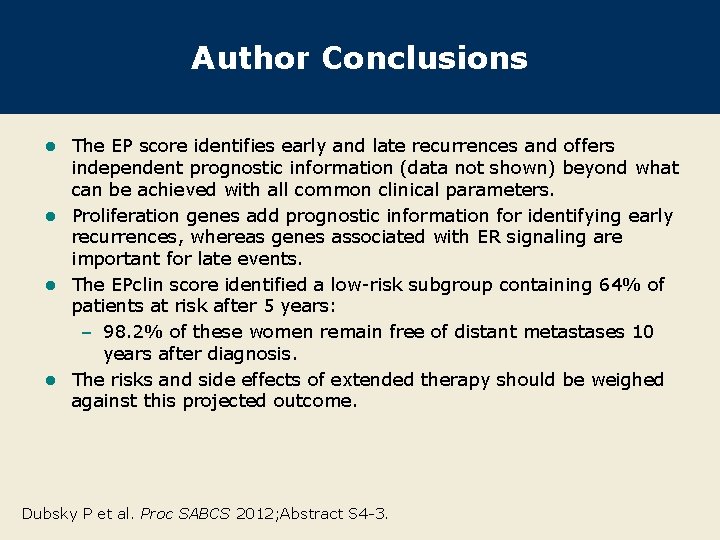
Author Conclusions The EP score identifies early and late recurrences and offers independent prognostic information (data not shown) beyond what can be achieved with all common clinical parameters. l Proliferation genes add prognostic information for identifying early recurrences, whereas genes associated with ER signaling are important for late events. l The EPclin score identified a low-risk subgroup containing 64% of patients at risk after 5 years: – 98. 2% of these women remain free of distant metastases 10 years after diagnosis. l The risks and side effects of extended therapy should be weighed against this projected outcome. l Dubsky P et al. Proc SABCS 2012; Abstract S 4 -3.
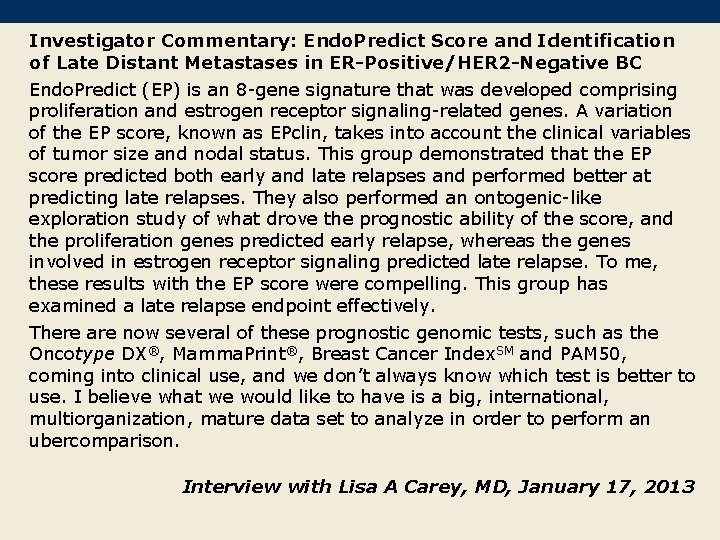
Investigator Commentary: Endo. Predict Score and Identification of Late Distant Metastases in ER-Positive/HER 2 -Negative BC Endo. Predict (EP) is an 8 -gene signature that was developed comprising proliferation and estrogen receptor signaling-related genes. A variation of the EP score, known as EPclin, takes into account the clinical variables of tumor size and nodal status. This group demonstrated that the EP score predicted both early and late relapses and performed better at predicting late relapses. They also performed an ontogenic-like exploration study of what drove the prognostic ability of the score, and the proliferation genes predicted early relapse, whereas the genes involved in estrogen receptor signaling predicted late relapse. To me, these results with the EP score were compelling. This group has examined a late relapse endpoint effectively. There are now several of these prognostic genomic tests, such as the Oncotype DX®, Mamma. Print®, Breast Cancer Index. SM and PAM 50, coming into clinical use, and we don’t always know which test is better to use. I believe what we would like to have is a big, international, multiorganization, mature data set to analyze in order to perform an ubercomparison. Interview with Lisa A Carey, MD, January 17, 2013