
The End of the Cold War Part II
- Slides: 24
The End of the Cold War Part II
Causes of the Collapse of the Soviet Union • Government leaders were disillusioned by Khrushchev’s secret speech, the rise of capitalism, and the lack of world revolution • New freedoms, such as assembly, speech, and religion undermined the familiar and rigid sense of order – there were many protests and demonstrations • Ethnic and social conflicts reappeared in the Balkans leading to strikes and growing incidents of crime – Czechoslovakians versus Slovakians – Serbs versus Albanian Kosovars in Kosovo – Serbs and Croats versus Muslims in Bosnia. Herzegovina
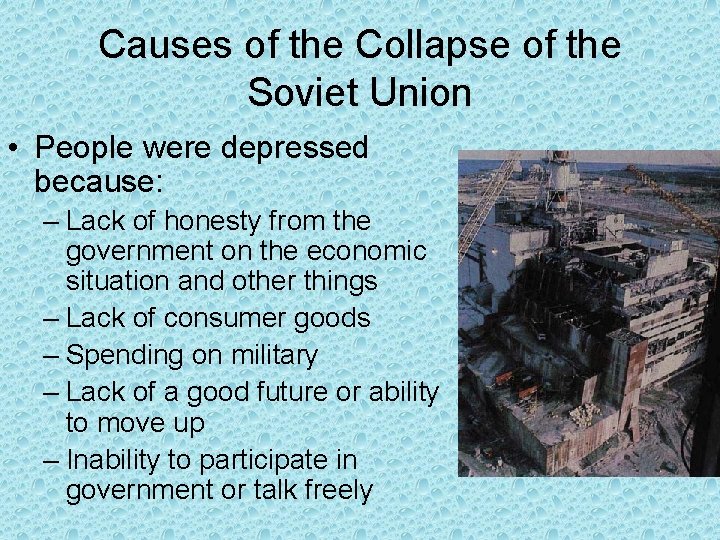
Causes of the Collapse of the Soviet Union • During the mid-1980 s, there was a fall in world oil prices, which deprived the USSR of currency • In Apr. 1986, a melt-down at a nuclear reactor at Chernobyl caused an expensive clean-up • In 1988, a terrible earthquake in Armenia killed 25, 000 and massive destruction. There was a poor response from the rest of the USSR, which showed apathy and a lack of unity
Causes of the Collapse of the Soviet Union • People were depressed because: – Lack of honesty from the government on the economic situation and other things – Lack of consumer goods – Spending on military – Lack of a good future or ability to move up – Inability to participate in government or talk freely
Mikhail Gorbachev • In order for his reforms of glasnost and perestroika to take place, he needed to end the Cold War to lower defense spending • He declared that the satellite nations were in charge of their own future and he assured them that he would not intervene in their affairs • He supported change and opposed the use of force to stop it • Satellite nations had been kept in check through the use of Soviet force
Poland • “Reform communists” and Solidarity leaders came together in a roundtable talks from Feb. -Apr 1989 • Solidarity was legalized, strikes were legalized, elements of a free market were introduced, and Senate elections were to be held • The communists had control of the media and money, so they expected to win the elections, but they lost 99 of 100 seats • They formed the first non-communist majority in the Eastern Europe • The President resigned in 1990 and the leader of Solidarity, Lech Walesa, was elected President in Dec. 1990
Hungary • Economic problems in Hungary led to the people urging for reform • Janos Kadar resigned in April 1988 and the President of Hungary was now a “reform communist” named Imre Pozsgay • President George H. W. Bush met with opposition party leaders in July 1989 • He wanted a multi-party system and other reforms • Gorbachev consented to a request to cut down the barb wire fence (iron curtain) between Hungary and Austria • Elections were held in October 1989 that replaced the communist leader with a democratic one
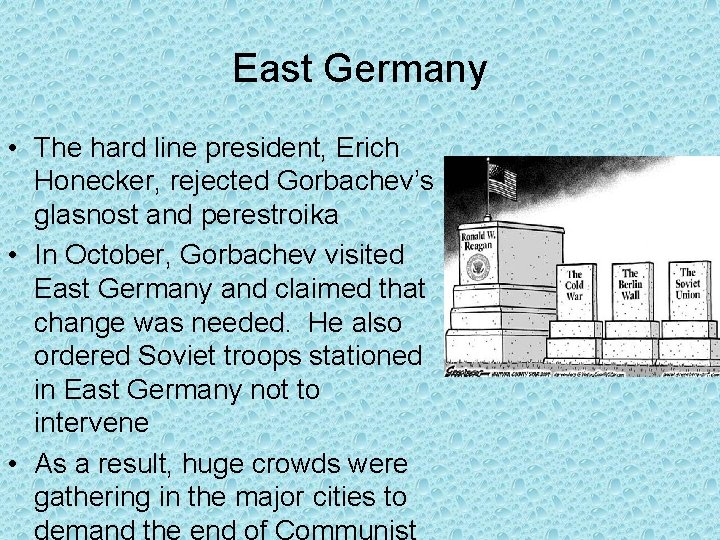
East Germany • The hard line president, Erich Honecker, rejected Gorbachev’s glasnost and perestroika • In October, Gorbachev visited East Germany and claimed that change was needed. He also ordered Soviet troops stationed in East Germany not to intervene • As a result, huge crowds were gathering in the major cities to demand the end of Communist
East Germany • Thousands fled from East Germany to Austria to Hungary to West Germany • Demonstrators were beaten by police • On Oct. 18, Honecker resigned • When new arrangements for travel to the West were announced, reporters asked the government spokesman when the checkpoints would be opening. He said “Right away” • Thousands of East Berliners began gathering at the checkpoints, to the surprise of the border guards, who had received no orders
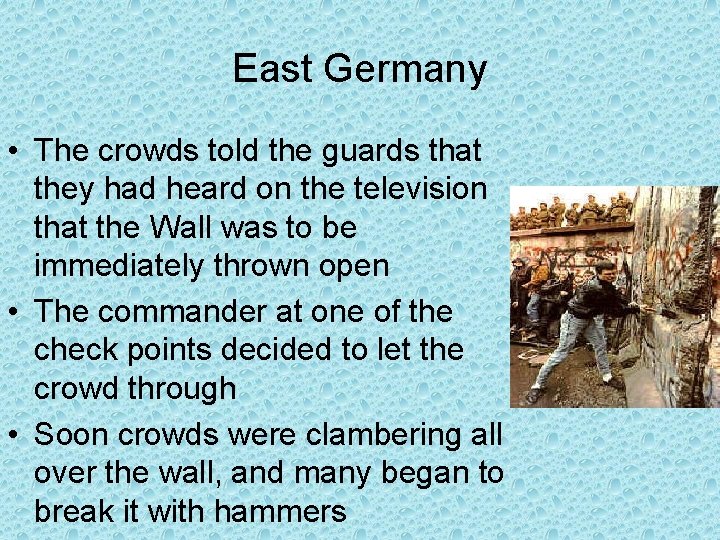
East Germany • The crowds told the guards that they had heard on the television that the Wall was to be immediately thrown open • The commander at one of the check points decided to let the crowd through • Soon crowds were clambering all over the wall, and many began to break it with hammers
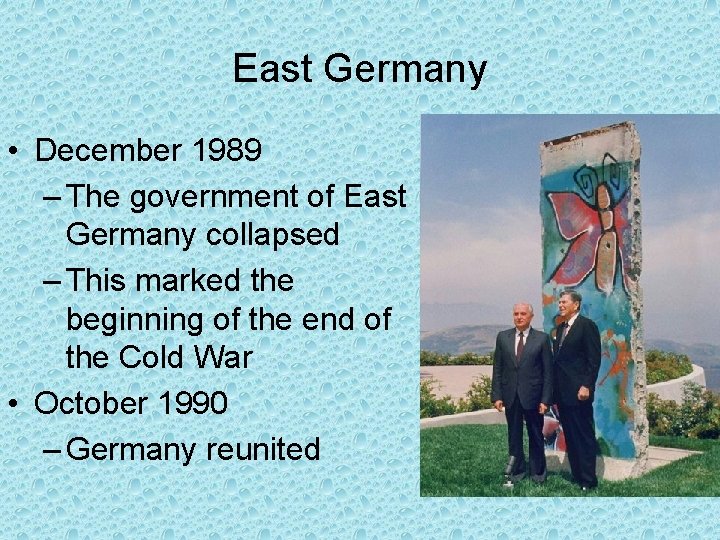
East Germany • December 1989 – The government of East Germany collapsed – This marked the beginning of the end of the Cold War • October 1990 – Germany reunited
Czechoslovakia • In Nov. 1989, a student demonstration was crushed by police • Alexander Dubcek came back to Czechoslovakia to support Civic Forum, a reform movement/party/union of workers • Workers demonstrated and threatened a general strike if the government didn’t resign • The government resigned in Dec. 1989 and Dubcek and other reformers were elected to leadership positions • All this was called the Velvet Revolution because there was no violence
Causes of the Collapse of the Soviet Union • Bulgaria, Romania, Yugoslavia, and Albania communism fell in 1990 • In June 1990, Russia declared their independence from the USSR • August 1991 – Mikhail Gorbachev’s policies of glasnost and perestroika caused the old-guard communists to want to preserve the system – They tried a military coup, but it was foiled with the help of Russian Republic president Boris Yeltsin (one of the republics in the Union of Soviet Socialist Republics, or USSR)
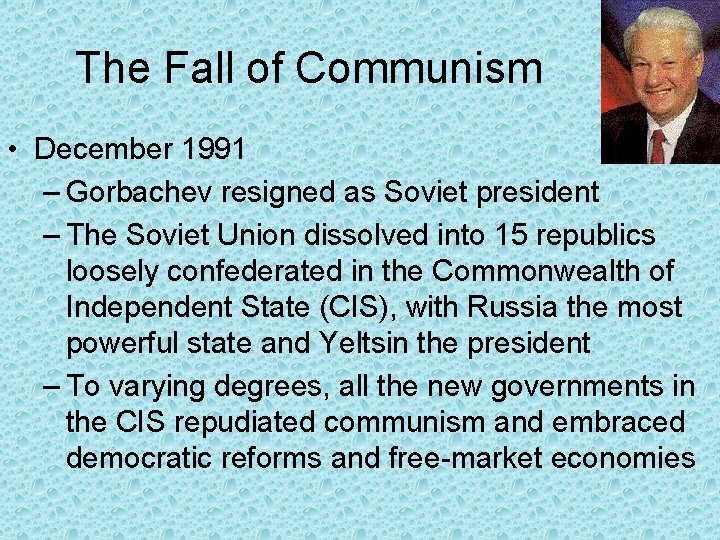
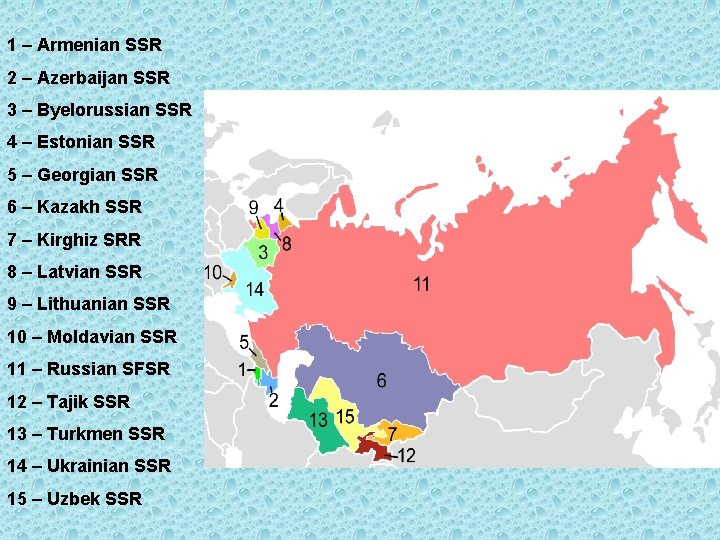
The Fall of Communism • December 1991 – Gorbachev resigned as Soviet president – The Soviet Union dissolved into 15 republics loosely confederated in the Commonwealth of Independent State (CIS), with Russia the most powerful state and Yeltsin the president – To varying degrees, all the new governments in the CIS repudiated communism and embraced democratic reforms and free-market economies
1 – Armenian SSR 2 – Azerbaijan SSR 3 – Byelorussian SSR 4 – Estonian SSR 5 – Georgian SSR 6 – Kazakh SSR 7 – Kirghiz SRR 8 – Latvian SSR 9 – Lithuanian SSR 10 – Moldavian SSR 11 – Russian SFSR 12 – Tajik SSR 13 – Turkmen SSR 14 – Ukrainian SSR 15 – Uzbek SSR
The Fall of Communism • Results of the Fall of the Soviet Union – The demise of the Soviet Union was a complete end to the Cold War – No more tension over nuclear war between the U. S. and Russia – It also marked the virtual end of communism world-wide – Democracy now had no more ideological battles left to fight
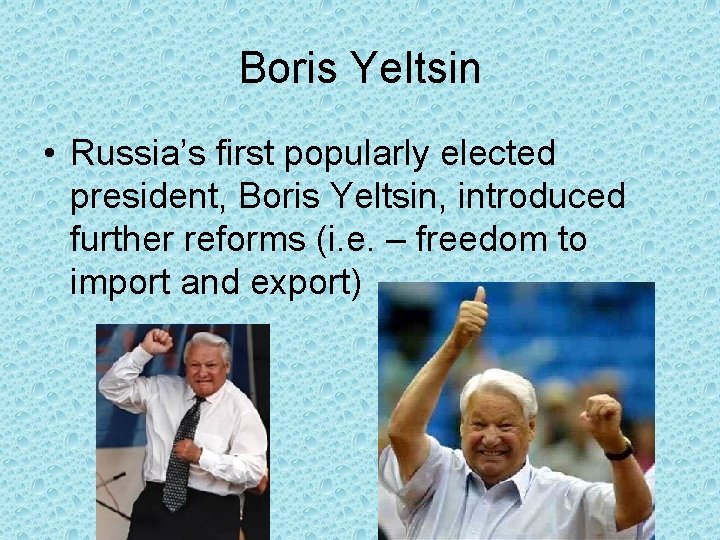
Boris Yeltsin • Russia’s first popularly elected president, Boris Yeltsin, introduced further reforms (i. e. – freedom to import and export)
Results of No More Cold War in Russia • Russia’s transition to a free-market economy has not been smooth • 25% of the population lives in poverty, which was largely nonexistent in the last decades of the Soviet Union • Law and order has broken down and organized crime has flourished
Results of No More Cold War • GDP has dropped • The U. S. is left as the “world’s policeman” • There has been a wave of democratization throughout Latin America, Africa, and Eastern Europe • Space exploration has declined without the competitive pressure of the space race
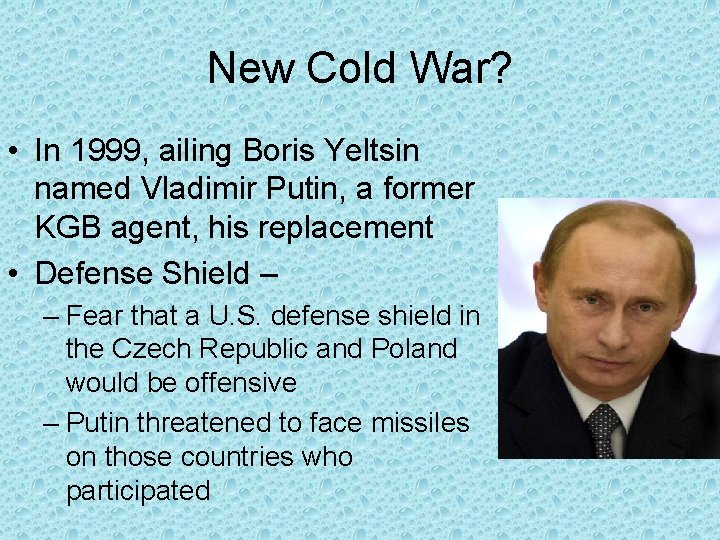
New Cold War? • In 1999, ailing Boris Yeltsin named Vladimir Putin, a former KGB agent, his replacement • Defense Shield – – Fear that a U. S. defense shield in the Czech Republic and Poland would be offensive – Putin threatened to face missiles on those countries who participated
New Cold War? • U. S. Influence in Eastern Bloc – Russia is resentful at attempts to get former satellite nations and former parts of the USSR into NATO and the EU – Former President Vladimir Putin compared it to the Third Reich • Disabled Spy Satellite – U. S. hit a disabled toxic spy satellite in Feb. 2008 – China and the USSR believed the U. S. was testing anti-satellite technology
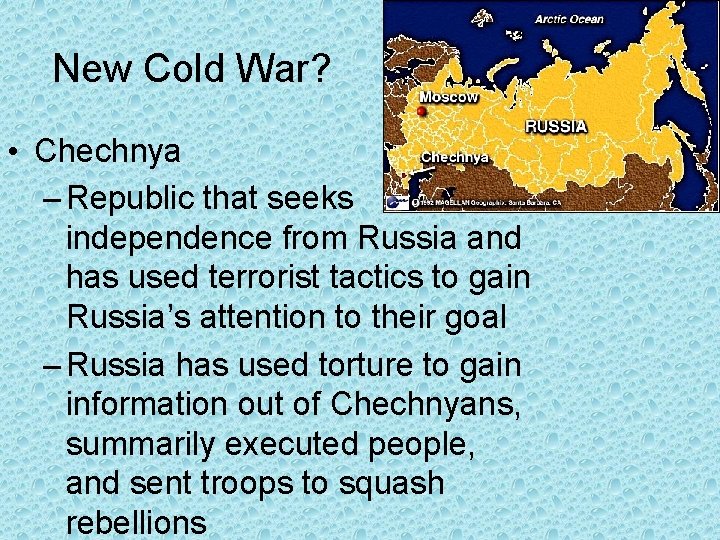
New Cold War? • Chechnya – Republic that seeks independence from Russia and has used terrorist tactics to gain Russia’s attention to their goal – Russia has used torture to gain information out of Chechnyans, summarily executed people, and sent troops to squash rebellions
New Cold War? • Elections – In Mar. 2008 were deemed by some to be unfair because: • the government controls censorship • intimidated voters • harasses opposition groups • authorities would fill out and cast ballots • Oppose Kosovo Independence – UN and EU support Kosovo independence – EU wants to send peacekeeping troops, which Russia believes needs Security Council approval