
The Emperors New Clothes Craig K Harmon President







- Slides: 51
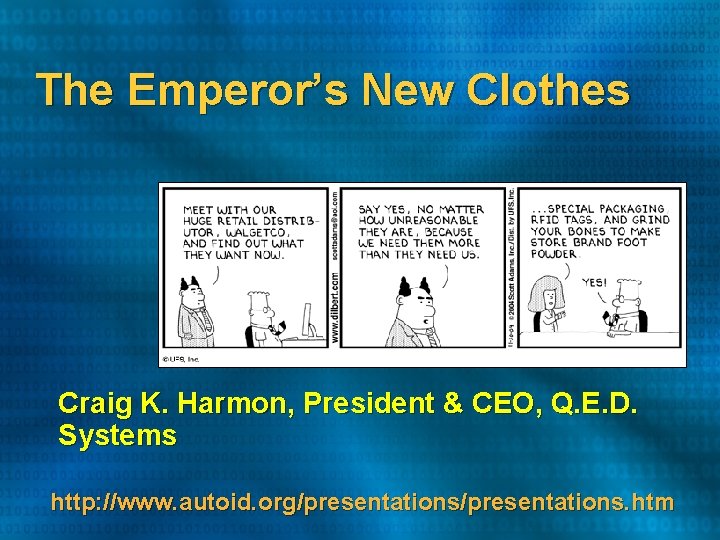
The Emperor’s New Clothes Craig K. Harmon, President & CEO, Q. E. D. Systems http: //www. autoid. org/presentations. htm
Q. E. D. Systems • Craig K. Harmon • President & CEO Visit our web sites: http: //www. autoid. org and http: //www. qed. org Chair, ISO TC 122/104 JWG - Supply Chain Applications of RFID Chair, RFID Experts Group (REG) Chair, U. S. TAG to ISO/IEC JTC 1/SC 31/WG 4 “RFID” Senior Project Editor ISO/IEC JTC 1/SC 31/WG 4/SG 3 (RFID - Air Interface - 18000) Chair, ASC MH 10/SC 8/WG 4, RFID for Returnable Containers Chair, ISO TC 122/WG 4 (Shipping Labels) & ISO TC 122/WG 7 (Product Packaging) Vice-chair, ASC MH 10 and U. S. TAG to ISO TC 122 (Packaging) Member, EPCglobal HAG (UHFGen 2), FMCG BAG, HLS BAG, SAG Past Chair, ASC INCITS T 6 (RFID) - ANS INCITS 256: 1999, 2001 JTC 1/SC 31 Liaison Officer to the International Telecommunications Union (ITU-R), International Air Transport Association (IATA), and European Telecommunications Standards Institute (ETSI) ASC MH 10/SC 8 Liaison Universal Postal Union (UPU) Physical Encoding Group (PEG) Advisor and Member of U. S. Postal Service Strategic Technology Council ISO TC 104 & 122 (Freight Containers / Packaging) Liaison Officer to JTC 1/SC 31 Project Editor, ISO 18185 -7 (Electronic Container Seal - Physical Layer) Chairman & Project Editor, ANS MH 10. 8. 2 (Data Application Identifiers) Vocabulary Rapporteur to ISO/IEC JTC 1/SC 31 Co-chair, HIBCC Automatic Identification Technical Committee (AITC) AIAG Bar Code, Applications, 2 D, Tire, Returnables, & RFID Committees Project Editor, EIA Shipping Label, Product Package, & Component Marking Original Advisor, U. S. Department of Defense in Migration to Commercial Standards Original Project Editor, NATO STANAG 2233 (RFID for NATO Asset Tracking) Standards Advisor, R 1 - RFID China Forum (Cooperation of China, Korea, Japan) Comp. TIA Subject Matter Expert - Professional Skills Certification - RFID Comp. TIA RFID Certified Professional (CRCP) - RFID+ Recipient of the 2004 Richard Dilling Award
Microsoft RFID Myths 1. There are no set Standards for RFID 2. 3. 4. 5. today. Replacing bar code-based processes with RFID processes will achieve ROI RFID benefits only retailers, not suppliers. RFID is the only way to automate manual receiving processes. The EPC is an RFID replacement of the current bar code (GTIN/U. P. C. ).
Microsoft RFID Myths 6. Adoption of RFID won’t require 7. 8. 9. 10. facility, equipment, and process changes. Only companies with metal and liquid products face readability challenges. Consistently reading every EPC on a pallet is easy. All RFID tags are the same. EPC technology can only be used for retail goods.
My Favorite Quote of Bill Gates People have a tendency to overestimate technology in the short term, and underestimate it in the long term.
The Technology
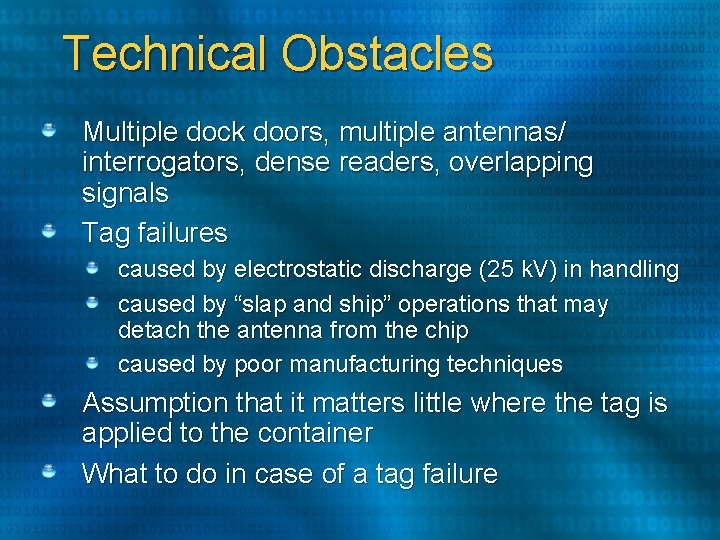
Technical Obstacles Multiple dock doors, multiple antennas/ interrogators, dense readers, overlapping signals Tag failures caused by electrostatic discharge (25 k. V) in handling caused by “slap and ship” operations that may detach the antenna from the chip caused by poor manufacturing techniques Assumption that it matters little where the tag is applied to the container What to do in case of a tag failure
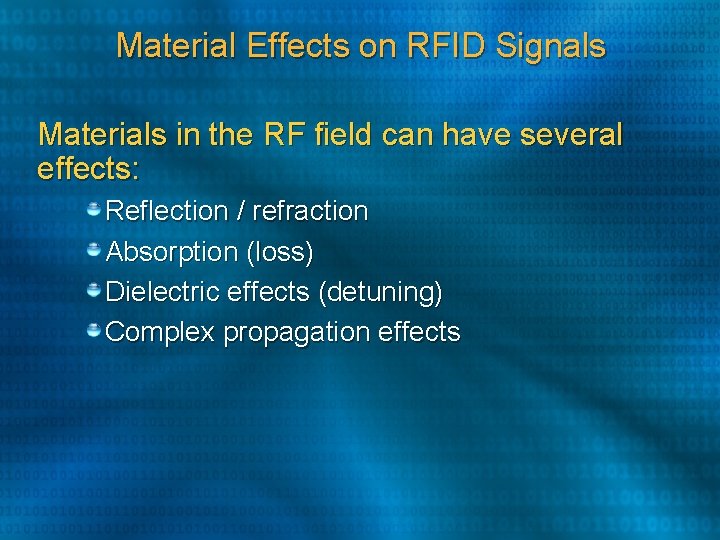
Material Effects on RFID Signals Materials in the RF field can have several effects: Reflection / refraction Absorption (loss) Dielectric effects (detuning) Complex propagation effects
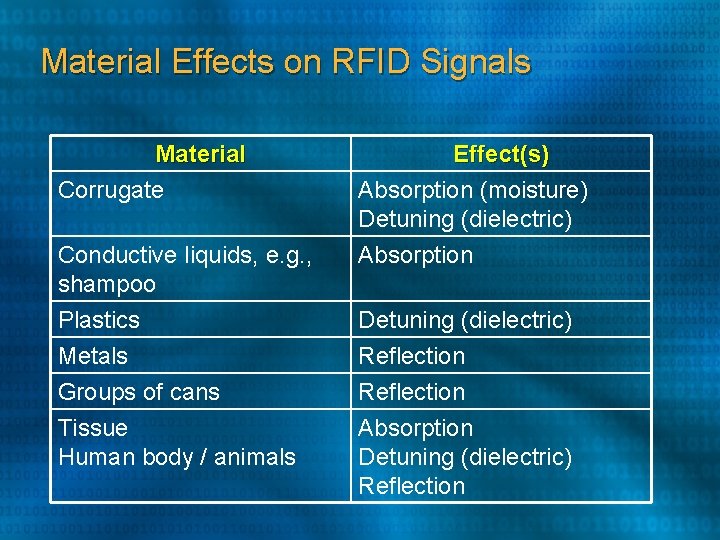
Material Effects on RFID Signals Material Corrugate Effect(s) Absorption (moisture) Detuning (dielectric) Conductive liquids, e. g. , shampoo Absorption Plastics Metals Groups of cans Tissue Human body / animals Detuning (dielectric) Reflection Absorption Detuning (dielectric) Reflection
Overcoming the Same Overlap - shielding, trip switches, antenna selection (ISO TR 24729 -3) Tag failure - care in applying tags, encode-printapply Poor quality - ISO standards (currently in the REG) on tag manufacturing (ISO 9000 ish) and tag quality measurement Tag location - characterization of containers, dielectric backing, dielectric inserts, contentinsensitive labels (ISO TR 24729 -1) Back-up - REG recommendations on bar code and human-readable (ISO TR 24729 -1)
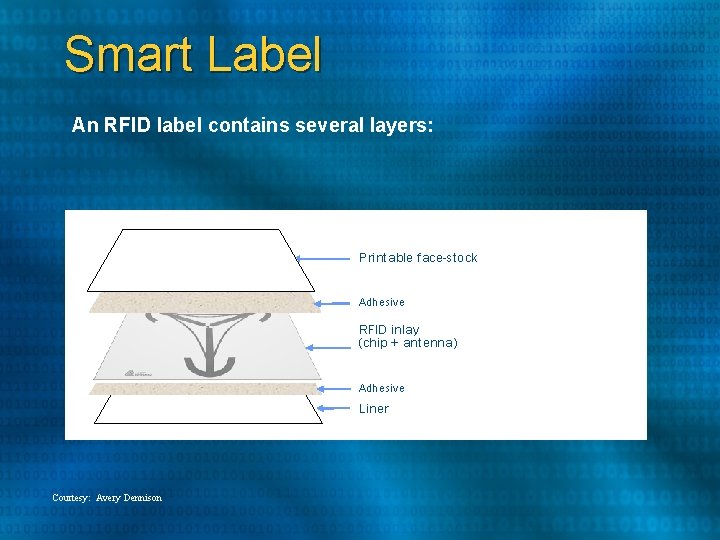
Smart Label An RFID label contains several layers: Printable face-stock Adhesive RFID inlay (chip + antenna) Adhesive Liner Courtesy: Avery Dennison
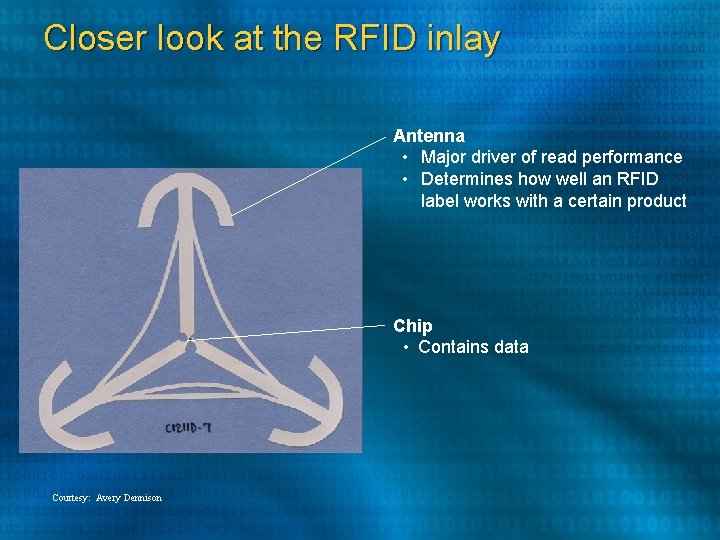
Closer look at the RFID inlay Antenna • Major driver of read performance • Determines how well an RFID label works with a certain product Chip • Contains data Courtesy: Avery Dennison
The Data
Its all about the data Inventory databases are currently structured with product codes New technology should not require new data Oftentimes new data structures are simply means by which sponsors can secure revenue streams Refresh technology when that technology becomes cost effective Do not “rush” into new data structures without understanding the impact on existing information systems
RFID vs Key-entry & Bar Code RFID is not a replacement for a bar code!! Use RFID where there is a positive ROI When analyzing your business process, which makes the most sense? ALWAYS HAVE A BACK-UP PLAN With RFID back-up, what is the key-entry solution: Keying 96 1 s and 0 s? 32 octal character representation of binary data? 29 decimal character representation of binary data? 24 hexadecimal character representation of binary data? For bar code back-up, will you use existing bar codes or new ones?
Serialization EPC implementation requires reengineering of your business processes Existing inventory data bases are product code not serial number driven Appreciate the amount of additional data that you will be both filtering and processing Encoding existing serial numbers may be preferable to migration to a binary system EPC does NOT require its serialization for its arbitration/anti-collision methods
Blocks vs Fields of Data Bar codes are one at a time Two-dimensional symbols are often blocks of data Data rich RF tags are blocks of data Serial number only tags require data base / communications access to identify the data Are your systems ready for these changes? Are you ready for the investment to enable these changes?
Implementation Issues Read zone control Application of tags Where in the process Where on the container How are the labels being applied Use ISO standards (avoid Class 0 and Class 1 v 1) EPC requires pre-population of data at the recipient (X 12 856 / EDIFACT DESADV / XML) or access to the EPCIS Back-up in case of tag failure Recycling Data concerns Return on investment
International Standards
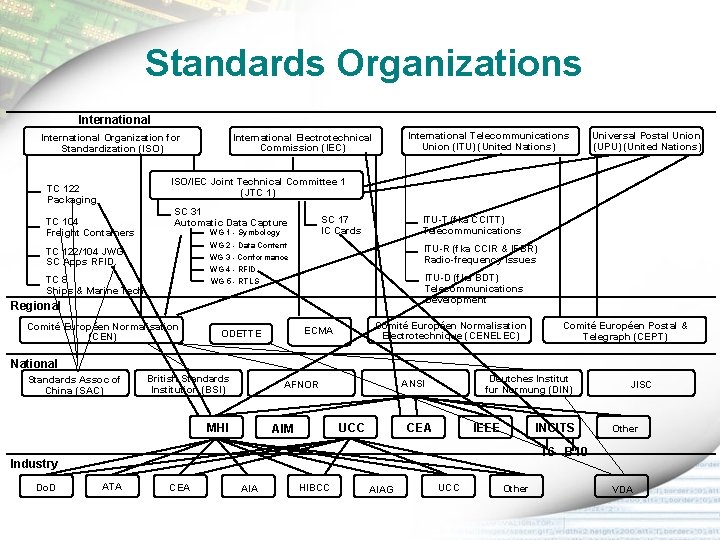
Standards Organizations International Telecommunications Union (ITU) (United Nations) International Electrotechnical Commission (IEC) International Organization for Standardization (ISO) Universal Postal Union (UPU) (United Nations) ISO/IEC Joint Technical Committee 1 (JTC 1) TC 122 Packaging TC 104 Freight Containers SC 31 Automatic Data Capture ITU-T (fka CCITT) Telecommunications SC 17 IC Cards WG 1 - Symbology WG 2 - Data Content TC 122/104 JWG SC Apps RFID ITU-R (fka CCIR & IFBR) Radio-frequency Issues WG 3 - Conformance WG 4 - RFID WG 5 - RTLS TC 8 Ships & Marine Tech ITU-D (fka BDT) Telecommunications Development Regional Comité Européen Normalisation (CEN) Comité Européen Normalisation Electrotechnique (CENELEC) ECMA ODETTE Comité Européen Postal & Telegraph (CEPT) National Standards Assoc of China (SAC) British Standards Institution (BSI) MHI UCC AIM Deutches Institut fur Normung (DIN) ANSI AFNOR CEA IEEE INCITS Other T 6 B 10 Industry Do. D JISC ATA CEA AIA HIBCC AIAG UCC Other VDA
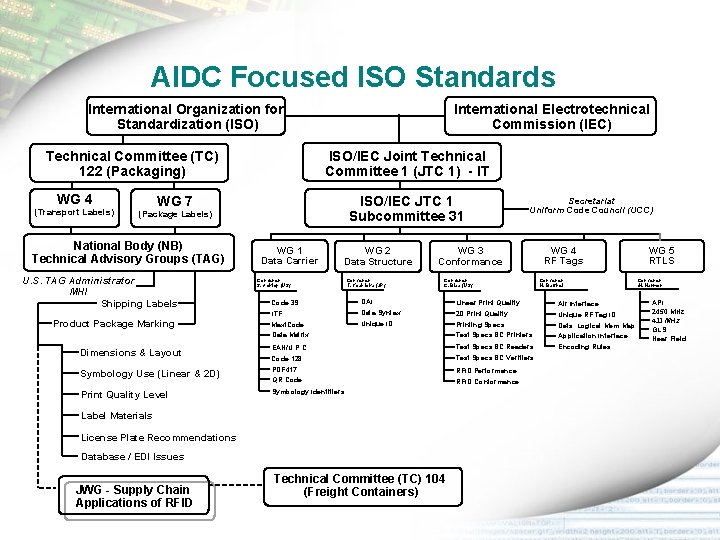
AIDC Focused ISO Standards International Electrotechnical Commission (IEC) International Organization for Standardization (ISO) Technical Committee (TC) 122 (Packaging) WG 4 (Transport Labels) ISO/IEC Joint Technical Committee 1 (JTC 1) - IT WG 7 ISO/IEC JTC 1 Subcommittee 31 (Package Labels) National Body (NB) Technical Advisory Groups (TAG) U. S. TAG Administrator MHI Shipping Labels Product Package Marking WG 1 Data Carrier WG 2 Data Structure Convener S. Ackley (US) Convener T. Yoshioka (JP) Secretariat Uniform Code Council (UCC) WG 3 Conformance Convener C. Biss (US) Code 39 DAI Linear Print Quality ITF Maxi. Code Data Matrix Data Syntax 2 D Print Quality Printing Specs Test Specs BC Printers Unique ID EAN/U. P. C. Test Specs BC Readers Code 128 Test Specs BC Verifiers Symbology Use (Linear & 2 D) PDF 417 QR Code RFID Performance Print Quality Level Symbology Identifiers Dimensions & Layout Label Materials License Plate Recommendations Database / EDI Issues JWG - Supply Chain Applications of RFID Technical Committee (TC) 104 (Freight Containers) RFID Conformance WG 4 RF Tags Convener H. Barthel Air Interface Unique RF Tag ID Defs. Logical Mem Map Application Interface Encoding Rules WG 5 RTLS Convener M. Harmon API 2450 MHz 433 MHz GLS Near Field
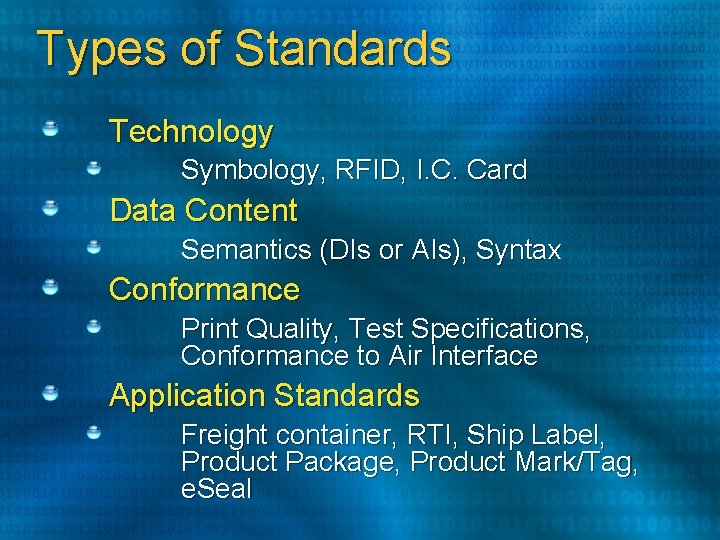
Types of Standards Technology Symbology, RFID, I. C. Card Data Content Semantics (DIs or AIs), Syntax Conformance Print Quality, Test Specifications, Conformance to Air Interface Application Standards Freight container, RTI, Ship Label, Product Package, Product Mark/Tag, e. Seal
ISO/IEC JTC 1/SC 31 Automatic Identification and Data Capture Techniques Working Group (WG) 4 RFID for Item Management
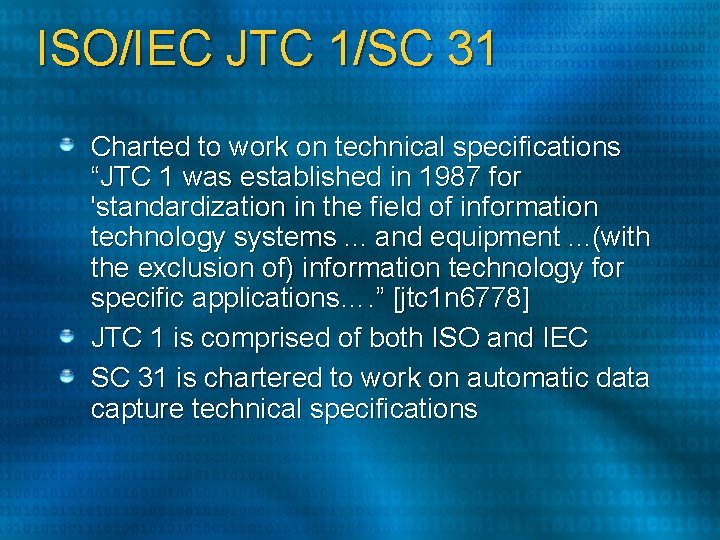
ISO/IEC JTC 1/SC 31 Charted to work on technical specifications “JTC 1 was established in 1987 for 'standardization in the field of information technology systems. . . and equipment. . . (with the exclusion of) information technology for specific applications…. ” [jtc 1 n 6778] JTC 1 is comprised of both ISO and IEC SC 31 is chartered to work on automatic data capture technical specifications
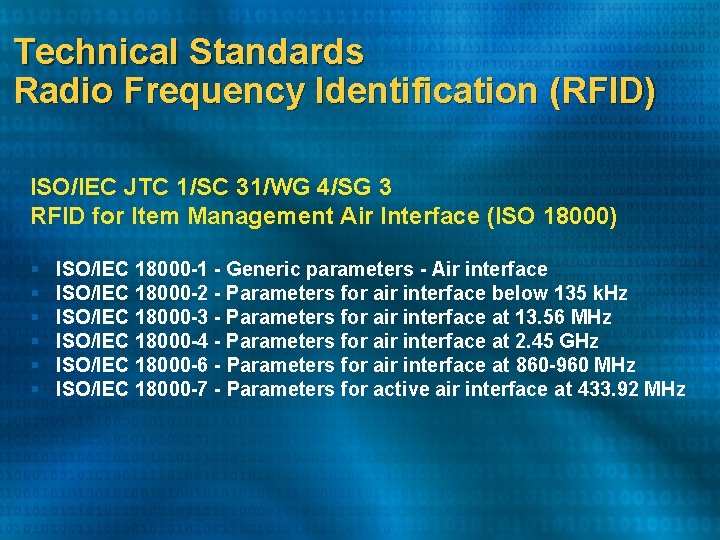
Technical Standards Radio Frequency Identification (RFID) ISO/IEC JTC 1/SC 31/WG 4/SG 3 RFID for Item Management Air Interface (ISO 18000) § § § ISO/IEC 18000 -1 - Generic parameters - Air interface ISO/IEC 18000 -2 - Parameters for air interface below 135 k. Hz ISO/IEC 18000 -3 - Parameters for air interface at 13. 56 MHz ISO/IEC 18000 -4 - Parameters for air interface at 2. 45 GHz ISO/IEC 18000 -6 - Parameters for air interface at 860 -960 MHz ISO/IEC 18000 -7 - Parameters for active air interface at 433. 92 MHz
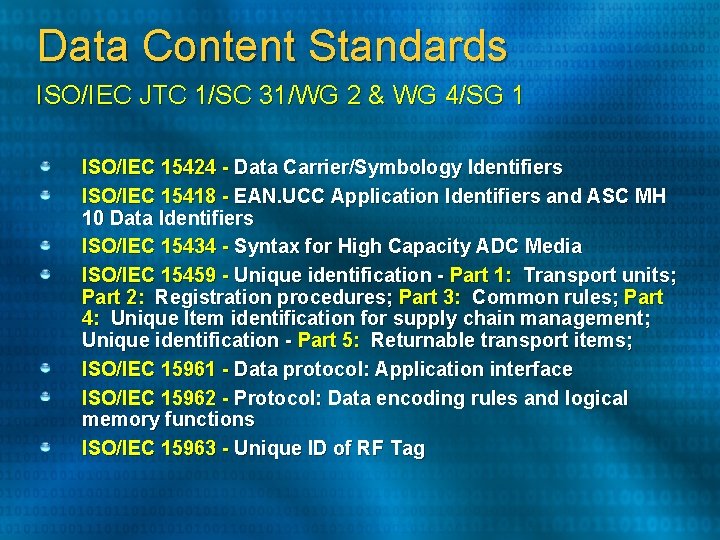
Data Content Standards ISO/IEC JTC 1/SC 31/WG 2 & WG 4/SG 1 ISO/IEC 15424 - Data Carrier/Symbology Identifiers ISO/IEC 15418 - EAN. UCC Application Identifiers and ASC MH 10 Data Identifiers ISO/IEC 15434 - Syntax for High Capacity ADC Media ISO/IEC 15459 - Unique identification - Part 1: Transport units; Part 2: Registration procedures; Part 3: Common rules; Part 4: Unique Item identification for supply chain management; Unique identification - Part 5: Returnable transport items; ISO/IEC 15961 - Data protocol: Application interface ISO/IEC 15962 - Protocol: Data encoding rules and logical memory functions ISO/IEC 15963 - Unique ID of RF Tag
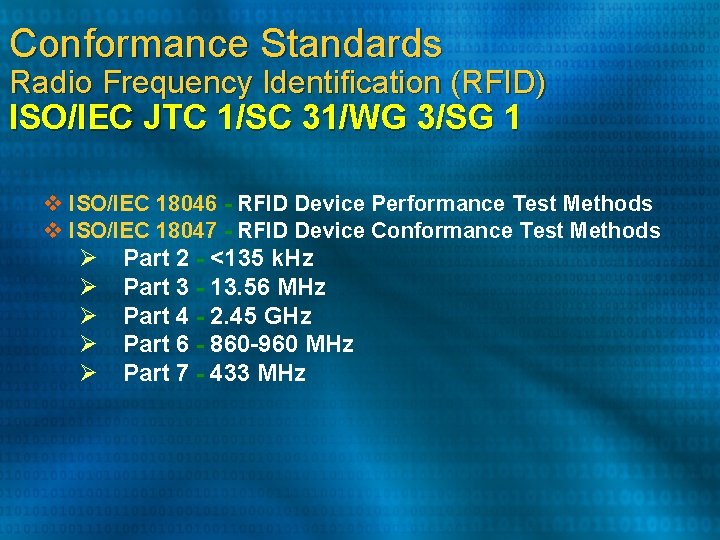
Conformance Standards Radio Frequency Identification (RFID) ISO/IEC JTC 1/SC 31/WG 3/SG 1 v ISO/IEC 18046 - RFID Device Performance Test Methods v ISO/IEC 18047 - RFID Device Conformance Test Methods Ø Part 2 - <135 k. Hz Ø Part 3 - 13. 56 MHz Ø Part 4 - 2. 45 GHz Ø Part 6 - 860 -960 MHz Ø Part 7 - 433 MHz
ISO TC 122/104 Joint Working Group (JWG) (Supply chain applications of RFID)
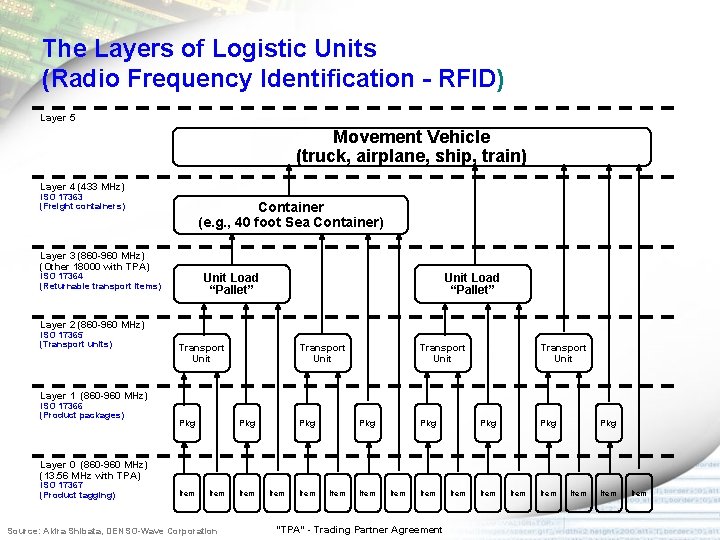
The Layers of Logistic Units (Radio Frequency Identification - RFID) Layer 5 Movement Vehicle (truck, airplane, ship, train) Layer 4 (433 MHz) ISO 17363 (Freight containers) Container (e. g. , 40 foot Sea Container) Layer 3 (860 -960 MHz) (Other 18000 with TPA) Unit Load “Pallet” ISO 17364 (Returnable transport items) Unit Load “Pallet” Layer 2 (860 -960 MHz) ISO 17365 (Transport units) Transport Unit Layer 1 (860 -960 MHz) ISO 17366 (Product packages) Pkg Pkg Layer 0 (860 -960 MHz) (13. 56 MHz with TPA) ISO 17367 (Product tagging) Item Source: Akira Shibata, DENSO-Wave Corporation Item Item “TPA” - Trading Partner Agreement Item Item
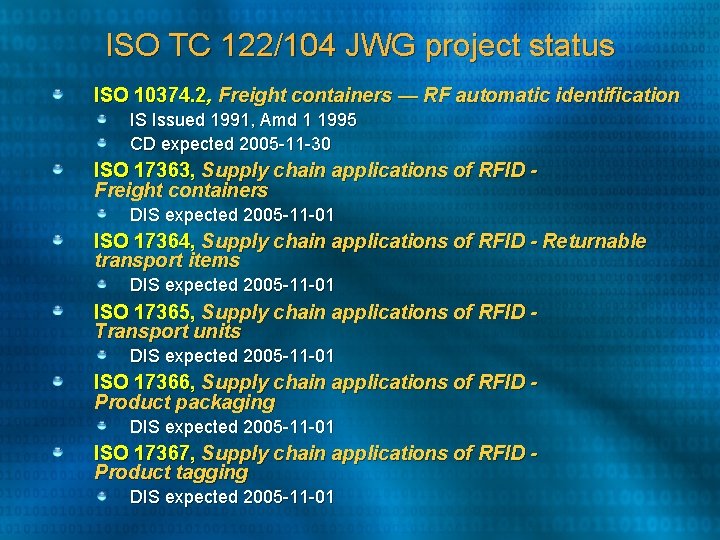
ISO TC 122/104 JWG project status ISO 10374. 2, Freight containers — RF automatic identification IS Issued 1991, Amd 1 1995 CD expected 2005 -11 -30 ISO 17363, Supply chain applications of RFID Freight containers DIS expected 2005 -11 -01 ISO 17364, Supply chain applications of RFID - Returnable transport items DIS expected 2005 -11 -01 ISO 17365, Supply chain applications of RFID Transport units DIS expected 2005 -11 -01 ISO 17366, Supply chain applications of RFID Product packaging DIS expected 2005 -11 -01 ISO 17367, Supply chain applications of RFID Product tagging DIS expected 2005 -11 -01
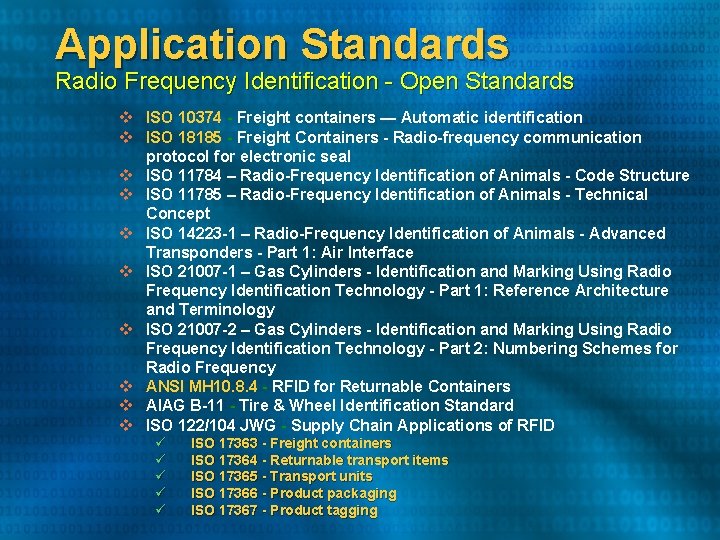
Application Standards Radio Frequency Identification - Open Standards v ISO 10374 - Freight containers — Automatic identification v ISO 18185 - Freight Containers - Radio-frequency communication protocol for electronic seal v ISO 11784 – Radio-Frequency Identification of Animals - Code Structure v ISO 11785 – Radio-Frequency Identification of Animals - Technical Concept v ISO 14223 -1 – Radio-Frequency Identification of Animals - Advanced Transponders - Part 1: Air Interface v ISO 21007 -1 – Gas Cylinders - Identification and Marking Using Radio Frequency Identification Technology - Part 1: Reference Architecture and Terminology v ISO 21007 -2 – Gas Cylinders - Identification and Marking Using Radio Frequency Identification Technology - Part 2: Numbering Schemes for Radio Frequency v ANSI MH 10. 8. 4 - RFID for Returnable Containers v AIAG B-11 - Tire & Wheel Identification Standard v ISO 122/104 JWG - Supply Chain Applications of RFID ü ü ü ISO 17363 - Freight containers ISO 17364 - Returnable transport items ISO 17365 - Transport units ISO 17366 - Product packaging ISO 17367 - Product tagging
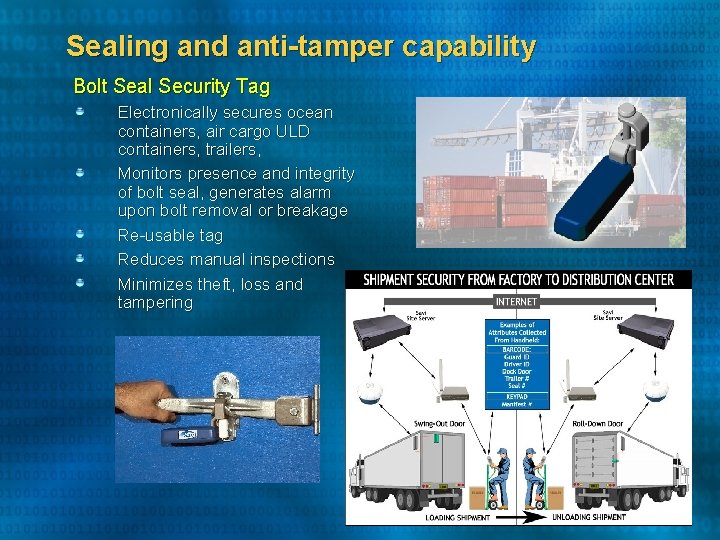
Sealing and anti-tamper capability Bolt Seal Security Tag Electronically secures ocean containers, air cargo ULD containers, trailers, Monitors presence and integrity of bolt seal, generates alarm upon bolt removal or breakage Re-usable tag Reduces manual inspections Minimizes theft, loss and tampering
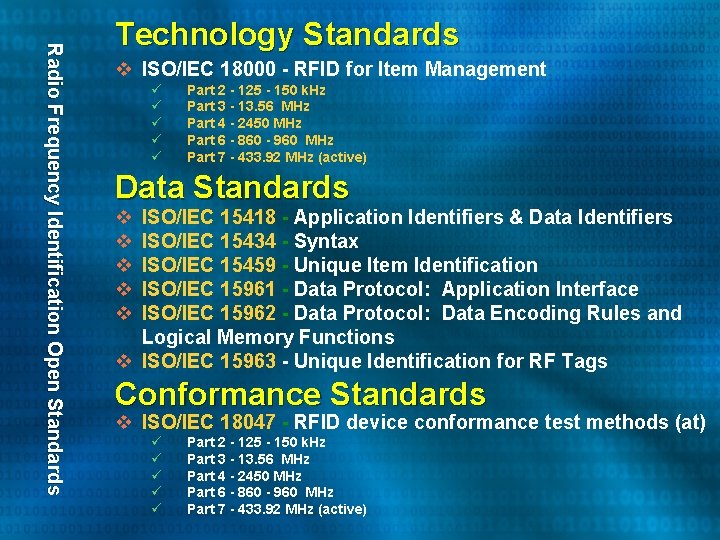
R a d i o F r e q u e n c y I d e n ti fi c a ti o n O p e n S ta n d a r d s Technology Standards v ISO/IEC 18000 - RFID for Item Management ü ü ü Part 2 - 125 - 150 k. Hz Part 3 - 13. 56 MHz Part 4 - 2450 MHz Part 6 - 860 - 960 MHz Part 7 - 433. 92 MHz (active) Data Standards v v v ISO/IEC 15418 - Application Identifiers & Data Identifiers ISO/IEC 15434 - Syntax ISO/IEC 15459 - Unique Item Identification ISO/IEC 15961 - Data Protocol: Application Interface ISO/IEC 15962 - Data Protocol: Data Encoding Rules and Logical Memory Functions v ISO/IEC 15963 - Unique Identification for RF Tags Conformance Standards v ISO/IEC 18047 - RFID device conformance test methods (at) ü ü ü Part 2 - 125 - 150 k. Hz Part 3 - 13. 56 MHz Part 4 - 2450 MHz Part 6 - 860 - 960 MHz Part 7 - 433. 92 MHz (active)
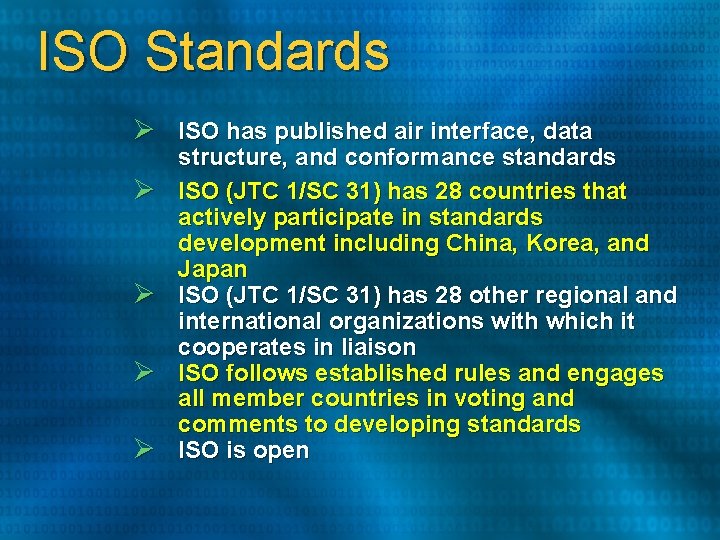
ISO Standards Ø ISO has published air interface, data Ø Ø structure, and conformance standards ISO (JTC 1/SC 31) has 28 countries that actively participate in standards development including China, Korea, and Japan ISO (JTC 1/SC 31) has 28 other regional and international organizations with which it cooperates in liaison ISO follows established rules and engages all member countries in voting and comments to developing standards ISO is open
The Five Cent Tag
Instant Checkout…A Dream Come True? ? “Chip to remove shopping blues” —Post-Courier, January 1994 “ 1. 5¢ electronic bar code announced” —San Francisco Chronicle “Tiny microchip identifies groceries in seconds. ” —Chicago Tribune “Scanning range of four yards” “Checkout in one minute” —NY Times —The Times, London
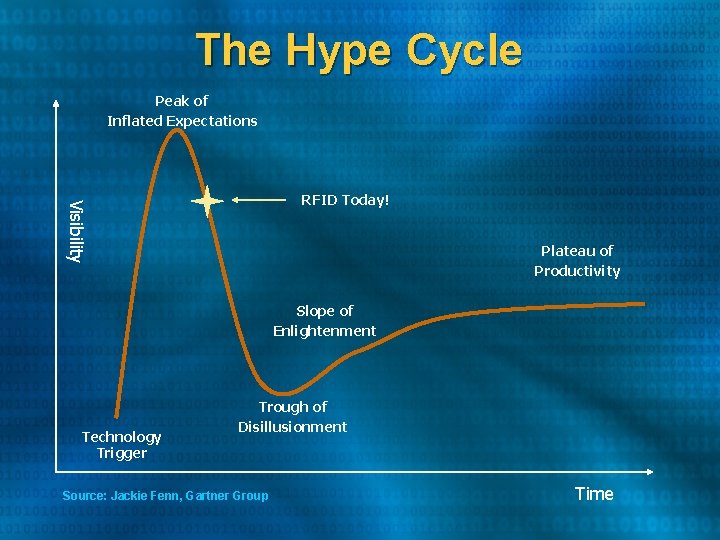
The Hype Cycle Peak of Inflated Expectations Visibility RFID Today! Plateau of Productivity Slope of Enlightenment Technology Trigger Trough of Disillusionment Source: Jackie Fenn, Gartner Group Time
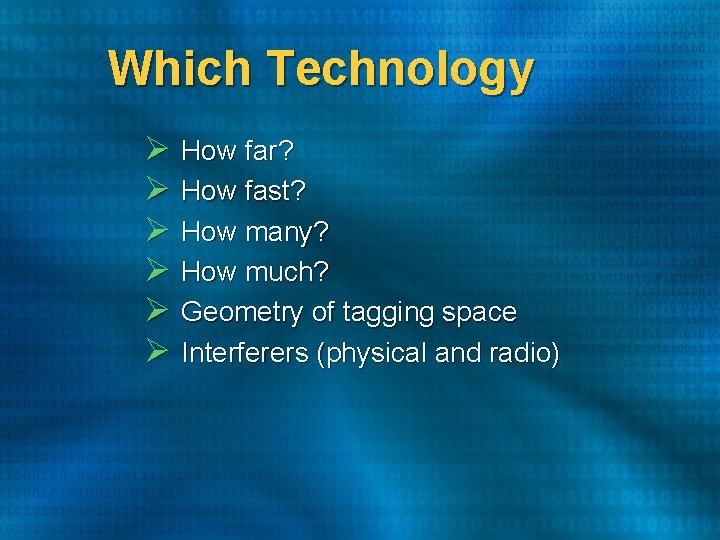
Which Technology Ø How far? Ø How fast? Ø How many? Ø How much? Ø Geometry of tagging space Ø Interferers (physical and radio)
How far, how fast, how many, how much, attached to what?
Recent Developments Ø 860 - 960 MHz Includes Industrial, Scientific, & Medical (ISM) band Technology enhancement (frequency agile and listen before talk) permits 902 - 928 MHz used in Region 2 (U. S. ) 865. 6 - 867. 6 MHz nearing finalization in Region 1 (Europe) 908. 5 - 914 MHz regulations finalized in Region 3 (Korea) 950 - 956 MHz regulations in process in Region 3 (Japan - Jul ‘ 05) Engaging China to develop “in band” regulations (regulations expected by 1 September 2005) ISO/IEC 18000 -6 (860 -960 MHz) re-opened to address new developments, such as Gen 2
Recent Developments Ø 433. 92 MHz ü ü ü ISM band permitted by ITU (implemented in Region 1 but for different parameters in Regions 2 and 3) ITU receptive to Regions 2 and 3 supporting Region 1 for a 433 MHz allocation for freight containers Chairman of ISO TC 104 (Freight containers) has made request to ITU and WCO to embrace both passive (860 960) and active (433. 92 MHz) calling out 18000 -6 and 18000 -7 Approved in Korea Approval expected in Japan (Nov ‘ 05) Received support through new (April 2004) FCC rules, specific to RFID, that increases both power and duty cycle. Engaging China to develop 434 MHz in RFID regulations (regulations expected by 1 September 2005)
China is sensitive to foreign Intellectual Property Technology I. P. Subscription I. P. Access I. P. As a WTO member China will most likely accept the technology with some concessions from I. P. holders China has its own National Product Code and D-NPC will most likely be preferred to EPC China considers its data and communications to be national security issues so the data base will be Chinese in China and not likely EPCIS. China is pushing for an Asian standard that will most likely include 18000 -6, 18000 -7, NPC, their own R 1 Data Harmonization Network
RFID Experts Group (REG)
RFID Experts Group Formed in February 2004 to assist Do. D with RFID implementation Under the AIM Global umbrella in July 2004 Reaching out for international cooperation Europe Japan Korea China
REG Working Groups (WGs) Ø WG 5 -I: Interrogator System Implementation & Ø Ø Ø Operations WG 5 -B: Back-up WG 5 -L: Enabled Labels & Packaging WG 5 -R: Recyclability WG 5 -Q: Tag Quality WG 5 -E: Education & Certification WG 5 -G: Global Operation (Regulatory) WG 5 -P: Privacy WG 5 -F: Safety (Public Policy) WG : 5 -C: Security WG : 5 -T: Sensors and Transducers WG 5 -S: Technology Selection WG 5 -C: Software & Middleware
ISO/IEC Implementation TRs ISO/IEC 24729 -1, Information technology — Radio frequency identification for item management — Implementation guidelines – Part 1: RFID-enabled labels and packaging Source: REG WG 5 -L & 5 -B ISO/IEC 24729 -2, Information technology — Radio frequency identification for item management — Implementation guidelines – Part 2: Recyclability of RF tags Source: REG WG 5 -R ISO/IEC 24729 -3, Information technology — Radio frequency identification for item management — Implementation guidelines – Part 3: RFID interrogator/antenna installation Source: REG WG 5 -I
Recommendations Ø Commence the development of industry standards using ISO 1736 x as model ü ü ü ISO 17363 - Supply chain applications of RFID - Freight containers ISO 17364 - Supply chain applications of RFID - Returnable transport items ISO 17365 - Supply chain applications of RFID - Transport units ISO 17366 - Supply chain applications of RFID - Product packaging ISO 17367 - Supply chain applications of RFID - Product tagging Ø Use common air interface, syntax, and semantics Ø Data structures can follow existing suite of industry bar code standards (plus unique identification)
Thank You!!!