
The Emergence of the Global Fintech Market Economic
The Emergence of the Global Fintech Market: Economic and Technological Determinants Christian Haddad EDHEC Business School, France Lars Hornuf University of Bremen, Germany
Outline ▬ ▬ ▬ ▬ ▬ Introduction Motivation Research question Hypotheses Data and method Summary statistics Empirical results Policy implication Conclusion 2
INTRODUCTION ▬ It is defined as a process whereby a smaller company with fewer resources is able to successfully challenge established incumbent businesses (Christensen, Raynor, and Mc. Donald, 2015). ▬ Amazon’s evolutionary disruption of the publishing industry, to Uber’s emergence distrupting the taxi industry, to Airbnb upsetting the hotel industry (Zachariadis and Ozcan, 2017). ▬ ATMs enabled the explosive growth of retail finance during the last decades of the 20 th century and Online banking (1999) ▬ Fintech has revolutionized the financial industry by changing the way consumers interact with banks 3
MOTIVATION ▬ Crowdlending : Scholars have analyzed : • The geography of investor behavior (Lin and Viswanathan, 2015) • The likelihood of loan defaults (Serrano-Cinca et al. , 2015; Iyer et al. , 2016) • Investors privacy preferences when making an investment decision (Burtch et al. , 2016) ▬ Equity crowdfunding & reward-based crowdfunding : Researchers have investigated: • The dynamics of success and failure among crowdfunded ventures (Mollick, 2014) • The determinants of funding success (Ahlers et al. , 2015; Vulkan et al. , 2016) • The regulation of equity crowdfunding (Hornuf and Schwienbacher, 2016) ▬ Risk and regulatory : Bohme et al. , 2015; Gandal and Halaburda, 2016 ▬ Social trading platforms : Doering et al. , 2015 ▬ Robo-advisors : Fein, 2015 ▬ Mobile payment and e-wallet services : Mjolsnes and Rong, 2003; Mallat et al. , 2004, Mallat, 2007 4
MOTIVATION ▬ Global European crowdfunding market : Dushnisky et al. (2016) Provide a comprehensive overview of the European market Conclude that legal and cultural traits affect crowdfunding platformation ▬ Global venture capitalist investments : Cumming and Schwienbacher (2016) Examine venture capitalist investments in fintech startups around the world Attribute venture capital deals in the fintech sector to the differential enforcement of financial institution rules among startups versus large established financial institutions after the financial crisis 5
RESEARCH QUESTION Why do some countries have more Fintech startups than others ? 6
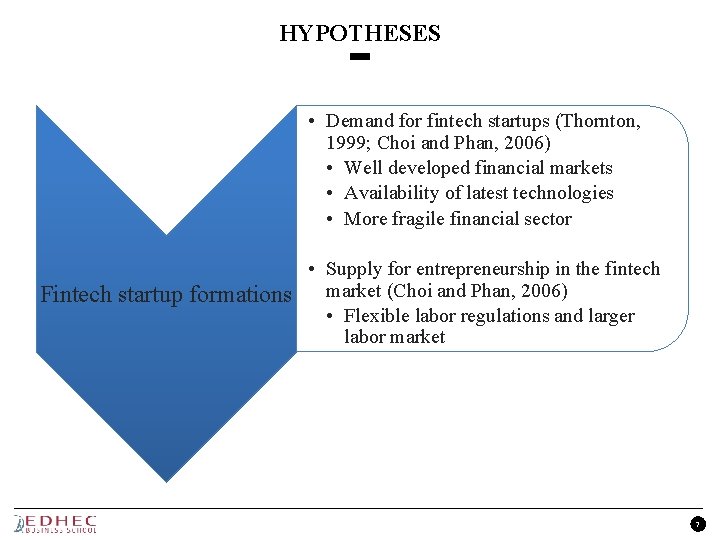
HYPOTHESES • Demand for fintech startups (Thornton, 1999; Choi and Phan, 2006) • Well developed financial markets • Availability of latest technologies • More fragile financial sector • Supply for entrepreneurship in the fintech Fintech startup formations market (Choi and Phan, 2006) • Flexible labor regulations and larger labor market 7
HYPOTHESES H 1: Fintech startups formations occur more frequently in countries with welldeveloped economies and capital markets • Access to capital is more available in well-developed economies • Larger capital market offers greater opportunities to distrupt established financial institutitions H 2: Fintech startups formations occur more frequently in countries where the latest technology and supporting infrastructure are readily available • Technological advancements are among the most important drivers of entrepreneurship • Mobile and smartphone usage accelerated the change through digitalization 8
HYPOTHESES H 3: Fintech startup formations occur more frequently in countries with a more fragile financial sector • Lack of trust in the banking sector • The increased cost of debt to small firms • The strict regulation that applies on banks H 4: Fintech startups are more frequent in countries with a more benevolent and a larger labor market • Flexible labor market regulation • Large labor force 9
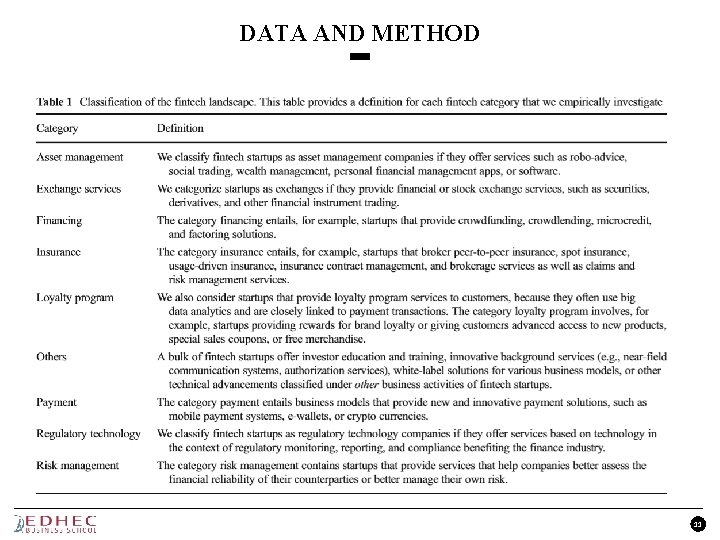
DATA AND METHOD ▬ Crunch. Base database (Bernstein et al. , 2016; Cumming et al. , 2016). ▬ 7, 353 fintech startups. ▬ Period studied 2005 – 2015 covering 107 countries ▬ We categorize nine types of startups (EY, 2016; WEF, 2017) : Asset management Exchange services Financing Insurance Loyalty program Others Payment Regulatory technology Risk management 10
DATA AND METHOD 11
SUMMARY STATISTICS 12
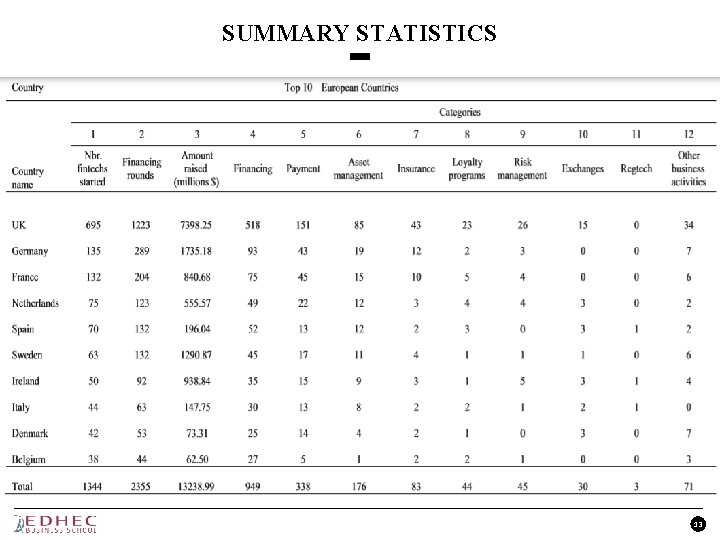
SUMMARY STATISTICS 13
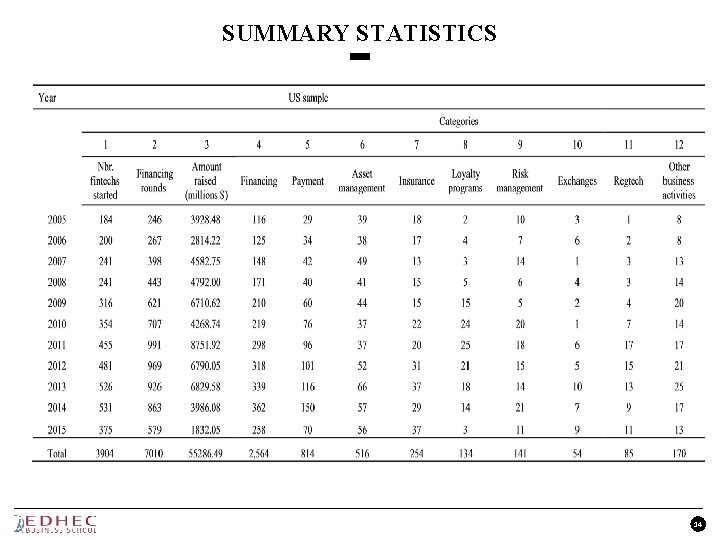
SUMMARY STATISTICS 14
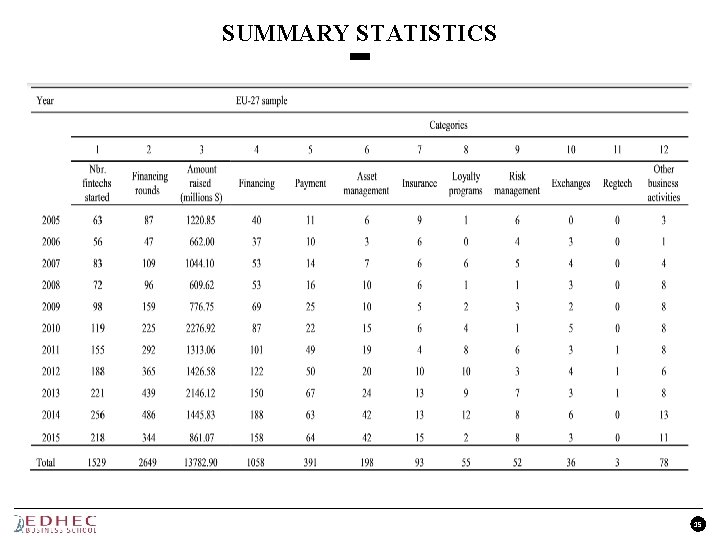
SUMMARY STATISTICS 15
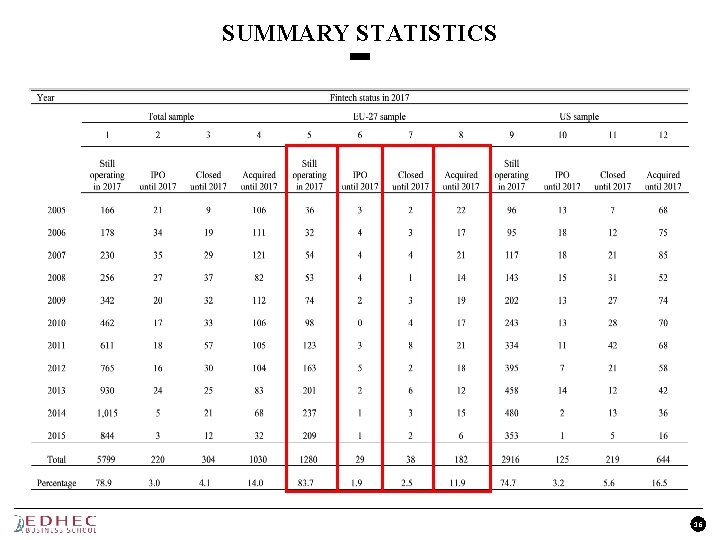
SUMMARY STATISTICS 16
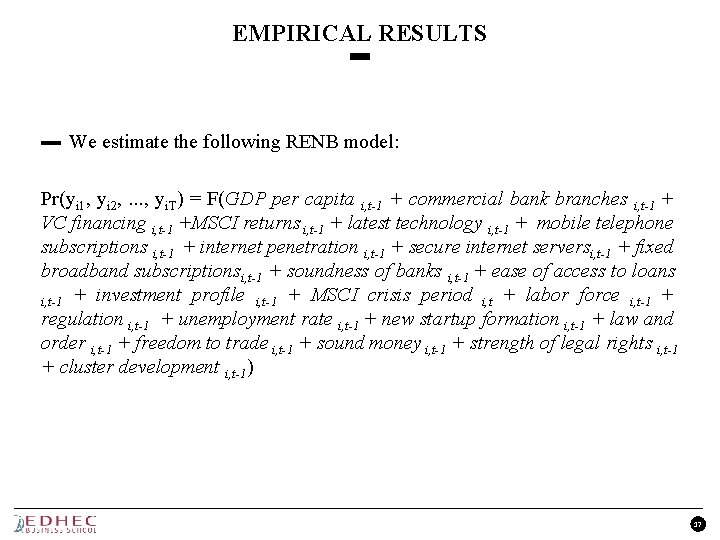
EMPIRICAL RESULTS ▬ We estimate the following RENB model: Pr(yi 1, yi 2, . . . , yi. T) = F(GDP per capita i, t-1 + commercial bank branches i, t-1 + VC financing i, t-1 +MSCI returns i, t-1 + latest technology i, t-1 + mobile telephone subscriptions i, t-1 + internet penetration i, t-1 + secure internet serversi, t-1 + fixed broadband subscriptionsi, t-1 + soundness of banks i, t-1 + ease of access to loans i, t-1 + investment profile i, t-1 + MSCI crisis period i, t + labor force i, t-1 + regulation i, t-1 + unemployment rate i, t-1 + new startup formation i, t-1 + law and order i, t-1 + freedom to trade i, t-1 + sound money i, t-1 + strength of legal rights i, t-1 + cluster development i, t-1) 17
EMPIRICAL RESULTS 18
EMPIRICAL RESULTS 19
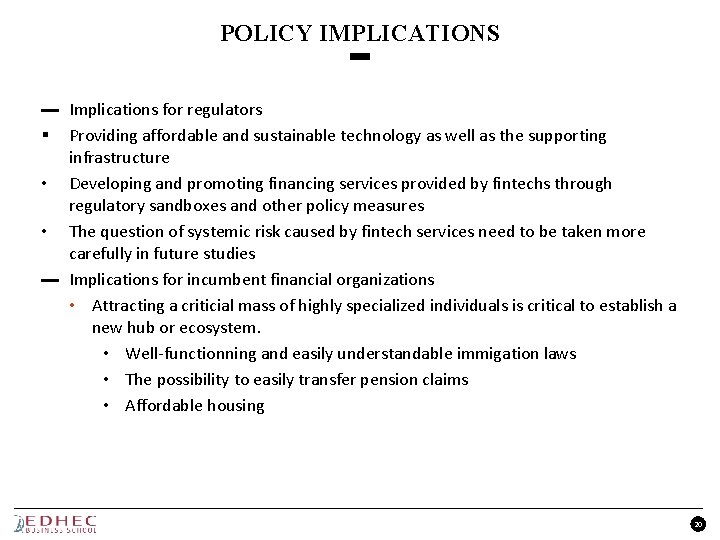
POLICY IMPLICATIONS ▬ Implications for regulators § Providing affordable and sustainable technology as well as the supporting infrastructure • Developing and promoting financing services provided by fintechs through regulatory sandboxes and other policy measures • The question of systemic risk caused by fintech services need to be taken more carefully in future studies ▬ Implications for incumbent financial organizations • Attracting a criticial mass of highly specialized individuals is critical to establish a new hub or ecosystem. • Well-functionning and easily understandable immigation laws • The possibility to easily transfer pension claims • Affordable housing 20
POLICY IMPLICATIONS ▬ Implications for fintech entrepreneurs • Keeping Fintech innovative unique ideas away from banks and large established firms • Cooperation with banks might make sense in some cases • Monitoring upcoming changes in the regulatory environment ▬ • • • Implications for investors in fintechs Promoting the development of venture capital financing Opportunities for investors are available in both developed and developing countries Caution is needed when investing in some sectors of fintechs like equity crowdfunfing 21
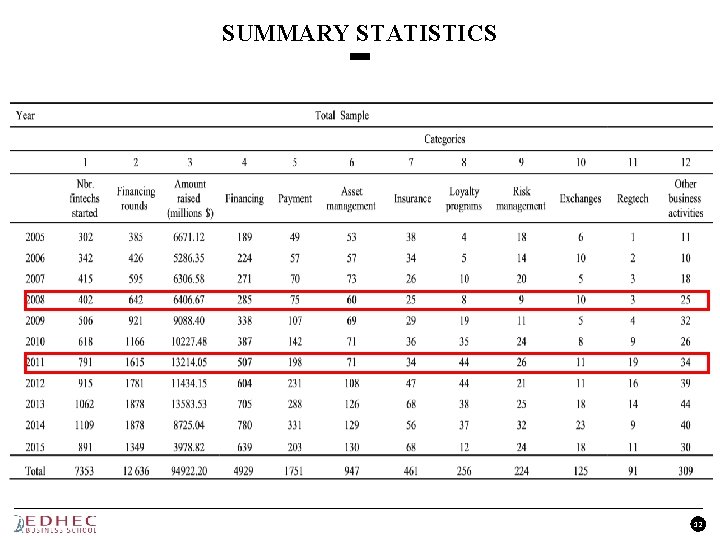
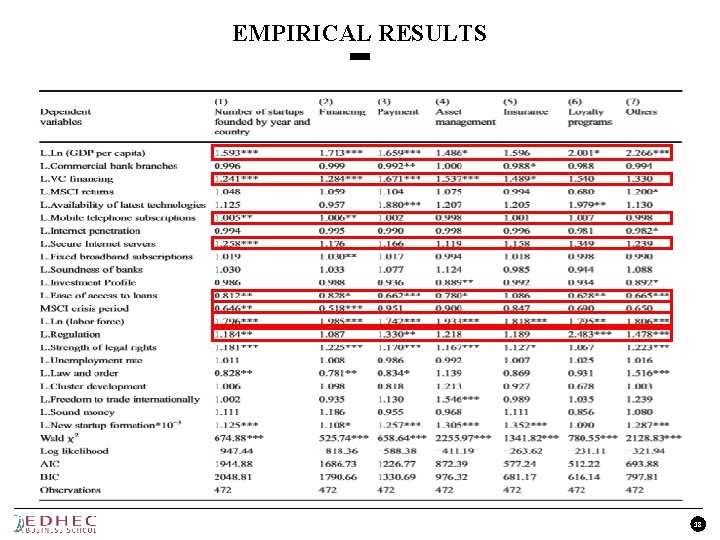
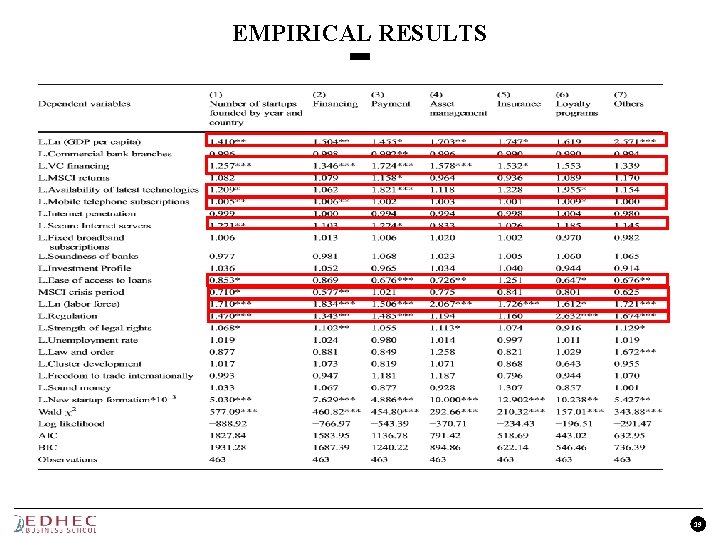
CONCLUSION ▬ Explored the global fintech market • USA had the largest fintech market until 2015 • Financing is the most important segment of the emerging market ▬ Empirical findings • Countries witness more fintech startup formations when : • The economy is well developed and venture capital is available • The economy has secured internet severs, more mobile telephone subscriptions and available labor force • The economy suffered more from the financial crisis and credit loans are unavailable 22

Thank you! Contact information: Christian. haddad@edhec. edu
- Slides: 23