
The Emergence of Systems Biology Vijay Saraswat IBM
The Emergence of Systems Biology Vijay Saraswat IBM TJ Watson Research Center and The Pennsylvania State University
Systems Biology Goal: To help the biologist model, simulate, analyze, design and diagnose biological systems. n Develop system-level understanding of biological systems q q q n q Genomic DNA, Messenger RNA, proteins, information pathways, signaling networks Intra-cellular systems, Intercell regulation… Cells, Organisms n ~12 orders of magnitude in space and time! Key question: Function from Structure q n How do various components of a biological system interact in order to produce complex biological functions? How do you design systems with specific properties (e. g. organs from cells)? Share Formal Theories, Code, Models … Promises profound advances in Biology and Computer Science

Systems Biology n Work subsumes past work on mathematical modeling in biology: q q q Hodgkin-Huxley model for neural firing Michaelis-Menten equation for Enzyme Kinetics Gillespie algorithm for Monte-Carlo simulation of stochastic systems. Bifurcation analysis for Xenopus cell cycle Flux balance analysis, metabolic control analysis… This is not the first time… n Why Now? q q Exploiting genomic data Scale n q q Across the internet, across space and time. Integration of computational tools Integration of new analysis techniques Collaboration using markupbased interlingua Moore’s Law!
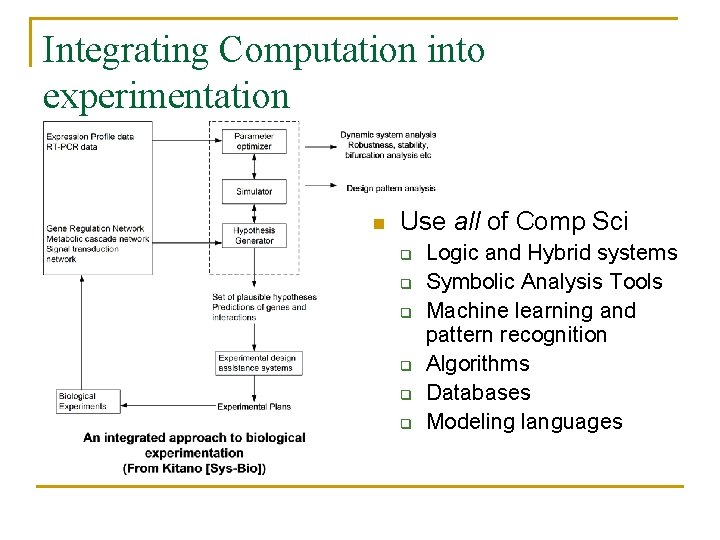
Integrating Computation into experimentation n Use all of Comp Sci q q q Logic and Hybrid systems Symbolic Analysis Tools Machine learning and pattern recognition Algorithms Databases Modeling languages
Area is Exploding in interest… n Conferences… q q q n Bio. Concur ‘ 03 Pacific Sym Bio. Computing ‘ 04 International Workshop on Systems Biology Comp Methods in Sys Bio, 2004 Systeomatics 2004 Websites q q q www. sbml. org www. cellml. org www. systemsbiology. org n Projects q q q Bio. Spice (DARPA) Cell. ML (U Auckland) SBML n q Post-genomic institutes n n Cal. Tech, U Hertfordshire, Argonne, Virginia, U Conn… Harvard/MIT, Princeton Systems q Bio. Spice, Charon, Cellerator, COPASI, DBSolve, E-Cell, Gepasi, Jarnac, JDesigner, Jig. Cell, Net. Builder, Stoch. Sim, Virtual Cell…
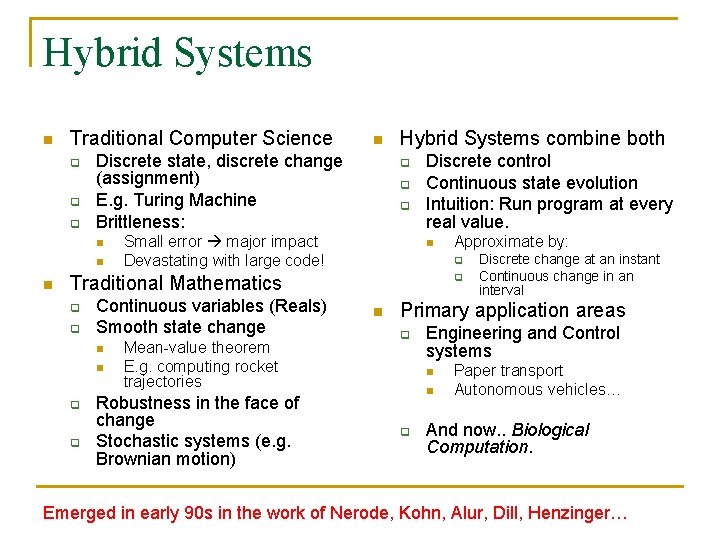
Hybrid Systems n Traditional Computer Science q q q Discrete state, discrete change (assignment) E. g. Turing Machine Brittleness: n n Hybrid Systems combine both q q q Small error major impact Devastating with large code! Discrete control Continuous state evolution Intuition: Run program at every real value. n q Traditional Mathematics q q Continuous variables (Reals) Smooth state change n n q q Mean-value theorem E. g. computing rocket trajectories Robustness in the face of change Stochastic systems (e. g. Brownian motion) Approximate by: q n Discrete change at an instant Continuous change in an interval Primary application areas q Engineering and Control systems n n q Paper transport Autonomous vehicles… And now. . Biological Computation. Emerged in early 90 s in the work of Nerode, Kohn, Alur, Dill, Henzinger…
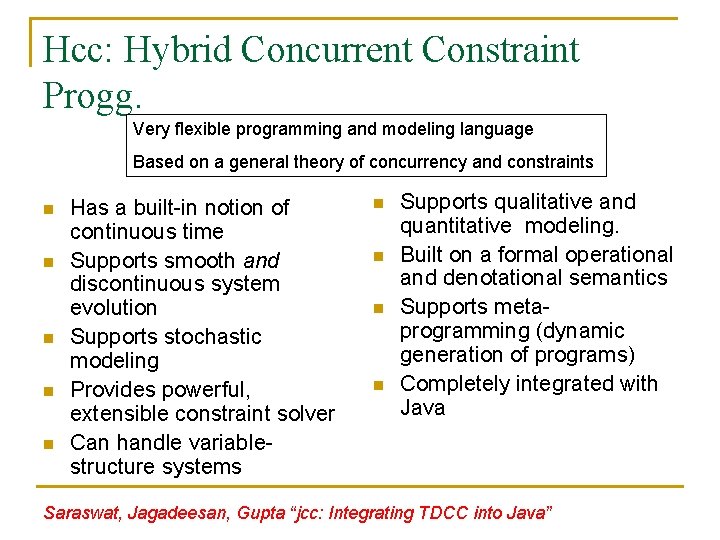
Hcc: Hybrid Concurrent Constraint Progg. Very flexible programming and modeling language Based on a general theory of concurrency and constraints n n n Has a built-in notion of continuous time Supports smooth and discontinuous system evolution Supports stochastic modeling Provides powerful, extensible constraint solver Can handle variablestructure systems n n Supports qualitative and quantitative modeling. Built on a formal operational and denotational semantics Supports metaprogramming (dynamic generation of programs) Completely integrated with Java Saraswat, Jagadeesan, Gupta “jcc: Integrating TDCC into Java”
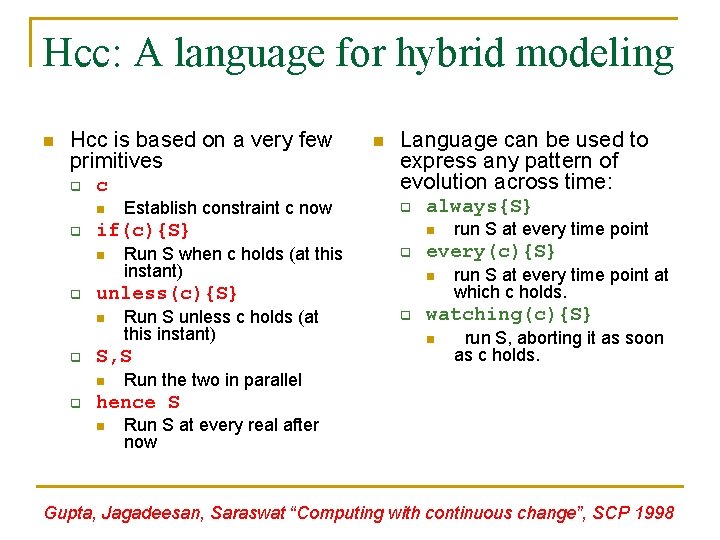
Hcc: A language for hybrid modeling n Hcc is based on a very few primitives q c n q Run S when c holds (at this instant) Run S unless c holds (at this instant) S, S n q q always{S} n q q run S at every time point every(c){S} n unless(c){S} n q Language can be used to express any pattern of evolution across time: if(c){S} n q Establish constraint c now n run S at every time point at which c holds. watching(c){S} n run S, aborting it as soon as c holds. Run the two in parallel hence S n Run S at every real after now Gupta, Jagadeesan, Saraswat “Computing with continuous change”, SCP 1998
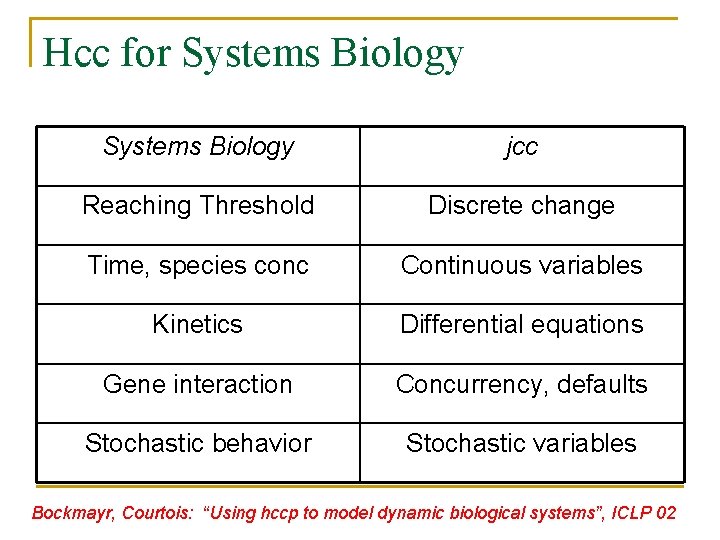
Hcc for Systems Biology jcc Reaching Threshold Discrete change Time, species conc Continuous variables Kinetics Differential equations Gene interaction Concurrency, defaults Stochastic behavior Stochastic variables Bockmayr, Courtois: “Using hccp to model dynamic biological systems”, ICLP 02
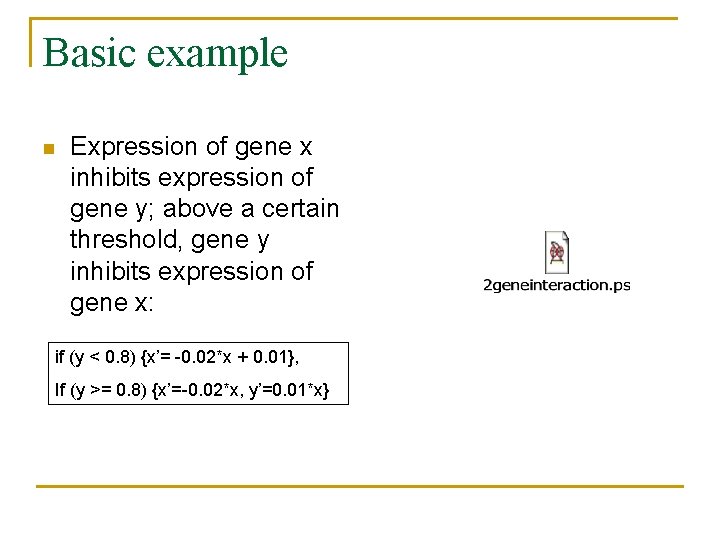
Basic example n Expression of gene x inhibits expression of gene y; above a certain threshold, gene y inhibits expression of gene x: if (y < 0. 8) {x’= -0. 02*x + 0. 01}, If (y >= 0. 8) {x’=-0. 02*x, y’=0. 01*x}
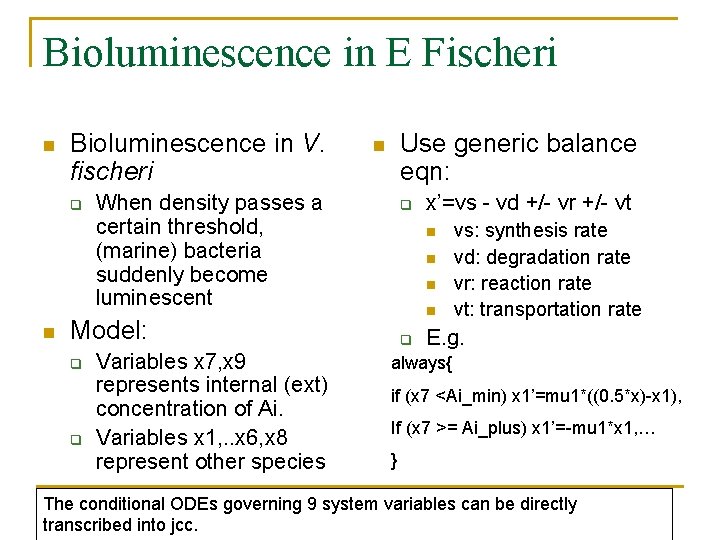
Bioluminescence in E Fischeri n Bioluminescence in V. fischeri q n Use generic balance eqn: n When density passes a certain threshold, (marine) bacteria suddenly become luminescent q n n Model: q q Variables x 7, x 9 represents internal (ext) concentration of Ai. Variables x 1, . . x 6, x 8 represent other species x’=vs - vd +/- vr +/- vt q vs: synthesis rate vd: degradation rate vr: reaction rate vt: transportation rate E. g. always{ if (x 7 <Ai_min) x 1’=mu 1*((0. 5*x)-x 1), If (x 7 >= Ai_plus) x 1’=-mu 1*x 1, … } The conditional ODEs governing 9 system variables can be directly transcribed into jcc.
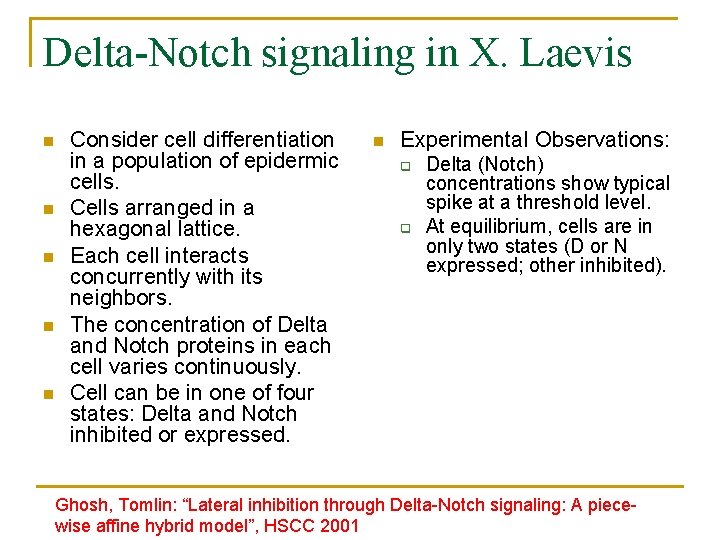
Delta-Notch signaling in X. Laevis n n n Consider cell differentiation in a population of epidermic cells. Cells arranged in a hexagonal lattice. Each cell interacts concurrently with its neighbors. The concentration of Delta and Notch proteins in each cell varies continuously. Cell can be in one of four states: Delta and Notch inhibited or expressed. n Experimental Observations: q q Delta (Notch) concentrations show typical spike at a threshold level. At equilibrium, cells are in only two states (D or N expressed; other inhibited). Ghosh, Tomlin: “Lateral inhibition through Delta-Notch signaling: A piecewise affine hybrid model”, HSCC 2001
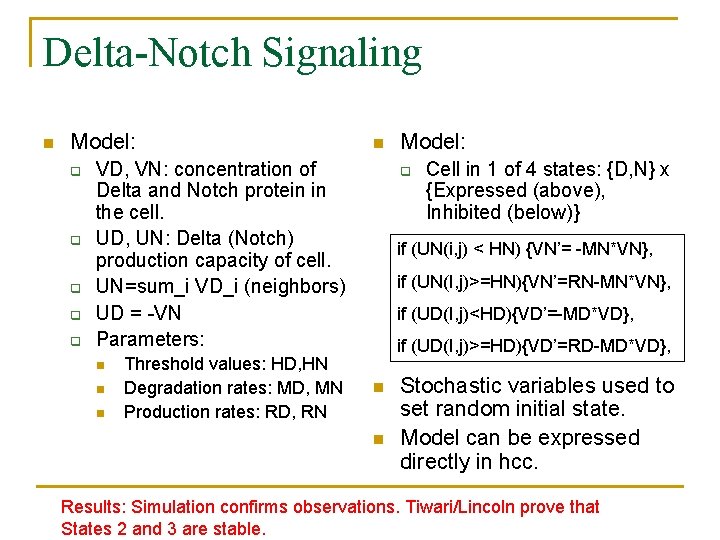
Delta-Notch Signaling n Model: q q q n VD, VN: concentration of Delta and Notch protein in the cell. UD, UN: Delta (Notch) production capacity of cell. UN=sum_i VD_i (neighbors) UD = -VN Parameters: n n n Threshold values: HD, HN Degradation rates: MD, MN Production rates: RD, RN Model: q Cell in 1 of 4 states: {D, N} x {Expressed (above), Inhibited (below)} if (UN(i, j) < HN) {VN’= -MN*VN}, if (UN(I, j)>=HN){VN’=RN-MN*VN}, if (UD(I, j)<HD){VD’=-MD*VD}, if (UD(I, j)>=HD){VD’=RD-MD*VD}, n n Stochastic variables used to set random initial state. Model can be expressed directly in hcc. Results: Simulation confirms observations. Tiwari/Lincoln prove that States 2 and 3 are stable.
Alternative splicing regulation n Alternative splicing occurs in post transcriptional regulation of RNA Through selective elimination of introns, the same premessenger RNA can be used to generate many kinds of mature RNA The SR protein appears to control this process through activation and inhibition. n n Because of complexity, experimentation can focus on only one site at a time. Bockmayr et al use Hybrid CCP to model SR regulation at a single site. q n Michaelis-Menten model using 7 kinetic reactions This is used to create an nsite model by abstracting the action at one site via a splice efficiency function. Results described in [Alt], uses default reasoning properties of HCC.
Programming Languages Issues n Languages for largescale modeling q q n Hi-perf num computation Arrays Stochastic methods Large-scale parallelism (e. g SPMD) Efficient compilation issues q Identify patterns, integrate libraries of highperformance code n Integration of reasoning techniques q n n Syntax/Semantics Integration of Spatial dimension q n Eg finite state analysis of hybrid systems Moving to PDEs Developing models across the Internet q Semantic web… Exciting time for the development of new languages!
Acknowledgements q q [Sys-Bio]: Kitano “Systems Biology: Towards system-level understanding of Biological Systems”, in Foundations of Systems Biology, MIT Press, 2001 [Delta-Notch]: Tiwari, Lincoln “Automatic Techniques for stability analysis of Delta-Notch lateral inhibition mechanism”, CSB 2002. [HCC-Bio]: Bockmayr, Courtois “Using hybrid concurrent constraint programming to model dynamic biological systems”, ICLP 2002 [Alt]: Eveillard, Ropers, de Jong, Branlant, Bockmayr “A multi-site constraint programming model of alternate splicing regulation”, INRIA Tech Rep, May 2003
HCC references q q Gupta, Jagadeesan, Saraswat “Computing with Continuous Change”, Science of Computer Programming, Jan 1998, 30 (1— 2), pp 3 --49 Saraswat, Jagadeesan, Gupta “Timed Default Concurrent Constraint Programming”, Journal of Symbolic Computation, Nov-Dec 1996, 22 (5— 6), pp 475 -520. Gupta, Jagadeesan, Saraswat “Programming in Hybrid Constraint Languages”, Nov 1995, Hybrid Systems II, LNCS 999. Alenius, Gupta “Modeling an AERCam: A case study in modeling with concurrent constraint languages”, CP’ 98 Workshop on Modeling and Constraints, Oct 1998.
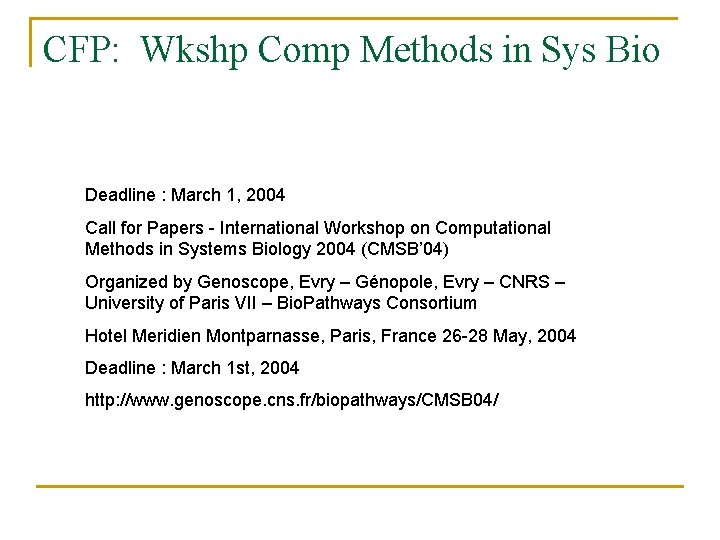
CFP: Wkshp Comp Methods in Sys Bio Deadline : March 1, 2004 Call for Papers - International Workshop on Computational Methods in Systems Biology 2004 (CMSB’ 04) Organized by Genoscope, Evry – Génopole, Evry – CNRS – University of Paris VII – Bio. Pathways Consortium Hotel Meridien Montparnasse, Paris, France 26 -28 May, 2004 Deadline : March 1 st, 2004 http: //www. genoscope. cns. fr/biopathways/CMSB 04/
- Slides: 18