
The Emergence of a Civilization The image above
The Emergence of a Civilization
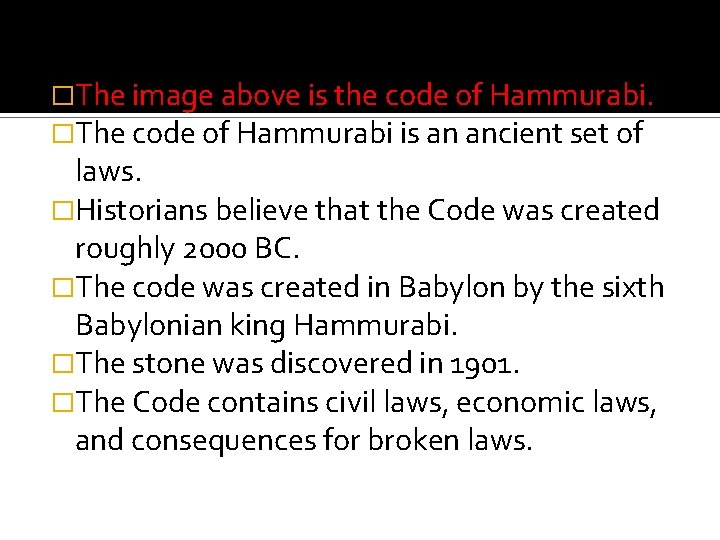
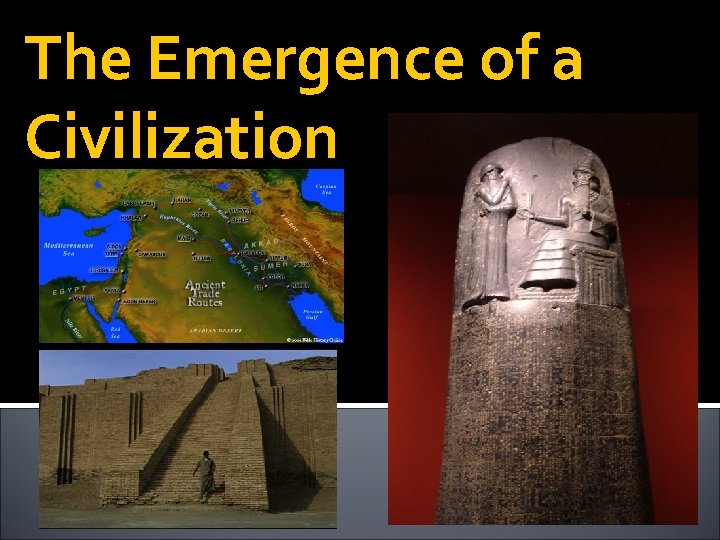
�The image above is the code of Hammurabi. �The code of Hammurabi is an ancient set of laws. �Historians believe that the Code was created roughly 2000 BC. �The code was created in Babylon by the sixth Babylonian king Hammurabi. �The stone was discovered in 1901. �The Code contains civil laws, economic laws, and consequences for broken laws.

How was Writing Invented? �After the emergence of sedentarization writing began to develop. �People needed to keep track of their possessions as well as their surplus. �Furthermore, people needed to have evidence of trade, first “bills” �People also began to document events, first written history began during this time.
Irrigation �The Fertile Crescent had an abundance of fertile land due to the flooding of several rivers. �However, these rivers did not overflow at the same time every year. �People had to take precautions to protect their fields. �Furthermore, precipitation was irregular and very light.

�People began to create irrigation canals. �These canals allowed farmers to water their fields event during times of drought. �This ensured a constant abundance of food. �People also began building dikes. �These dikes protected fields from overflowing rivers. �Reservoirs were created to store water encase of severe drought.
First Civilizations �Agriculture allowed for more people in a society to be fed. �This allowed for more people to develop trades. �Over time these villages grow and become cities. �Chiefs turn into Kings or Emperors, which pass laws that their people must follow. �Writing allowed these laws to be documented
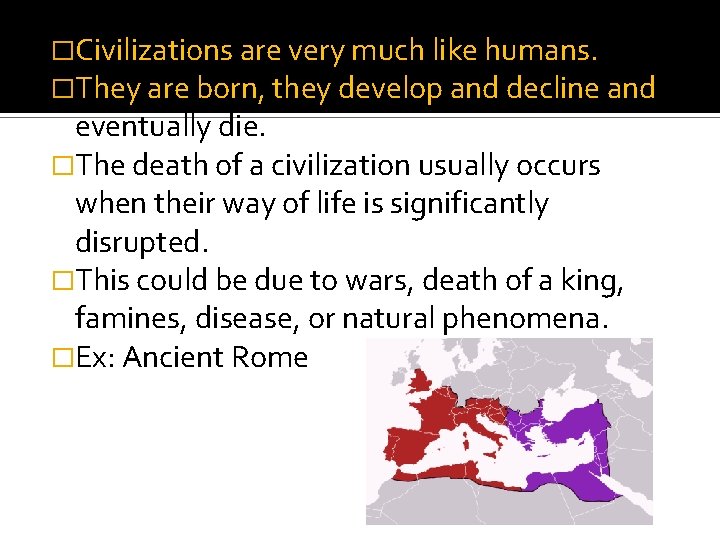
�Civilizations are very much like humans. �They are born, they develop and decline and eventually die. �The death of a civilization usually occurs when their way of life is significantly disrupted. �This could be due to wars, death of a king, famines, disease, or natural phenomena. �Ex: Ancient Rome
Labour and Trade �Writing was a new way of communicating. �It was also a perfect way to keep track of surplus and trading. �It was the surpluses produced by farmers that led to the development of craftsmen and trade. �In Mesopotamia the population split in to more diverse groups.
�Each of these new groups had a specific role and provided a specific service. 1. Peasants: farmed the land, raised livestock, provided manual labour. This group made up most of the population. 2. Craftspeople: made tools, bricks, weapons, pots, etc. They also provided labour to upkeep public buildings. 3. Merchants: were responsible for trading. They imported products different areas. 4. Soldiers: protected the territory and routes used by merchants.

�Merchants would travel very long distances to trade their goods. �Trading journeys could last months or even years. �These trade routes were often very dangerous. Soldiers were needed to protect the caravans. �Merchants used the wheel to help carry products over long distances. �It was this invention that started the first shipping businesses.
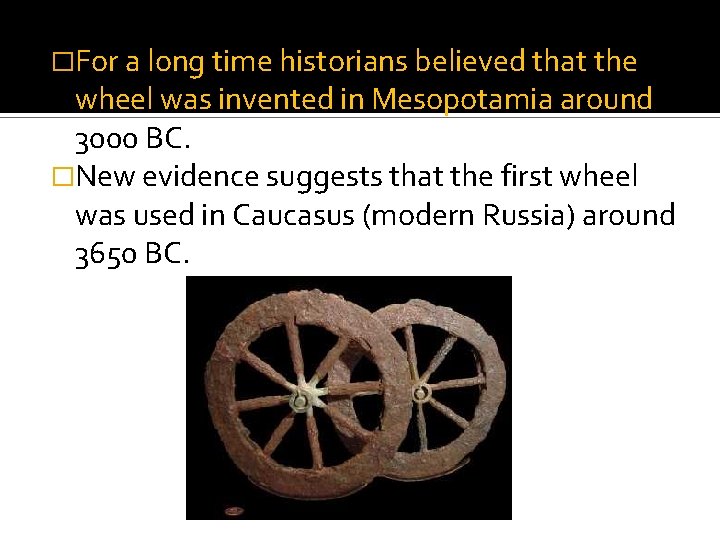
�For a long time historians believed that the wheel was invented in Mesopotamia around 3000 BC. �New evidence suggests that the first wheel was used in Caucasus (modern Russia) around 3650 BC.
Cuneiform and it’s evolution �Cuneiform took almost 1000 years to develop into the written language known to the Mesopotamians. � 3500 BC people began drawing objects and pictograms on clay tablets. �Once the clay had dried the drawings remained, which created the first written documents.
�Pictograms were to represent animals, crops, or religious figures. �It was harder to represent complex situations. For example: conversations. �As the need to record more complex situations pictograms became simpler. �These symbols eventually began representing sounds. �Eventually symbols did not look like the original drawing. They were a system of lines and wedges.
�Cuneiform comes from the Latin word, which mean s nails or corner. �This written language had over 700 different symbols. �It is read from left to right and in rows. �It was used account for surplus, trade, laws and religious traditions. �Not everyone in ancient Mesopotamia could read or write this was seen as an honour and reserved for scribes. � Scribes had to study from when they were very young.
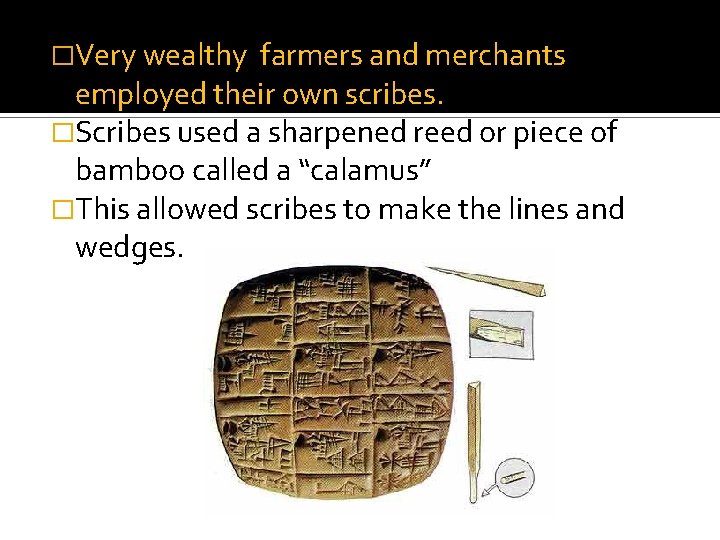
�Very wealthy farmers and merchants employed their own scribes. �Scribes used a sharpened reed or piece of bamboo called a “calamus” �This allowed scribes to make the lines and wedges.
Mesopotamian Society �Mesopotamian society was very hierarchical. �Hierarchical: social organization each group in society must submit and obey to a more powerful group. �There were many social groups. �At the head of society was the king. �Every city in Mesopotamia had its own organization, its own king and its own laws.
Politics in Mesopotamia �There were roughly ten major cities in Mesopotamia. �Each of these cities were independent from one another, but all shared the same religion. �All cities were built near farms and were protected by a large stone wall. �There were two parts to every city the higher part and the lower part.
�The part were broken up into the higher city and the lower city. �The lower city contained houses, shops, and markets. �The higher city included the royal palace, royal warehouses, and the Ziggurat. �The Ziggurat was a temple and considered very sacred land. Very few people were allowed to set foot within its walls. �The higher city was also protected by another wall. �See page 40 in your workbooks.
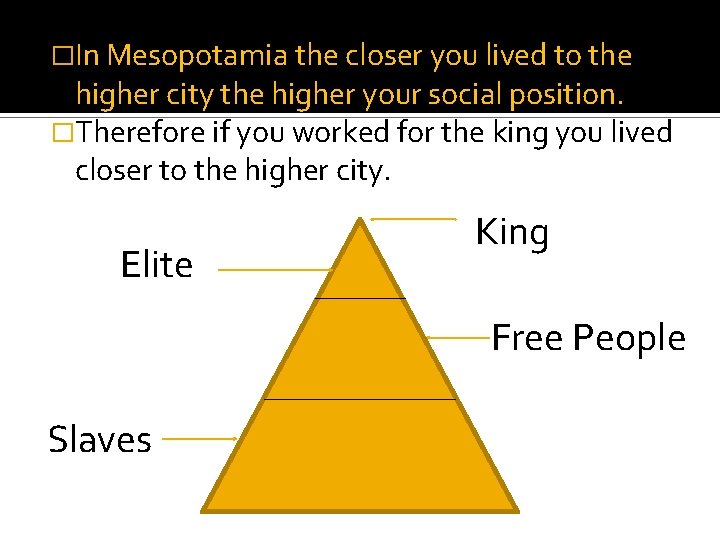
�In Mesopotamia the closer you lived to the higher city the higher your social position. �Therefore if you worked for the king you lived closer to the higher city. Elite King Free People Slaves
Mesopotamian: Law and Justice �Mesopotamian kings made laws. �Once the laws were made it was up to the king to enforce these laws. �The King enforced these laws through his military. �Whoever was caught breaking the kings laws were punished. �One example was the code of Hammurabi �Different cities had different laws.
Mesopotamian Religion �Mesopotamian religion is the oldest known religion. �The Mesopotamians worshiped many gods. �Different Gods had different powers and were worshiped for different reasons. �Religious leaders (high priests) maintained the temples. �Mesopotamian temples were called ziggurats �Priests organized feasts and other festivals.
- Slides: 21