
The EMC effect JLab experimental findings and plans
The EMC effect - JLab experimental findings and plans John Arrington Argonne National Lab 2 nd International Conference on the Initial Stages of High. Energy Nuclear Collisions Dec 6, 2014
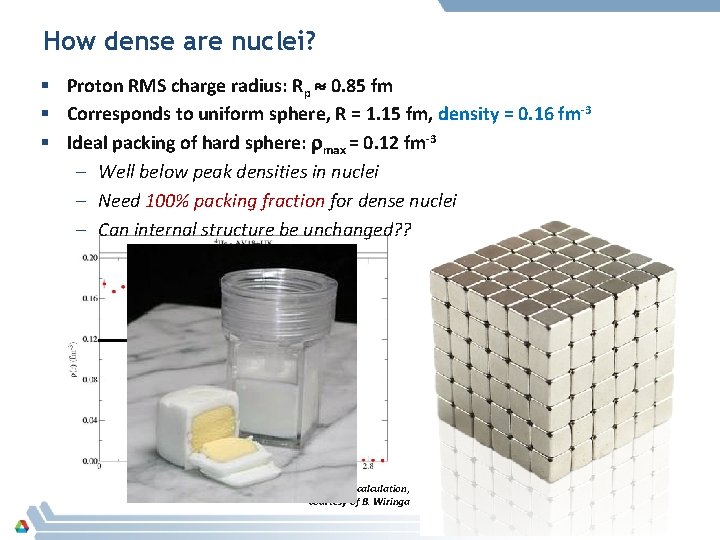
How dense are nuclei? § Proton RMS charge radius: Rp 0. 85 fm § Corresponds to uniform sphere, R = 1. 15 fm, density = 0. 16 fm-3 § Ideal packing of hard sphere: rmax = 0. 12 fm-3 – Well below peak densities in nuclei – Need 100% packing fraction for dense nuclei – Can internal structure be unchanged? ? Ideal packing limit 4 He matter density from GFMC calculation, courtesy of B. Wiringa
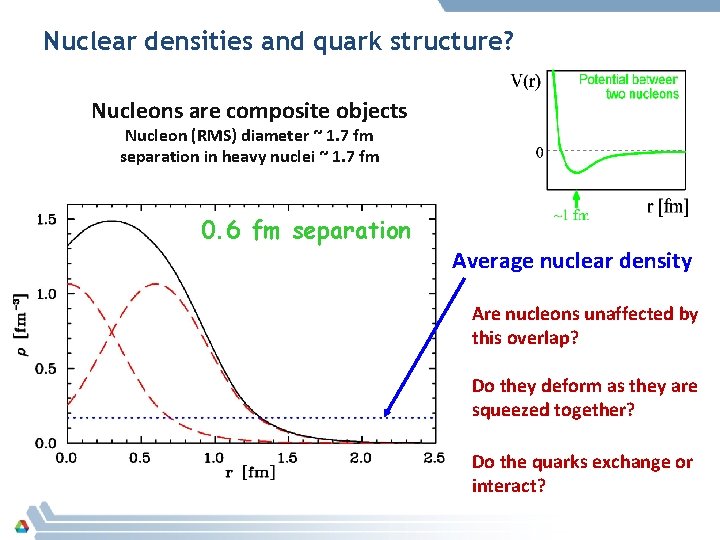
Nuclear densities and quark structure? Nucleons are composite objects Nucleon (RMS) diameter ~ 1. 7 fm separation in heavy nuclei ~ 1. 7 fm separation 1. 2 0. 6 Average nuclear density Are nucleons unaffected by this overlap? Do they deform as they are squeezed together? Do the quarks exchange or interact?
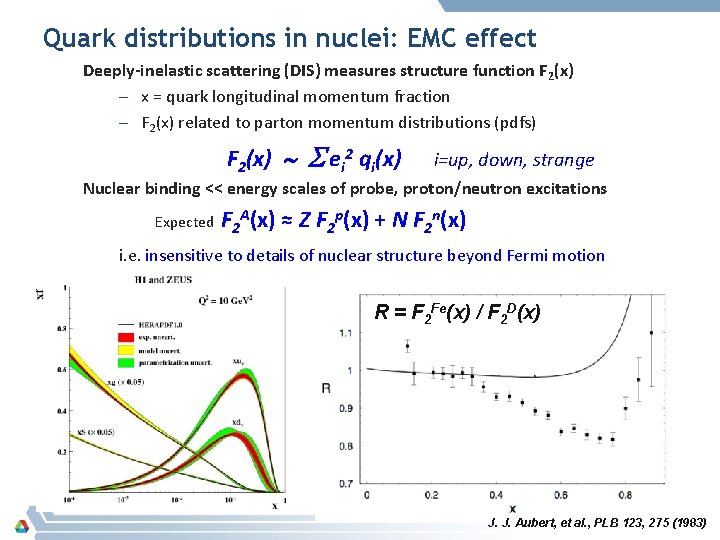
Quark distributions in nuclei: EMC effect Deeply-inelastic scattering (DIS) measures structure function F 2(x) – x = quark longitudinal momentum fraction – F 2(x) related to parton momentum distributions (pdfs) F 2(x) ~ S ei 2 qi(x) i=up, down, strange Nuclear binding << energy scales of probe, proton/neutron excitations Expected F 2 A(x) ≈ Z F 2 p(x) + N F 2 n(x) i. e. insensitive to details of nuclear structure beyond Fermi motion R = F 2 Fe(x) / F 2 D(x) J. J. Aubert, et al. , PLB 123, 275 (1983)
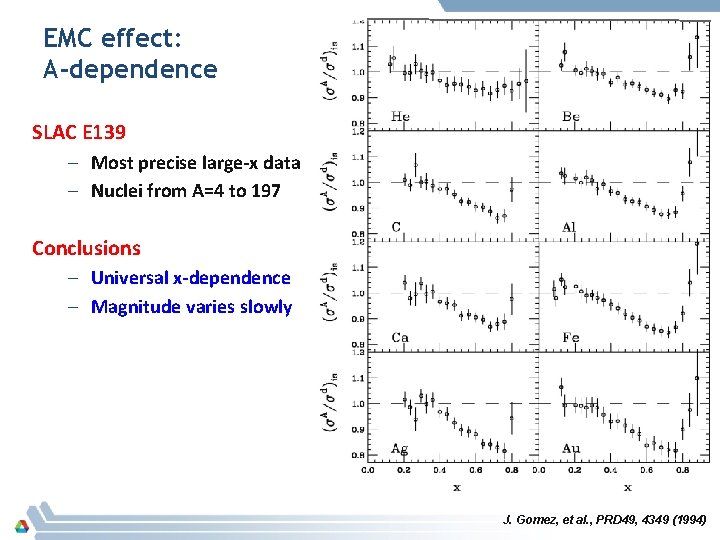
EMC effect: A-dependence SLAC E 139 – Most precise large-x data – Nuclei from A=4 to 197 Conclusions – Universal x-dependence – Magnitude varies slowly J. Gomez, et al. , PRD 49, 4349 (1994)
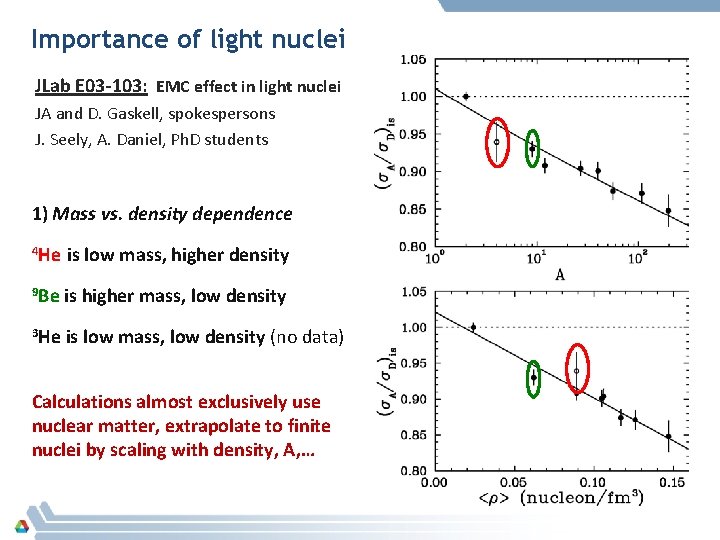
Importance of light nuclei JLab E 03 -103: EMC effect in light nuclei JA and D. Gaskell, spokespersons J. Seely, A. Daniel, Ph. D students 1) Mass vs. density dependence 4 He is low mass, higher density 9 Be is higher mass, low density 3 He is low mass, low density (no data) Calculations almost exclusively use nuclear matter, extrapolate to finite nuclei by scaling with density, A, …
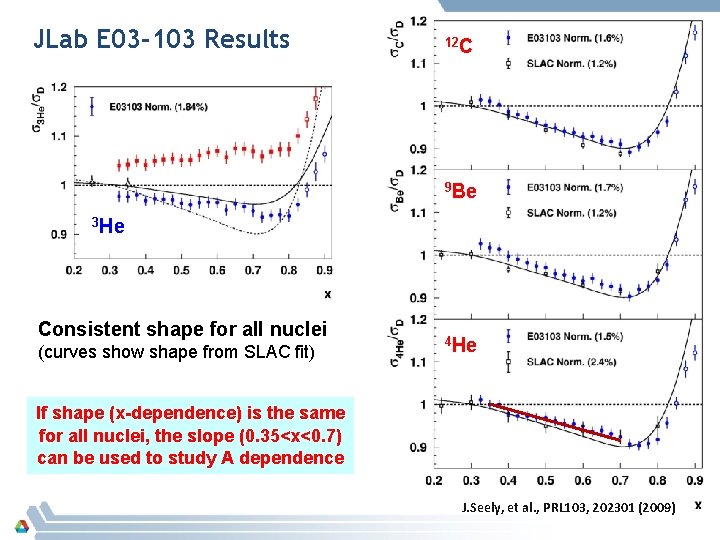
JLab E 03 -103 Results 12 C 9 Be 3 He Consistent shape for all nuclei (curves show shape from SLAC fit) 4 He If shape (x-dependence) is the same for all nuclei, the slope (0. 35<x<0. 7) can be used to study A dependence J. Seely, et al. , PRL 103, 202301 (2009) 7

A-dependence of EMC effect Density determined from ab initio few-body calculation S. C. Pieper and R. B. Wiringa, Ann. Rev. Nucl. Part. Sci 51, 53 (2001) Data show smooth behavior as density increases, as generally expected… except for 9 Be has low average density, but large component of structure is 2 a+n Most nucleons in tight, a-like configurations K. Arai, et al. , PRC 54, 132 (1996) J. Seely, et al. , PRL 103, 202301 (2009)
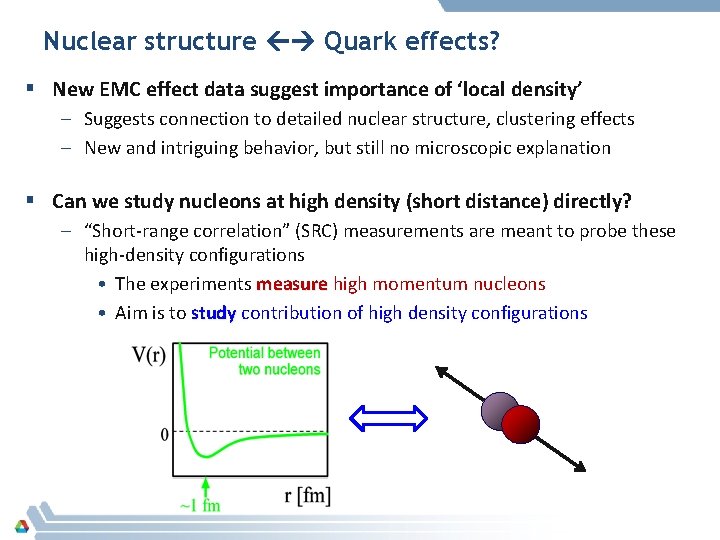
Nuclear structure Quark effects? § New EMC effect data suggest importance of ‘local density’ – Suggests connection to detailed nuclear structure, clustering effects – New and intriguing behavior, but still no microscopic explanation § Can we study nucleons at high density (short distance) directly? – “Short-range correlation” (SRC) measurements are meant to probe these high-density configurations • The experiments measure high momentum nucleons • Aim is to study contribution of high density configurations
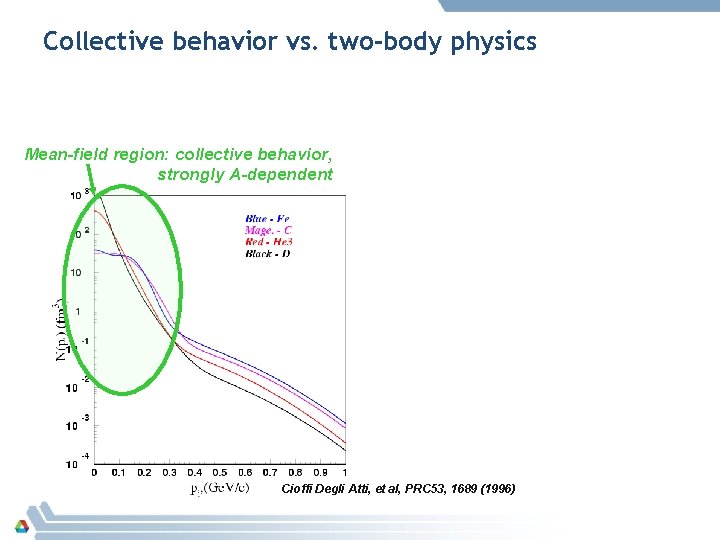
Collective behavior vs. two-body physics Mean-field region: collective behavior, strongly A-dependent Cioffi Degli Atti, et al, PRC 53, 1689 (1996) 10
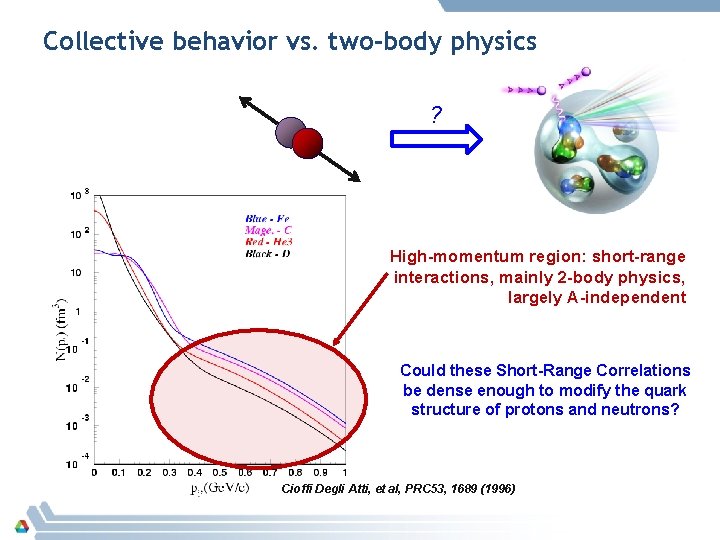
Collective behavior vs. two-body physics ? High-momentum region: short-range interactions, mainly 2 -body physics, largely A-independent Could these Short-Range Correlations be dense enough to modify the quark structure of protons and neutrons? Cioffi Degli Atti, et al, PRC 53, 1689 (1996) 11
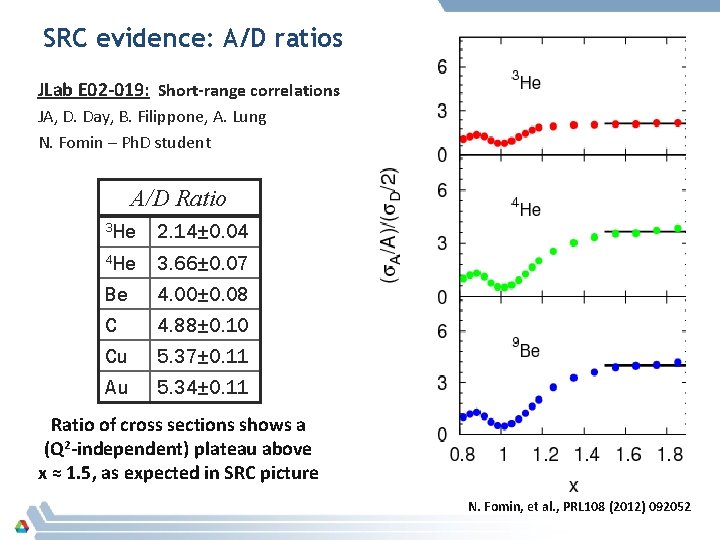
SRC evidence: A/D ratios JLab E 02 -019: Short-range correlations JA, D. Day, B. Filippone, A. Lung N. Fomin – Ph. D student A/D Ratio 3 He 2. 14± 0. 04 4 He 3. 66± 0. 07 Be 4. 00± 0. 08 C 4. 88± 0. 10 Cu 5. 37± 0. 11 Au 5. 34± 0. 11 Ratio of cross sections shows a (Q 2 -independent) plateau above x ≈ 1. 5, as expected in SRC picture N. Fomin, et al. , PRL 108 (2012) 092052
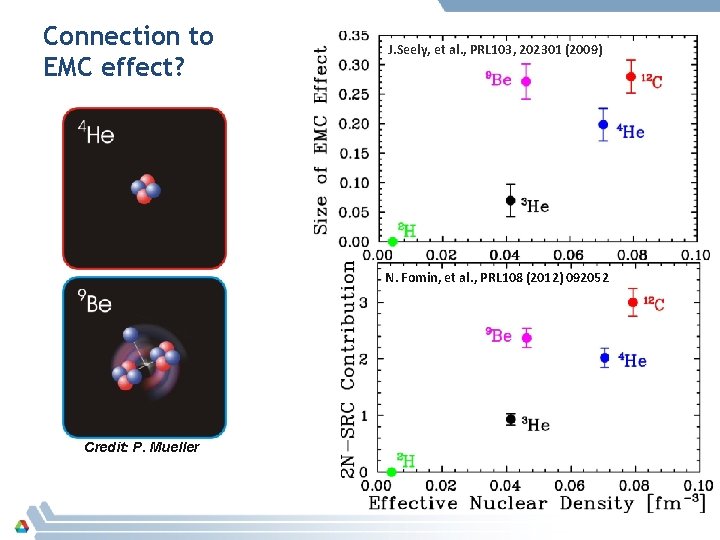
Connection to EMC effect? J. Seely, et al. , PRL 103, 202301 (2009) N. Fomin, et al. , PRL 108 (2012) 092052 Credit: P. Mueller

EMC effect: Importance of two-body effects? 5 -10% suppression in all nucleons? 25 -50% change in the 20% of nucleons at very high momenta? J. Seely, et al. , PRL 103, 202301 (2009) N. Fomin, et al. , PRL 108, 092052 (2012) JA, A. Daniel, D. Day, N. Fomin, D. Gaskell, P. Solvignon, PRC 86, 065204 (2012) O. Hen, et al, PRC 85, 047301 (2012) L. Weinstein, et al. , PRL 106, 052301 (2011)
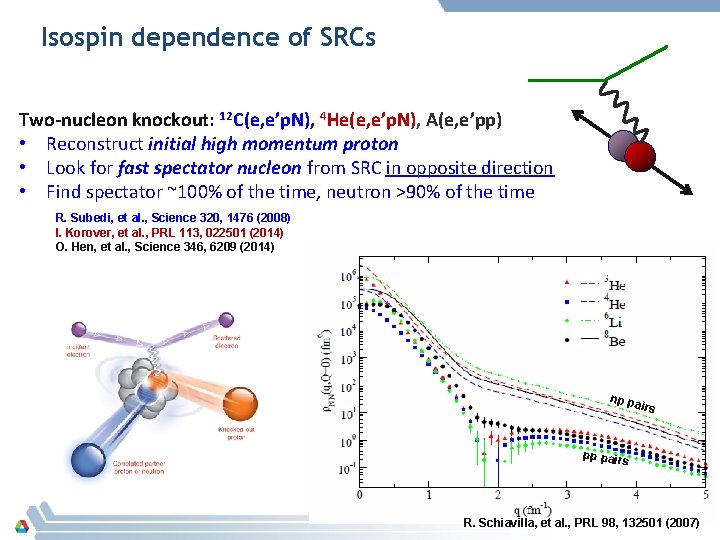
Isospin dependence of SRCs Two-nucleon knockout: 12 C(e, e’p. N), 4 He(e, e’p. N), A(e, e’pp) • Reconstruct initial high momentum proton • Look for fast spectator nucleon from SRC in opposite direction • Find spectator ~100% of the time, neutron >90% of the time R. Subedi, et al. , Science 320, 1476 (2008) I. Korover, et al. , PRL 113, 022501 (2014) O. Hen, et al. , Science 346, 6209 (2014) np p airs pp pairs R. Schiavilla, et al. , PRL 98, 132501 (2007)
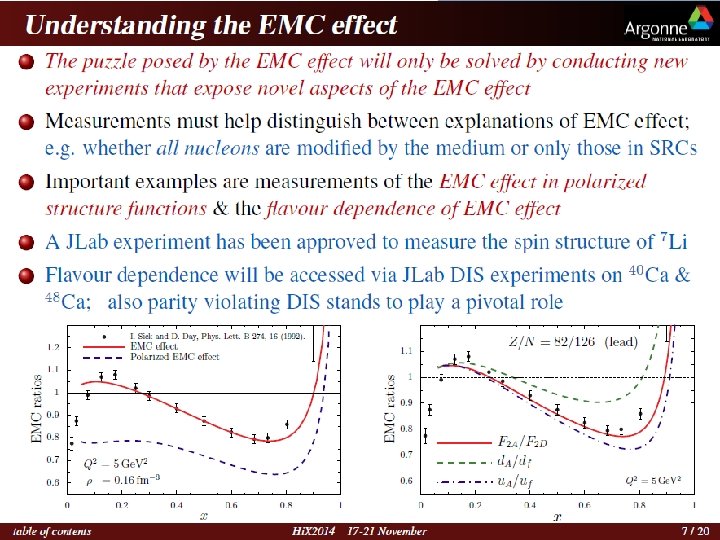
Isospin dependence of the EMC effect § EMC effect nearly always assumed to be identical for d(x), u(x) § Becoming hard to believe, at least for non-isoscalar nuclei (3 He, 208 Pb) – EMC/SRC connection + SRC n-p dominance suggests enhanced highmomentum distribution and enhanced EMC effect in minority nucleons – 48 Ca, 208 Pb expected to have significant neutron skin: neutrons preferentially sit near the surface, in low density regions – Recent calculations show difference for u-, d-quark, as result of scalar and vector mean-field potentials in asymmetric nuclear matter [I. Cloet, et al, PRL 109, 182301 (2012); PRL 102, 252301 (2009)] § Impacts input pdfs for n-A, p-A, A-A collisions: Important for hard, flavor-dependent processes (e. g. W+/W-) § Key measurement: parity-violating DIS from 48 Ca (So. LID collab. at JLab) – 2 H PVDIS: search for beyond standard model physics – 1 H PVDIS: clean separation of d(x)/u(x) at large x in the proton – Nuclei: flavor dependence of EMC effect, Charge-symmetry violation
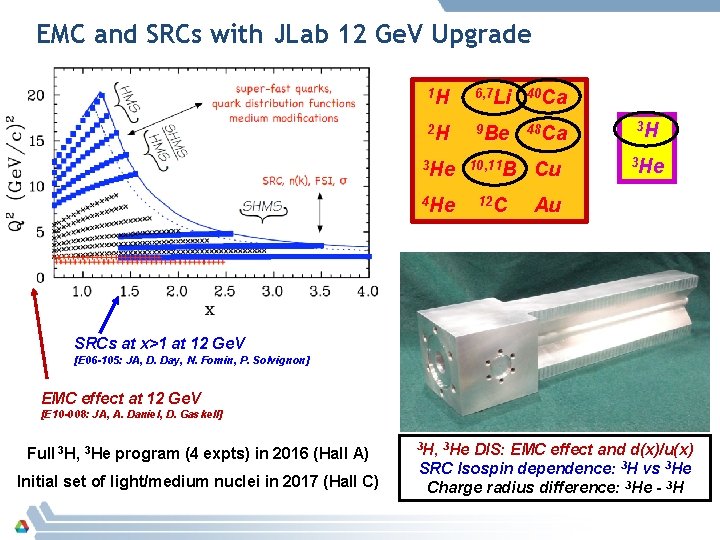
EMC and SRCs with JLab 12 Ge. V Upgrade 1 H 6, 7 Li 40 Ca 2 H 9 Be 48 Ca 3 H 3 He 10, 11 B Cu 3 He 4 He 12 C Au SRCs at x>1 at 12 Ge. V [E 06 -105: JA, D. Day, N. Fomin, P. Solvignon] EMC effect at 12 Ge. V [E 10 -008: JA, A. Daniel, D. Gaskell] Full 3 H, 3 He program (4 expts) in 2016 (Hall A) Initial set of light/medium nuclei in 2017 (Hall C) 3 H, 3 He DIS: EMC effect and d(x)/u(x) SRC Isospin dependence: 3 H vs 3 He Charge radius difference: 3 He - 3 H
Future Plans 1) Additional nuclei to study cluster structure, EMC-SRC correlation 2) Two-body physics driving SRCs makes deuteron the most ‘natural’ place to study impact of extremely high density configurations – Isolate SRCs and probe their quark distributions
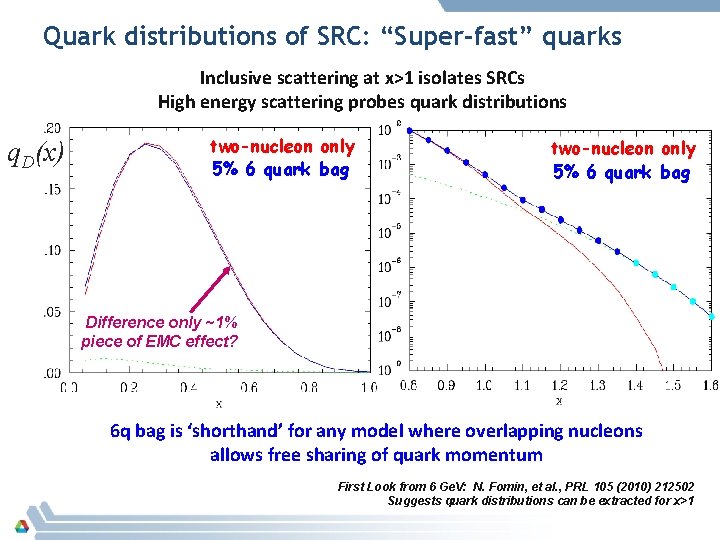
Quark distributions of SRC: “Super-fast” quarks Inclusive scattering at x>1 isolates SRCs High energy scattering probes quark distributions q. D(x) two-nucleon only 5% 6 quark bag Difference only ~1% piece of EMC effect? 6 q bag is ‘shorthand’ for any model where overlapping nucleons allows free sharing of quark momentum First Look from 6 Ge. V: N. Fomin, et al. , PRL 105 (2010) 212502 Suggests quark distributions can be extracted for x>1
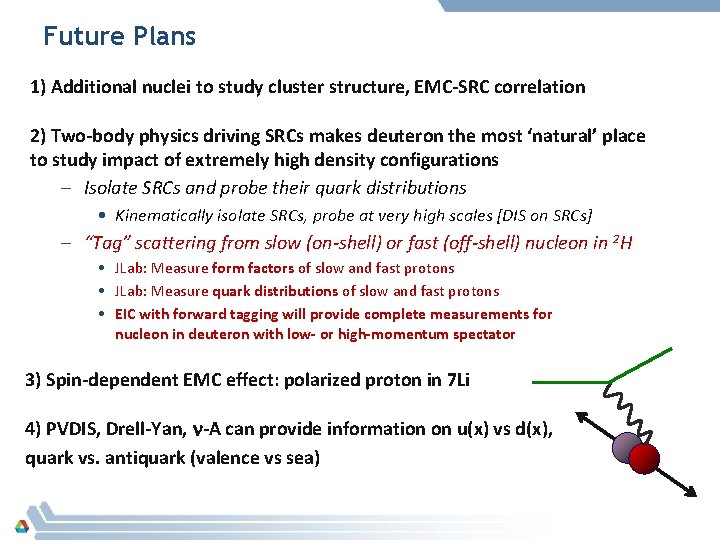
Future Plans 1) Additional nuclei to study cluster structure, EMC-SRC correlation 2) Two-body physics driving SRCs makes deuteron the most ‘natural’ place to study impact of extremely high density configurations – Isolate SRCs and probe their quark distributions • Kinematically isolate SRCs, probe at very high scales [DIS on SRCs] – “Tag” scattering from slow (on-shell) or fast (off-shell) nucleon in 2 H • JLab: Measure form factors of slow and fast protons • JLab: Measure quark distributions of slow and fast protons • EIC with forward tagging will provide complete measurements for nucleon in deuteron with low- or high-momentum spectator 3) Spin-dependent EMC effect: polarized proton in 7 Li 4) PVDIS, Drell-Yan, n-A can provide information on u(x) vs d(x), quark vs. antiquark (valence vs sea)

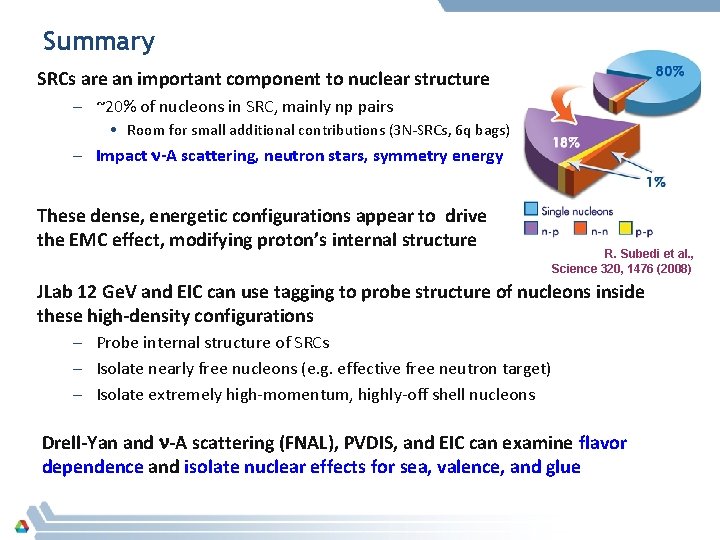
Summary SRCs are an important component to nuclear structure – ~20% of nucleons in SRC, mainly np pairs • Room for small additional contributions (3 N-SRCs, 6 q bags) – Impact n-A scattering, neutron stars, symmetry energy These dense, energetic configurations appear to drive the EMC effect, modifying proton’s internal structure R. Subedi et al. , Science 320, 1476 (2008) JLab 12 Ge. V and EIC can use tagging to probe structure of nucleons inside these high-density configurations – Probe internal structure of SRCs – Isolate nearly free nucleons (e. g. effective free neutron target) – Isolate extremely high-momentum, highly-off shell nucleons Drell-Yan and n-A scattering (FNAL), PVDIS, and EIC can examine flavor dependence and isolate nuclear effects for sea, valence, and glue
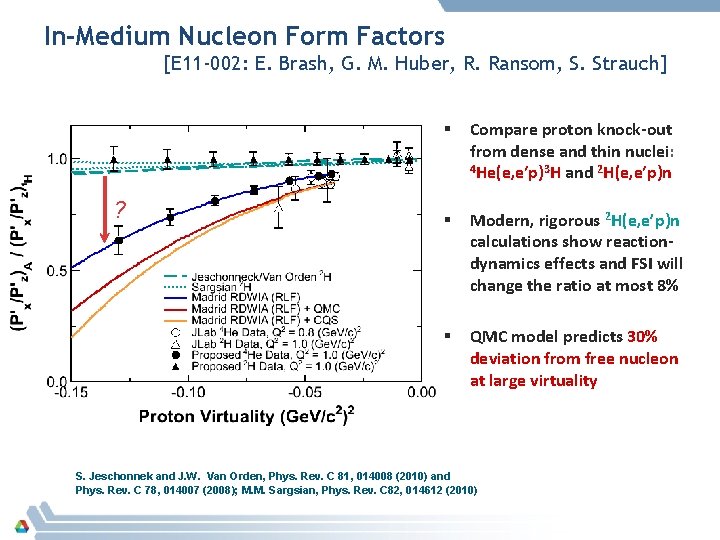
In-Medium Nucleon Form Factors [E 11 -002: E. Brash, G. M. Huber, R. Ransom, S. Strauch] ? § Compare proton knock-out from dense and thin nuclei: 4 He(e, e′p)3 H and 2 H(e, e′p)n § Modern, rigorous 2 H(e, e’p)n calculations show reactiondynamics effects and FSI will change the ratio at most 8% § QMC model predicts 30% deviation from free nucleon at large virtuality S. Jeschonnek and J. W. Van Orden, Phys. Rev. C 81, 014008 (2010) and Phys. Rev. C 78, 014007 (2008); M. M. Sargsian, Phys. Rev. C 82, 014612 (2010)
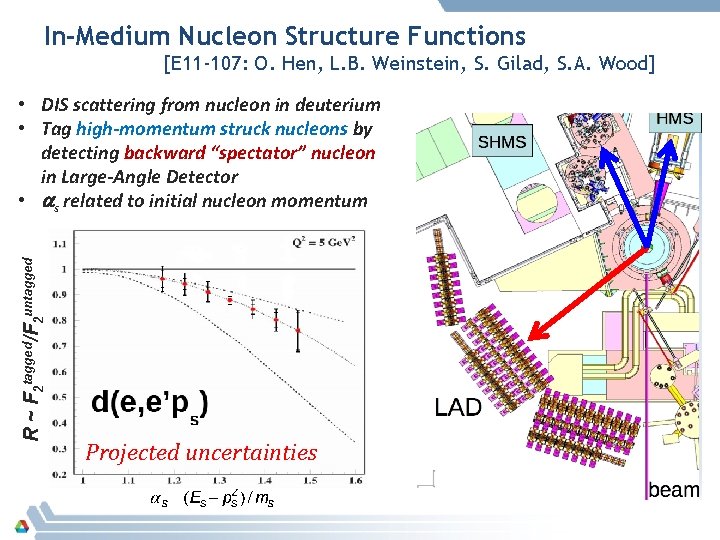
In-Medium Nucleon Structure Functions [E 11 -107: O. Hen, L. B. Weinstein, S. Gilad, S. A. Wood] R ~ F 2 tagged/F 2 untagged • DIS scattering from nucleon in deuterium • Tag high-momentum struck nucleons by detecting backward “spectator” nucleon in Large-Angle Detector • as related to initial nucleon momentum Projected uncertainties
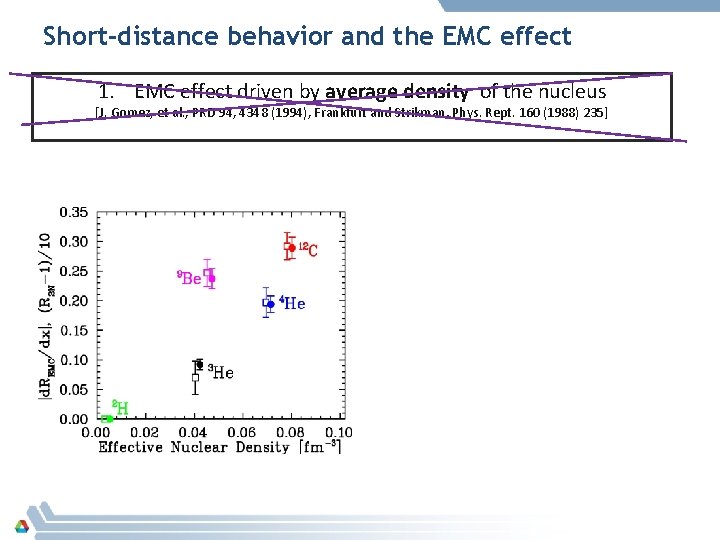
Short-distance behavior and the EMC effect 1. EMC effect driven by average density of the nucleus [J. Gomez, et al. , PRD 94, 4348 (1994), Frankfurt and Strikman, Phys. Rept. 160 (1988) 235]
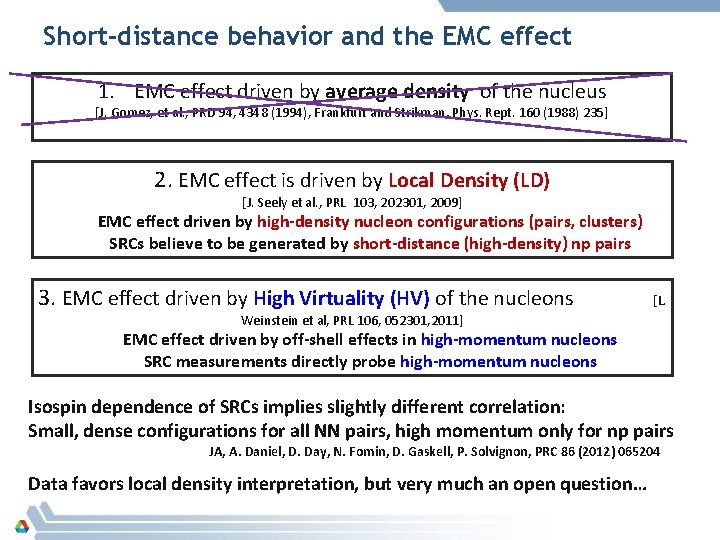
Short-distance behavior and the EMC effect 1. EMC effect driven by average density of the nucleus [J. Gomez, et al. , PRD 94, 4348 (1994), Frankfurt and Strikman, Phys. Rept. 160 (1988) 235] 2. EMC effect is driven by Local Density (LD) [J. Seely et al. , PRL 103, 202301, 2009] EMC effect driven by high-density nucleon configurations (pairs, clusters) SRCs believe to be generated by short-distance (high-density) np pairs 3. EMC effect driven by High Virtuality (HV) of the nucleons [L. Weinstein et al, PRL 106, 052301, 2011] EMC effect driven by off-shell effects in high-momentum nucleons SRC measurements directly probe high-momentum nucleons Isospin dependence of SRCs implies slightly different correlation: Small, dense configurations for all NN pairs, high momentum only for np pairs JA, A. Daniel, D. Day, N. Fomin, D. Gaskell, P. Solvignon, PRC 86 (2012) 065204 Data favors local density interpretation, but very much an open question…
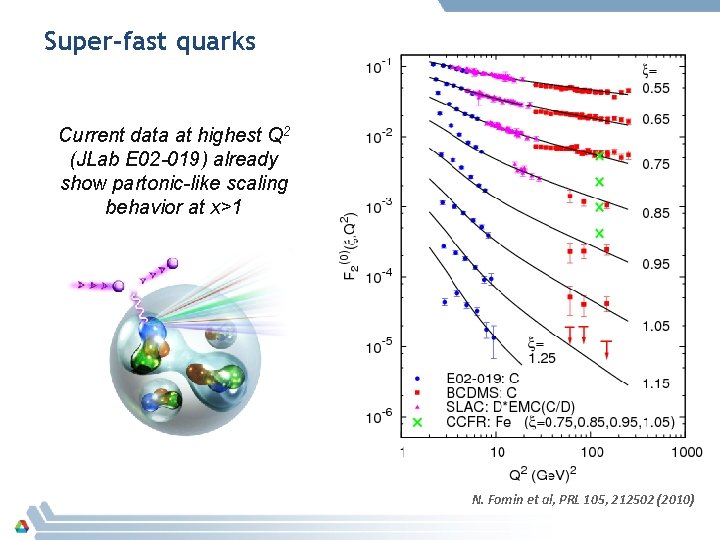
Super-fast quarks Current data at highest Q 2 (JLab E 02 -019) already show partonic-like scaling behavior at x>1 N. Fomin et al, PRL 105, 212502 (2010)
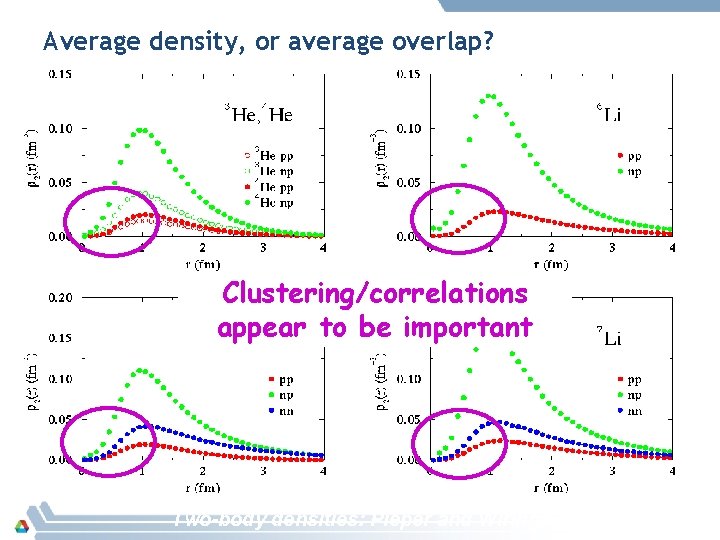
Average density, or average overlap? Clustering/correlations appear to be important Two-body densities: Pieper and Wiringa
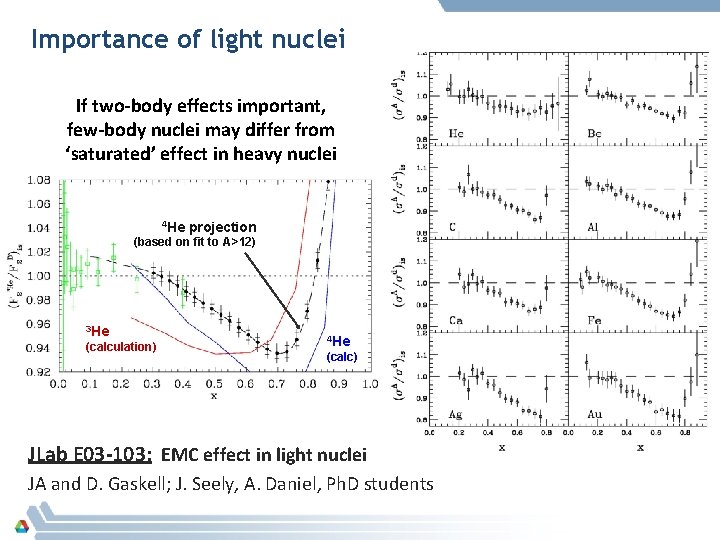
Importance of light nuclei If two-body effects important, few-body nuclei may differ from ‘saturated’ effect in heavy nuclei 4 He projection (based on fit to A>12) 3 He (calculation) 4 He (calc) JLab E 03 -103: EMC effect in light nuclei JA and D. Gaskell; J. Seely, A. Daniel, Ph. D students
![High-momentum nucleons (Short-Range Correlations) n(k) [fm-3] N-N interaction Hard interaction at short range Pairs](http://slidetodoc.com/presentation_image_h2/849516082bd8f8ffab1c9edb2b7b6c24/image-31.jpg "High-momentum nucleons (Short-Range Correlations) n(k) [fm-3] N-N interaction Hard interaction at short range Pairs")
High-momentum nucleons (Short-Range Correlations) n(k) [fm-3] N-N interaction Hard interaction at short range Pairs of high-momentum nucleons (up to 1 Ge. V/c) Nucleon momentum distribution in 12 C Mean field part Small N-N separation k [Ge. V/c] Even in 2 H, nearly half of the K. E. comes from the ~5% of nucleons above k=250 Me. V/c Large momenta High-density configurations
- Slides: 31