
The ELINP project Towards experiments with intense gammabeams

The ELI-NP project: Towards experiments with intense gammabeams * Dimiter L. Balabanski (ELI-NP/IFIN-HH) * This work is supported by Extreme Light Infrastructure – Nuclear Physics (ELI-NP) – Phase I, a project co-financed by the European Union through the European Regional Development Fund. 1 th th NEC’ 2013 Conference, Sept. 9 – 16 , 2013, Varna, Bulgaria

Where is ELI-NP ? Bucharest 4 km Φ = 800 m IFIN-HH Magurele ELI-NP 2
Portfolio of the National Institute for Physics and Nuclear Engineering (IFIN-HH) • ELI-NP γ-ray facility: two 10 PV lasers and an intense (1013 γ/s) γ beam of 0. 1% bandwidth (under construction); • 9 MV Tandem Van-de-Graaff accelerator; • 3 MV and 1 MV Tandetrons (commissioned in 2012); • 19 Me. V (commissioned in 2013) and 13 Me. V cyclotrons; • Gamma-ray irradiation facility; • Radioactive waste treatment plant; • Research reactor (decommissioning project). IFIN-HH applies for TNA status within the Horizon 2020 ENSAR-2 project 3
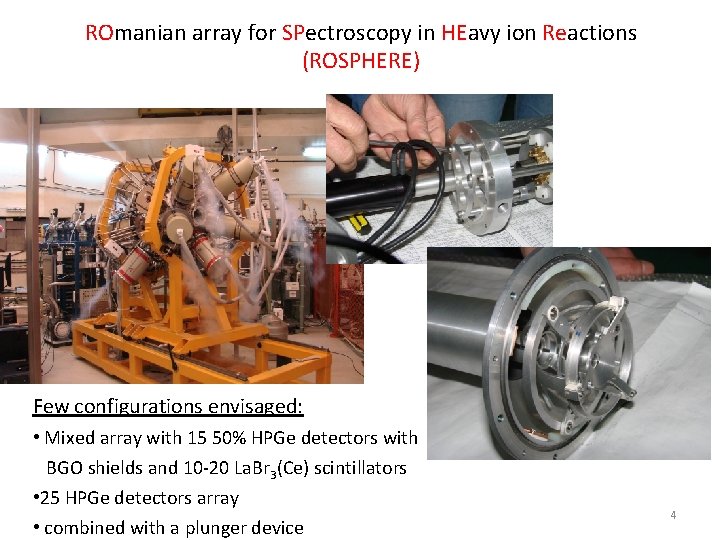
ROmanian array for SPectroscopy in HEavy ion Reactions (ROSPHERE) Few configurations envisaged: • Mixed array with 15 50% HPGe detectors with BGO shields and 10 -20 La. Br 3(Ce) scintillators • 25 HPGe detectors array • combined with a plunger device 4
Extreme Light Infrastructure – Nuclear Physics 5
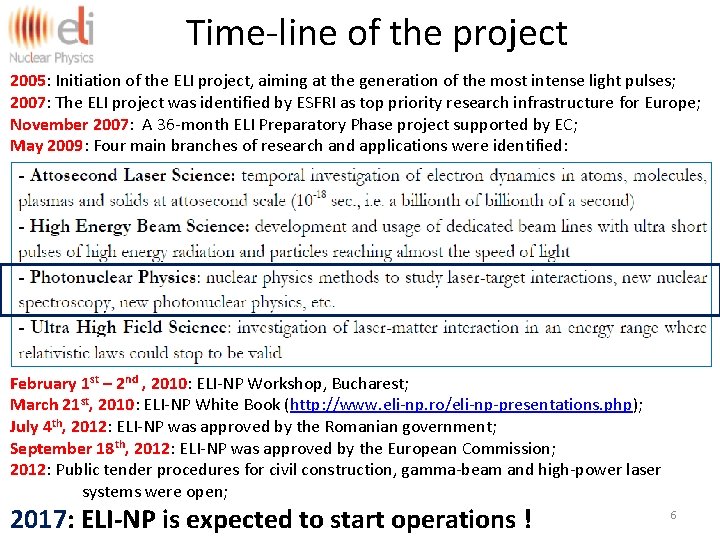
Time-line of the project 2005: Initiation of the ELI project, aiming at the generation of the most intense light pulses; 2007: The ELI project was identified by ESFRI as top priority research infrastructure for Europe; November 2007: A 36 -month ELI Preparatory Phase project supported by EC; May 2009: Four main branches of research and applications were identified: February 1 st – 2 nd , 2010: ELI-NP Workshop, Bucharest; March 21 st, 2010: ELI-NP White Book (http: //www. eli-np. ro/eli-np-presentations. php); July 4 th, 2012: ELI-NP was approved by the Romanian government; September 18 th, 2012: ELI-NP was approved by the European Commission; 2012: Public tender procedures for civil construction, gamma-beam and high-power laser systems were open; 2017: ELI-NP is expected to start operations ! 6
EUROPEAN UNION GOVERNMENT OF ROMANIA Structural Instruments 2007 -2013 Sectoral Operational Programme „Increase of Economic Competitiveness” “Investments for Your Future” Extreme Light Infrastructure – Nuclear Physics (ELI-NP) - Phase I Project co-financed by the European Regional Development Fund Implementation Status NEC’ 2013 Conference, Sept. 9 th – 16 th, 2013, Varna, Bulgaria 7

Milestones of Extreme Light Infrastructure – Nuclear Physics 11 aprilie 2013 12 decembrie 2012 14 iunie 2013 28 msai 2013 6 iunie 2013 23 august 2013 16 iulie 2013 7 August 2013 8
High-power laser source 9

brilliant γ beam (1013 γ/s/100 μm 2) 700 Me. V LINAC Parameters of the gamma-beam 10
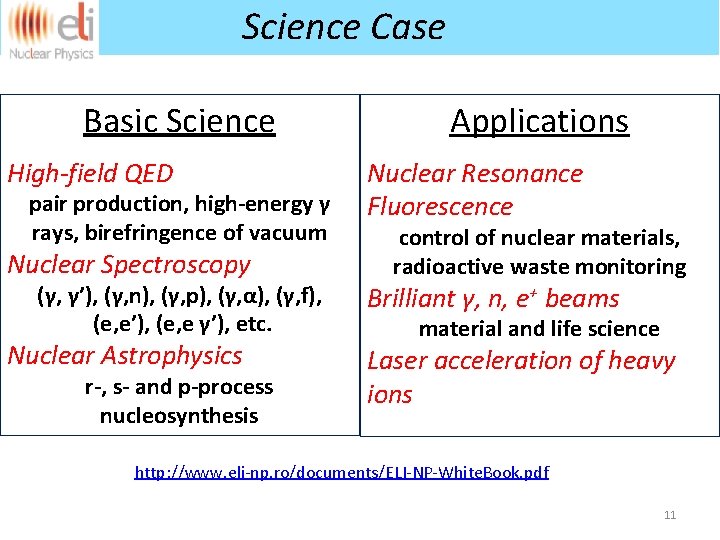
Science Case Basic Science High-field QED pair production, high-energy γ rays, birefringence of vacuum Nuclear Spectroscopy (γ, γ’), (γ, n), (γ, p), (γ, α), (γ, f), (e, e’), (e, e γ’), etc. Nuclear Astrophysics r-, s- and p-process nucleosynthesis Applications Nuclear Resonance Fluorescence control of nuclear materials, radioactive waste monitoring Brilliant γ, n, e+ beams material and life science Laser acceleration of heavy ions http: //www. eli-np. ro/documents/ELI-NP-White. Book. pdf 11
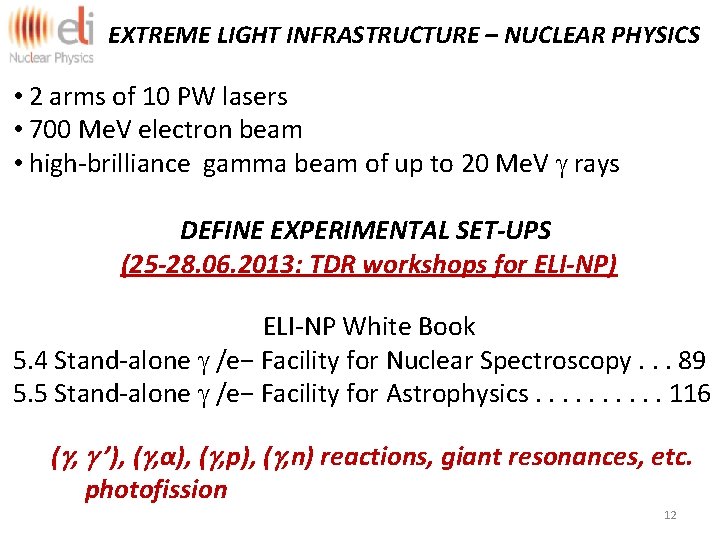
EXTREME LIGHT INFRASTRUCTURE – NUCLEAR PHYSICS • 2 arms of 10 PW lasers • 700 Me. V electron beam • high-brilliance gamma beam of up to 20 Me. V rays DEFINE EXPERIMENTAL SET-UPS (25 -28. 06. 2013: TDR workshops for ELI-NP) ELI-NP White Book 5. 4 Stand-alone /e− Facility for Nuclear Spectroscopy. . . 89 5. 5 Stand-alone /e− Facility for Astrophysics. . 116 ( , ’), ( , α), ( , p), ( , n) reactions, giant resonances, etc. photofission 12
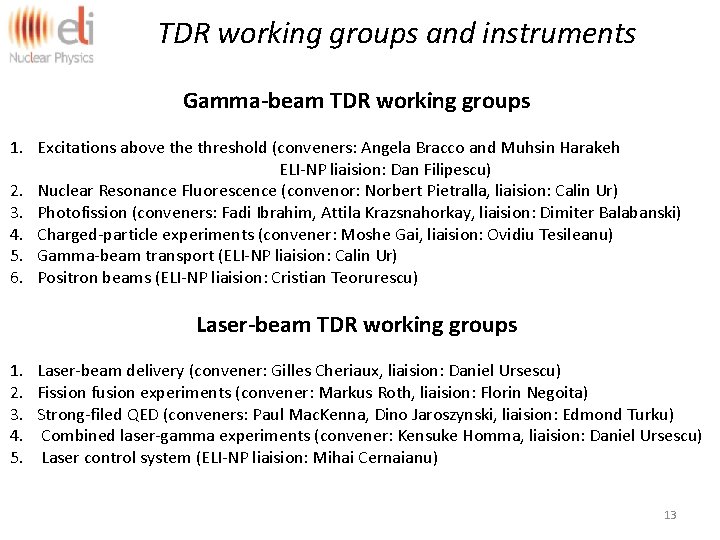
TDR working groups and instruments Gamma-beam TDR working groups 1. Excitations above threshold (conveners: Angela Bracco and Muhsin Harakeh ELI-NP liaision: Dan Filipescu) 2. Nuclear Resonance Fluorescence (convenor: Norbert Pietralla, liaision: Calin Ur) 3. Photofission (conveners: Fadi Ibrahim, Attila Krazsnahorkay, liaision: Dimiter Balabanski) 4. Charged-particle experiments (convener: Moshe Gai, liaision: Ovidiu Tesileanu) 5. Gamma-beam transport (ELI-NP liaision: Calin Ur) 6. Positron beams (ELI-NP liaision: Cristian Teorurescu) Laser-beam TDR working groups 1. 2. 3. 4. 5. Laser-beam delivery (convener: Gilles Cheriaux, liaision: Daniel Ursescu) Fission fusion experiments (convener: Markus Roth, liaision: Florin Negoita) Strong-filed QED (conveners: Paul Mac. Kenna, Dino Jaroszynski, liaision: Edmond Turku) Combined laser-gamma experiments (convener: Kensuke Homma, liaision: Daniel Ursescu) Laser control system (ELI-NP liaision: Mihai Cernaianu) 13
Photonuclear reactions lifetimes: ps - as 14
Parity measurement from azimuthal distribution 15
16
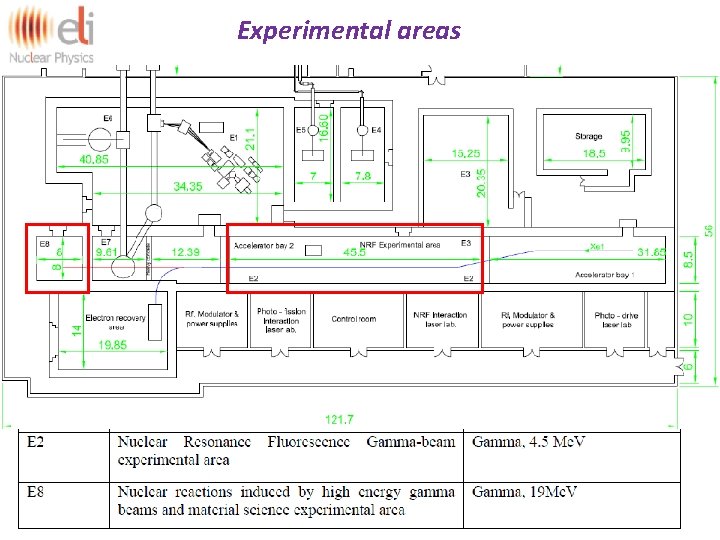
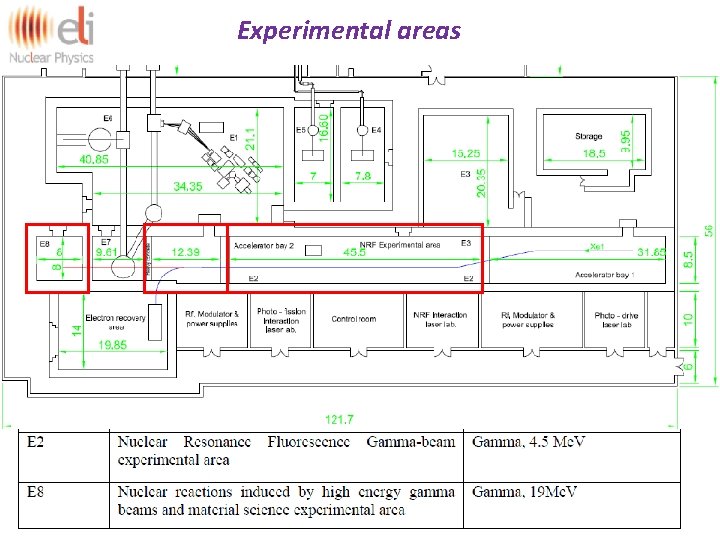
Experimental areas 17

Instrumentation (gamma beams) Nuclear structure set-up: modular and very flexible • high resolution neutron detection • gamma-ray detection with medium resolution • high-resolution γ-ray detection (in some cases) 4π high-efficiency ball for cross section measurements High-resolution γ-ray set-up with a crystal monochromator • 10 e. V beam resolution • combined with a total absorption spectrometer NRF set-up • rings of segmented HPGe detectors • good timing detectors Gas-filled fission detector set-up (combined with gamma-ray detectors) Production of RIB with IGISOL-type technique (not in the baseline project) Si-strip detector set-up Gas-filled TPC 18 Bubble chamber
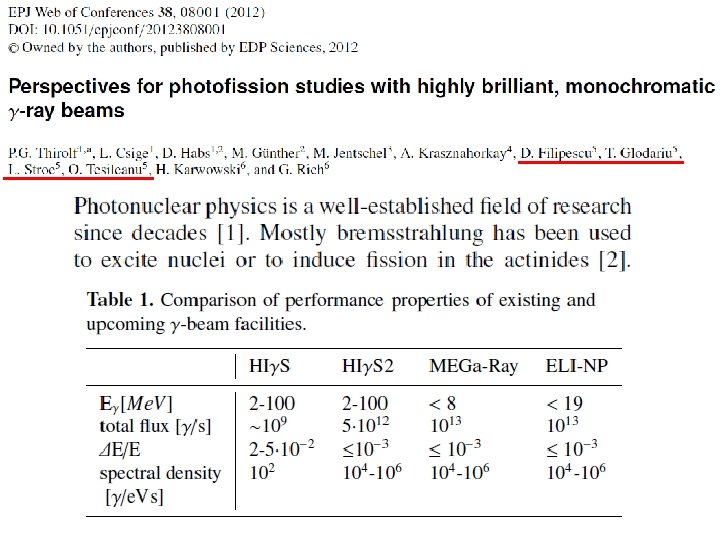
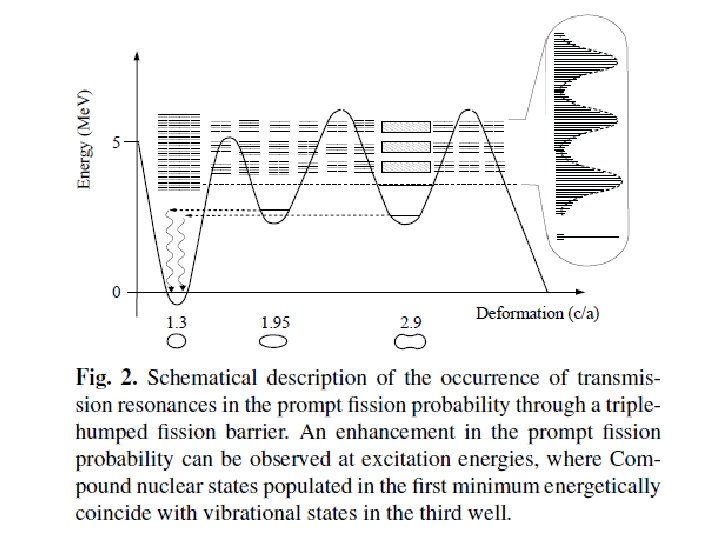
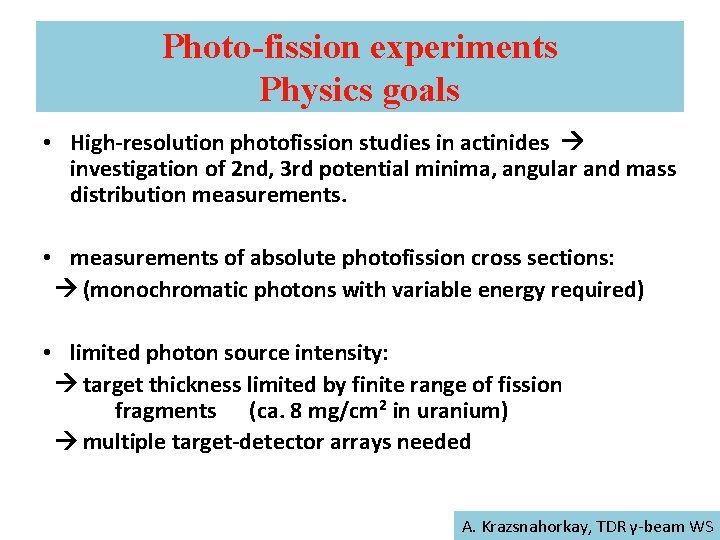
Photo-fission experiments Physics goals • High-resolution photofission studies in actinides investigation of 2 nd, 3 rd potential minima, angular and mass distribution measurements. • measurements of absolute photofission cross sections: (monochromatic photons with variable energy required) • limited photon source intensity: target thickness limited by finite range of fission fragments (ca. 8 mg/cm 2 in uranium) multiple target-detector arrays needed A. Krazsnahorkay, TDR γ-beam WS

GEM (Gas-electron multiplier) position-sensitive detectors Thick GEM board with 1. 6 mm thickness, 1 mm holes, and 1. 5 mm pitch size
Experimental areas 23
Let’s see what else we can squeeze from phot In fission fragments share about 200 Me. V and have angular momentum of 20ħ. The nuclear spin ensemble has oblate orientation with respect to the beam axis. The ions are emitted in a charge state around 20+. Optional experiments • High-spin physics of exotic nuclei • ISOL studies of exotic nuclei Let’s make an excursion round other laboratories where nuclear structure studies on fission fragments are done and
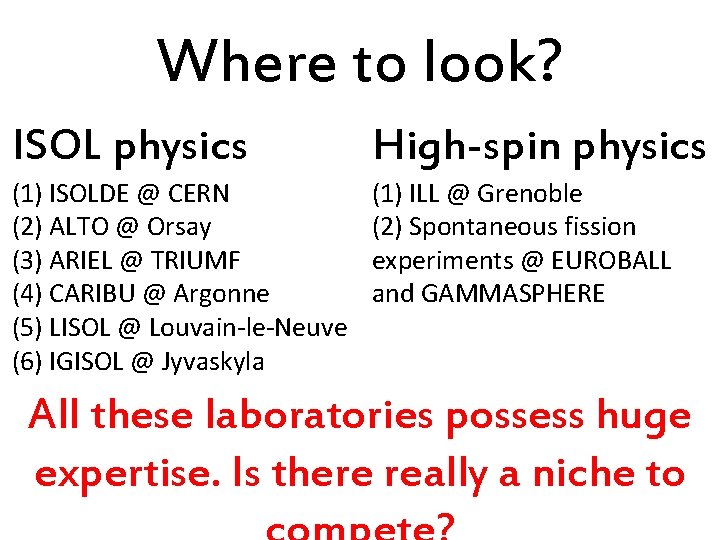
Where to look? ISOL physics High-spin physics (1) ISOLDE @ CERN (2) ALTO @ Orsay (3) ARIEL @ TRIUMF (4) CARIBU @ Argonne (5) LISOL @ Louvain-le-Neuve (6) IGISOL @ Jyvaskyla (1) ILL @ Grenoble (2) Spontaneous fission experiments @ EUROBALL and GAMMASPHERE All these laboratories possess huge expertise. Is there really a niche to

Ion guides
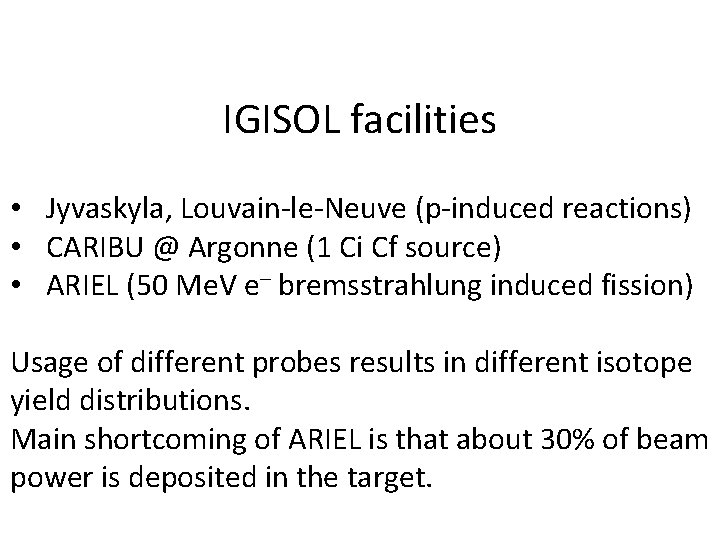
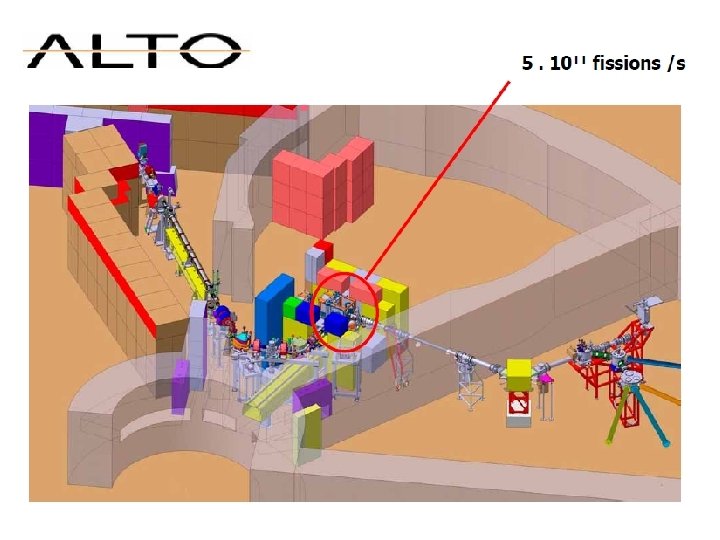
IGISOL facilities • Jyvaskyla, Louvain-le-Neuve (p-induced reactions) • CARIBU @ Argonne (1 Ci Cf source) • ARIEL (50 Me. V e─ bremsstrahlung induced fission) Usage of different probes results in different isotope yield distributions. Main shortcoming of ARIEL is that about 30% of beam power is deposited in the target.
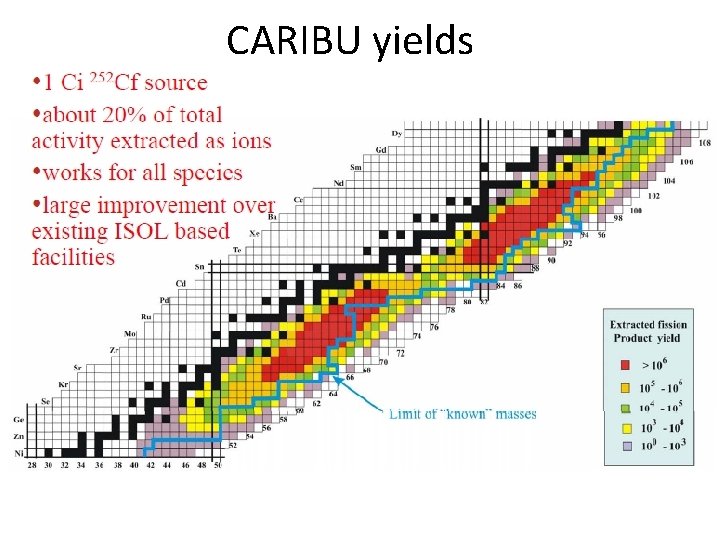
CARIBU yields
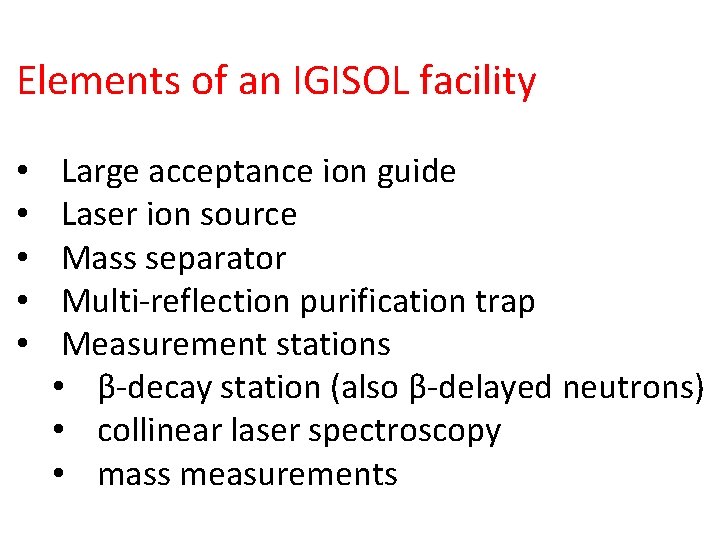
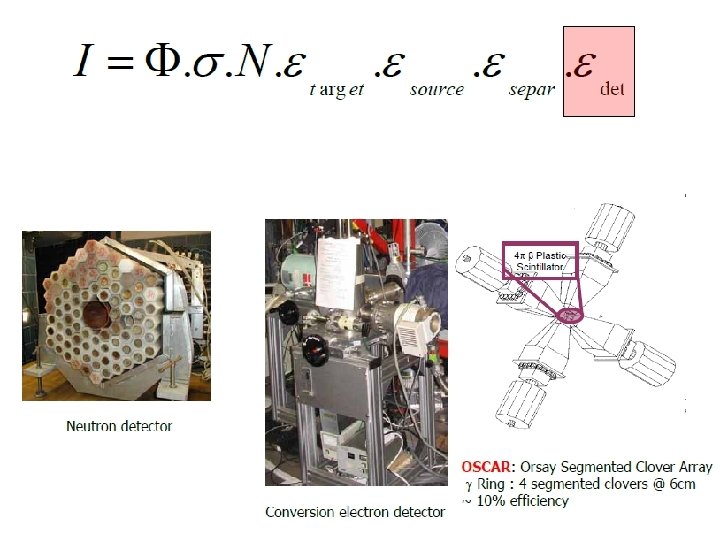
Elements of an IGISOL facility • • • Large acceptance ion guide Laser ion source Mass separator Multi-reflection purification trap Measurement stations • β-decay station (also β-delayed neutrons) • collinear laser spectroscopy • mass measurements
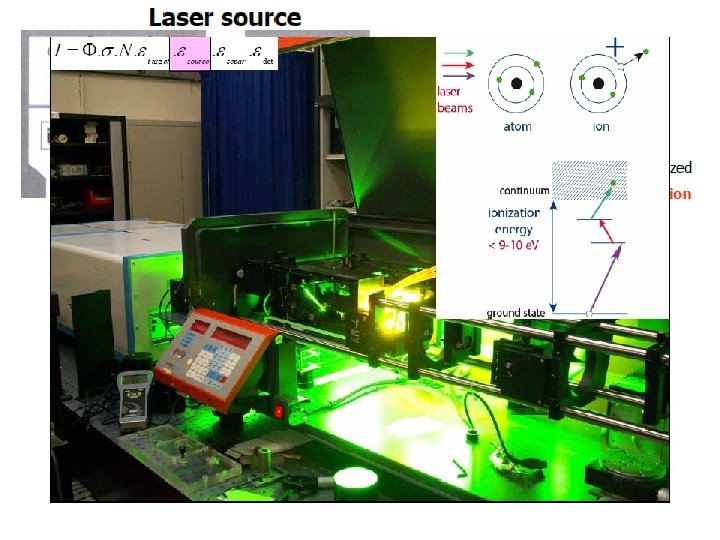
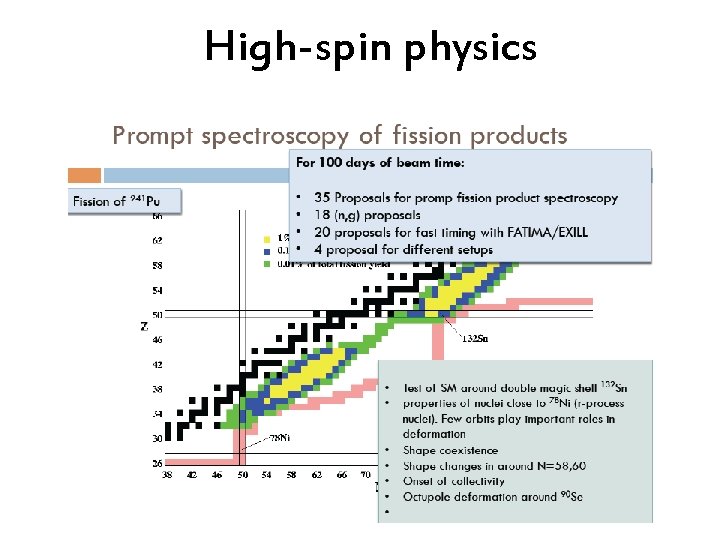
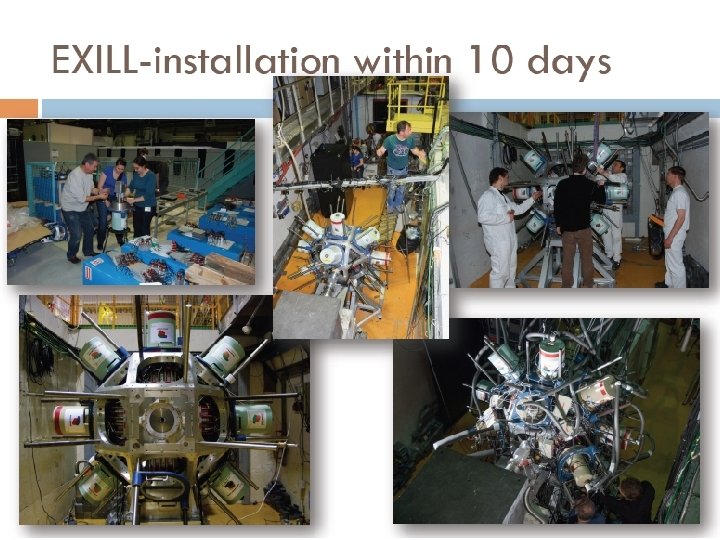
High-spin physics
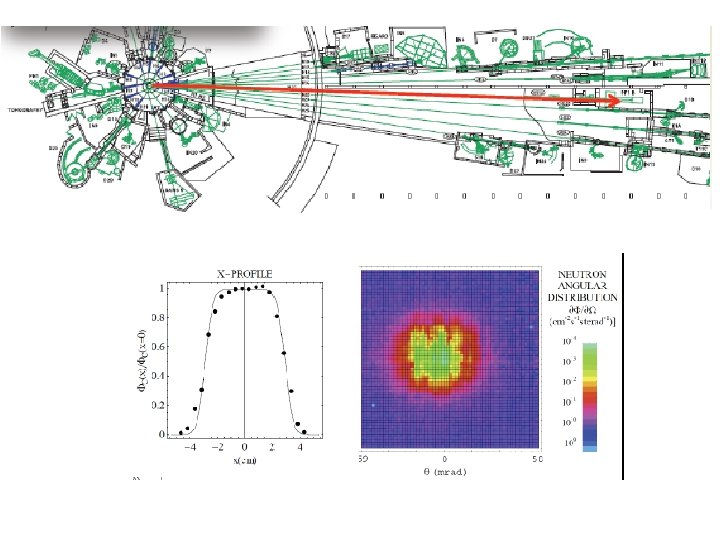
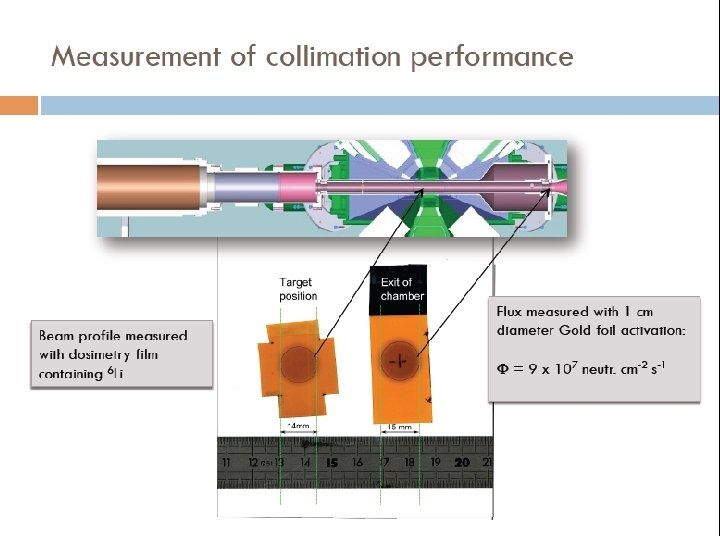
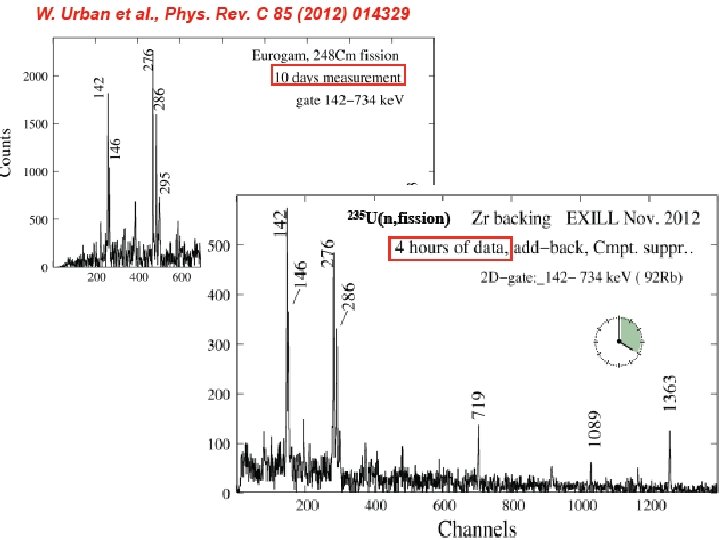
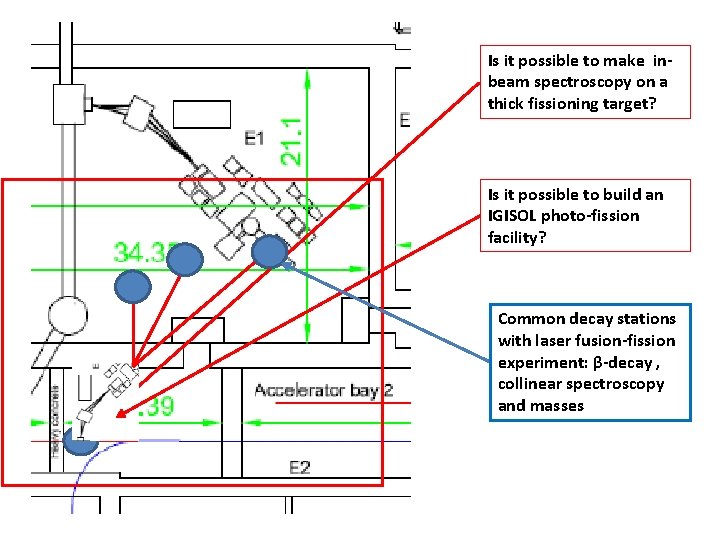
Is it possible to make inbeam spectroscopy on a thick fissioning target? Is it possible to build an IGISOL photo-fission facility? Common decay stations with laser fusion-fission experiment: β-decay , collinear spectroscopy and masses
Finally 1. There are many scientific and technical challenges ahead of us. However, time is short and we need to find solutions now. 2. ELI-NP is open for collaborations. We are building a user community. Formal collaborations to be established through Mo. Us. 3. Cooperation between nuclear and laser physicists needs to be established, e. g. first unify the language (!) 39
40
- Slides: 40