
The Elephant Shark Genome Insights into Evolutionary History

- Slides: 21
The Elephant Shark Genome: Insights into Evolutionary History and Human Autoimmune Diseases Group L Jackie Davis, Tom De. Voto, Tyler Kiehnle, Manika Kosaraju, Brian Maloney, Kristen Turi & Elaine Wirth
A Quick Question Cartilaginous fish (or fish whose structure is made up of cartilage) can help scientists pinpoint genes crucial to bone development and autoimmune diseases. A) True B) False
Article Background “A Window to Bone Disease in a Shark’s Skeleton” • • • Published Jan 2014 by Sindya Bhanoo in the New York Times By sequencing the Elephant Shark genome, it was discovered that the shark is missing several genes necessary for bone development o The reduction of these genes in sharks has resulted in reduction of bone development. Also discovered that the Elephant Shark lacks certain immune cells crucial to fighting infections and preventing autoimmune reactions Implications: The identification of the genes involved in bone formation may lead to the development of treatments for diseases such as osteoporosis and rheumatoid arthritis
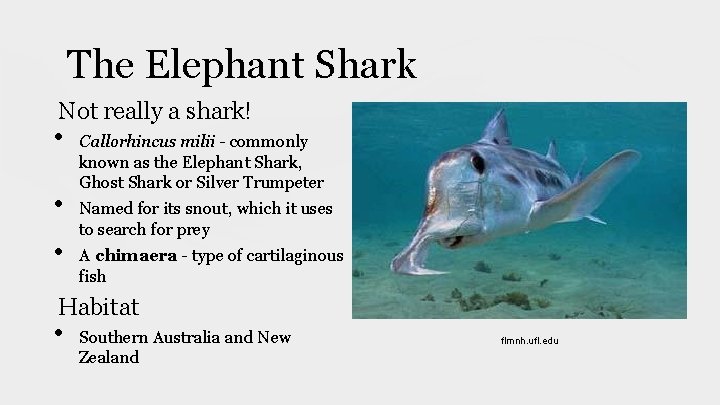
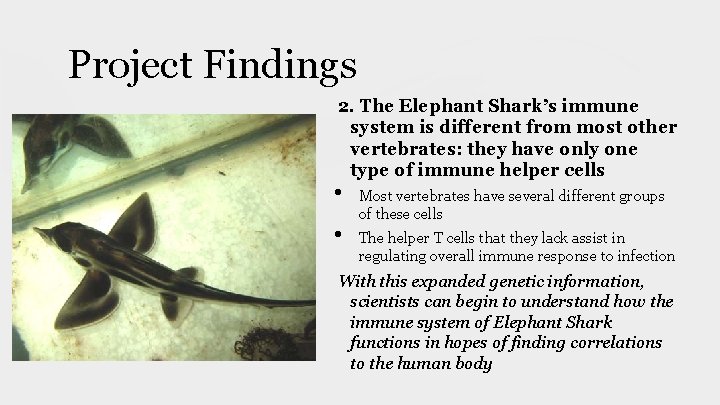
The Elephant Shark Not really a shark! • • • Callorhincus milii - commonly known as the Elephant Shark, Ghost Shark or Silver Trumpeter Named for its snout, which it uses to search for prey A chimaera - type of cartilaginous fish Habitat • Southern Australia and New Zealand flmnh. ufl. edu
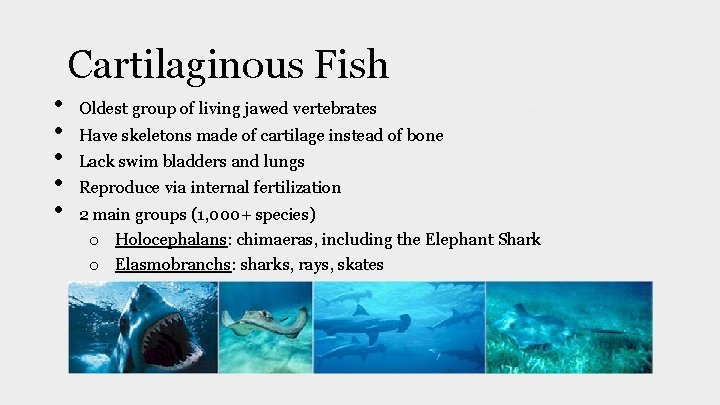
Cartilaginous Fish • • • Oldest group of living jawed vertebrates Have skeletons made of cartilage instead of bone Lack swim bladders and lungs Reproduce via internal fertilization 2 main groups (1, 000+ species) o Holocephalans: chimaeras, including the Elephant Shark o Elasmobranchs: sharks, rays, skates
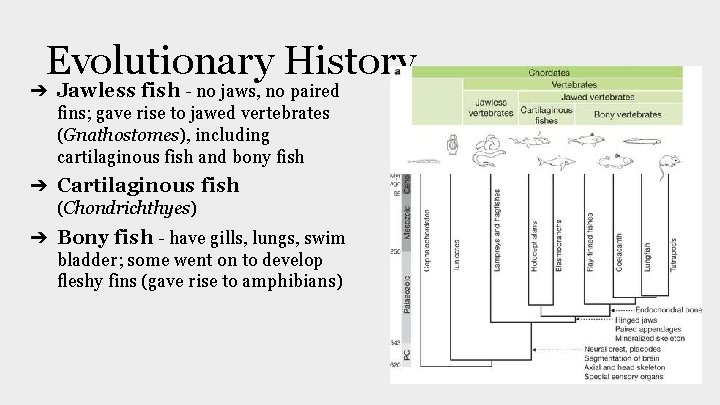
Evolutionary History ➔ Jawless fish - no jaws, no paired fins; gave rise to jawed vertebrates (Gnathostomes), including cartilaginous fish and bony fish ➔ Cartilaginous fish (Chondrichthyes) ➔ Bony fish - have gills, lungs, swim bladder; some went on to develop fleshy fins (gave rise to amphibians)
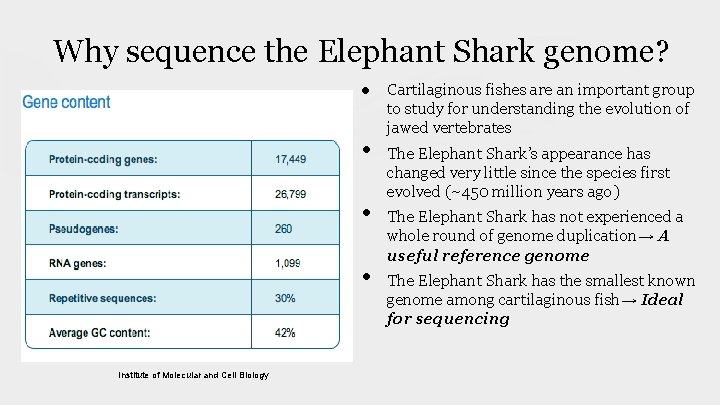
Why sequence the Elephant Shark genome? ● Cartilaginous fishes are an important group to study for understanding the evolution of jawed vertebrates • • • Institute of Molecular and Cell Biology The Elephant Shark’s appearance has changed very little since the species first evolved (~450 million years ago) The Elephant Shark has not experienced a whole round of genome duplication→ A useful reference genome The Elephant Shark has the smallest known genome among cartilaginous fish→ Ideal for sequencing
The Elephant Shark Genome Project Goals. . . • • • Understand how bony skeletons evolved Learn whether cartilaginous fishes lost their bone -forming ability or if they never possessed it Identify specialized features that have led to the evolution of diverse groups of bony vertebrates Sequenced by researchers from the Agency for Science, Technology, & Research in Singapore Finished in January 2014
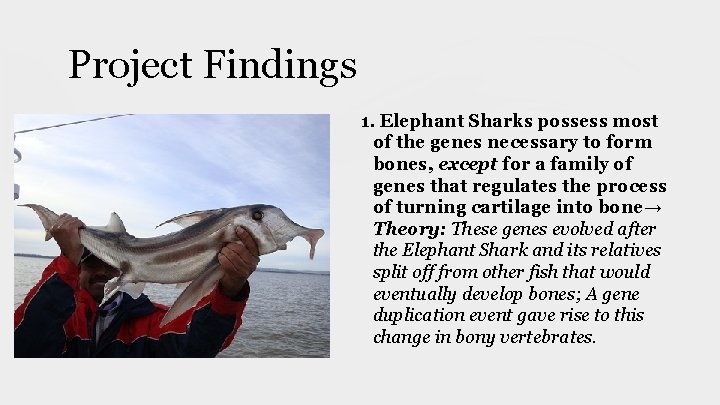
Project Findings 1. Elephant Sharks possess most of the genes necessary to form bones, except for a family of genes that regulates the process of turning cartilage into bone→ Theory: These genes evolved after the Elephant Shark and its relatives split off from other fish that would eventually develop bones; A gene duplication event gave rise to this change in bony vertebrates.
Project Findings 2. The Elephant Shark’s immune system is different from most other vertebrates: they have only one type of immune helper cells • • Most vertebrates have several different groups of these cells The helper T cells that they lack assist in regulating overall immune response to infection With this expanded genetic information, scientists can begin to understand how the immune system of Elephant Shark functions in hopes of finding correlations to the human body
The Immune System • • • Basics The innate immune system is the dominant of host defense in most organisms that counters microorganisms or toxins The adaptive immune system has evolutionary origins and allows for a stronger immune response with immunological memory “Helper T Cells” help direct the innate and adaptive immune systems by determining which response the body makes in response to a pathogen. Implications ● Elephant Sharks are unique in that they lack “Helper T Cells” ● These cells were previously thought to be essential for immune system defense against infections ● Because Elephant Sharks are made up of all cartilage and no bones, researchers are using genome analysis to develop new strategies for combatting immune infections and bone diseases including osteoporosis
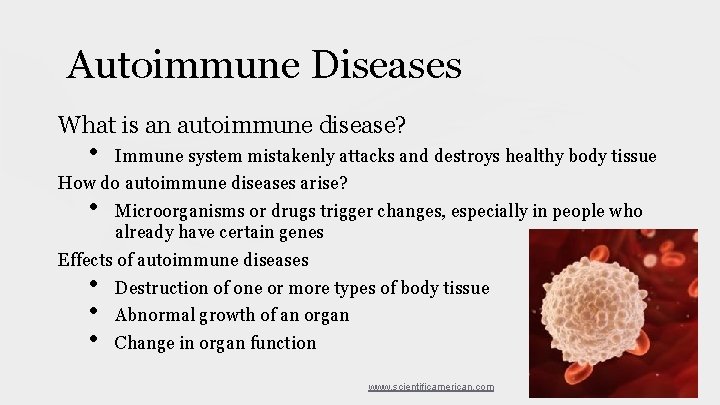
Autoimmune Diseases What is an autoimmune disease? • Immune system mistakenly attacks and destroys healthy body tissue How do autoimmune diseases arise? • Microorganisms or drugs trigger changes, especially in people who already have certain genes Effects of autoimmune diseases • • • Destruction of one or more types of body tissue Abnormal growth of an organ Change in organ function www. scientificamerican. com
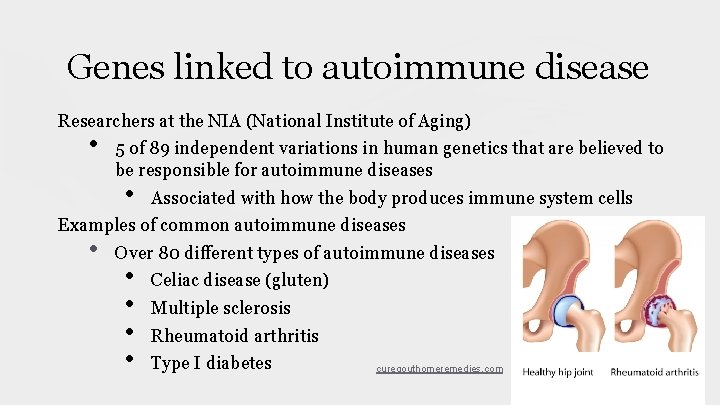
Genes linked to autoimmune disease Researchers at the NIA (National Institute of Aging) • 5 of 89 independent variations in human genetics that are believed to be responsible for autoimmune diseases • Associated with how the body produces immune system cells Examples of common autoimmune diseases • Over 80 different types of autoimmune diseases • • Celiac disease (gluten) Multiple sclerosis Rheumatoid arthritis Type I diabetes curegouthomeremedies. com
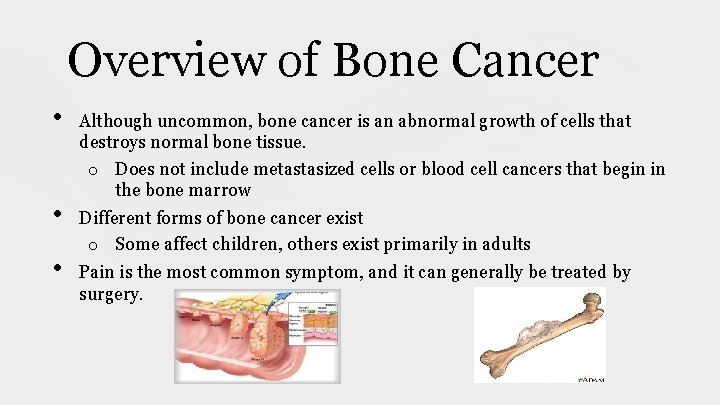
Overview of Bone Cancer • • • Although uncommon, bone cancer is an abnormal growth of cells that destroys normal bone tissue. o Does not include metastasized cells or blood cell cancers that begin in the bone marrow Different forms of bone cancer exist o Some affect children, others exist primarily in adults Pain is the most common symptom, and it can generally be treated by surgery.
Genetic Factors of Bone Cancer • • People with several hereditary genetic diseases are more at risk for bone cancer o Li-Fraumeni Syndrome - caused by mutation of the p 53 tumor suppressor gene o Rothmond-Thomson Syndrome - abnormal changes in RECQL 4 gene o Some osteosarcomas have been linked to inheritance, though the specific genetic mutation has not yet been discovered. Other factors, like previous radiation treatment or bone marrow transplantation, also contribute to risk of contraction of bone cancer.
Overview of Osteoporosis • • • Osteoporosis can affect all people, yet it is most commonly found in postmenopausal women It is a disease that affects the density of bones, making them brittle and more susceptible to fracture Osteoporosis patients consist of those whose bone mineral density (BMD) is 2. 5 standard deviations below the average
• • • Genetic Factors of Osteoporosis is a multifactorial trait o Examples of non-genetic risk factors are gender, alcohol abuse, physical inactivity, low calcium intake Heritability of bone mineral density has been estimated at 60 -90% Genes that have been implicated in osteoporosis: o Vitamin D (VDR): Vitamin D receptor gene, vitamin d helps regulate calcium levels o Estrogen (ER): An estrogen receptor that is crucial to female development and menopause o Collagen (COLIA): Collagen is an important protein present in bones § Mutation causes formation of abnormal collagen, leading to weaker bones
Clicker Questions What is the correct evolutionary sequence of of fish over time? A) bony fish, cartilaginous fish, jaw-less fish B) jaw-less fish, cartilaginous fish, bony fish C) cartilaginous fish, jaw-less fish, bony fish
Clicker Questions Scientists hope to use the gene-sequence of the elephant shark to better understand how specific genes are applicable to human disease. Which of the following is NOT a disease that scientists are linking to specific genes found in the elephant shark? A) Bone cancer B) Osteoporosis C) Rheumatoid arthritis D) Heart disease
References "Autoimmune disorders: Medline. Plus Medical Encyclopedia. " U. S National Library of Medicine. N. p. , 29 May 2011. Web. 20 Apr. 2014. <http: //www. nlm. nih. gov/medlineplus/ency/article/000816. htm >. Bester, Cathleen. "Ghost Shark. " Ichthyology at the Florida Museum of Natural History. The Florida Museum of Natural History, n. d. Web. <https: //www. flmnh. ufl. edu/fish/Gallery/Descript/Ghost. Shark. html>. Bhanoo, Sindya N. "A Window to Bone Disease in 'Shark's' Genome. " The New York Times. N. p. , 10 Jan. 2014. Web. Borrell, Brendan. "Why Sharks Have No Bones. " Nature (2014): n. pag. Web. <http: //www. nature. com/news/why-sharks-have-nobones-1. 14487>. "Elephant Shark Genome. " Elephant Shark Genome Project. Institute of Molecular and Cell Biology, 10 Jan. 2014. Web. <http: //esharkgenome. imcb. a-star. edu. sg/>. Giller, Geoffrey. "Slowly Evolving Elephant Shark Offers Clues about Why Some Fishes Have No Bones. " Scientific American (n. d. ): n. pag. Scientific American. 8 Jan. 2014. Web. "Immune System. " National Institute of Allergies and Infectious Diseases. N. p. , 14 Jan. 1923. Web. 22 Apr. 2014. <http: //www. niaid. nih. gov/topics/immunesystem/Pages/default. aspx >. Klappenbach, Laura. "The Basics of Vertebrate Evolution: From Jawless Fish to Mammals. " About. com Animals/Wildlife. N. p. , n. d. Web. <http: //animals. about. com/od/evolution/a/vertebrateevolu. htm >. Krans, Brian. "More Genetic Clues to Autoimmune Disorders Discovered. " Healthlines RSS News. N. p. , 27 Sept. 2013. Web. 22 Apr. 2014. <http: //www. healthline. com/health-news/ms-inherited-genes-affect-autoimmune-disease-risk-092713 >. Westerholm, Russell. "Elephant Shark's Entire Genome Sequenced, A First for Any Cartilaginous Fish. " University Herald [Chapel Hill, NC] 8 Jan. 2014: n. pag. Print. Spangler, Frederic, Janet Padgett, and Wilma Ek. "The Genetic Component of Osteoporosis. " The Genetic Component of Osteoporosis. Pro. Quest, n. d. Web. 22 Apr. 2014. <http: //www. csa. com/discoveryguides/archives/osteo. php>. "Osteoporosis. " Wikipedia. Wikimedia Foundation, 21 Apr. 2014. Web. 22 Apr. 2014.
Good presentations are clear, well-organized, and interesting. The best presentations are prepared with their audience in mind – you should understand it. Rate this presentation: A. B. C. D. E. There were many problems with this presentation. (2 pts. ) I had trouble understanding parts of the presentation. (4 pts. ) The presentation was OK. (6 pts. ) This was a very good presentation – clear, interesting and well-organized. (8 pts. ) This was an outstanding presentation that was well-organized, interesting and provoked good discussion. (10 pts. )