
The Elements of Poetry is hard to define



- Slides: 70
The Elements of Poetry is hard to define. Even poets argue among themselves about what makes a poem. There are some common characteristics, however, that we can use to help us differentiate between poetry and prose. (1) It should look like a poem, meaning that lines don’t run to the margins. Some lines are not even sentences. (2) There are usually some musical devices that give the poem a song-like, lyrical quality. (3) Images are conveyed through sensory details and figurative language. (4) The poem has some form to hold it together. Some poems actually have a prescribed form like haikus and sonnets. (5) The poem has some meaning, image or emotion it wants to share with the reader. That makes a poem!
To critically analyze a poem, we must look at its elements and see what they are doing to the poem. Then we can infer a meaning to it. The following slides will take us through the elements so that we can recognize them, and then we will try to put it all together and analyze the meaning of the poem.
Imagery • Imagery is the senses the poem evokes in the reader. Imagery puts the reader in the poem. It helps the reader to “see” the poem. • The tools of imagery are – Senses : sound, sight, touch, smell, taste, and emotion. – Figurative language : metaphor, simile, personification, hyperbole, etc.
Sensory details touch the five senses. They make the poem vivid to the reader. Let’s look at the sensory details in the poem “Those Winter Sundays. ”
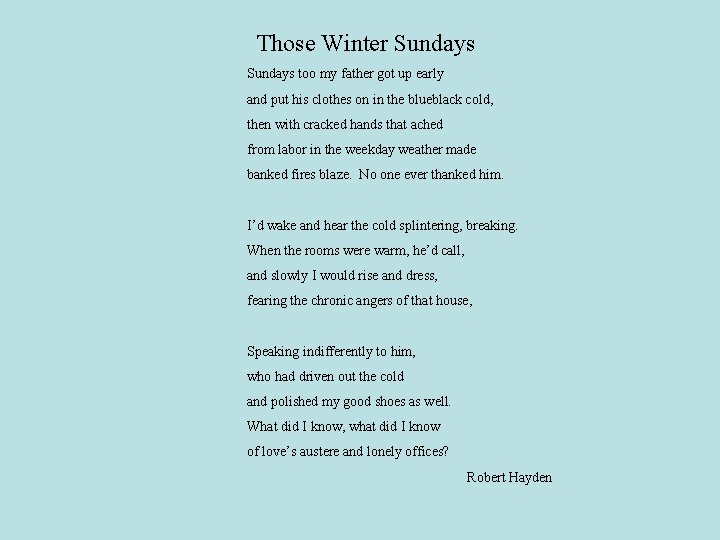
Those Winter Sundays too my father got up early and put his clothes on in the blueblack cold, then with cracked hands that ached from labor in the weekday weather made banked fires blaze. No one ever thanked him. I’d wake and hear the cold splintering, breaking. When the rooms were warm, he’d call, and slowly I would rise and dress, fearing the chronic angers of that house, Speaking indifferently to him, who had driven out the cold and polished my good shoes as well. What did I know, what did I know of love’s austere and lonely offices? Robert Hayden
In “Those Winter Sundays” Hayden has caused us to experience several senses. “…[B]lueblack cold” certainly makes us feel how cold it was. When the father’s hands are described as “cracked hands that ached” we can feel the roughness. He describes the cold “splintering and breaking. ” We can hear the trees and ice crack. And then the rooms “were warm” when the boy got up. We know how that feels on a cold day. When the boy fears “the chronic angers of that house” and when he speaks “indifferently to him” we know what emotions the boy is feeling. Hayden has caused us to feel cold, cracked hands and warm rooms. We hear splintering and breaking and feel anger and indifference. These sensory details make the poem come alive to us and help us to feel what the boy felt on those winter Sundays.
Figurative Language • Figurative language is words not meant to be taken literally. The words are symbolic. We know these images as metaphor, simile, personification, hyperbole, and others. Because the poet is comparing a less familiar object to a common one, the comparison makes the familiar image stronger. • The next slides will give examples of each type of image.
Metaphor is a figure of speech that makes a comparison between two unlike things, in which one thing becomes another without the use of the words like, as, than, or resembles.
Example: Love is a rose.
Simile is a figure of speech that makes a comparison between two unlike things, using words such as like, as, than, or resembles. Example: My love is like a red, red rose. - Robert Burns
Metaphor/Simile Metaphors and similes compare something in the poem to something familiar outside the poem. Making the connection requires background knowledge for the metaphor/simile to be meaningful to the reader. Look at the metaphors in the poem, “Frost. ”
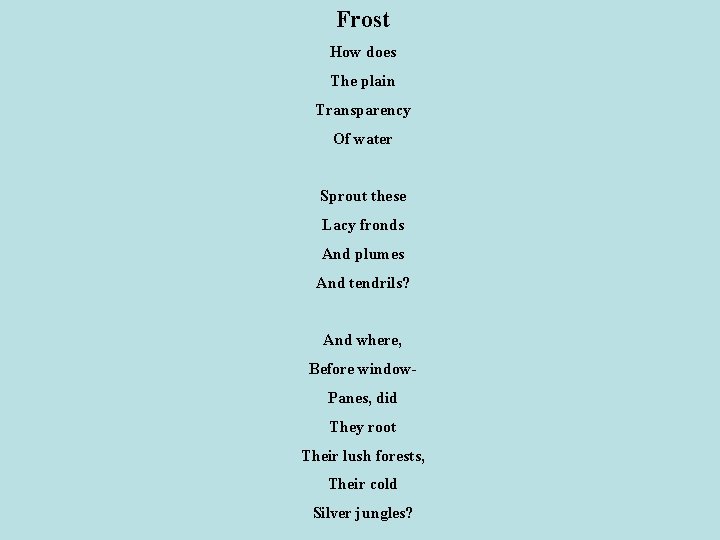
Frost How does The plain Transparency Of water Sprout these Lacy fronds And plumes And tendrils? And where, Before window. Panes, did They root Their lush forests, Their cold Silver jungles?
The author of this poem compared the frost on a window to the lacy fronds, plumes, and tendrils of a fern. In the last stanza she has expanded the comparison to “crystal forests” and “silver jungles. ” Let us picture that in our minds. Can we “see” the frost on the window?
Personification is a special kind of metaphor in which a nonhuman thing is talked about as if it was human (given human characteristics).
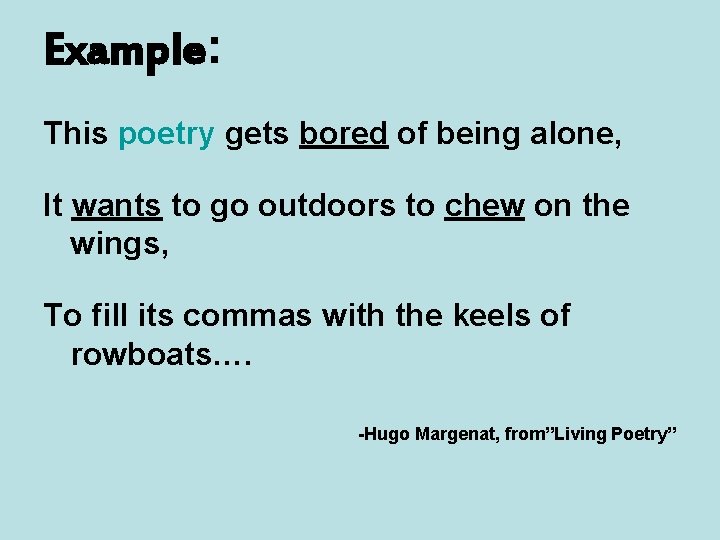
Example: This poetry gets bored of being alone, It wants to go outdoors to chew on the wings, To fill its commas with the keels of rowboats…. -Hugo Margenat, from”Living Poetry”
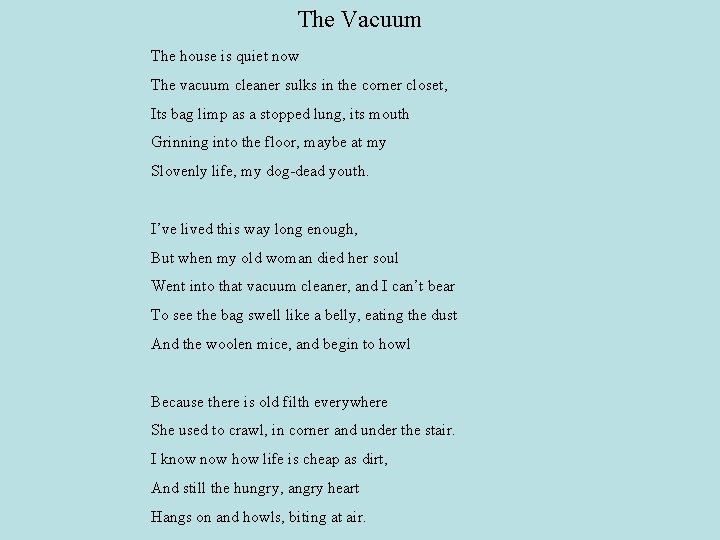
Personification When an author uses personification, he gives human characteristics to a non-human object. Look at the human characteristics used by Howard Nemerov in his poem “The Vacuum. ” Also notice how personification reveals the speaker’s attitude toward housekeeping.
The Vacuum The house is quiet now The vacuum cleaner sulks in the corner closet, Its bag limp as a stopped lung, its mouth Grinning into the floor, maybe at my Slovenly life, my dog-dead youth. I’ve lived this way long enough, But when my old woman died her soul Went into that vacuum cleaner, and I can’t bear To see the bag swell like a belly, eating the dust And the woolen mice, and begin to howl Because there is old filth everywhere She used to crawl, in corner and under the stair. I know how life is cheap as dirt, And still the hungry, angry heart Hangs on and howls, biting at air.
Hyperbole/ Exaggeration The poet uses hyperbole to overstate something to reveal the truth. In a poem called “Sow” Sylvia Plath describes how much the sow eats. She writes, “Of kitchen slops and, stomaching no constraint, / Proceeded to swill/ The seven seas and every earthquaking continent. ” How much did the sow eat?
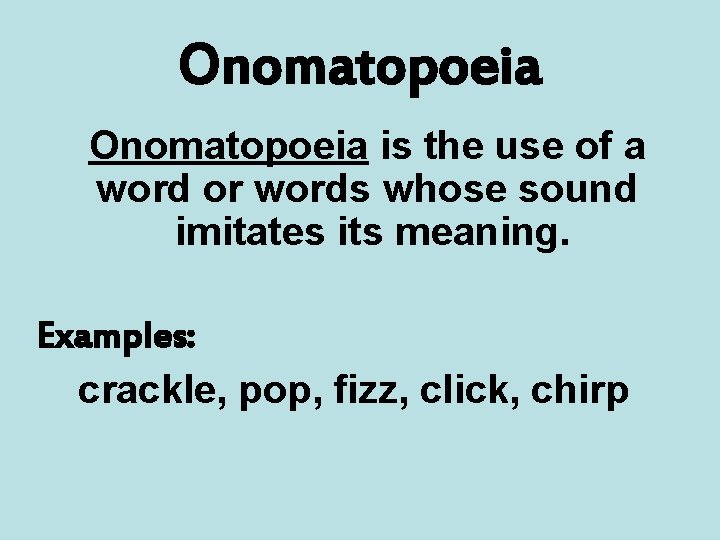
Onomatopoeia is the use of a word or words whose sound imitates its meaning. Examples: crackle, pop, fizz, click, chirp
Onomatopoeia We are familiar with onomatopoeia even if we don’t understand the word. When two cars collide, what sound do they make? Crash! That is onomatopoeia – words that make the sound they are imitating. Here is a poem by Eve Merriam appropriately titled “Onomatopoeia. ” See how many sounds are heard.
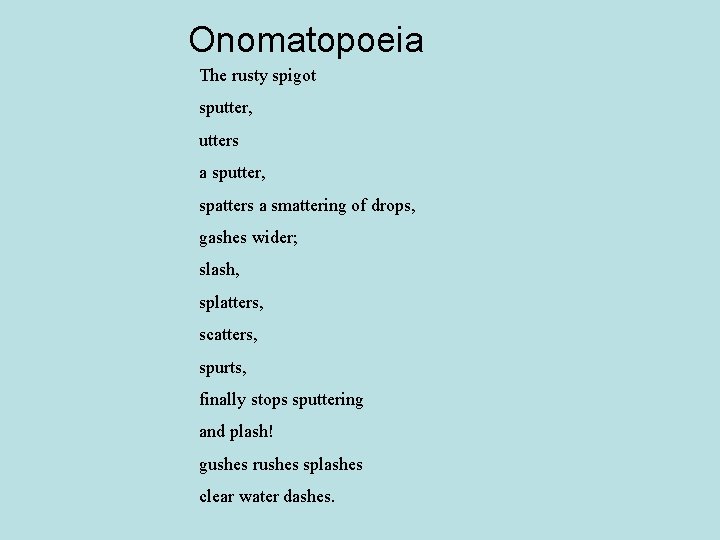
Onomatopoeia The rusty spigot sputter, utters a sputter, spatters a smattering of drops, gashes wider; slash, splatters, scatters, spurts, finally stops sputtering and plash! gushes rushes splashes clear water dashes.
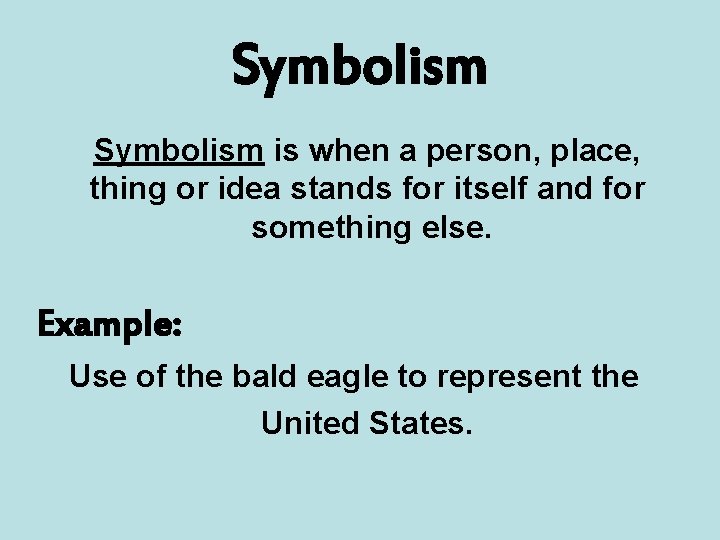
Symbolism is when a person, place, thing or idea stands for itself and for something else. Example: Use of the bald eagle to represent the United States.
Understatement • Understatement - basically the opposite of hyperbole. Often it is ironic. • Ex. Calling a slow moving person “Speedy” • Ex. Yao Ming is slightly taller than Ms. Marinucci.
Idiom • An expression where the literal meaning of the words is not the meaning of the expression. It means something other than what it actually says. • Ex. It’s raining cats and dogs.
Allusion • Allusion comes from the verb “allude” which means “to refer to” • An allusion is a reference to something famous. A tunnel walled and overlaid With dazzling crystal: we had read Of rare Aladdin’s wondrous cave, And to our own his name we gave. From “Snowbound” John Greenleaf Whittier
Alliteration is the use of similar sounds at the beginning of a word.
Music The poet uses musical devices to make the poem song-like. In fact, some poems are/were songs. The musical devices we will discuss, and be responsible for, are assonance (which is similar to alliteration), onomatopoeia, rhythm, rhyme, repetition, and pause.
Assonance is the use of similar vowel sounds within a word.
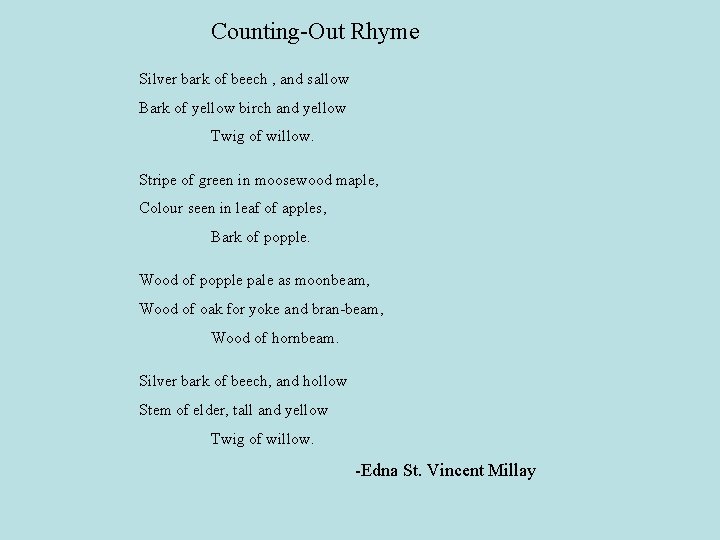
Rhythm is the beat of a poem. It is the pattern of stressed and unstressed syllables. There are several rhythm patterns in poetry which we will not go into in this presentation which will be shown later. Let’s look at the following poem and see if we can identify the pattern of stressed and unstressed beats.
Counting-Out Rhyme Silver bark of beech , and sallow Bark of yellow birch and yellow Twig of willow. Stripe of green in moosewood maple, Colour seen in leaf of apples, Bark of popple. Wood of popple pale as moonbeam, Wood of oak for yoke and bran-beam, Wood of hornbeam. Silver bark of beech, and hollow Stem of elder, tall and yellow Twig of willow. -Edna St. Vincent Millay
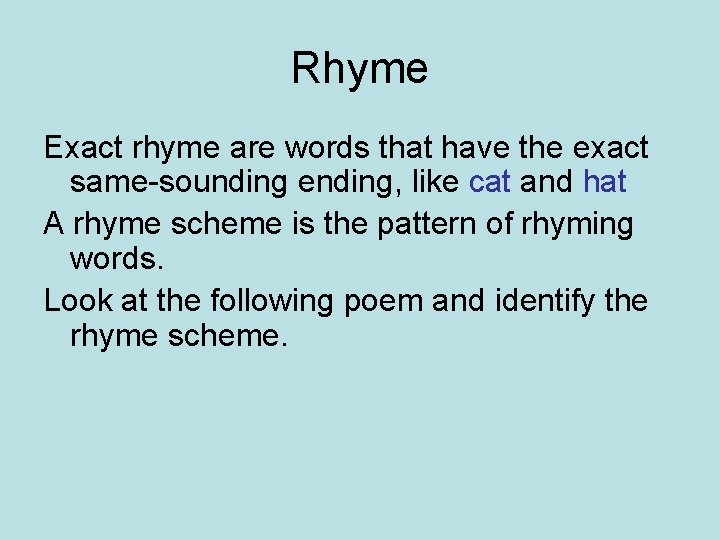
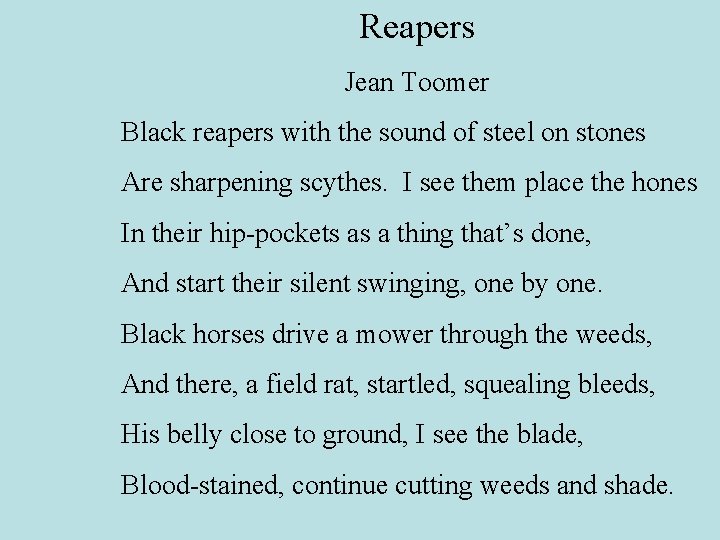
Rhyme Exact rhyme are words that have the exact same-sounding ending, like cat and hat A rhyme scheme is the pattern of rhyming words. Look at the following poem and identify the rhyme scheme.
Reapers Jean Toomer Black reapers with the sound of steel on stones Are sharpening scythes. I see them place the hones In their hip-pockets as a thing that’s done, And start their silent swinging, one by one. Black horses drive a mower through the weeds, And there, a field rat, startled, squealing bleeds, His belly close to ground, I see the blade, Blood-stained, continue cutting weeds and shade.
END RHYME • A word at the end of one line rhymes with a word at the end of another line Hector the Collector Collected bits of string. Collected dolls with broken heads And rusty bells that would not ring.
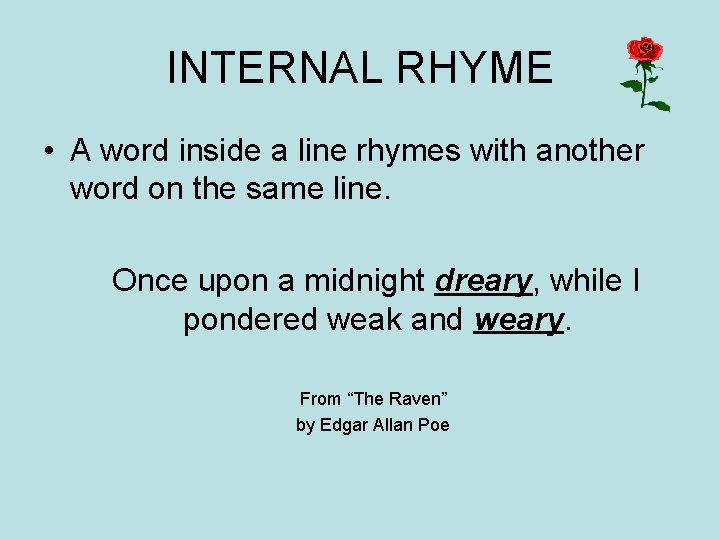
INTERNAL RHYME • A word inside a line rhymes with another word on the same line. Once upon a midnight dreary, while I pondered weak and weary. From “The Raven” by Edgar Allan Poe
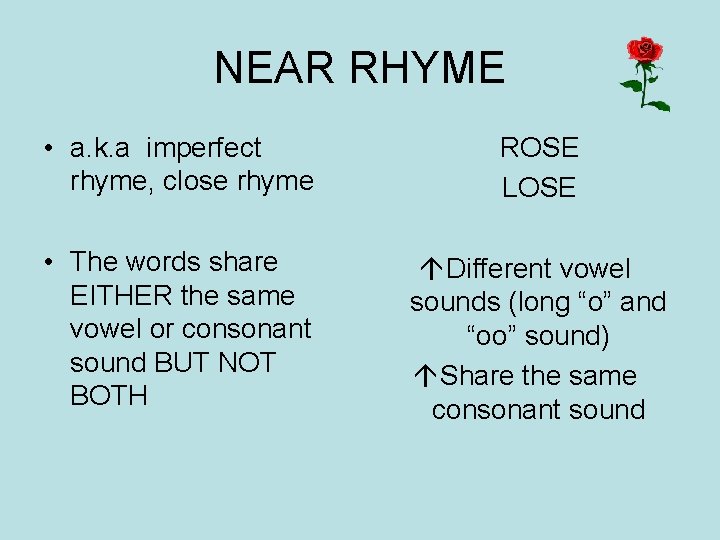
NEAR RHYME • a. k. a imperfect rhyme, close rhyme ROSE LOSE • The words share EITHER the same vowel or consonant sound BUT NOT BOTH á Different vowel sounds (long “o” and “oo” sound) á Share the same consonant sound
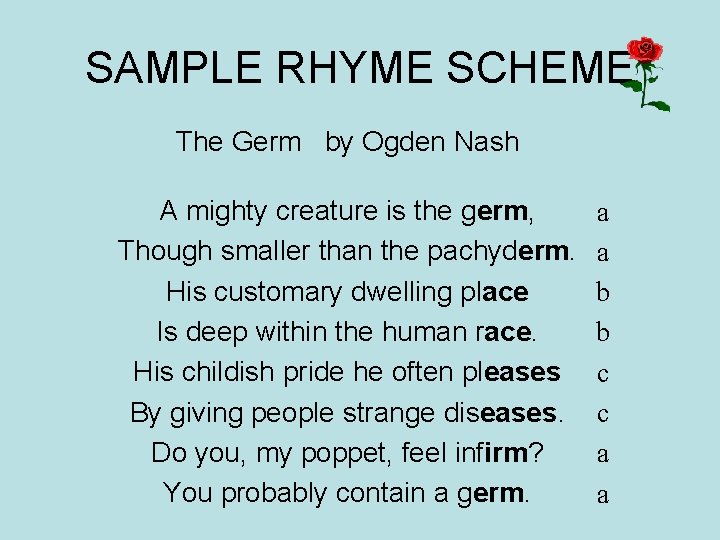
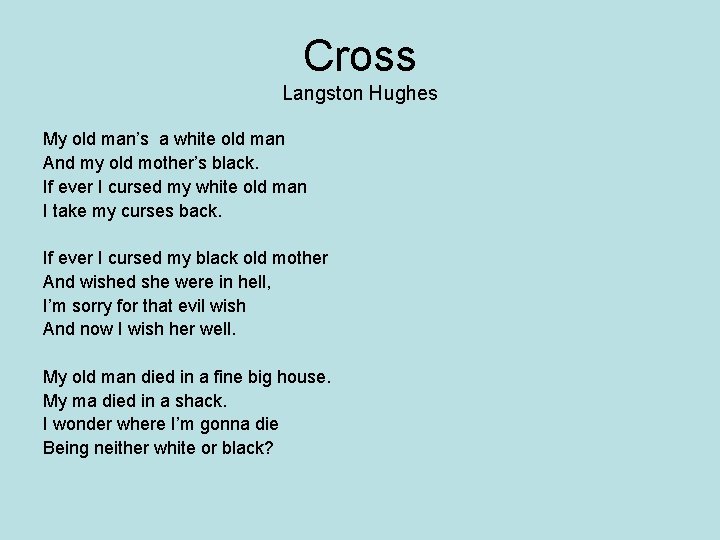
Rhyme Scheme • Having a certain rhyme scheme also is a way to give structure to poetry. • Look at the example first and letter it • Look at the rhyme scheme in the poem “Cross” by Langston Hughes. See how it holds the poem together. Also notice the use of stanzas. Why did Hughes put these words in the stanza?
SAMPLE RHYME SCHEME The Germ by Ogden Nash A mighty creature is the germ, Though smaller than the pachyderm. His customary dwelling place Is deep within the human race. His childish pride he often pleases By giving people strange diseases. Do you, my poppet, feel infirm? You probably contain a germ. a a b b c c a a
Cross Langston Hughes My old man’s a white old man And my old mother’s black. If ever I cursed my white old man I take my curses back. If ever I cursed my black old mother And wished she were in hell, I’m sorry for that evil wish And now I wish her well. My old man died in a fine big house. My ma died in a shack. I wonder where I’m gonna die Being neither white or black?
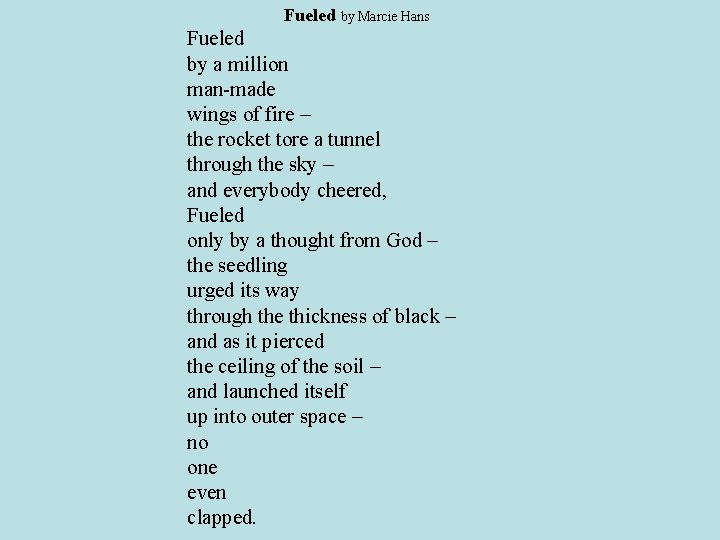
Letters Repetitive initial consonant sounds in a poem are called alliteration. Repetition of other consonant sounds is called consonance. Repetitive vowel sounds are called assonance. The following poem has many examples of each. See how many you can find. Also notice what other element of poetry you can find.
Fueled by Marcie Hans Fueled by a million man-made wings of fire – the rocket tore a tunnel through the sky – and everybody cheered, Fueled only by a thought from God – the seedling urged its way through the thickness of black – and as it pierced the ceiling of the soil – and launched itself up into outer space – no one even clapped.
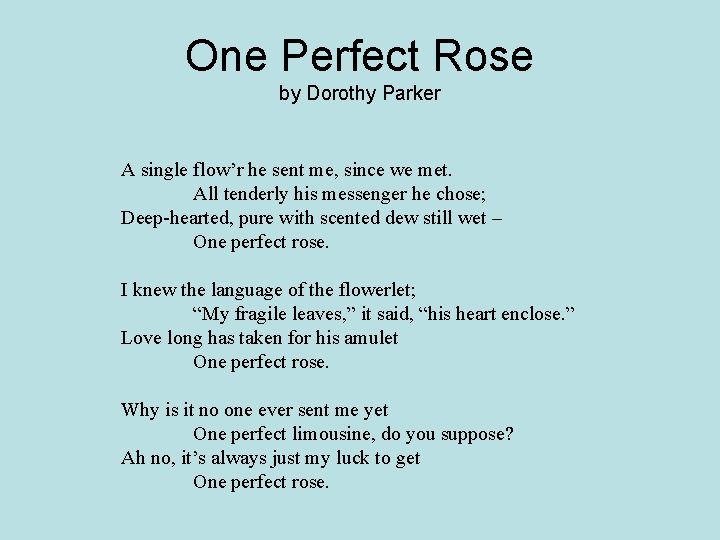
Repetition • Poems also create music through the repetition of words and lines. • Look at the poem “One Perfect Rose” by Dorothy Parker. One line is repeated three times. Notice how the meaning of the line changes by the third repetition.
One Perfect Rose by Dorothy Parker A single flow’r he sent me, since we met. All tenderly his messenger he chose; Deep-hearted, pure with scented dew still wet – One perfect rose. I knew the language of the flowerlet; “My fragile leaves, ” it said, “his heart enclose. ” Love long has taken for his amulet One perfect rose. Why is it no one ever sent me yet One perfect limousine, do you suppose? Ah no, it’s always just my luck to get One perfect rose.
Form • Form is the structure of the poem. Any type of writing must have something to hold it together. The structure can be created through many means: meter, stanza, rhyme scheme, or set patterns of poetry like sonnet, haiku , concrete, and others.
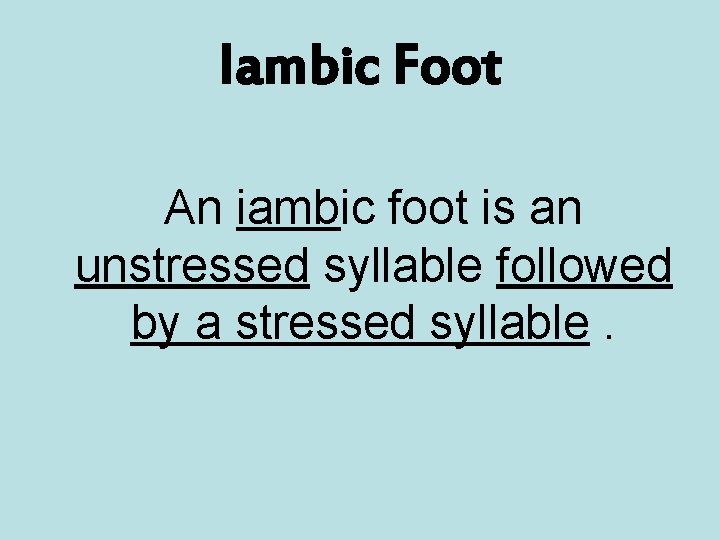
Iambic Foot An iambic foot is an unstressed syllable followed by a stressed syllable.
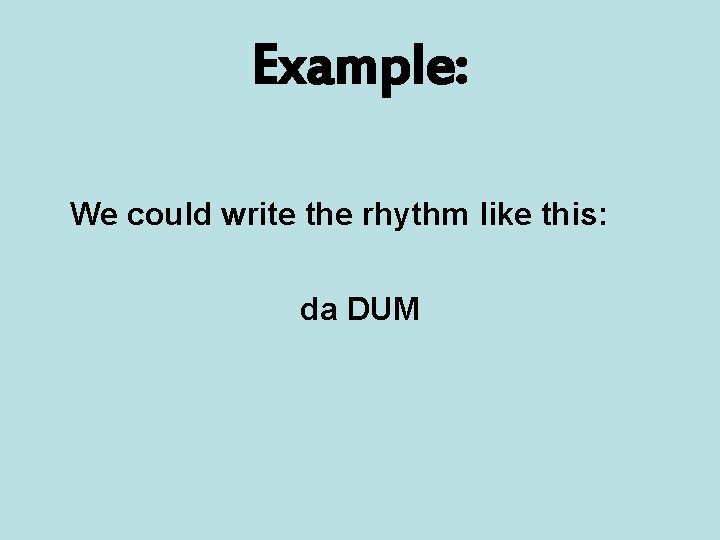
Example: We could write the rhythm like this: da DUM
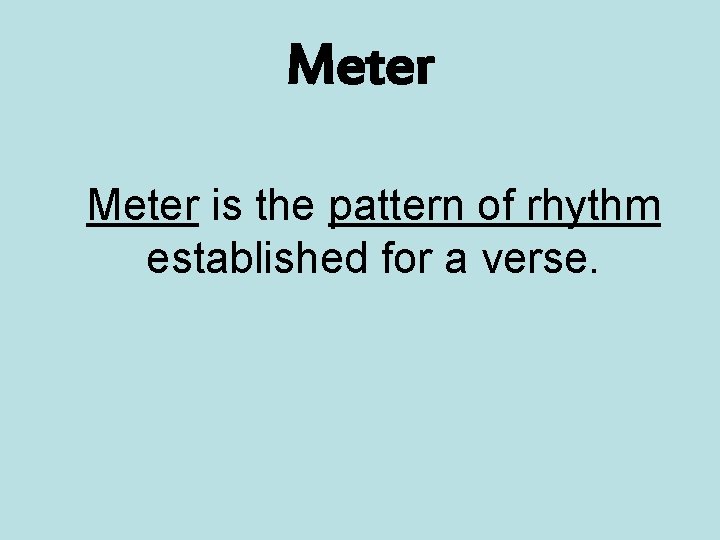
Meter is the pattern of rhythm established for a verse.
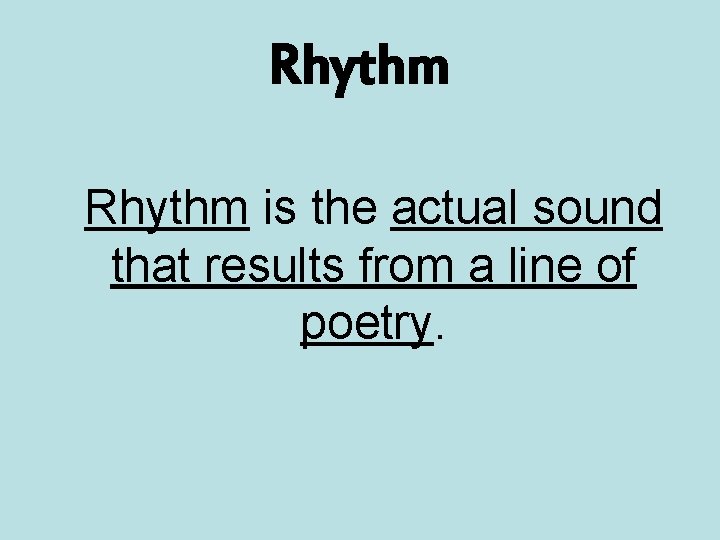
Rhythm is the actual sound that results from a line of poetry.
Iambic Pentameter is a line of poetry with five iambic feet in a row This is the most common meter in English poetry.
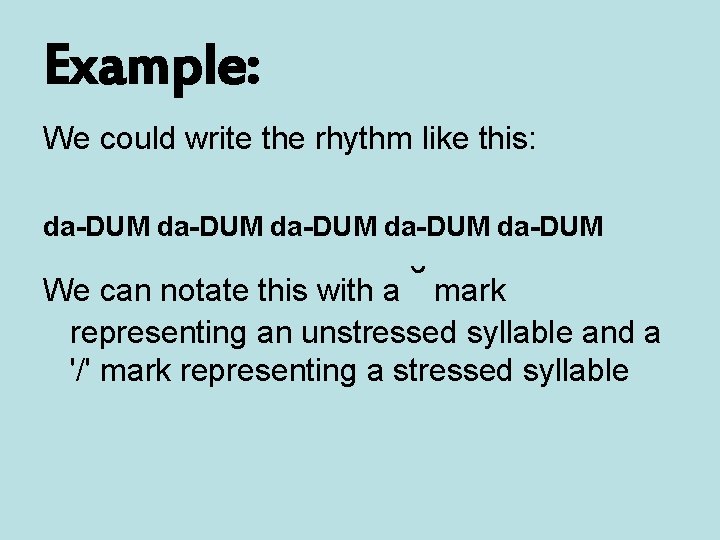
Example: We could write the rhythm like this: da-DUM da-DUM We can notate this with a ˘ mark representing an unstressed syllable and a '/' mark representing a stressed syllable
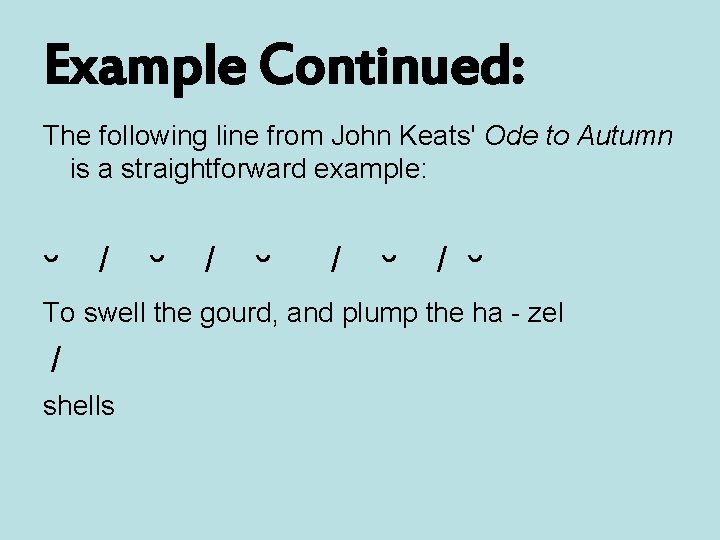
Example Continued: The following line from John Keats' Ode to Autumn is a straightforward example: ˘ / ˘ / ˘ To swell the gourd, and plump the ha - zel / shells
Stanza • A stanza in poetry is like a paragraph in prose. The author divides the poem by grouping words into stanzas. We can often see the structure of the poem by the author’s use of stanza.
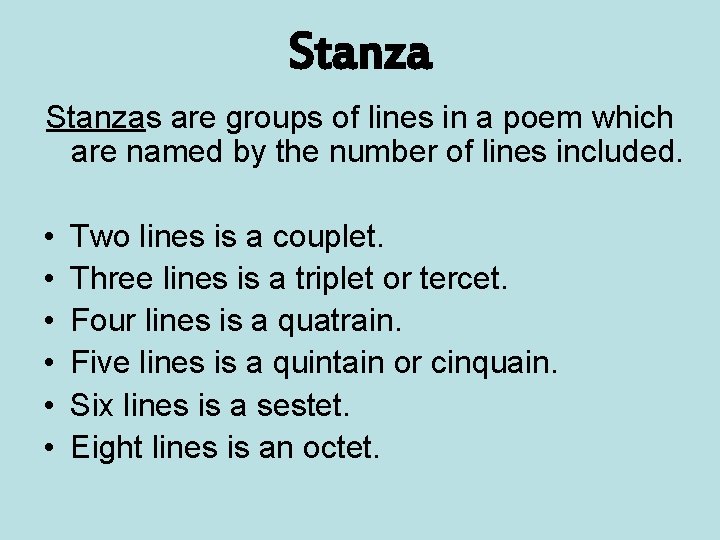
Stanzas are groups of lines in a poem which are named by the number of lines included. • • • Two lines is a couplet. Three lines is a triplet or tercet. Four lines is a quatrain. Five lines is a quintain or cinquain. Six lines is a sestet. Eight lines is an octet.
Pattern • Some poems are written in a set form like sonnets, haikus, limericks, concrete, etc. These patterns sometimes require a regular rhyme scheme or meter; or number of syllables or lines. Look at the following examples:
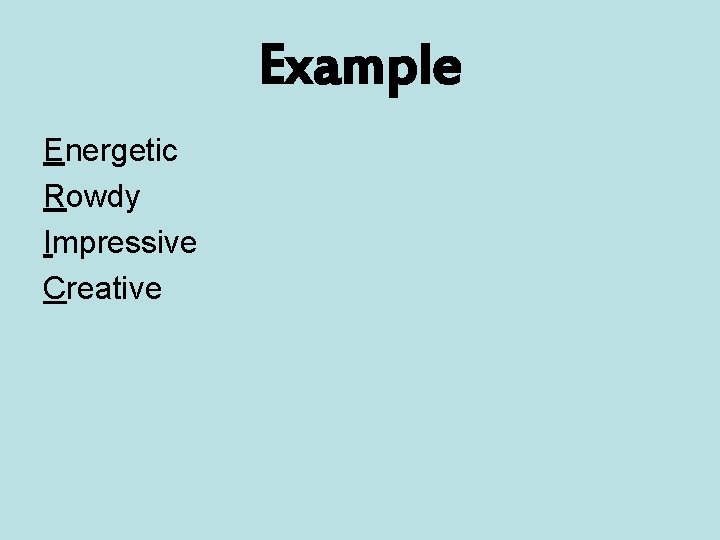
Acrostic poetry Acrostic poems use letter patterns to create multiple messages Example: When the first letters of lines read downward form a separate phrase or word.
Example Energetic Rowdy Impressive Creative
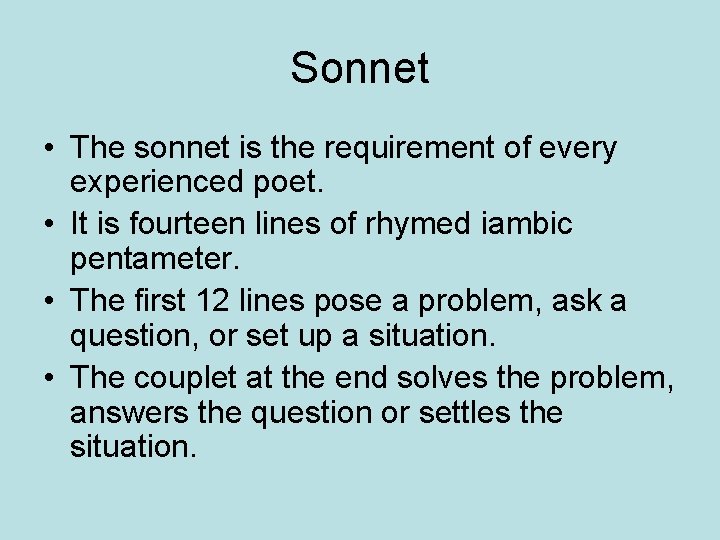
Sonnet • The sonnet is the requirement of every experienced poet. • It is fourteen lines of rhymed iambic pentameter. • The first 12 lines pose a problem, ask a question, or set up a situation. • The couplet at the end solves the problem, answers the question or settles the situation.
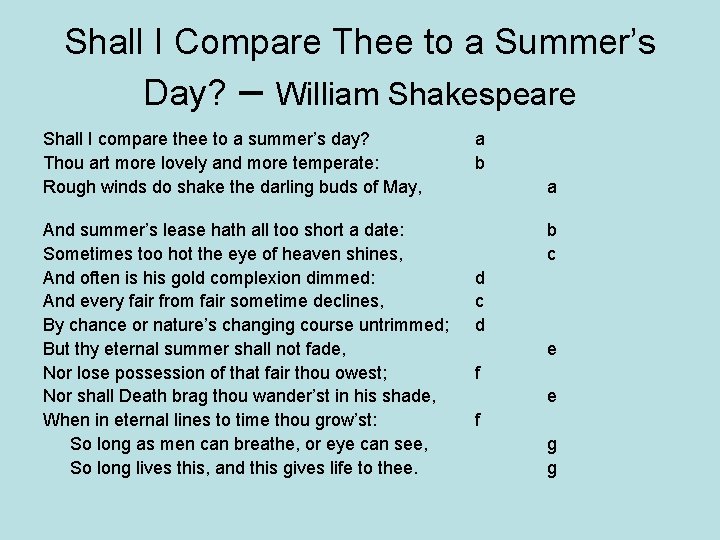
Shall I Compare Thee to a Summer’s Day? – William Shakespeare Shall I compare thee to a summer’s day? Thou art more lovely and more temperate: Rough winds do shake the darling buds of May, And summer’s lease hath all too short a date: Sometimes too hot the eye of heaven shines, And often is his gold complexion dimmed: And every fair from fair sometime declines, By chance or nature’s changing course untrimmed; But thy eternal summer shall not fade, Nor lose possession of that fair thou owest; Nor shall Death brag thou wander’st in his shade, When in eternal lines to time thou grow’st: So long as men can breathe, or eye can see, So long lives this, and this gives life to thee. a b c d e f g g
The previous sonnet is a famous one by William Shakespeare. It follows exactly the sonnet pattern. Iambic pentameter means that it has five feet of iamb meter (U/). The rhyme scheme is called Shakespearen because Shakespeare used it in all his sonnets. Look back at the poem and notice the rhyme and meter. Then see what the first four lines are talking about and how the couplet at the end completes it.
Haiku is a popular form of traditional Japanese poetry consists of 17 -syllables comprising three metrical lines of 5, 7, and 5 syllables.
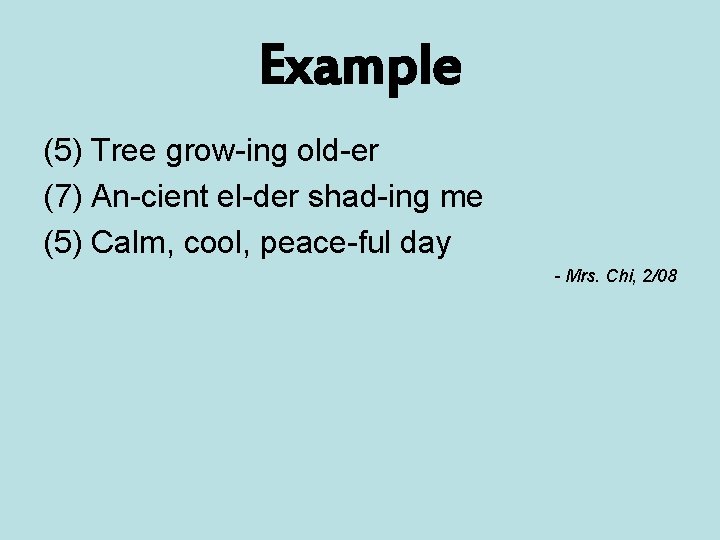
Example (5) Tree grow-ing old-er (7) An-cient el-der shad-ing me (5) Calm, cool, peace-ful day - Mrs. Chi, 2/08
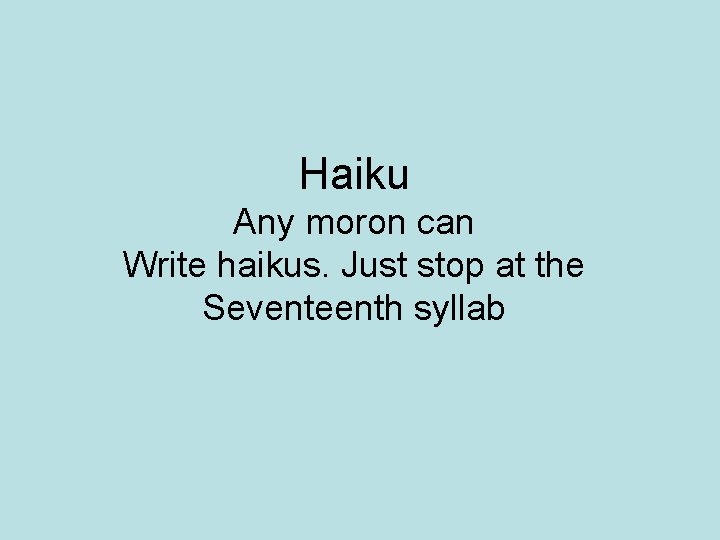
Haiku is an ancient Japanese pattern. It is three lines of seventeen syllables separated into 5 syllables in the first line, 7 syllables in the second, and 5 in the last. But a haiku is much more than that. Look at the following haiku written by Mike Reiss.
Haiku Any moron can Write haikus. Just stop at the Seventeenth syllab
I think he was trying to be funny. Did you laugh? Real haiku also have other characteristics besides syllables. 1. Haiku depend on imagery. 2. Haiku are condensed; the poet leaves out all unnecessary words. 3. Haiku are concerned with emotions; nature reflects these emotions. 4. Haiku rely heavily on the power of suggestion or connotation.
Here is a real Japanese haiku written by Japanese writer Kobayashi Issa. A gentle spring rain Look, a rat is lapping Sumida River. Here is one by American author Richard Wright. Over spring mountains A star ends the paragraph Of a thunderstorm. Finally, one by a former student, Jonathan Martin. Praying like a priest Then snapping with God’s power, The mantis chews love.
Limerick • The limerick has a strict pattern of five lines in an anapestic meter with a rhyme scheme of aa, bb, a. The limerick is almost always a light, humorous poem. Here is an example:
I sat next the Duchess at tea. It was just as I feared it would be: Her rumblings abdominal Were simply abominable And everyone thought they were me! -Anonymous
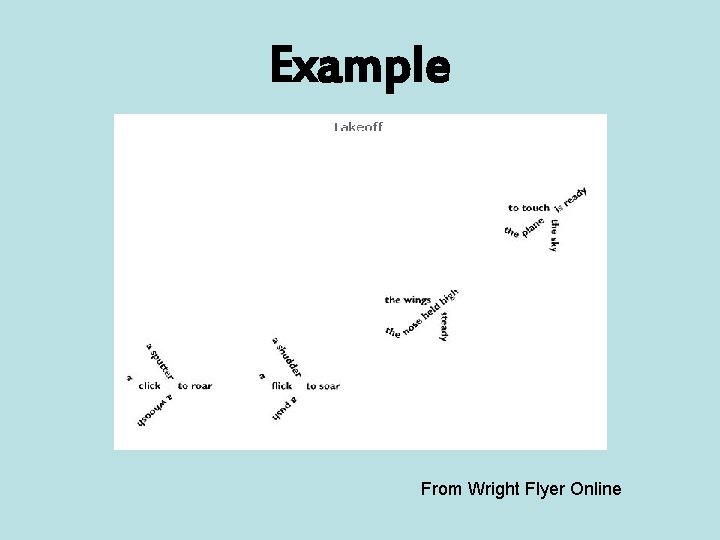
Concrete poetry Some poetry takes the shape of what the poem is about. Here is one called Poem by Philip G. Tannenbaum: Ido Ntl Ike Tel Eph One Boo ths Can you figure out what this is about?
Example From Wright Flyer Online
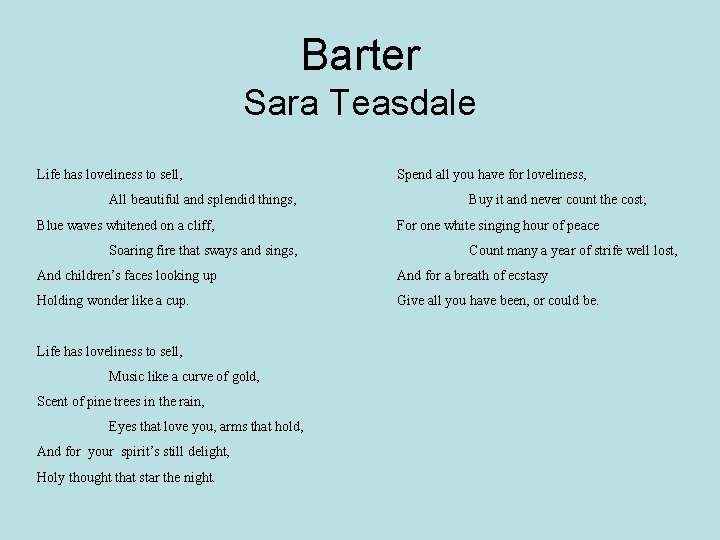
Putting it all Together or how to analyze a poem • Now that we have discussed the poetic tools, let’s apply them in the discussion of a poem. The main tools the poet uses are imagery, music and form. Look for these elements in the last poem of the presentation. Discuss how the poet creates and effect by the use of these tools.
Barter Sara Teasdale Life has loveliness to sell, All beautiful and splendid things, Blue waves whitened on a cliff, Soaring fire that sways and sings, Spend all you have for loveliness, Buy it and never count the cost; For one white singing hour of peace Count many a year of strife well lost, And children’s faces looking up And for a breath of ecstasy Holding wonder like a cup. Give all you have been, or could be. Life has loveliness to sell, Music like a curve of gold, Scent of pine trees in the rain, Eyes that love you, arms that hold, And for your spirit’s still delight, Holy thought that star the night.