
The Elements of Jyut Ping 1 What is
- Slides: 22
The Elements of “Jyut. Ping” 1
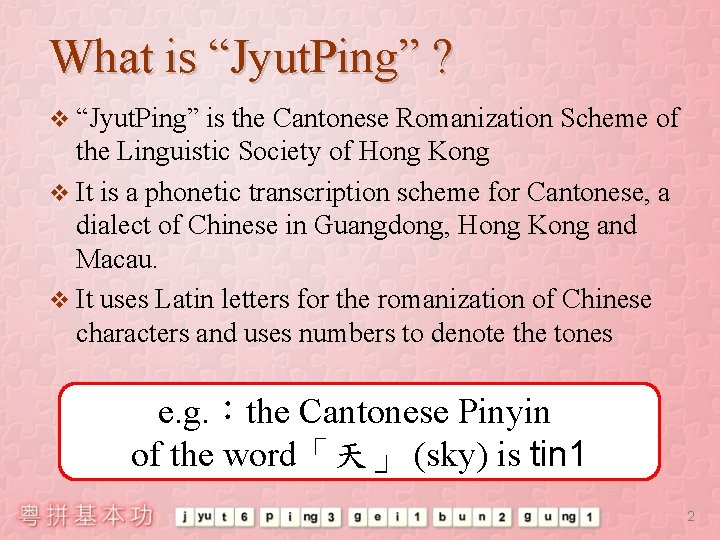
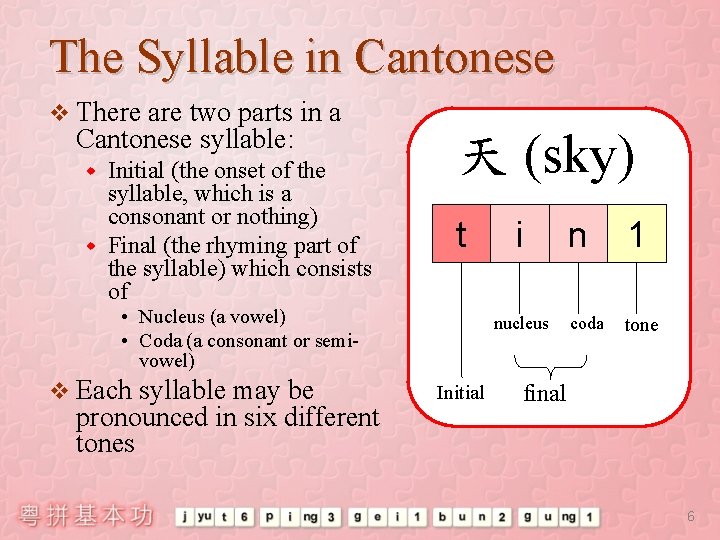
What is “Jyut. Ping” ? v “Jyut. Ping” is the Cantonese Romanization Scheme of the Linguistic Society of Hong Kong v It is a phonetic transcription scheme for Cantonese, a dialect of Chinese in Guangdong, Hong Kong and Macau. v It uses Latin letters for the romanization of Chinese characters and uses numbers to denote the tones e. g. :the Cantonese Pinyin of the word「天」 (sky) is tin 1 2
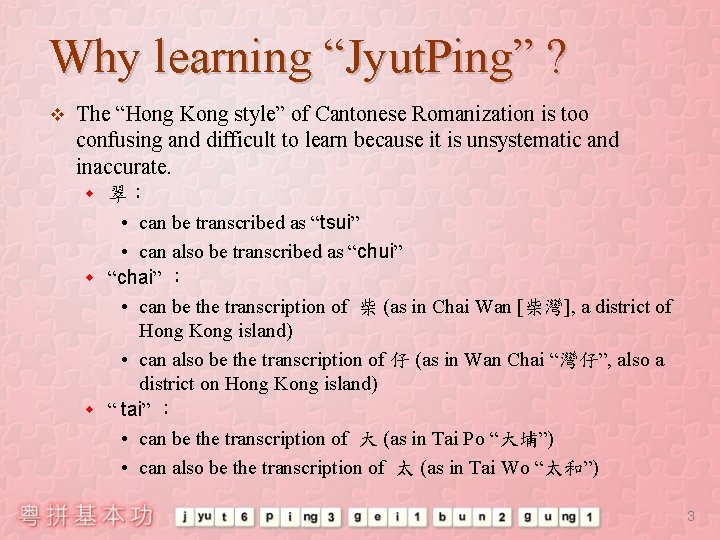
Why learning “Jyut. Ping” ? v The “Hong Kong style” of Cantonese Romanization is too confusing and difficult to learn because it is unsystematic and inaccurate. 翠: • can be transcribed as “tsui” • can also be transcribed as “chui” w “chai” : • can be the transcription of 柴 (as in Chai Wan [柴灣], a district of Hong Kong island) • can also be the transcription of 仔 (as in Wan Chai “灣仔”, also a district on Hong Kong island) w “ tai” : • can be the transcription of 大 (as in Tai Po “大埔”) • can also be the transcription of 太 (as in Tai Wo “太和”) w 3
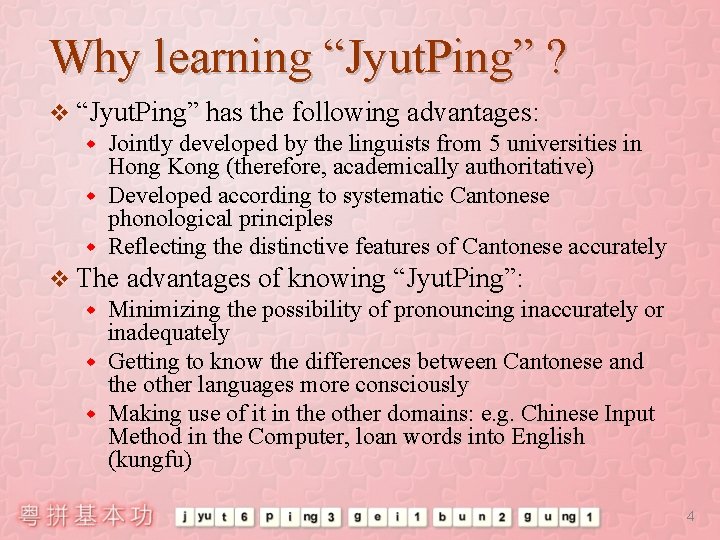
Why learning “Jyut. Ping” ? v “Jyut. Ping” has the following advantages: w Jointly developed by the linguists from 5 universities in Hong Kong (therefore, academically authoritative) w Developed according to systematic Cantonese phonological principles w Reflecting the distinctive features of Cantonese accurately v The advantages of knowing “Jyut. Ping”: w Minimizing the possibility of pronouncing inaccurately or inadequately w Getting to know the differences between Cantonese and the other languages more consciously w Making use of it in the other domains: e. g. Chinese Input Method in the Computer, loan words into English (kungfu) 4
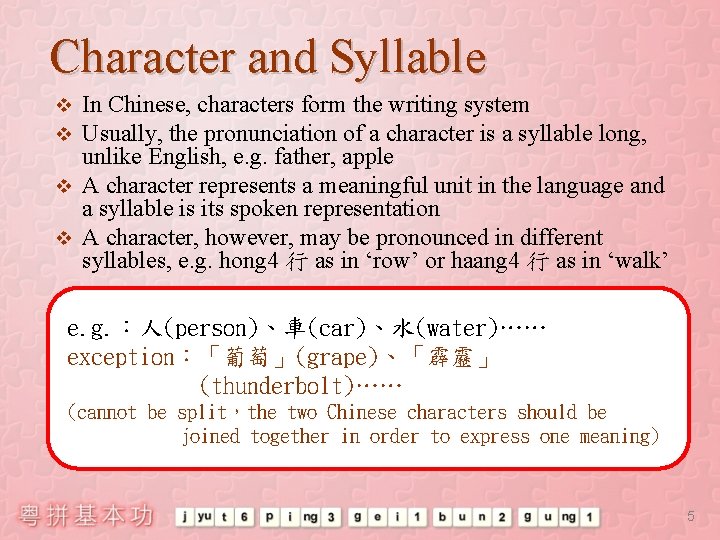
Character and Syllable In Chinese, characters form the writing system Usually, the pronunciation of a character is a syllable long, unlike English, e. g. father, apple v A character represents a meaningful unit in the language and a syllable is its spoken representation v A character, however, may be pronounced in different syllables, e. g. hong 4 行 as in ‘row’ or haang 4 行 as in ‘walk’ v v e. g. :人(person)、車(car)、水(water)…… exception:「葡萄」(grape)、「霹靂」 (thunderbolt)…… (cannot be split,the two Chinese characters should be joined together in order to express one meaning) 5
The Syllable in Cantonese v There are two parts in a Cantonese syllable: Initial (the onset of the syllable, which is a consonant or nothing) w Final (the rhyming part of the syllable) which consists of w 天 (sky) t • Nucleus (a vowel) • Coda (a consonant or semivowel) v Each syllable may be pronounced in six different tones i nucleus Initial n 1 coda tone final 6
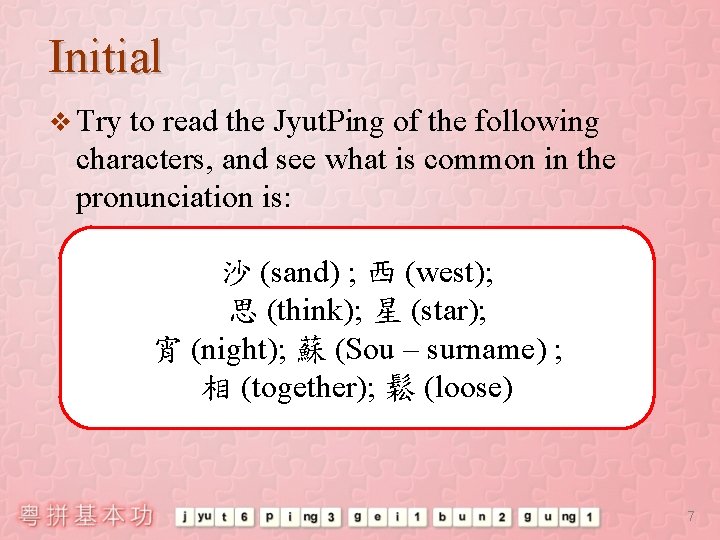
Initial v Try to read the Jyut. Ping of the following characters, and see what is common in the pronunciation is: 沙 (sand) ; 西 (west); 思 (think); 星 (star); 宵 (night); 蘇 (Sou – surname) ; 相 (together); 鬆 (loose) 7
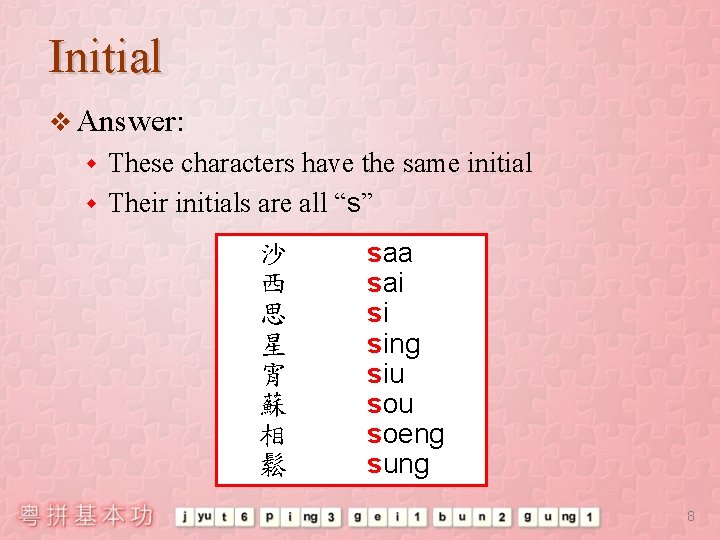
Initial v Answer: These characters have the same initial w Their initials are all “s” w 沙 西 思 星 宵 蘇 相 鬆 saa sai si sing siu soeng sung 8
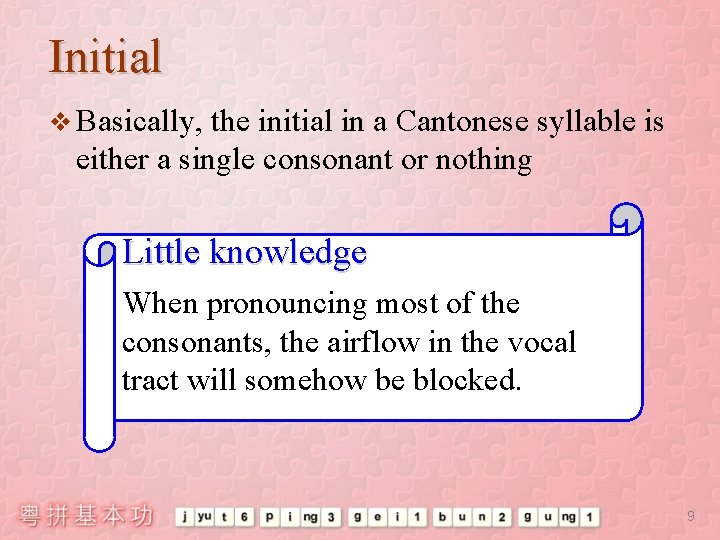
Initial v Basically, the initial in a Cantonese syllable is either a single consonant or nothing Little knowledge When pronouncing most of the consonants, the airflow in the vocal tract will somehow be blocked. 9
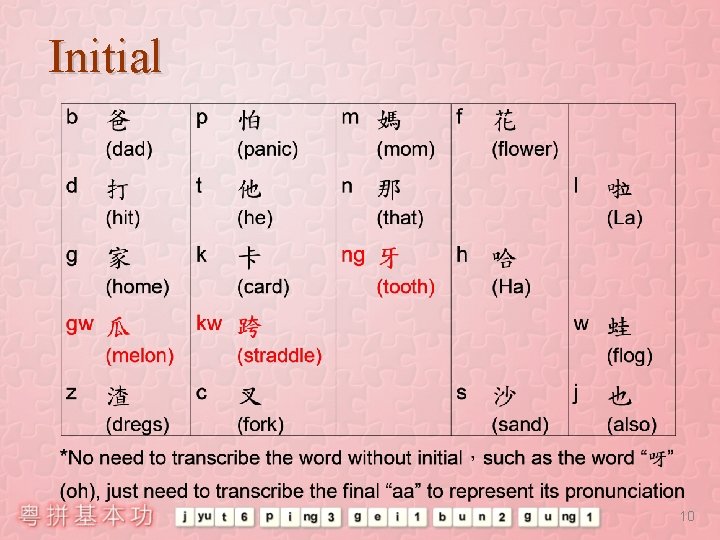
Initial 10
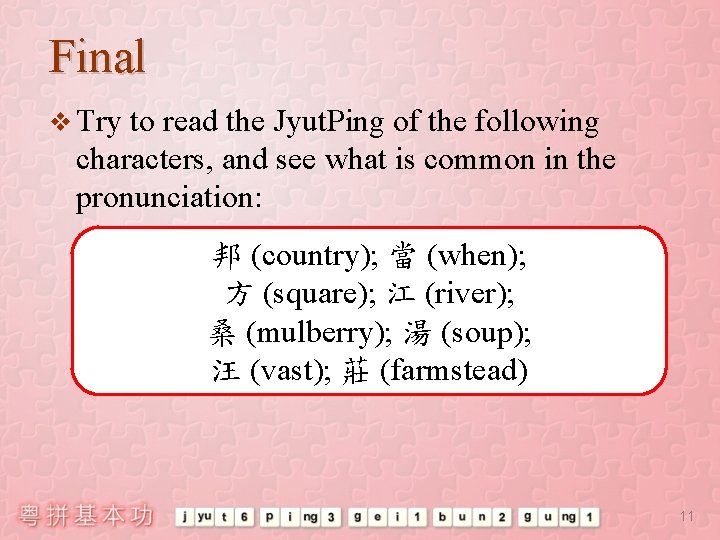
Final v Try to read the Jyut. Ping of the following characters, and see what is common in the pronunciation: 邦 (country); 當 (when); 方 (square); 江 (river); 桑 (mulberry); 湯 (soup); 汪 (vast); 莊 (farmstead) 11
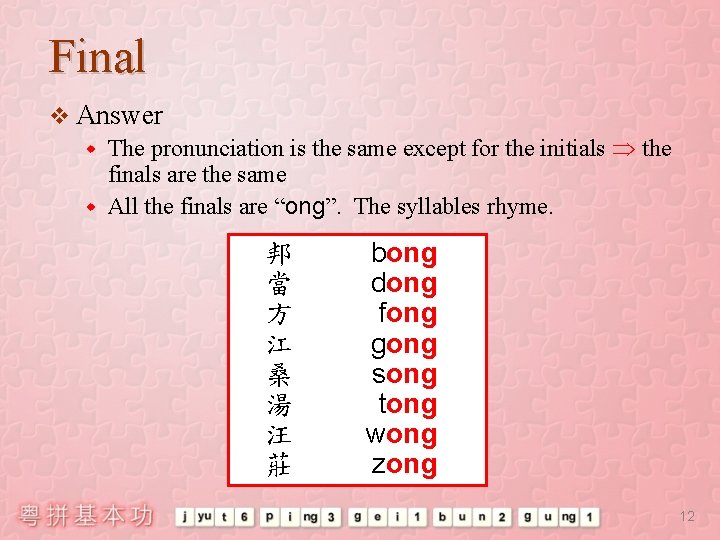
Final v Answer w The pronunciation is the same except for the initials the finals are the same w All the finals are “ong”. The syllables rhyme. 邦 當 方 江 桑 湯 汪 莊 bong dong fong gong song tong wong zong 12
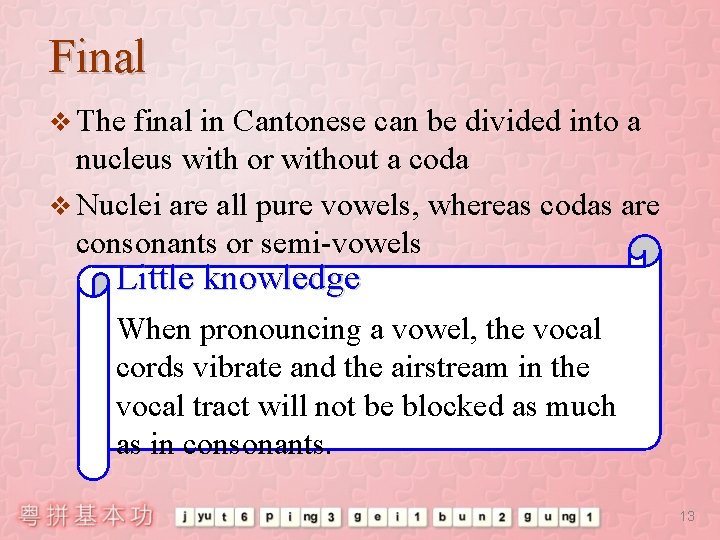
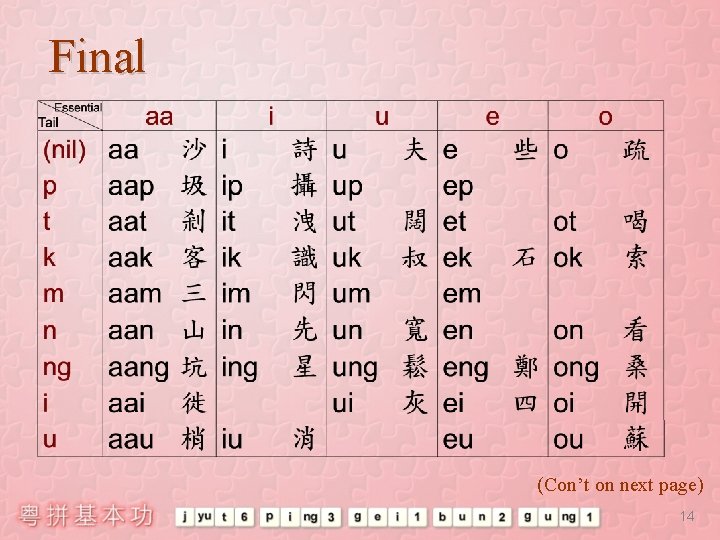
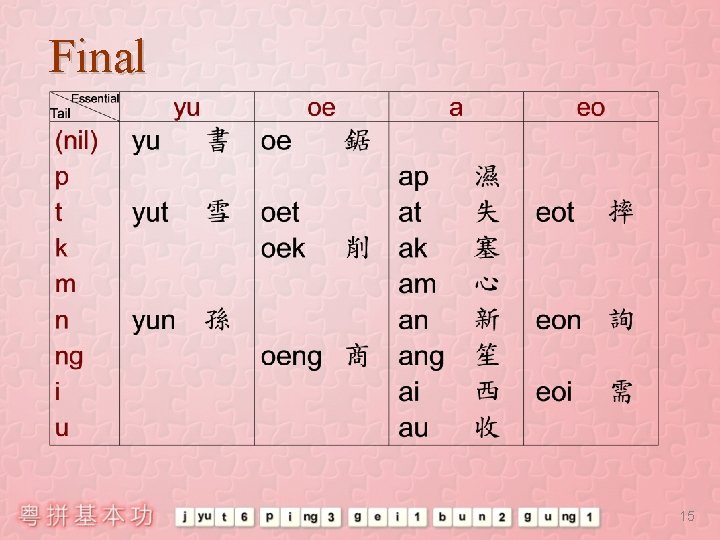
Final v The final in Cantonese can be divided into a nucleus with or without a coda v Nuclei are all pure vowels, whereas codas are consonants or semi-vowels Little knowledge When pronouncing a vowel, the vocal cords vibrate and the airstream in the vocal tract will not be blocked as much as in consonants. 13
Final (Con’t on next page) 14
Final 15
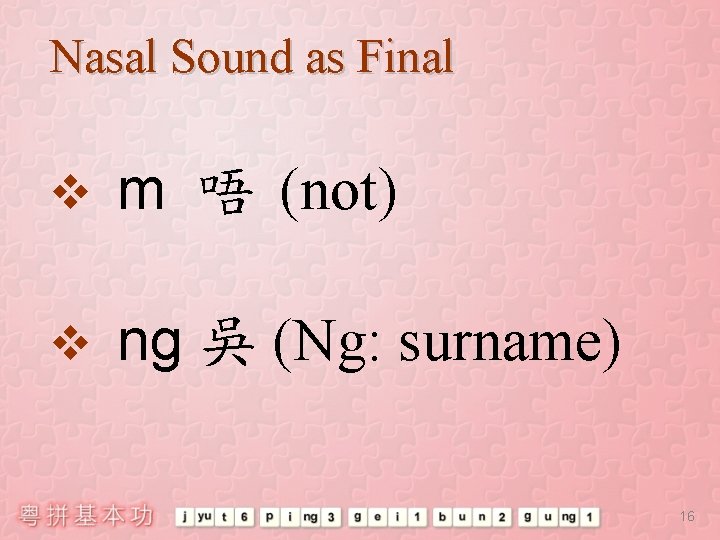
Nasal Sound as Final v m 唔 (not) v ng 吳 (Ng: surname) 16
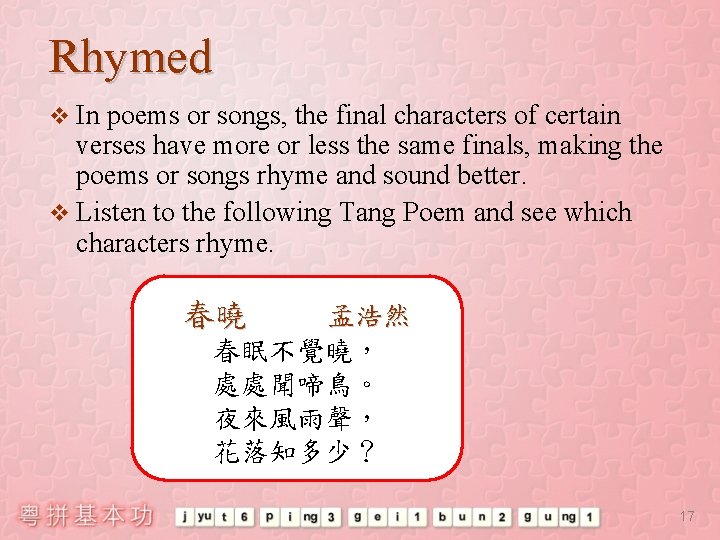
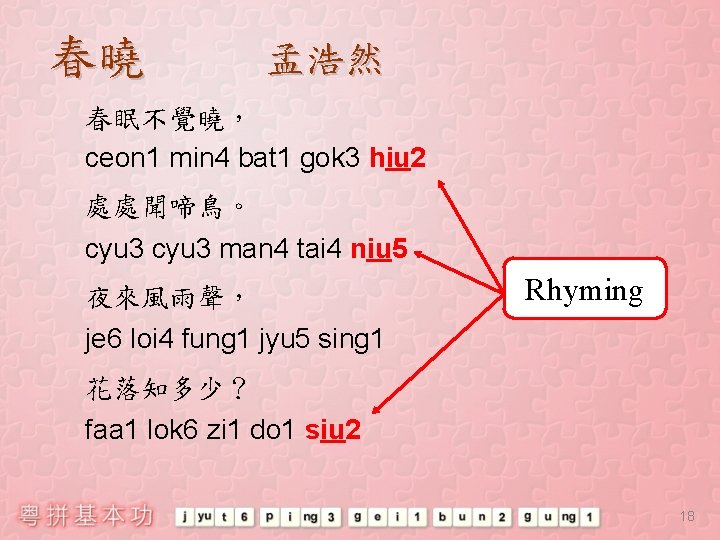
Rhymed v In poems or songs, the final characters of certain verses have more or less the same finals, making the poems or songs rhyme and sound better. v Listen to the following Tang Poem and see which characters rhyme. 春曉 孟浩然 春眠不覺曉, 處處聞啼鳥。 夜來風雨聲, 花落知多少? 17
春曉 孟浩然 春眠不覺曉, ceon 1 min 4 bat 1 gok 3 hiu 2 處處聞啼鳥。 cyu 3 man 4 tai 4 niu 5 夜來風雨聲, Rhyming je 6 loi 4 fung 1 jyu 5 sing 1 花落知多少? faa 1 lok 6 zi 1 do 1 siu 2 18
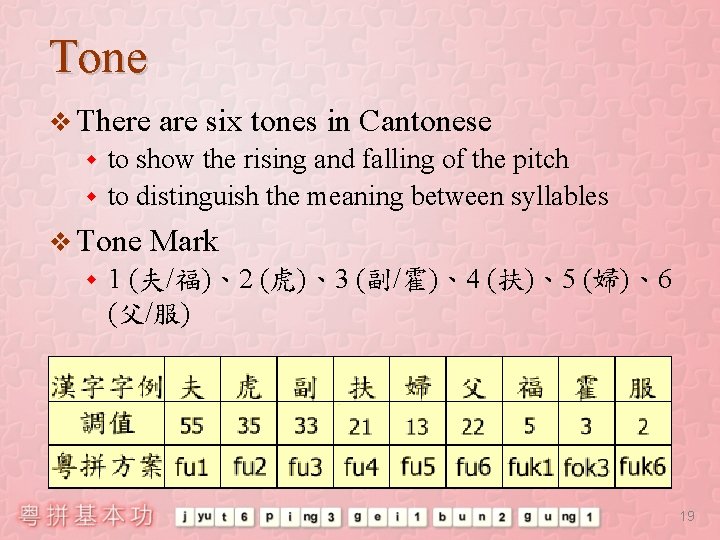
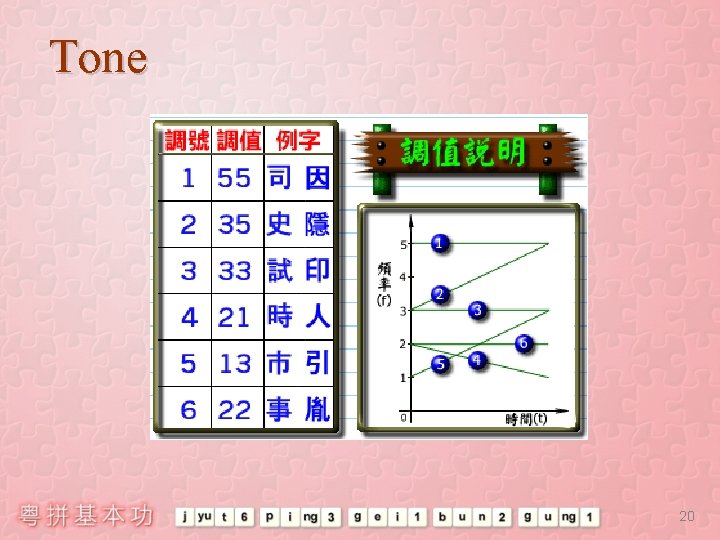
Tone v There are six tones in Cantonese to show the rising and falling of the pitch w to distinguish the meaning between syllables w v Tone w Mark 1 (夫/福)、2 (虎)、3 (副/霍)、4 (扶)、5 (婦)、6 (父/服) 19
Tone 20
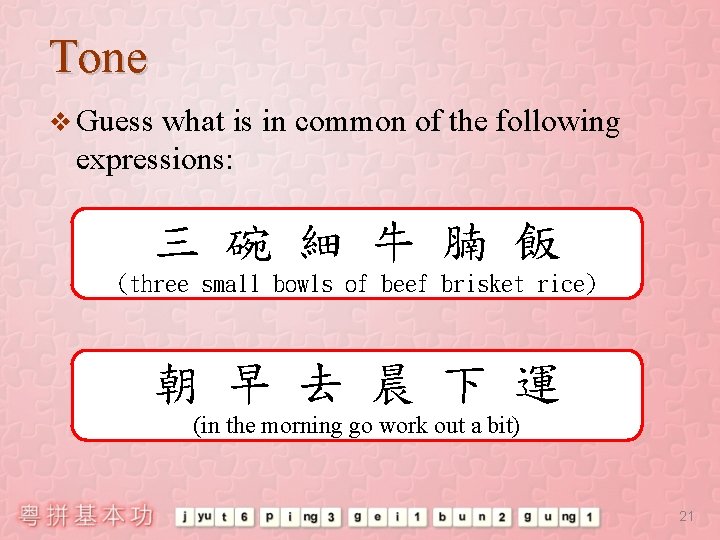
Tone v Guess what is in common of the following expressions: 三 碗 細 牛 腩 飯 (three small bowls of beef brisket rice) 朝 早 去 晨 下 運 (in the morning go work out a bit) 21
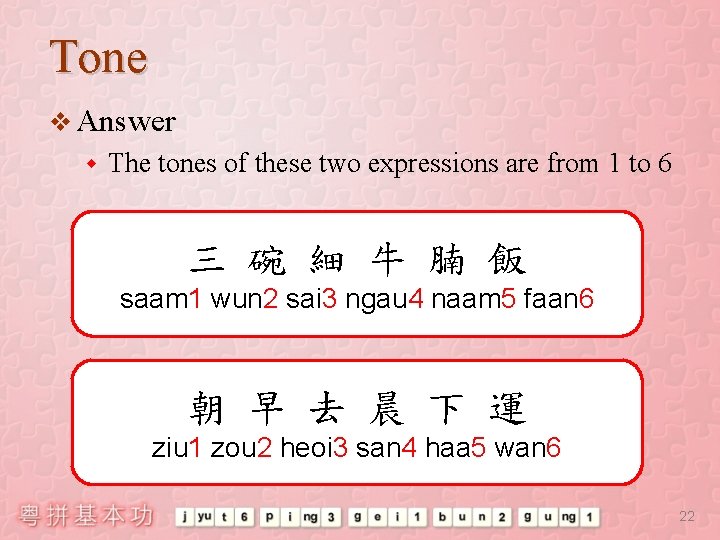
Tone v Answer w The tones of these two expressions are from 1 to 6 三 碗 細 牛 腩 飯 saam 1 wun 2 sai 3 ngau 4 naam 5 faan 6 朝 早 去 晨 下 運 ziu 1 zou 2 heoi 3 san 4 haa 5 wan 6 22