
The Elements of a Crime Class 2 Necessary
- Slides: 10
The Elements of a Crime Class #2
Necessary elements • With exceptions, every crime has at least two elements: – A criminal act, also called actus reus • Act means both an action or omission – A criminal intent, also called mens rea • Intent means state of mind • Example : Criminal Code of Georgia, Title 16, Section 16 -2 -1: « A ‘crime’ is a violation of a statute of this state in which there is a joint operation of an act or omission to act and intention or criminal negligence. » • Another requirement of some crimes : attendant circumstances => specified factors that must be present when the crime is committed (location, victim characteristics, etc. )
Criminal act • The criminal act is performed voluntarily • Unvoluntary acts, according to the Model Penal Code: reflexes, convulsions, bodily movements during unconsciousness or sleep, conduct during hypnosis, or a bodily movement that is not a product of the effort or determination of the actor • BUT: if a voluntary act is followed by an involuntary one, the court may still impose criminal liability depending on the circumstances. Example: Govt of Virgin Islands v. Smith, 278 F. 2 d 169 (1960).
• Perry is hypnotized at the local county fair. The hypnotist directs Perry to smash a banana cream pie into his girlfriend Shelley’s face. – Perry did not commit the act voluntarily, so he should not be convicted of a crime. • Timothy attends a party at a friend’s house and consumes several glasses of redwine. Timothy then attempts to drive his vehicle home. While driving, Timothy passes out at the wheel and hits another vehicle, killing its occupant. – Timothy’s acts of drinking several glasses of wine and then driving a vehicle are voluntary. His involuntary act (getting into a car accident while unconscious) was preceded by conscious, controllable, and voluntary action.
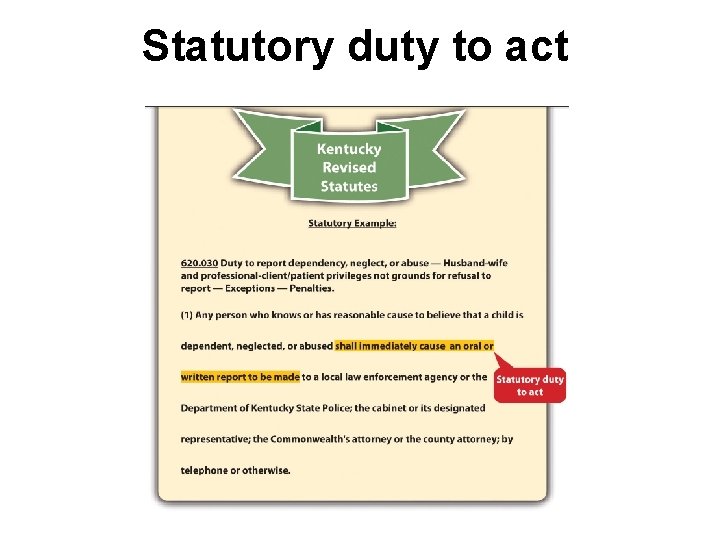
Omission to act • An omission to act can only be criminal when the law imposes a duty to act. – The legal duty to act becomes an element of the crime, and the prosecution must prove it beyond a reasonable doubt, along with proving the defendant’s inaction under the circumstances. • Failure or omission to act is only criminal in three situations: – When there is a statute that creates a legal duty to act – When there is a contract that creates a legal duty to act – When there is a special relationship between the parties that creates a legal duty to act
Statutory duty to act
Duty to act based on contract and special relationship • Duty to act based on a contract : examples => physician’s contractual duty to help a patient or a lifeguard’s duty to save someone who is drowning • Duty to act based on a special relationship : the most common relationships are parent-child, spouse-spouse, and employer-employee
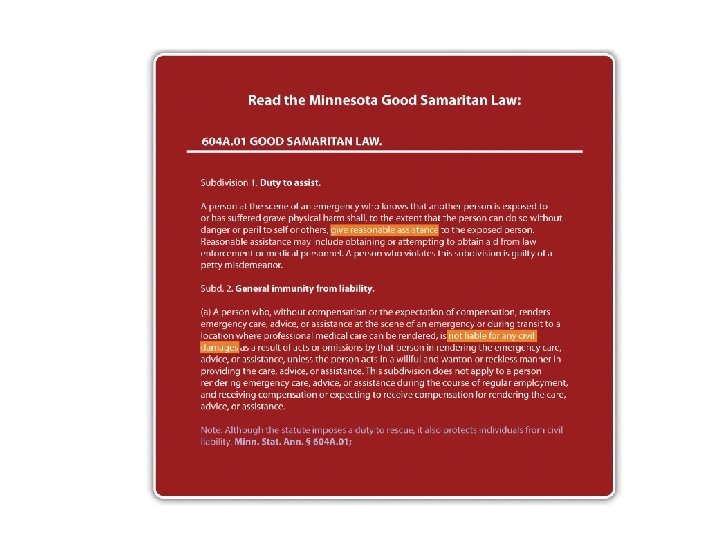
Example of failure to act that is criminal • Hermione stands on the shore at a public beach and watches as a child drowns. – If Penelope’s state has a Good Samaritan law, she may have a duty to help the child based on a statute. – If Penelope is the lifeguard, she may have a duty to save the child based on contract. – If Penelope is the child’s mother, she may have a duty to provide assistance based on their special relationship. – If Penelope is just a bysander, and no Good Samaritan law is in force, she has no duty to act and cannot be criminally prosecuted if the child suffers harm or drowns.
Possession as a criminal act • Most common objects that are criminal to possess: illegal contraband, drugs, and weapons • Because it is passive, possession should be knowing, meaning that the defendant is aware that he or she possesses the item. – In the vast majority of States, a statute permitting a conviction for possession without this knowledge or awareness lacks the criminal intent element and would be unenforceable. • There are two types of possession : – Actual possession indicates that the defendant has the item on or very near his or her person. – Constructive possession indicates that the item is not on the defendant’s person, but is within the defendant’s area of control, such as inside a house or automobile with the defendant.