
THE ELECTRON TRANSPORT CHAIN HERES THE BIG PICTURE
THE ELECTRON TRANSPORT CHAIN
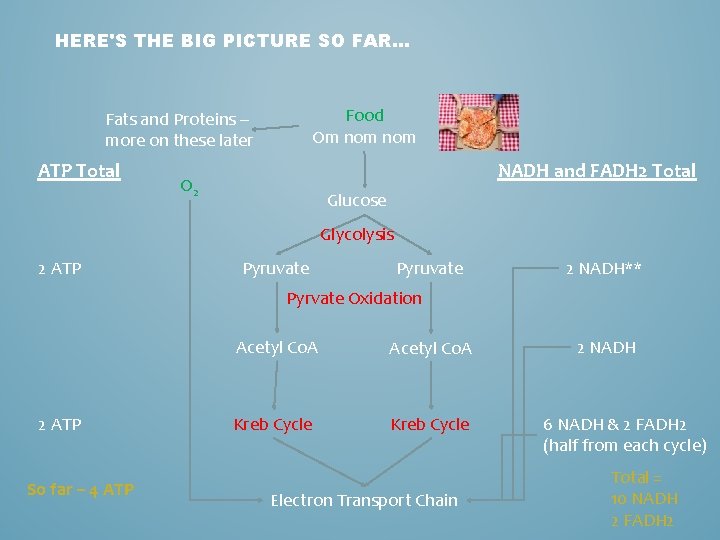
HERE'S THE BIG PICTURE SO FAR… Food Om nom Fats and Proteins – more on these later ATP Total NADH and FADH 2 Total O 2 Glucose Glycolysis 2 ATP Pyruvate 2 NADH** Pyrvate Oxidation 2 ATP So far – 4 ATP Acetyl Co. A Kreb Cycle Electron Transport Chain 2 NADH 6 NADH & 2 FADH 2 (half from each cycle) Total = 10 NADH 2 FADH 2
SO WHAT DO WE KNOW SO FAR? • Eat to consume food (Energy) • Food broken down Carbohydrates, Fats, Proteins • Glucose is used for glycolysis Enzyme reactions (substrate-level phosphorylation), breakdown of glucose to 2 pyruvate, net 2 ATP and 2 NADH • Pyruvates get oxidized 2 Acetyl –Co. A and 2 NADH • 1 Acetyl-Co. A enters Kreb Cycle 3 NADH, 1 FADH 2, 1 ATP
SO WHAT DO WE GOT SO FAR? FROM 1 GLUCOSE: • 4 ATP • 10 NADH – 2 Glycolysis – 2 Pyruvate Oxidation – 6 Kreb Cycle • 2 FADH 2 So where does the rest of the ATP come from?
WHAT IS THE ELECTRON TRANSPORT CHAIN? • During the Citric Acid Cycle (Krebs), potential energy is left over in NADH and FADH 2 • The Electron Transport Chain is designed to use an Electron from NADH and FADH 2 to drive H+ into the intermembrane space using 4 Protein Complexes
ELECTRON TRANSPORT CHAIN
NAMES OF COMPLEXES: NADH DEHYDROGENASE, SUCCINATE DEHYDROGENASE, CYTOCHROME COMPLEX, CYTOCHROME OXIDASE NAMES OF ELECTRON SHUTTLES: UBIQUINONE AND CYTOCHROME C
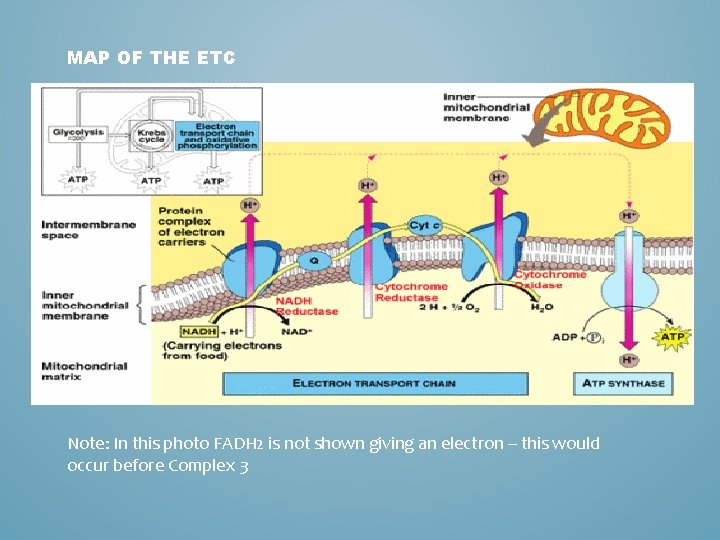
MAP OF THE ETC Note: In this photo FADH 2 is not shown giving an electron – this would occur before Complex 3
WHAT DO WE NEED TO KNOW? Key structures What key substances are involved? • Protein Complexes (Complex I, III, IV) • ATP Synthase • • NADH FADH 2 H+ O 2 ADP Phosphate group ATP
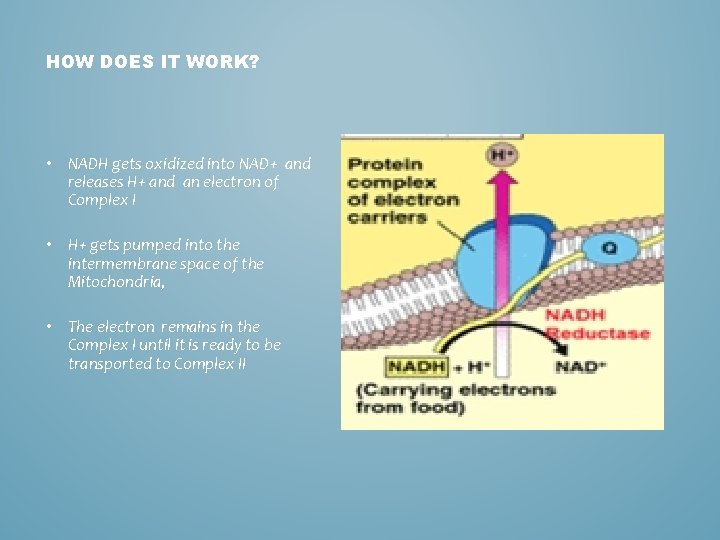
HOW DOES IT WORK? • NADH gets oxidized into NAD+ and releases H+ and an electron of Complex I • H+ gets pumped into the intermembrane space of the Mitochondria, • The electron remains in the Complex I until it is ready to be transported to Complex II
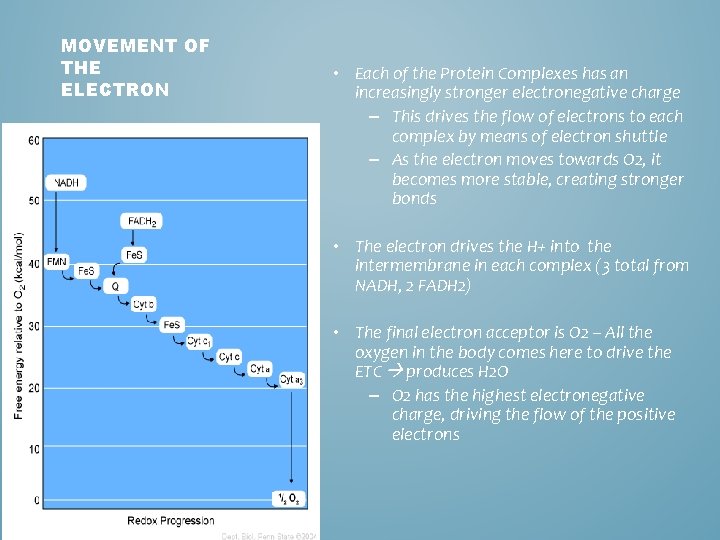
MOVEMENT OF THE ELECTRON • Each of the Protein Complexes has an increasingly stronger electronegative charge – This drives the flow of electrons to each complex by means of electron shuttle – As the electron moves towards O 2, it becomes more stable, creating stronger bonds • The electron drives the H+ into the intermembrane in each complex (3 total from NADH, 2 FADH 2) • The final electron acceptor is O 2 – All the oxygen in the body comes here to drive the ETC produces H 2 O – O 2 has the highest electronegative charge, driving the flow of the positive electrons
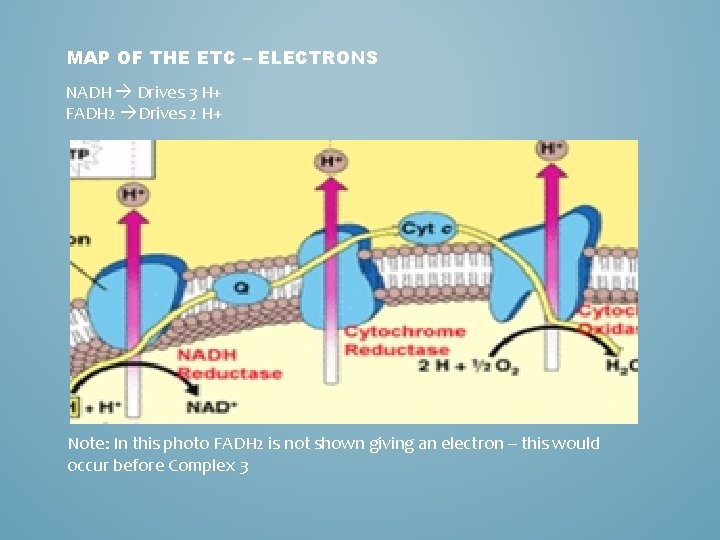
MAP OF THE ETC – ELECTRONS NADH Drives 3 H+ FADH 2 Drives 2 H+ Note: In this photo FADH 2 is not shown giving an electron – this would occur before Complex 3
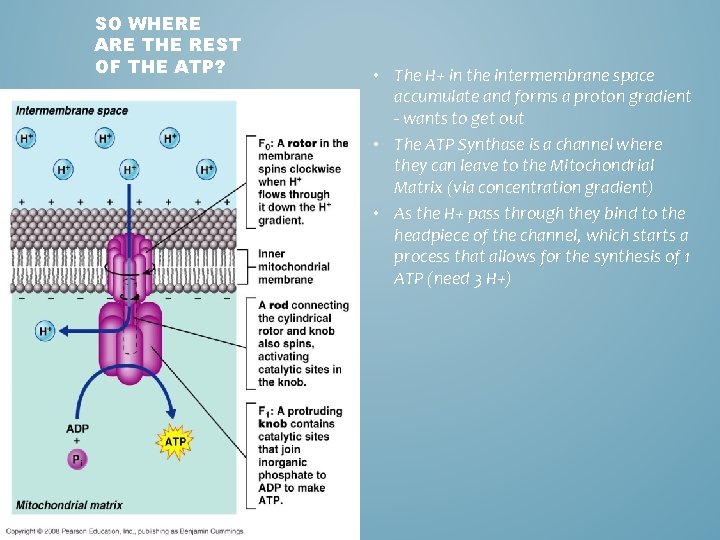
SO WHERE ARE THE REST OF THE ATP? • The H+ in the intermembrane space accumulate and forms a proton gradient - wants to get out • The ATP Synthase is a channel where they can leave to the Mitochondrial Matrix (via concentration gradient) • As the H+ pass through they bind to the headpiece of the channel, which starts a process that allows for the synthesis of 1 ATP (need 3 H+)
RESOURCES Khan Academy Intro to Cellular Respiration http: //www. khanacademy. org/science/biology/v/introduction-to-cellularrespiration Glycolysis http: //www. khanacademy. org/science/biology/v/glycolysis Pyruvate Oxidation - Youtube http: //www. youtube. com/watch? v=zfv. Vv. C 4 -u_A Krebs Cycle http: //www. khanacademy. org/science/biology/v/krebs---citric-acid-cycle Electron Transport Chain http: //www. khanacademy. org/science/biology/v/electron-transport-chain
HOMEWORK What I want you to record for Monday: • Height in cm • Weight in Kg
- Slides: 15