
The Electron Transport Chain AN ELECTRON LOOKING FOR
- Slides: 12
The Electron Transport Chain AN ELECTRON LOOKING FOR A HOME!!!!!!!
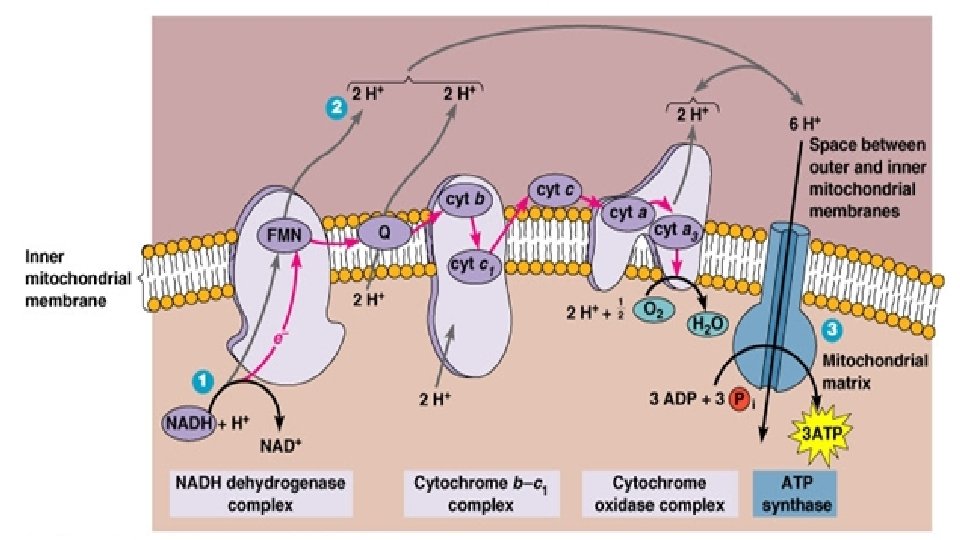
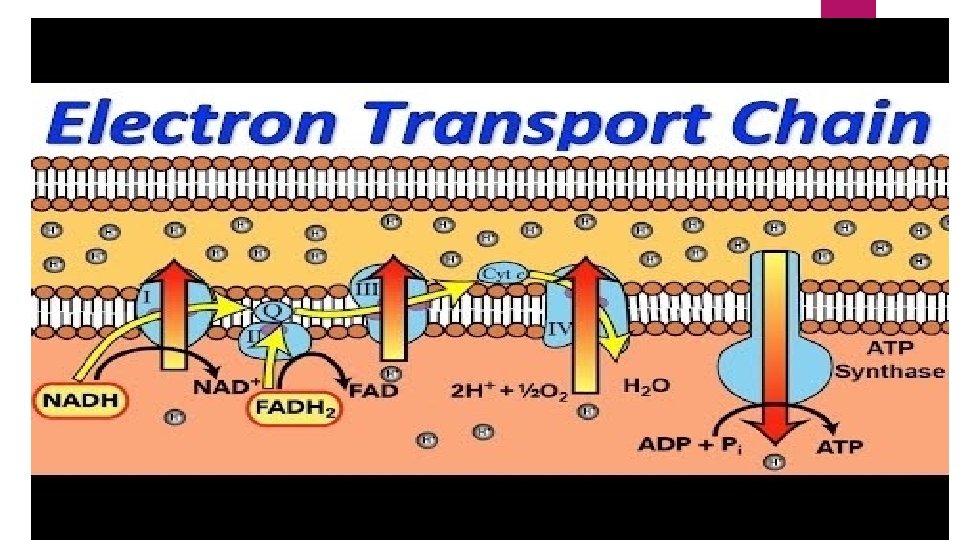
Electron Transport Chain The Electron transport chain is made up of 4 protein complexes and 2 mobile electron shuttles The ETC is located in the inner membrane of the mitochondria and is a system of membrane proteins (enzymes) that work together The final acceptor of electrons in the electron transport chain is oxygen The ETC exploits electronegativity to keep the electron moving along until it arrives at O 2 who has the highest electronegativity of all the electron acceptors.
Complex I: NADH Dehydrogenase Complex I is an integral protein complex located in the inner membrane The name for complex one is NADH dehydrogenase It pulls off the electron on NADH the energy released from this drives a proton from the Matrix to the Intermembrane space Complex I is able to pull this electron from NADH as it is an enzyme and the fact that it is more electronegative than NAD+
Hot Potato Pass It On The electron is then passed to Ubiquinone (Q or UQ), which is a hydrophobic molecule in the inner membrane that shuttles the electron to the next complex In order to carry the electron and remain hydrophobic Q picks up a hydrogen ion (H+) and releases it to the intermembrane space when it reaches complex III
Complex III: Cytochrome b-c Complex Q drops the electron (now with slightly less energy) to complex III Complex III is an integral membrane protein complex As mentioned before it also releases a proton to the intermembrane space Complex III accepts this electron (higher in electronegativity) and promptly gives it to a second shuttle CYTOCHROME C (Cyt C)
Hot Potato Pass It On Cyt C is a shuttle located on the intermembrane space side of the membrane Cyt C brings the electron to Complex IV
Complex IV: Cytochrome Oxidase Complex IV accepts the electron (higher electronegativity) and in doing so energy is released which is used to pump a third proton from the matrix to the intermembrane space Complex IV finally gives this low energy electron to OXYGEN Oxygen is the final electron acceptor and has the highest electronegativity of all the steps in the chain. Oxygen will bind to two protons (H+) floating in the matrix to create water
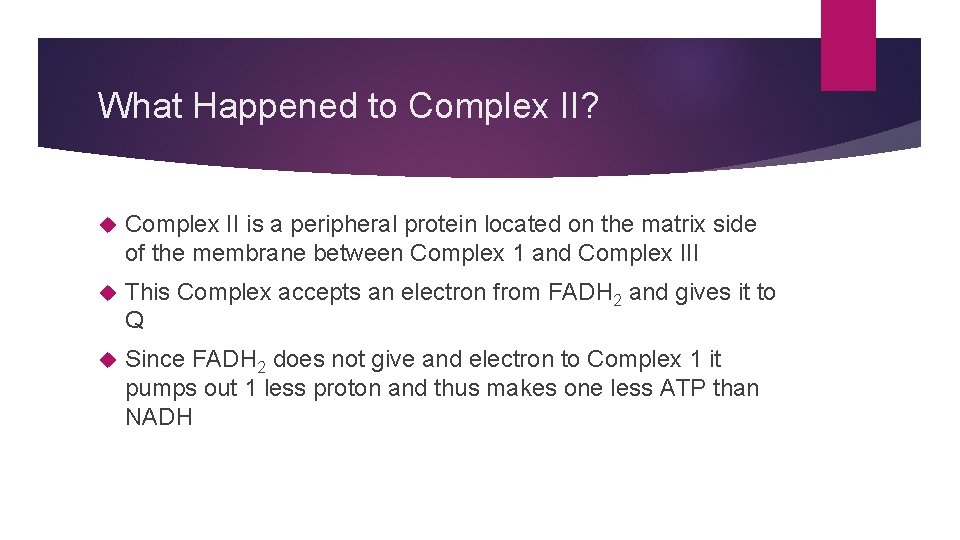
What Happened to Complex II? Complex II is a peripheral protein located on the matrix side of the membrane between Complex 1 and Complex III This Complex accepts an electron from FADH 2 and gives it to Q Since FADH 2 does not give and electron to Complex 1 it pumps out 1 less proton and thus makes one less ATP than NADH
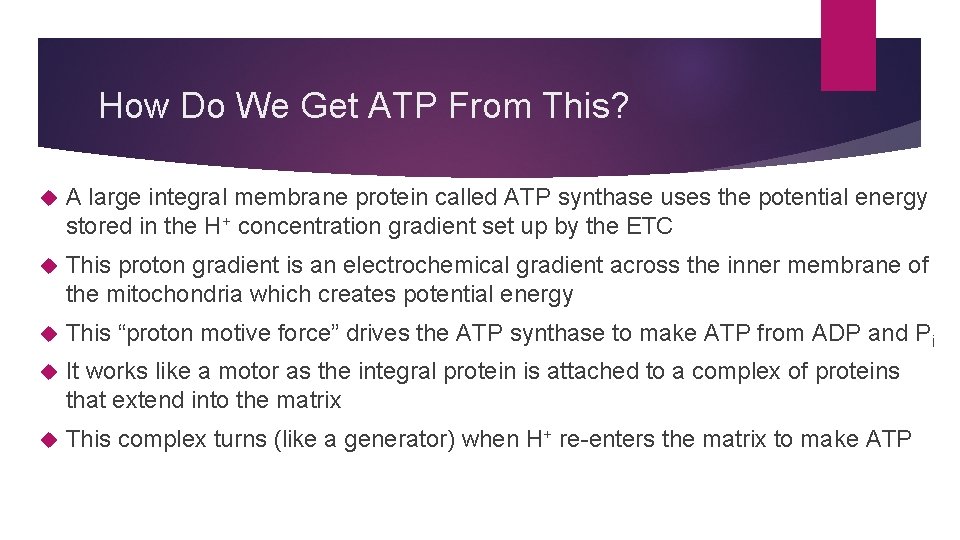
How Do We Get ATP From This? A large integral membrane protein called ATP synthase uses the potential energy stored in the H+ concentration gradient set up by the ETC This proton gradient is an electrochemical gradient across the inner membrane of the mitochondria which creates potential energy This “proton motive force” drives the ATP synthase to make ATP from ADP and P i It works like a motor as the integral protein is attached to a complex of proteins that extend into the matrix This complex turns (like a generator) when H+ re-enters the matrix to make ATP
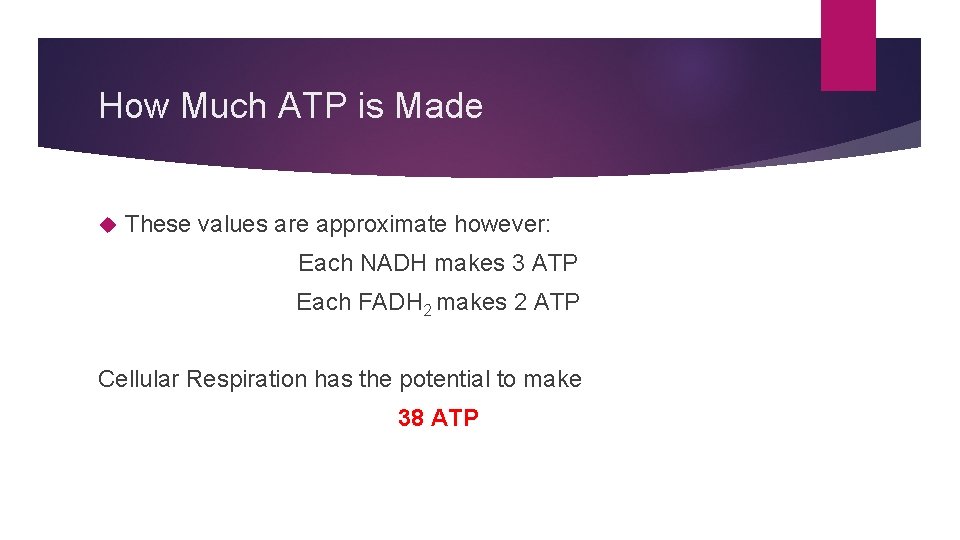
How Much ATP is Made These values are approximate however: Each NADH makes 3 ATP Each FADH 2 makes 2 ATP Cellular Respiration has the potential to make 38 ATP