
THE ELECTRON ION COLLIDER THE ULTIMATE COLLIDER TO


- Slides: 14
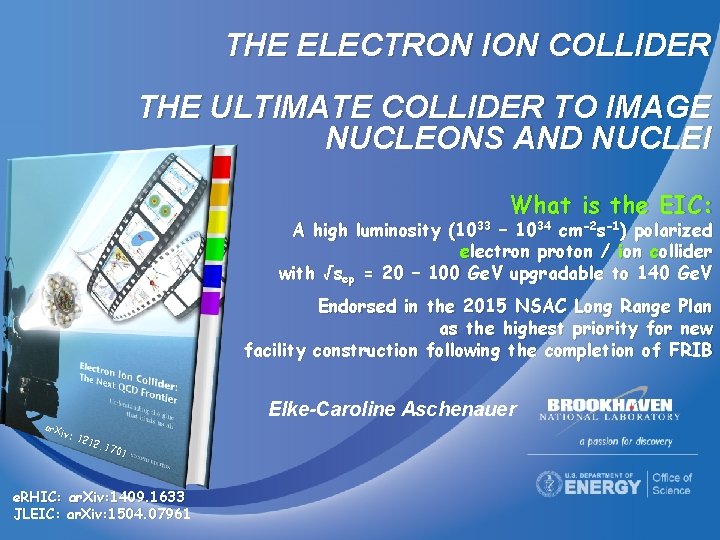
THE ELECTRON ION COLLIDER THE ULTIMATE COLLIDER TO IMAGE NUCLEONS AND NUCLEI What is the EIC: A high luminosity (1033 – 1034 cm-2 s-1) polarized electron proton / ion collider with √sep = 20 – 100 Ge. V upgradable to 140 Ge. V Endorsed in the 2015 NSAC Long Range Plan as the highest priority for new facility construction following the completion of FRIB ar. X iv: 121 2. 1 701 e. RHIC: ar. Xiv: 1409. 1633 JLEIC: ar. Xiv: 1504. 07961 Elke-Caroline Aschenauer
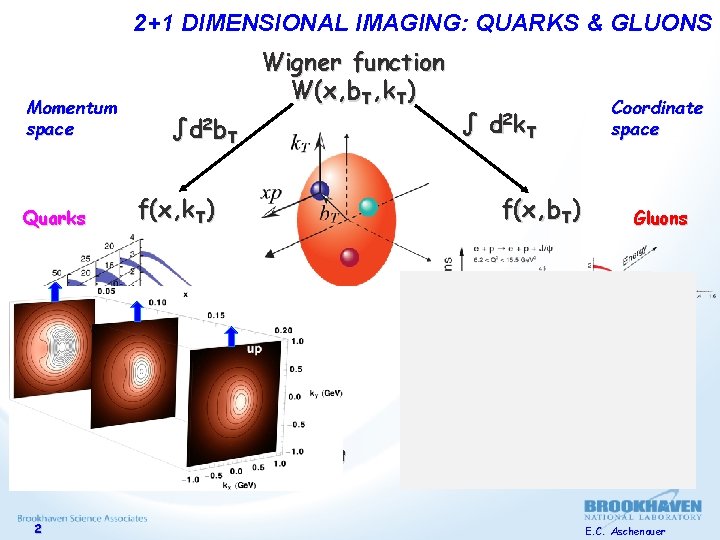
2+1 DIMENSIONAL IMAGING: QUARKS & GLUONS Momentum space Wigner function W(x, b. T, k. T) ∫d 2 b. T ∫ d 2 k. T Coordinate space f(x, k. T) f(x, b. T) Spin-dependent 3 D momentum space images from semi-inclusive scattering Spin-dependent 2+1 D coordinate space images from exclusive scattering Quarks 2 Gluons E. C. Aschenauer
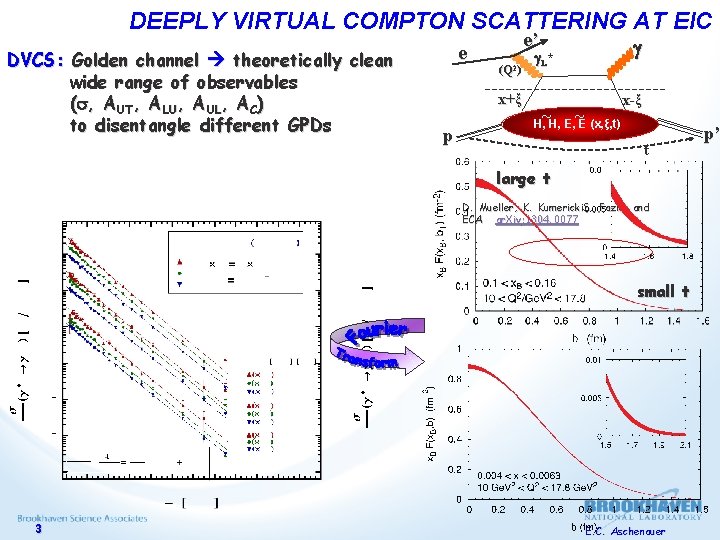
DEEPLY VIRTUAL COMPTON SCATTERING AT EIC DVCS: Golden channel theoretically clean wide range of observables (s, AUT, ALU, AUL, AC) to disentangle different GPDs e e’ (Q 2) x+ξ p g g. L* ~ ~ H, H, E, ~E (x, ξ, t) x-ξ t large t D. Mueller, K. Kumericki. S. Fazio, and ECA ar. Xiv: 1304. 0077 small t 3 E. C. Aschenauer p’
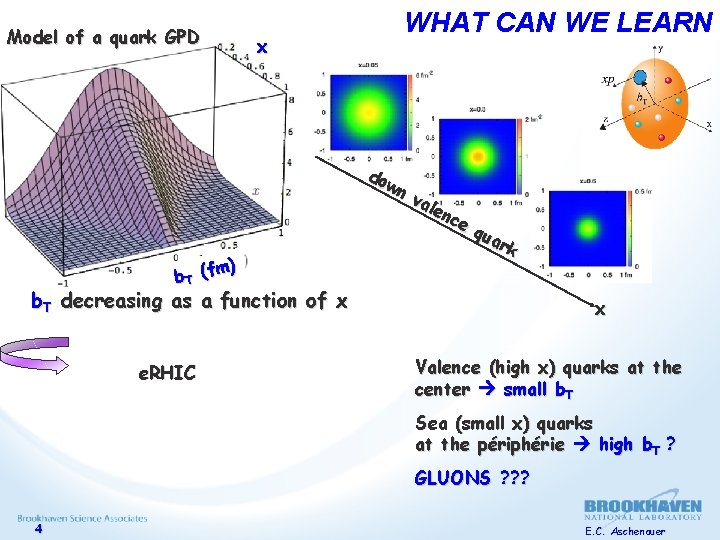
Model of a quark GPD ) b T (fm x WHAT CAN WE LEARN do wn val en ce qua rk b. T decreasing as a function of x e. RHIC x Valence (high x) quarks at the center small b. T Sea (small x) quarks at the périphérie high b. T ? GLUONS ? ? ? 4 E. C. Aschenauer
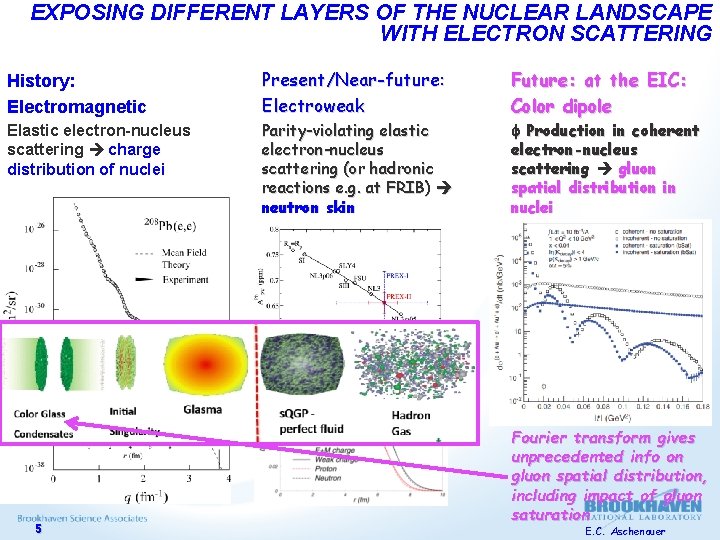
EXPOSING DIFFERENT LAYERS OF THE NUCLEAR LANDSCAPE WITH ELECTRON SCATTERING History: Electromagnetic Elastic electron-nucleus scattering charge distribution of nuclei 5 Present/Near-future: Electroweak Parity-violating elastic electron-nucleus scattering (or hadronic reactions e. g. at FRIB) neutron skin Future: at the EIC: Color dipole f Production in coherent electron-nucleus scattering gluon spatial distribution in nuclei Fourier transform gives unprecedented info on gluon spatial distribution, including impact of gluon saturation E. C. Aschenauer
6 E. C. Aschenauer
DIS LANDSCAPE: LUMI vs. √s Based on: http: //cerncourier. com/cws/article/cern/57304 7 E. C. Aschenauer
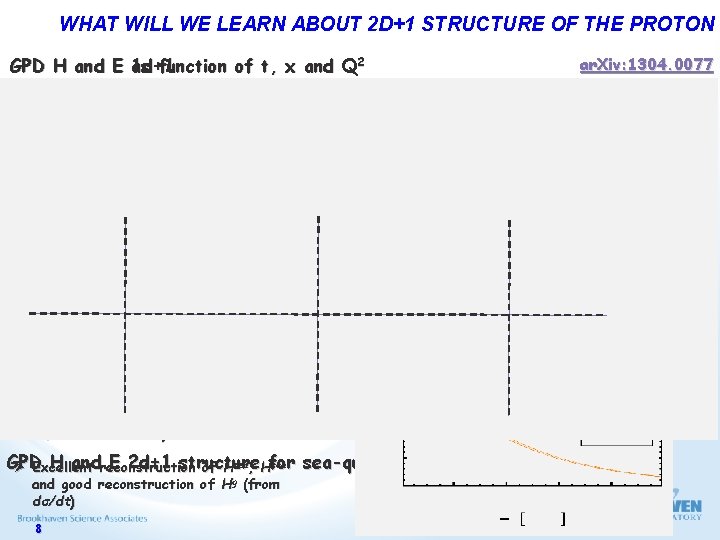
WHAT WILL WE LEARN ABOUT 2 D+1 STRUCTURE OF THE PROTON GPD H and E 1 d+1 as function of t, x and Q 2 ar. Xiv: 1304. 0077 Ø A global fit over all pseudo data was done, based on the GPDs-based model: [K. Kumerički, D Müller, K. Passek. Kumerički 2007] Ø Known values q(x), g(x) are assumed for Hq, Hg (at x=0, t=0 forward limits Eq, Eg are unknown) sea GPD H andreconstruction E 2 d+1 structure sea-quarks and gluons Ø Excellent of Hsea, Hfor and good reconstruction of Hg (from dσ/dt) 8 E. C. Aschenauer
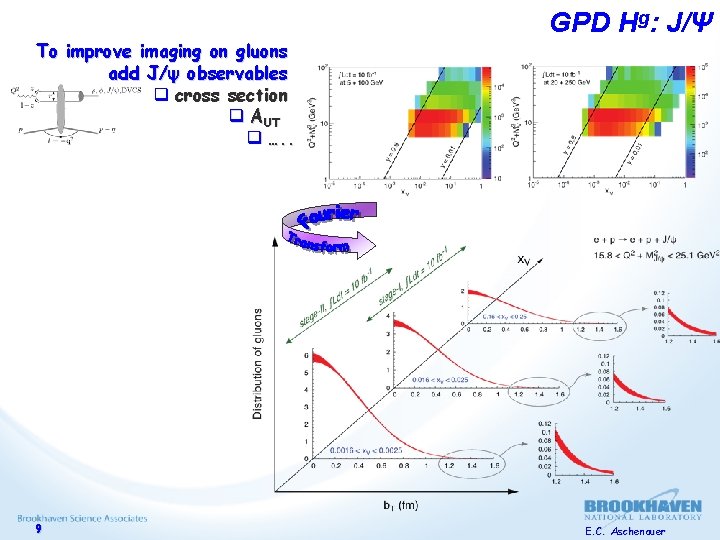
To improve imaging on gluons add J/ψ observables q cross section q AUT q …. . 9 GPD Hg: J/Ψ E. C. Aschenauer
e. RHIC: DIFFRACTIVE EVENTS IN e. A Diffractive physics will be a major component of the e. A program at an EIC q High sensitivity to gluon density: σ~[g(x, Q 2)]2 due to color-neutral exchange q Only known process where spatial gluon distributions of nuclei can be extracted q 2 Types: Coherent (A stays intact) & Incoherent (A breaks up) q Experimental challenging to identify Ø Rapidity gap ⇒hermetic detector Ø Breakup needs to be detected ⇒n and γ in Zero Degree Calorimeter, spectator tagging (Roman Pots), IR design! 10 E. C. Aschenauer
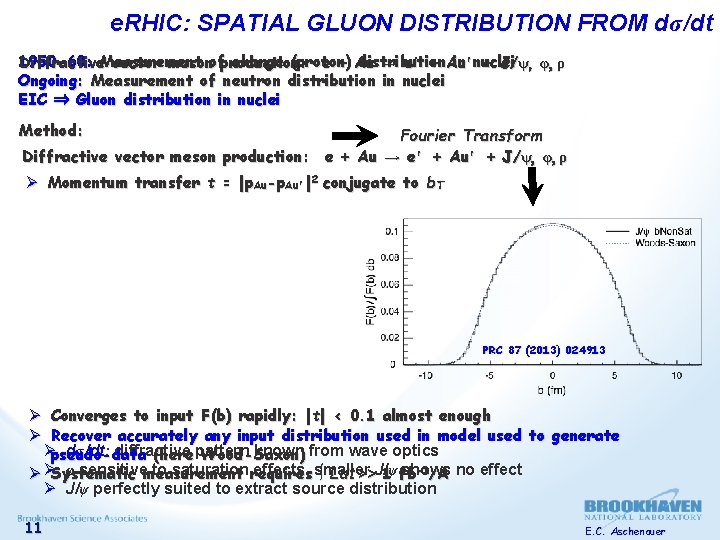
e. RHIC: SPATIAL GLUON DISTRIBUTION FROM dσ/dt 1950 -60: charge (proton) distribution in′ nuclei Diffractive. Measurement vector mesonofproduction: e + Au → e′ + Au + J/ψ, φ, ρ Ongoing: Measurement of neutron distribution in nuclei EIC ⇒ Gluon distribution in nuclei Method: Fourier Transform Diffractive vector meson production: e + Au → e′ + Au′ + J/ψ, φ, ρ 2 Ø Momentum transfer t = |p. Au-p. Au′ | conjugate to b. T PRC 87 (2013) 024913 Ø Converges to input F(b) rapidly: |t| < 0. 1 almost enough Ø Recover accurately any input distribution used in model used to generate Øpseudo-data dσ/dt: diffractive known from wave optics (here pattern Wood-Saxon) -1/A no effect φ sensitivemeasurement to saturation requires effects, smaller shows Ø ØSystematic ∫ Ldt >>J/ψ 1 fb Ø J/ψ perfectly suited to extract source distribution 11 E. C. Aschenauer
EIC PROJECT STATUS The EIC received in the 2015 Long Range Planning of the NSAC the following recommendation “We recommend a high-energy high-luminosity polarized EIC as the highest priority for new facility construction following the completion of FRIB” http: //science. energy. gov/~/media/np/nsac/pdf/2015 LRP/2015_LRPNS_091815. pdf Next Steps: A National Research Council (National Academy of Science (& Engineering & Arts) review of the project is expected to begin soon, and a report is expected in ~18 months. After the DOE will launch its Critical Decision (CD) process… q CD 0 soon after the NAS review. . (FY 2018) q CD 1: site selection q with a scenario of 1. 6% growth in US nuclear science funding from now on CD 3 start of construction estimated in 2022/23 12 E. C. Aschenauer
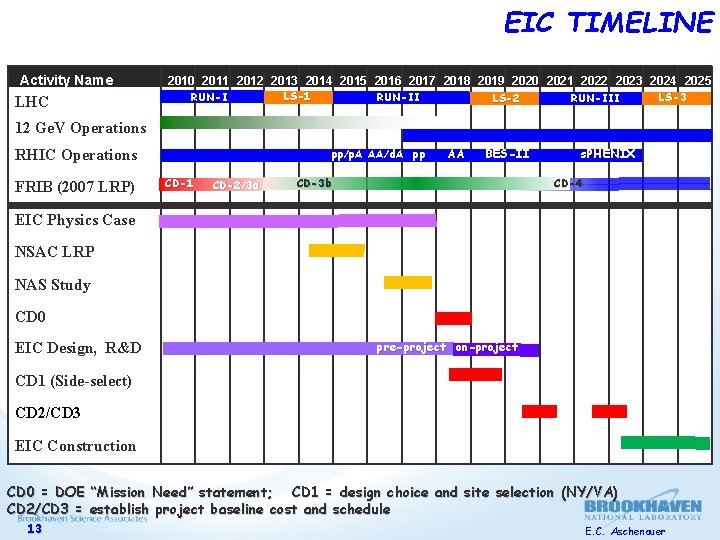
EIC TIMELINE Activity Name LHC 2010 2011 2012 2013 2014 2015 2016 2017 2018 2019 2020 2021 2022 2023 2024 2025 RUN-I LS-1 RUN-II LS-2 RUN-III LS-3 12 Ge. V Operations pp/p. A AA/d. A pp RHIC Operations FRIB (2007 LRP) CD-1 CD-2/3 a AA BES-II CD-3 b s. PHENIX CD-4 EIC Physics Case NSAC LRP NAS Study CD 0 EIC Design, R&D pre-project on-project CD 1 (Side-select) CD 2/CD 3 EIC Construction CD 0 = DOE “Mission Need” statement; CD 1 = design choice and site selection (NY/VA) CD 2/CD 3 = establish project baseline cost and schedule 13 E. C. Aschenauer
EIC USER COMMUNITY Currently ~630 members from 137 institutions from 27 countries from 6 world regions US: 47% Europe: 28% Asia: 19% à continuously growing à Please sign up and join us http: //www. eicug. org q Very active generic EIC detector R&D program: https: //wiki. bnl. gov/conferences/index. php/EIC_R%25 D 37 groups collaborate in tracking, calorimeter, PID consortia and ……. q EIC Conference series: POETIC (Physics Opportunities at an Elec. Tron-Ion Collider) 2016: POETIC combined with CTEQ Workshop November 14 - 18, 2016 at Temple University, Philadelphia, PA q Next EIC user group meeting: July 18 -22, 2017 in Trieste, Italy 14 E. C. Aschenauer