
The Electromagnetic Spectrum Year 11 Physics What is
- Slides: 18
The Electromagnetic Spectrum Year 11 Physics
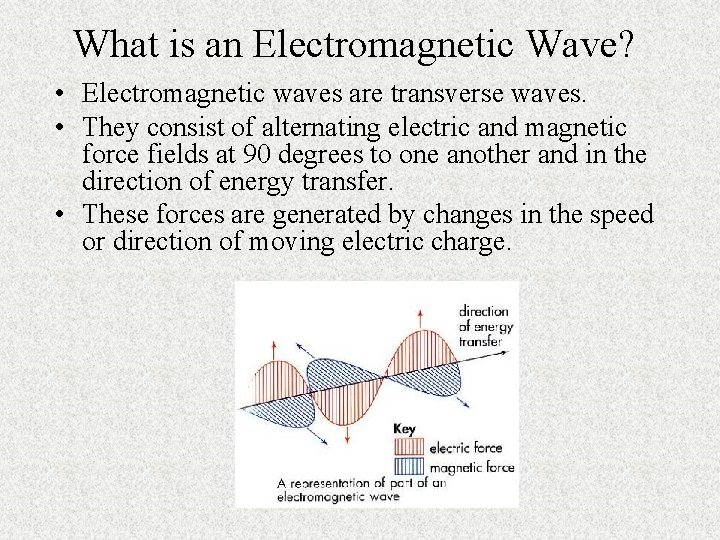
What is an Electromagnetic Wave? • Electromagnetic waves are transverse waves. • They consist of alternating electric and magnetic force fields at 90 degrees to one another and in the direction of energy transfer. • These forces are generated by changes in the speed or direction of moving electric charge.
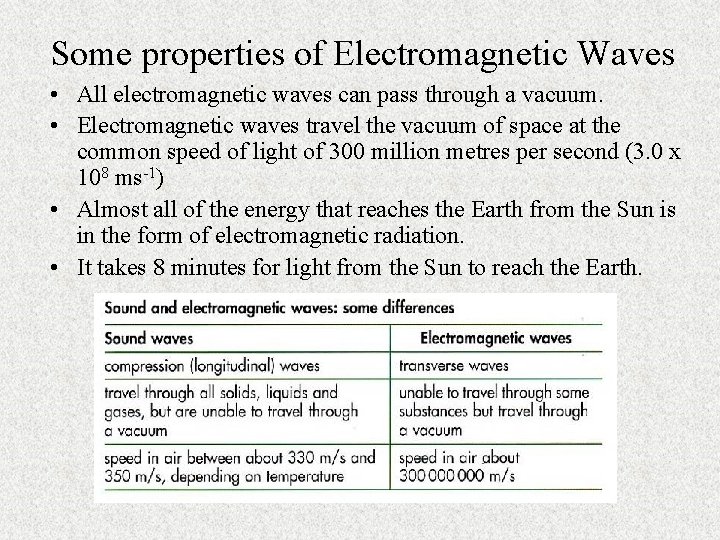
Some properties of Electromagnetic Waves • All electromagnetic waves can pass through a vacuum. • Electromagnetic waves travel the vacuum of space at the common speed of light of 300 million metres per second (3. 0 x 108 ms-1) • Almost all of the energy that reaches the Earth from the Sun is in the form of electromagnetic radiation. • It takes 8 minutes for light from the Sun to reach the Earth.
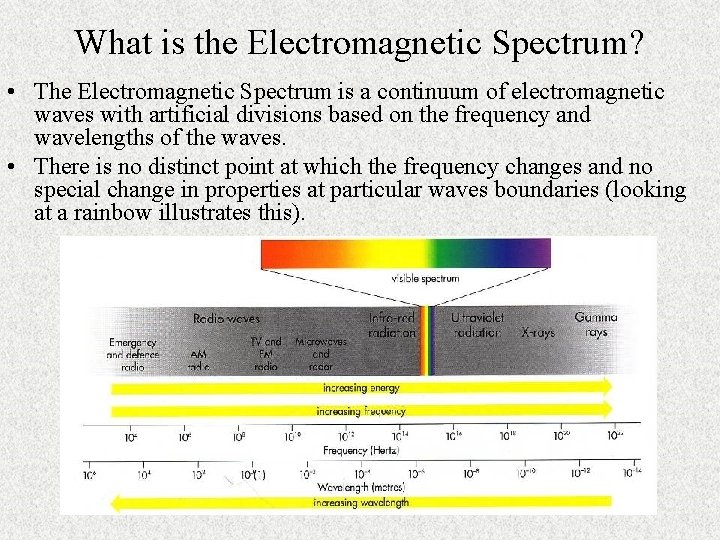
What is the Electromagnetic Spectrum? • The Electromagnetic Spectrum is a continuum of electromagnetic waves with artificial divisions based on the frequency and wavelengths of the waves. • There is no distinct point at which the frequency changes and no special change in properties at particular waves boundaries (looking at a rainbow illustrates this).
• Simply oscillating electrons in a wire or aerial can produce low frequency electromagnetic waves, like radio and television waves. • Light waves oscillate too rapidly in this way and are produced by the outer electrons changing energy levels (shells) in atoms. • X-rays are produced when the inner electrons change energy levels. • Gamma rays, which have extremely high frequencies, are produced by energy changes in the atomic nucleus.
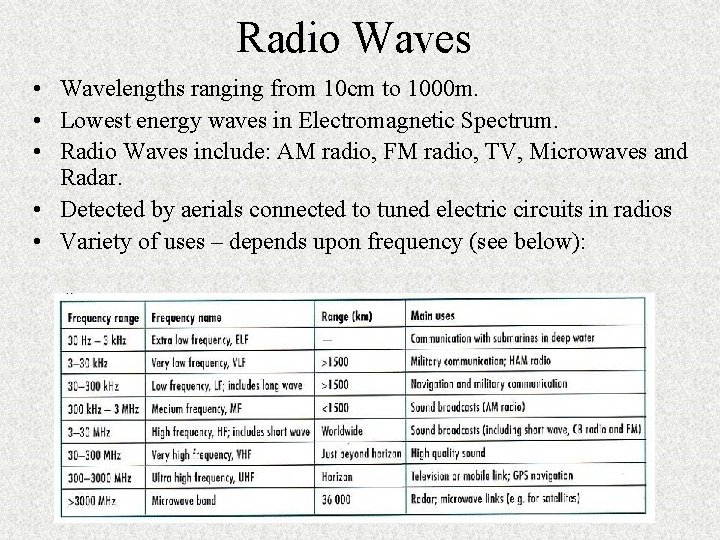
Radio Waves • Wavelengths ranging from 10 cm to 1000 m. • Lowest energy waves in Electromagnetic Spectrum. • Radio Waves include: AM radio, FM radio, TV, Microwaves and Radar. • Detected by aerials connected to tuned electric circuits in radios • Variety of uses – depends upon frequency (see below):
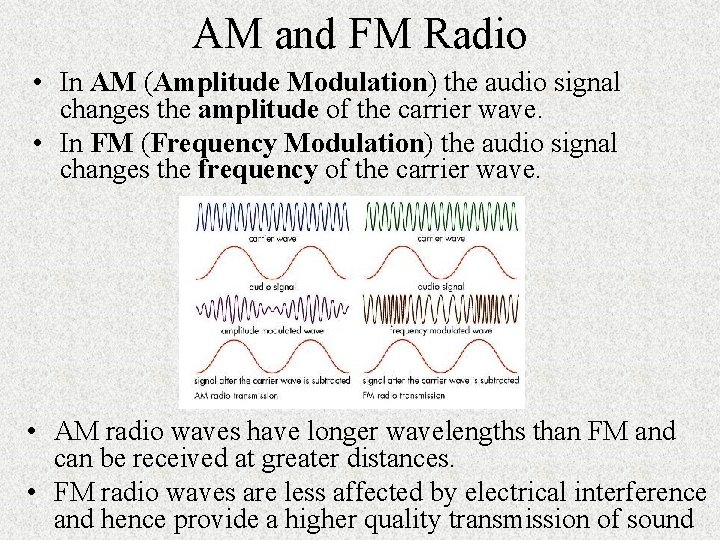
AM and FM Radio • In AM (Amplitude Modulation) the audio signal changes the amplitude of the carrier wave. • In FM (Frequency Modulation) the audio signal changes the frequency of the carrier wave. • AM radio waves have longer wavelengths than FM and can be received at greater distances. • FM radio waves are less affected by electrical interference and hence provide a higher quality transmission of sound
Television • Television signals are transmitted on two separate carrier waves – Visual signal is added onto one carrier wave using Amplitude Modulation (AM) – Audio signal is carried on a separate carrier wave using Frequency Modulation (FM) • When you select a particular channel, you are selecting the respective visual and audio carrier waves for that channel. • Your TV then completes the task of ‘stripping’ the carrier waves to produce the desired picture and sound.
Microwaves • Wavelengths ranging from 1 millimetre to 30 centimetres. • Were first used in World War 2 in Radar. • Used in microwave ovens (frequency of 2450 MHz) for cooking. Produced by a magnetron when cathode rays (a beam of electrons) rotate past an electric field. • Also, used in mobile phone communications at frequencies of around 900 MHz. Transmission can be across distances of up to 100 km, but there must be a direct ‘line of sight’ • Detected in the same way as radio waves and television signals
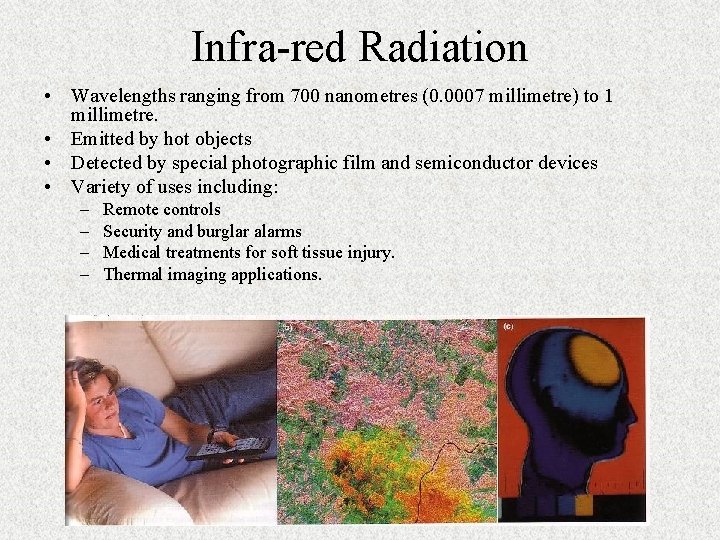
Infra-red Radiation • Wavelengths ranging from 700 nanometres (0. 0007 millimetre) to 1 millimetre. • Emitted by hot objects • Detected by special photographic film and semiconductor devices • Variety of uses including: – – Remote controls Security and burglar alarms Medical treatments for soft tissue injury. Thermal imaging applications.
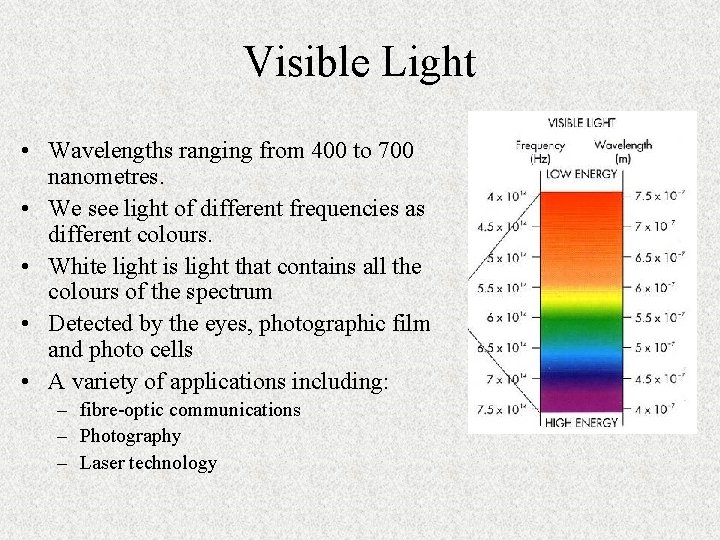
Visible Light • Wavelengths ranging from 400 to 700 nanometres. • We see light of different frequencies as different colours. • White light is light that contains all the colours of the spectrum • Detected by the eyes, photographic film and photo cells • A variety of applications including: – fibre-optic communications – Photography – Laser technology
Ultraviolet (UV) Radiation • Wavelengths ranging from 10 -400 nanometres. • Small doses beneficial to humans as it encourages production of vitamin D. • Larger doses can lead to cell and tissue damage – possibly causing skin cancer or eye cataracts. • Most types of glass absorb UV rays but clouds do NOT absorb UV (that is why you can get sunburnt on cloudy days) • Detected by photographic film, photo cells and fluorescent chemicals • Variety of uses including: – Photo-initiator chemicals in polymerisation – Astronomical observations – Sterilisation of hospital equipment
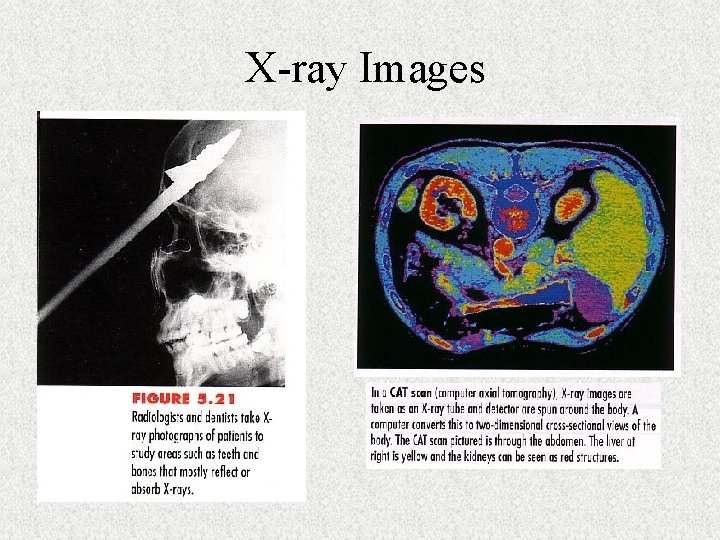
X-rays • • Wavelengths ranging from 0. 01 -10 nanometres. Have energy enough to pass through human flesh Detected by photographic film and fluorescent screen Variety of uses including: – Cancer treatment by focussing the rays to kill cancer cells – Finding weakness in metals and analysing structures of complex chemicals. – Imaging applications in medicine.
X-ray Images
Gamma Rays • Wavelengths less than 0. 01 nanometres. • Highest energy waves in Electromagnetic Spectrum. • Produced when energy is lost from the nucleus of an atom during radioactive decay. • Detected by photographic film or a Geiger-Müller counter. • Highly destructive to human tissue. • Can be used to kill cancer cells. • Also used in finding fractures and weaknesses in metals.
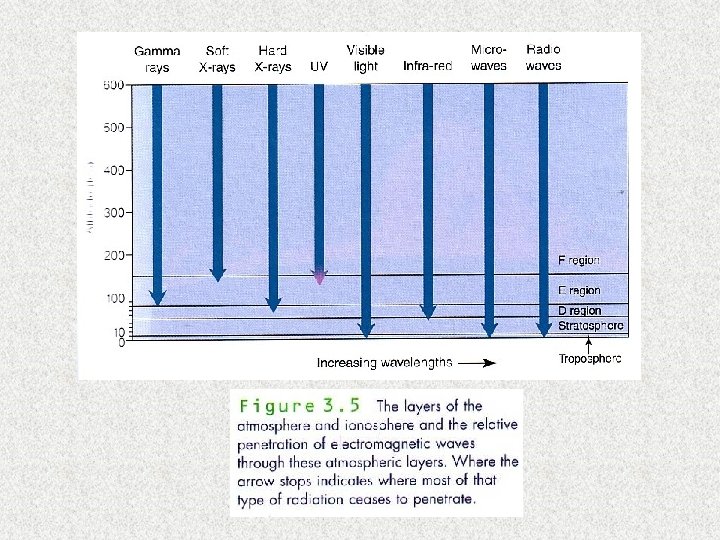
Atmospheric Filtering • Only a small range of the frequencies in the electromagnetic spectrum reach the Earth’s surface • The Earth’s atmosphere and ionosphere absorb the rest • Very little ultraviolet, X-ray or gamma radiation penetrates the atmosphere (a good thing)
• The ionosphere is the upper layer of the atmosphere in which the gaseous atoms and molecules have become ionised (gained or lost electrons) • The ionosphere itself can be divided into three layers: D, E and F • D: 50 – 80 km above Earth’s surface, absorbs short wavelength (hard, high energy) X-rays • E: 80 – 105 km above Earth’s surface, absorbs long wavelength (soft, low energy) X-rays • F: 145 – 300 km above Earth’s surface, absorbs short wavelength UV-rays