
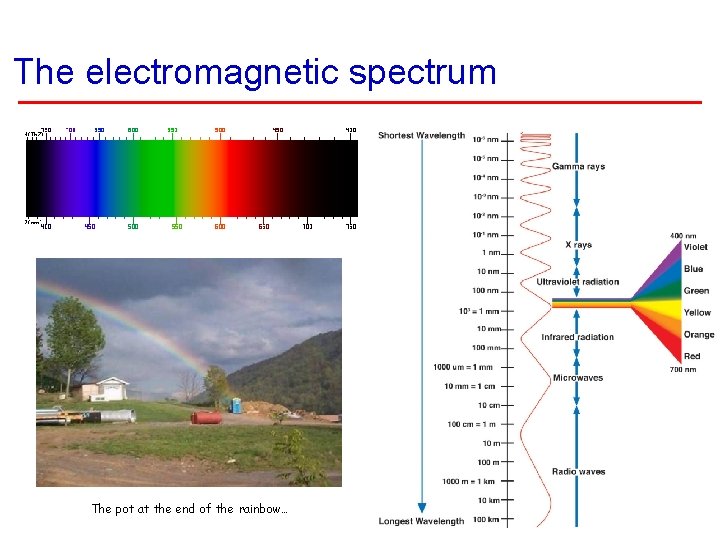
The electromagnetic spectrum The pot at the end
- Slides: 66
The electromagnetic spectrum The pot at the end of the rainbow…
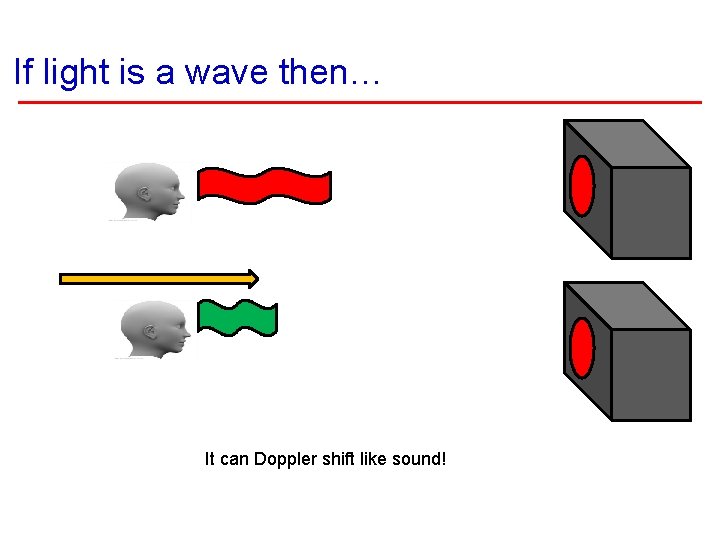
If light is a wave then… It can Doppler shift like sound!
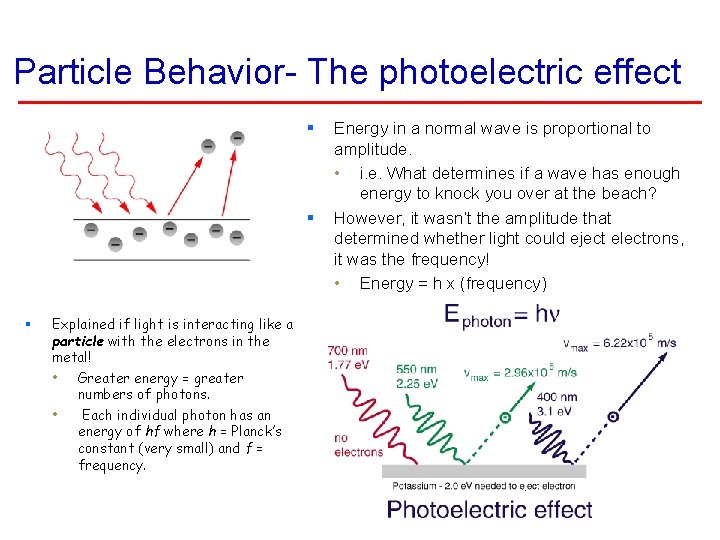
Particle Behavior- The photoelectric effect § § § Explained if light is interacting like a particle with the electrons in the metal! • Greater energy = greater numbers of photons. • Each individual photon has an energy of hf where h = Planck’s constant (very small) and f = frequency. Energy in a normal wave is proportional to amplitude. • i. e. What determines if a wave has enough energy to knock you over at the beach? However, it wasn’t the amplitude that determined whether light could eject electrons, it was the frequency! • Energy = h x (frequency)
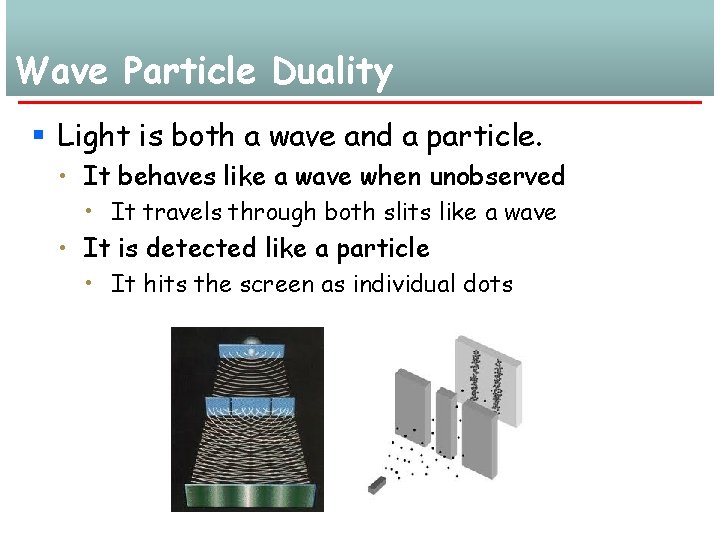
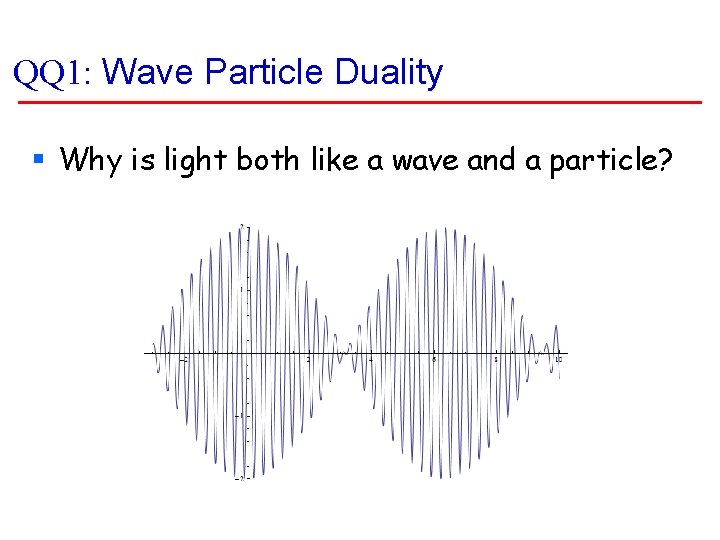
Wave Particle Duality § Light is both a wave and a particle. • It behaves like a wave when unobserved • It travels through both slits like a wave • It is detected like a particle • It hits the screen as individual dots
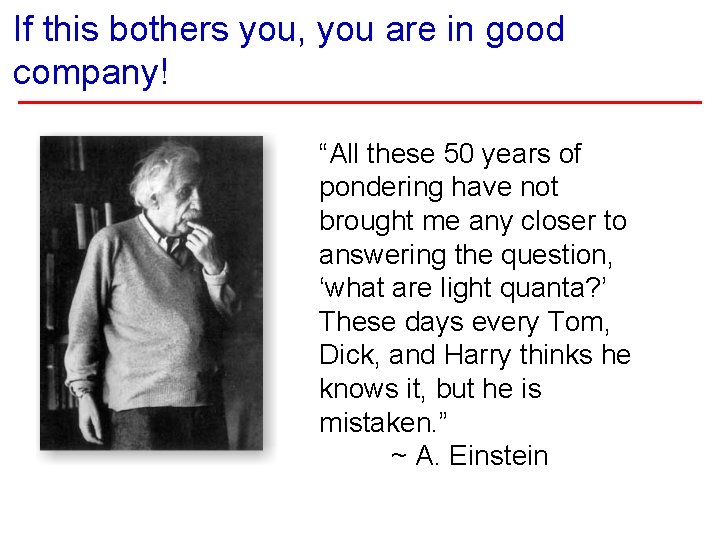
If this bothers you, you are in good company! “All these 50 years of pondering have not brought me any closer to answering the question, ‘what are light quanta? ’ These days every Tom, Dick, and Harry thinks he knows it, but he is mistaken. ” ~ A. Einstein
QQ 1: Wave Particle Duality § Why is light both like a wave and a particle?
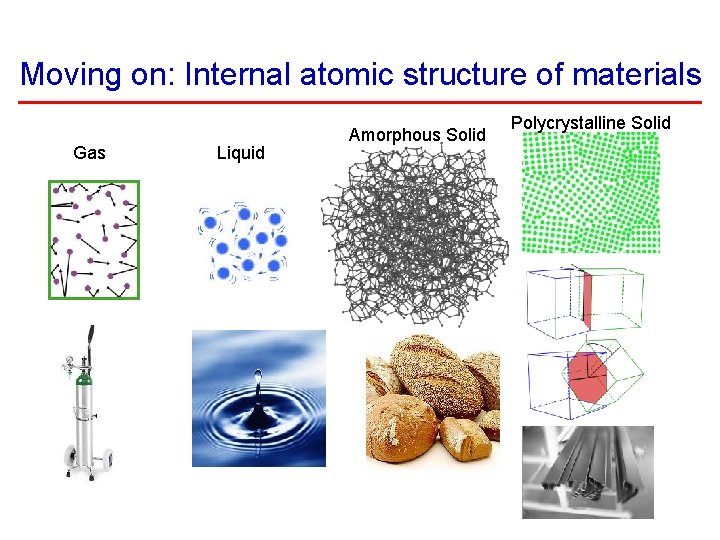
Moving on: Internal atomic structure of materials Gas Liquid Amorphous Solid Polycrystalline Solid
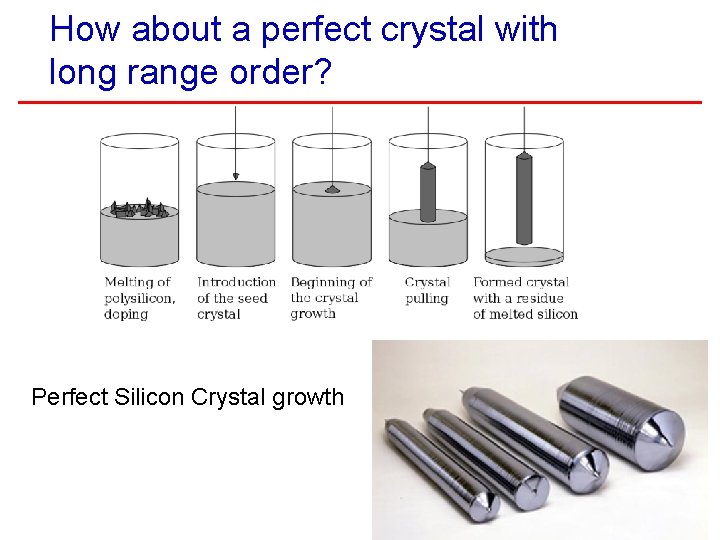
How about a perfect crystal with long range order? Perfect Silicon Crystal growth
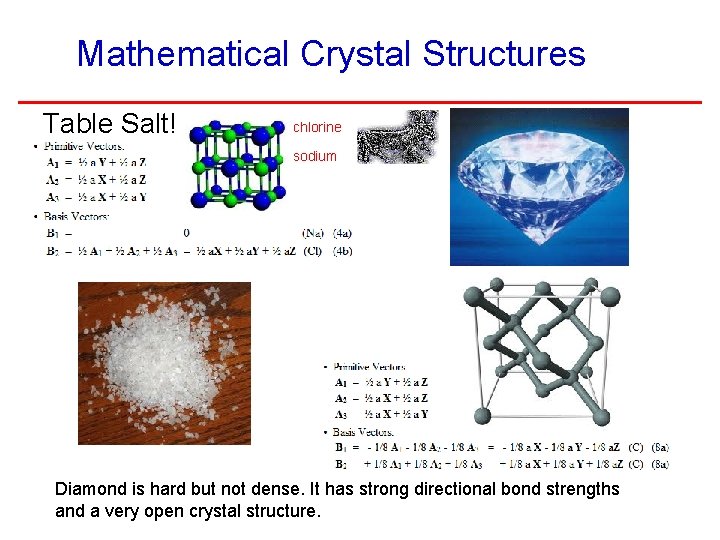
Mathematical Crystal Structures Table Salt! chlorine sodium Diamond is hard but not dense. It has strong directional bond strengths and a very open crystal structure.
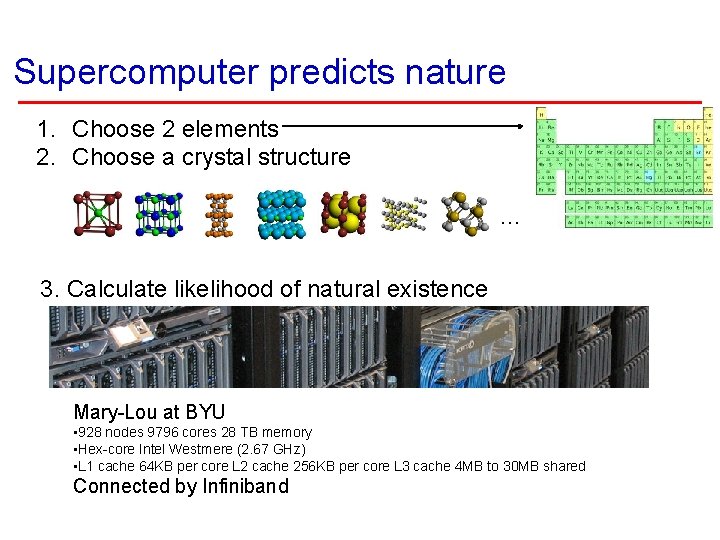
Supercomputer predicts nature 1. Choose 2 elements 2. Choose a crystal structure … 3. Calculate likelihood of natural existence Mary-Lou at BYU • 928 nodes 9796 cores 28 TB memory • Hex-core Intel Westmere (2. 67 GHz) • L 1 cache 64 KB per core L 2 cache 256 KB per core L 3 cache 4 MB to 30 MB shared Connected by Infiniband
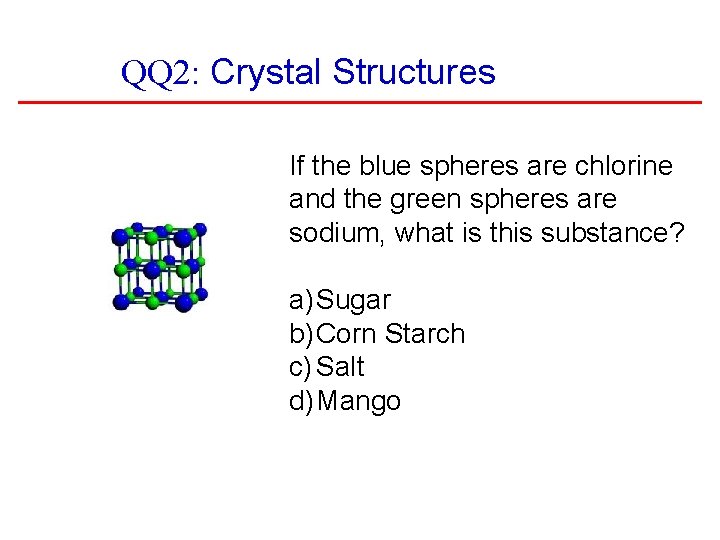
QQ 2: Crystal Structures If the blue spheres are chlorine and the green spheres are sodium, what is this substance? a) Sugar b) Corn Starch c) Salt d) Mango
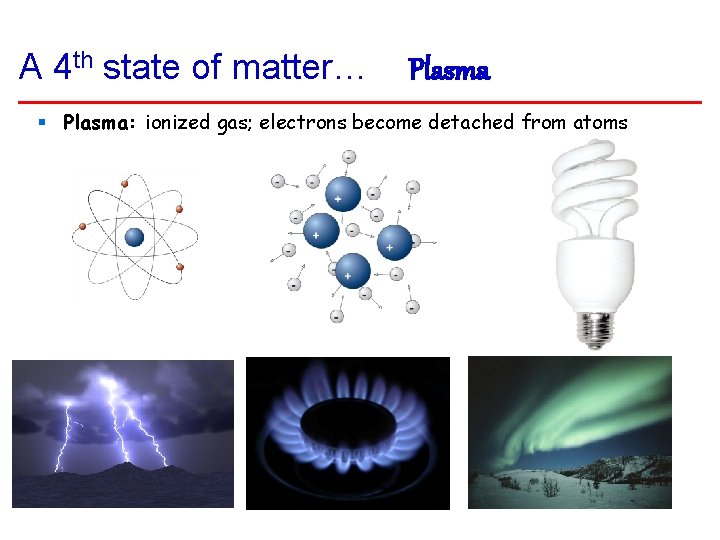
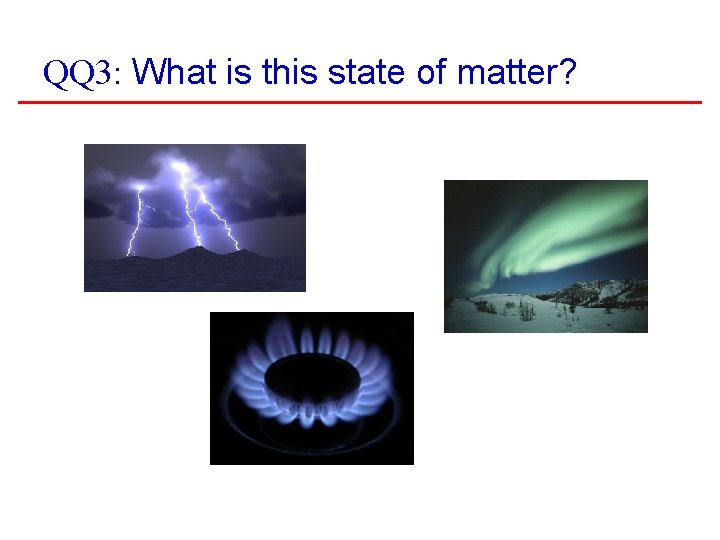
A 4 th state of matter… Plasma § Plasma: ionized gas; electrons become detached from atoms
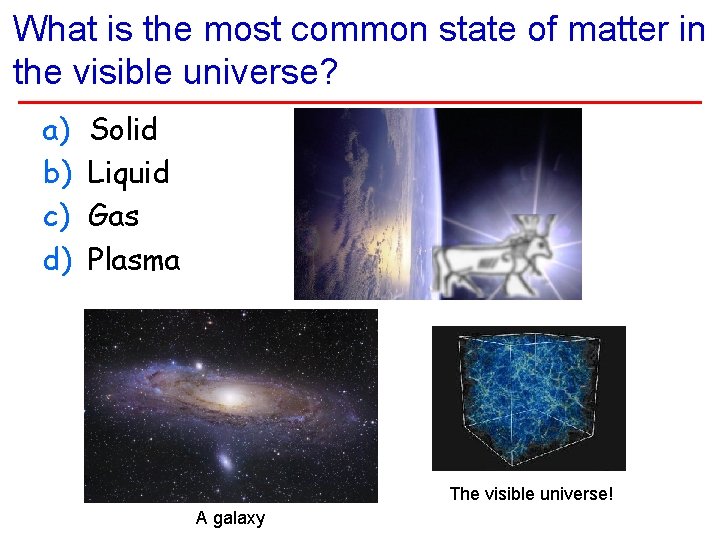
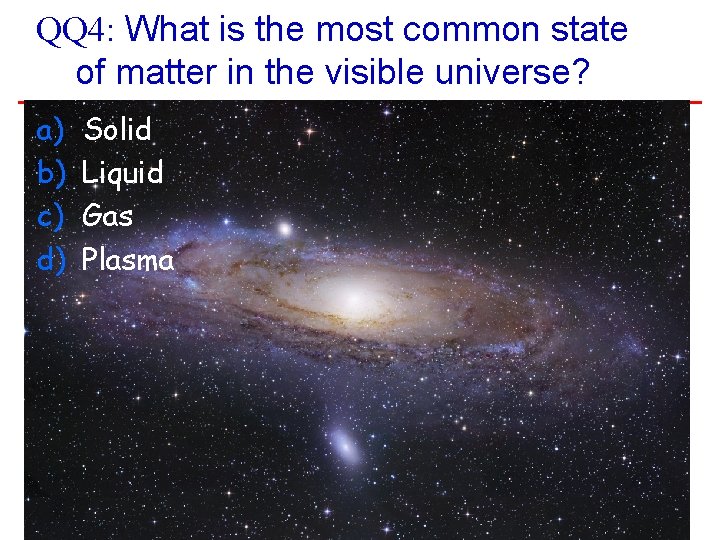
What is the most common state of matter in the visible universe? a) b) c) d) Solid Liquid Gas Plasma The visible universe! A galaxy Earth
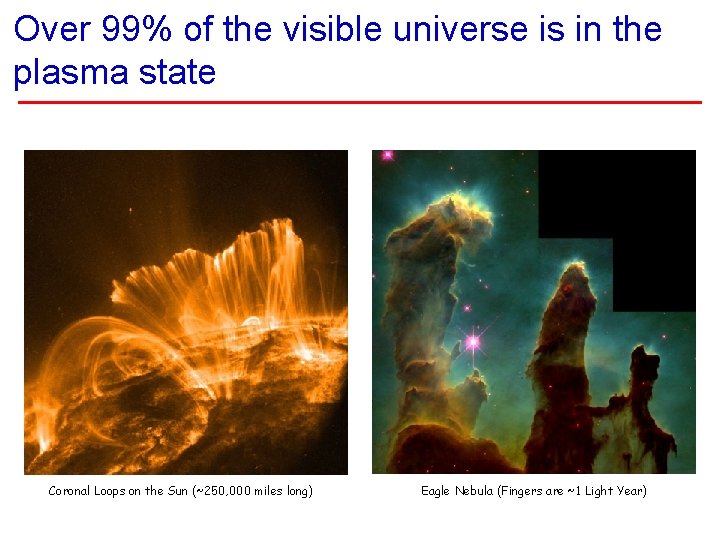
Over 99% of the visible universe is in the plasma state Coronal Loops on the Sun (~250, 000 miles long) Eagle Nebula (Fingers are ~1 Light Year)
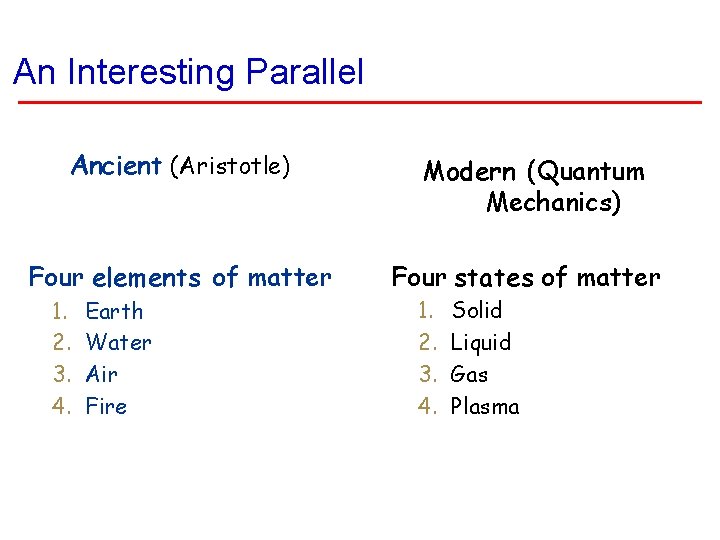
An Interesting Parallel Ancient (Aristotle) Four elements of matter 1. 2. 3. 4. Earth Water Air Fire Modern (Quantum Mechanics) Four states of matter 1. 2. 3. 4. Solid Liquid Gas Plasma
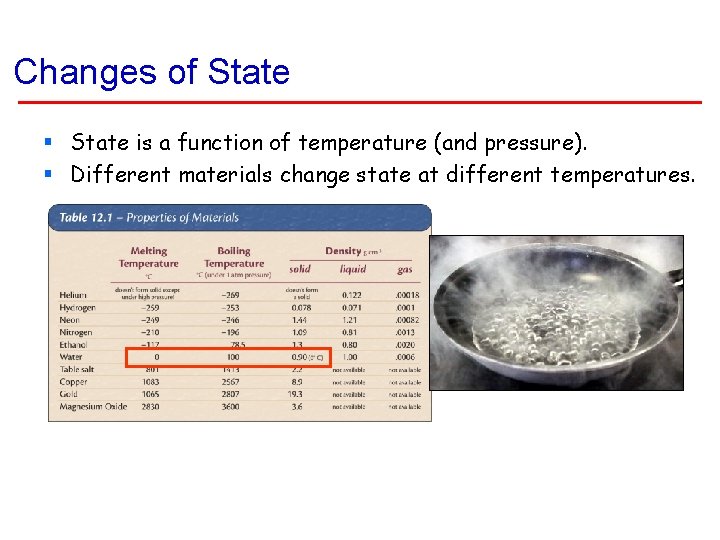
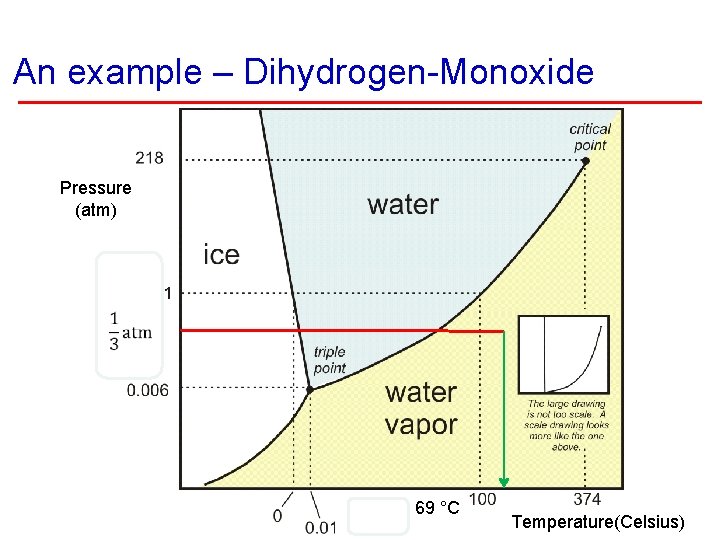
Changes of State § State is a function of temperature (and pressure). § Different materials change state at different temperatures.
An example – Dihydrogen-Monoxide Pressure (atm) 69 °C Temperature(Celsius)
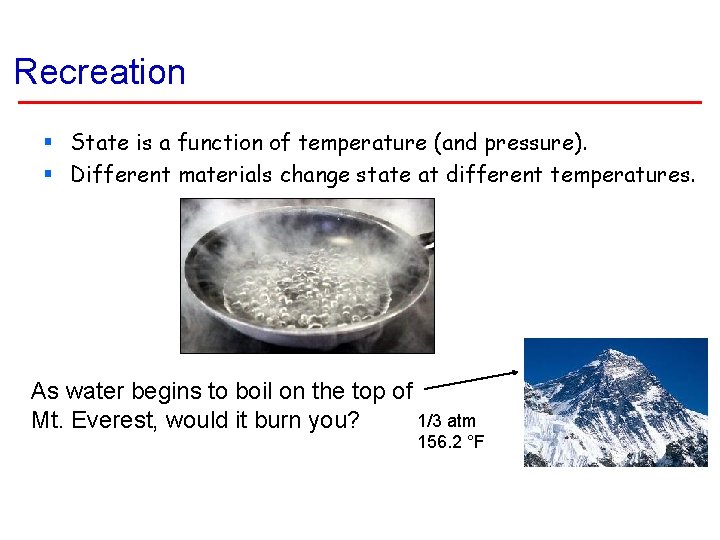
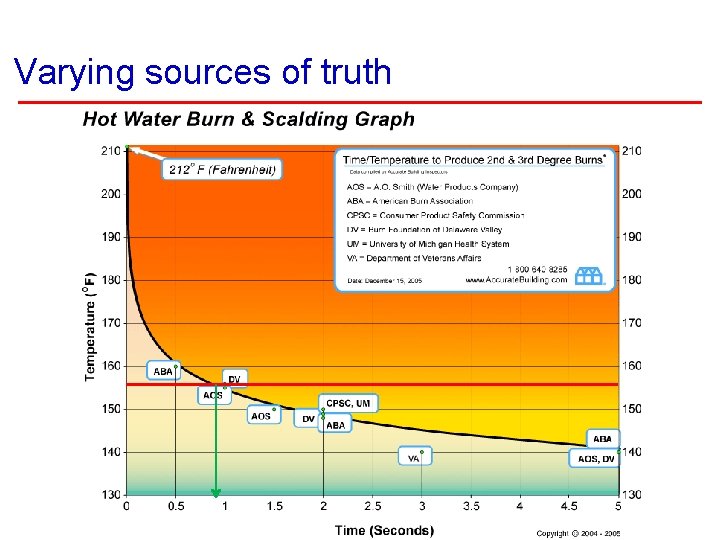
Recreation § State is a function of temperature (and pressure). § Different materials change state at different temperatures. As water begins to boil on the top of 1/3 atm Mt. Everest, would it burn you? 156. 2 °F
Varying sources of truth
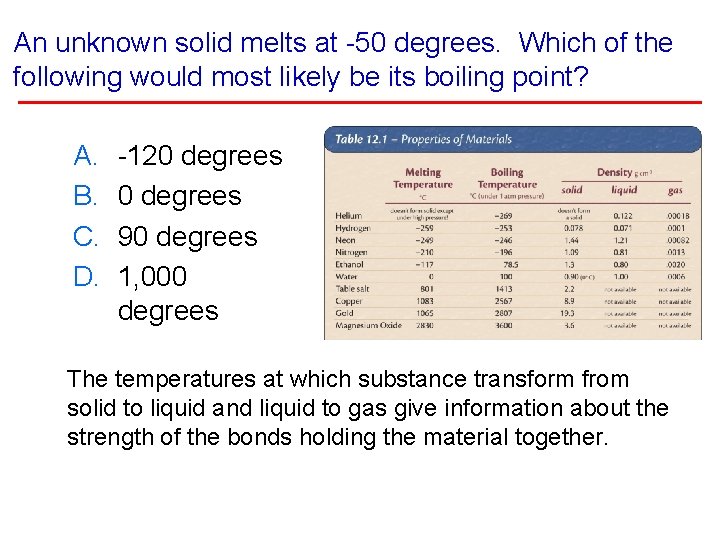
An unknown solid melts at -50 degrees. Which of the following would most likely be its boiling point? A. B. C. D. -120 degrees 90 degrees 1, 000 degrees The temperatures at which substance transform from solid to liquid and liquid to gas give information about the strength of the bonds holding the material together.
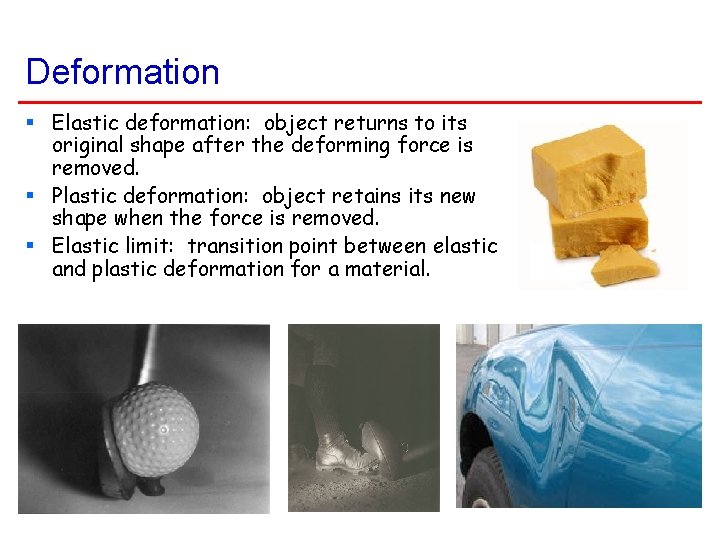
Deformation § Elastic deformation: object returns to its original shape after the deforming force is removed. § Plastic deformation: object retains its new shape when the force is removed. § Elastic limit: transition point between elastic and plastic deformation for a material.
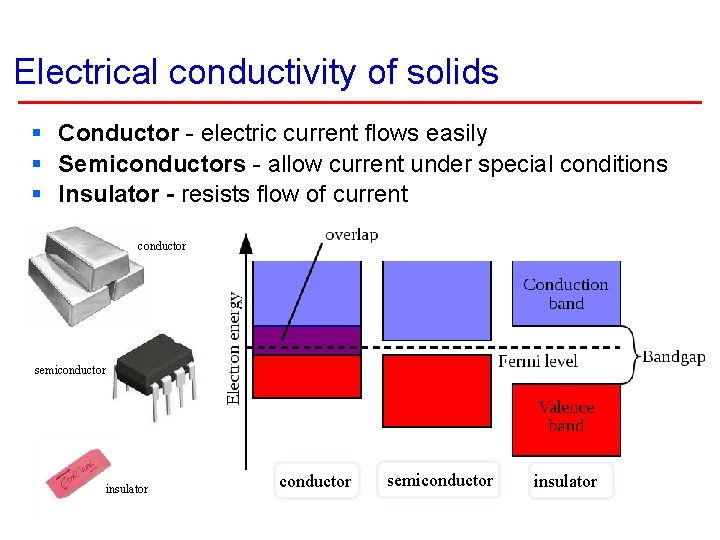
Electrical conductivity of solids § Conductor - electric current flows easily § Semiconductors - allow current under special conditions § Insulator - resists flow of current conductor semiconductor insulator
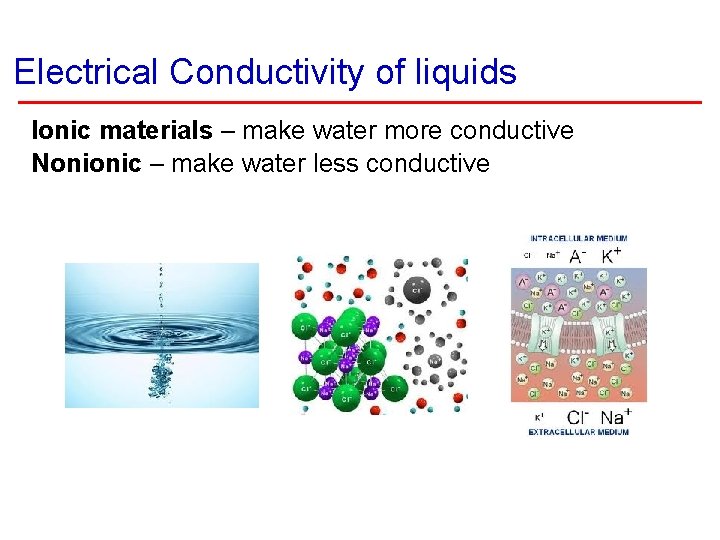
Electrical Conductivity of liquids Ionic materials – make water more conductive Nonionic – make water less conductive
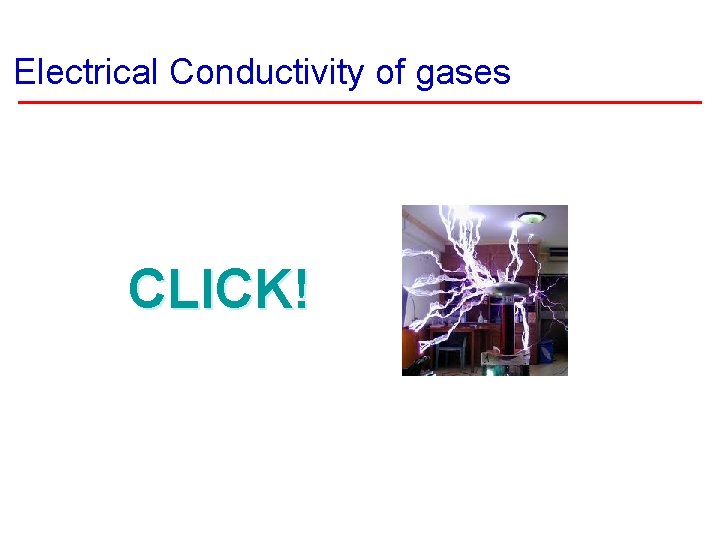
Electrical Conductivity of gases CLICK!
QQ 3: What is this state of matter?
QQ 4: What is the most common state of matter in the visible universe? a) b) c) d) Solid Liquid Gas Plasma Earth
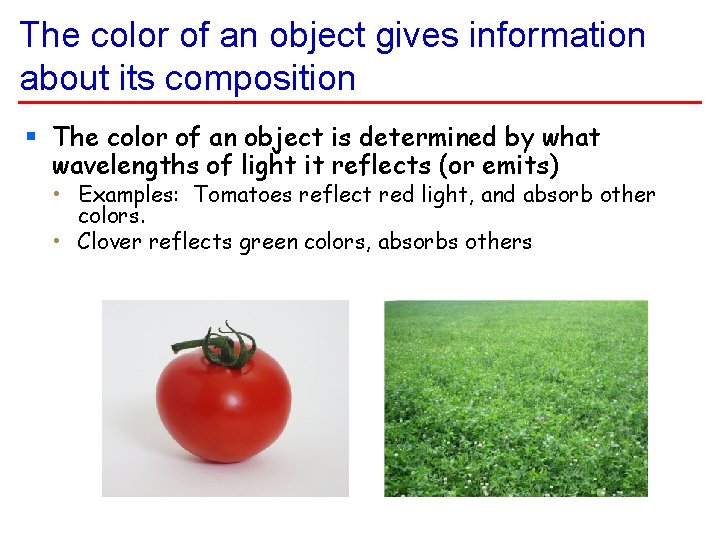
The color of an object gives information about its composition § The color of an object is determined by what wavelengths of light it reflects (or emits) • Examples: Tomatoes reflect red light, and absorb other colors. • Clover reflects green colors, absorbs others
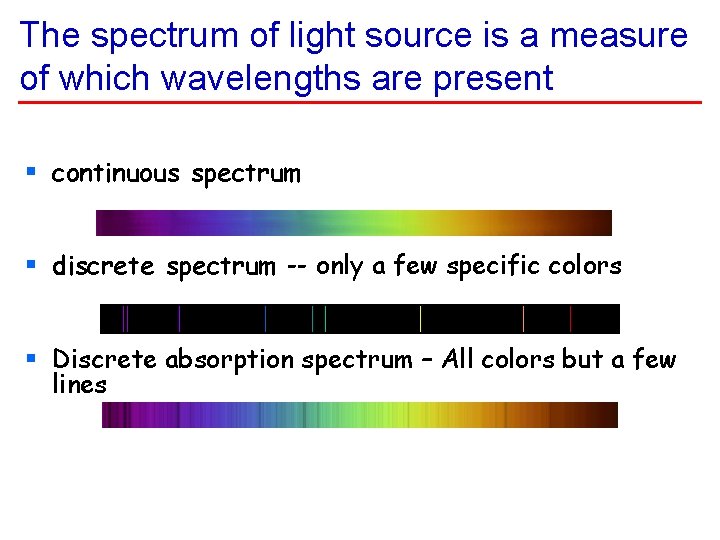
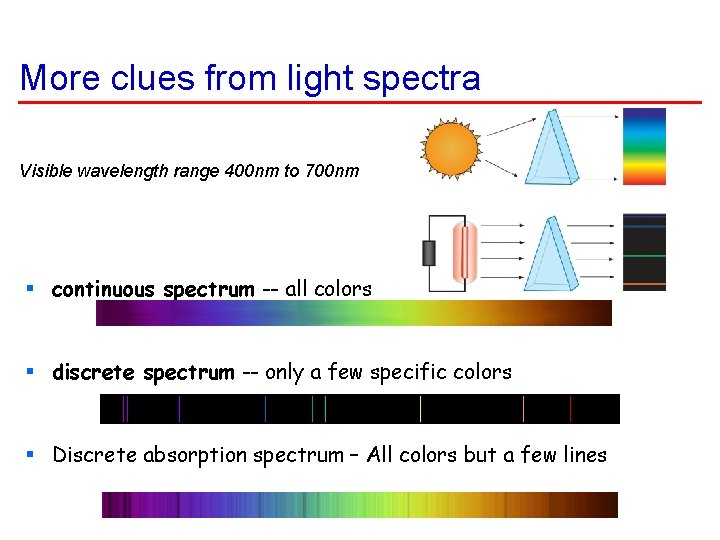
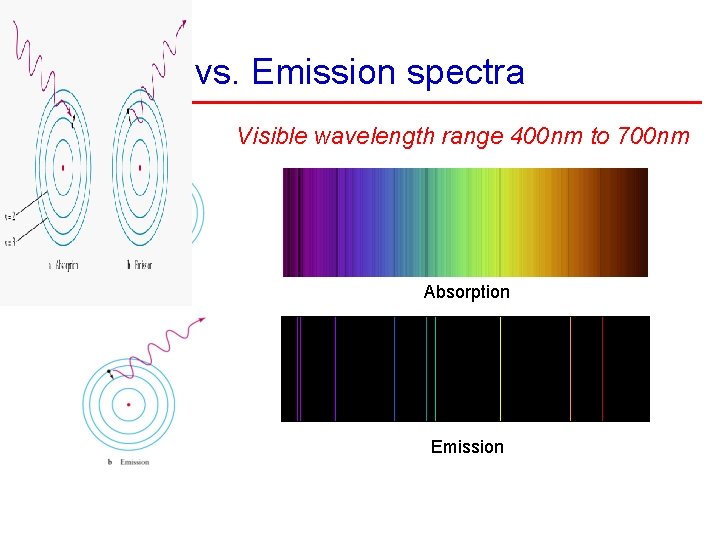
The spectrum of light source is a measure of which wavelengths are present § continuous spectrum § discrete spectrum -- only a few specific colors § Discrete absorption spectrum – All colors but a few lines
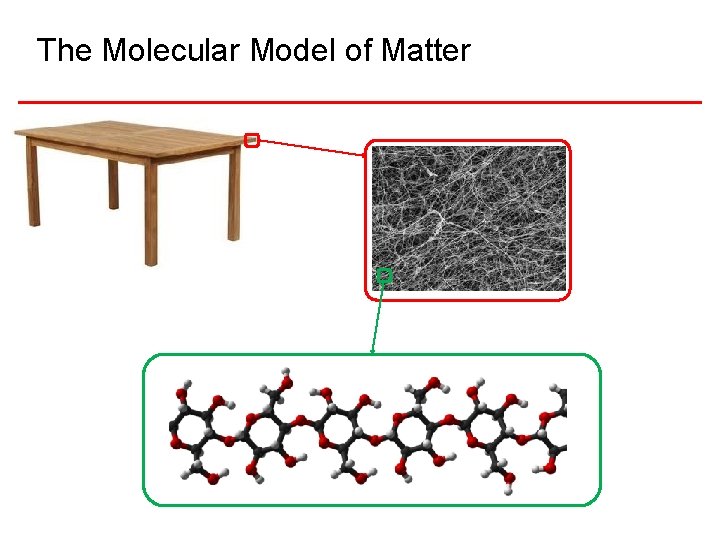
The Molecular Model of Matter
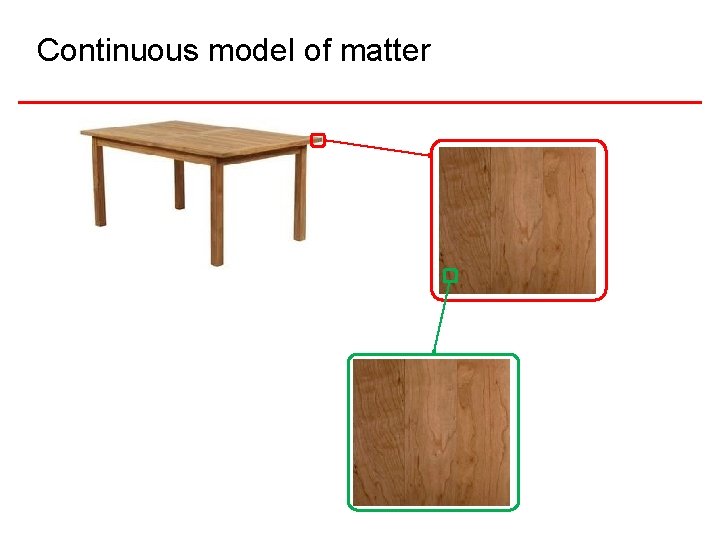
Continuous model of matter
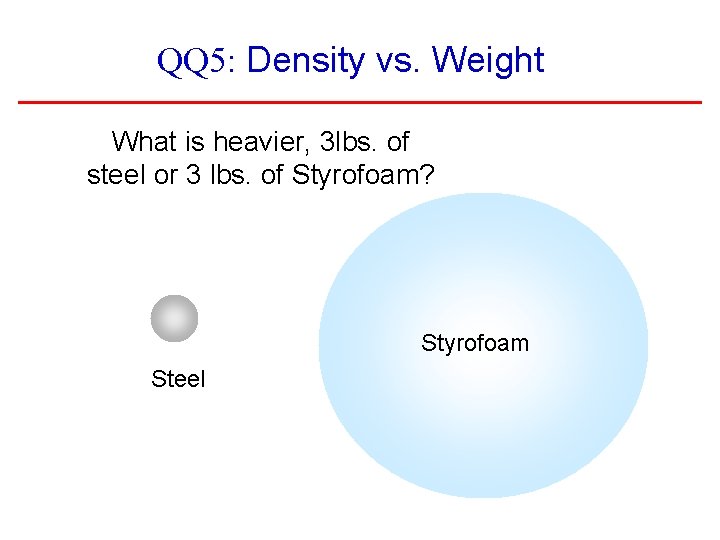
QQ 5: Density vs. Weight What is heavier, 3 lbs. of steel or 3 lbs. of Styrofoam? Styrofoam Steel
Continuous Model § Useful in many situations: • Fluid dynamics • Classical Electrodynamics § Has many limitations • Charge and light come in distinct packets • How do changes of state occur? ? !? • Etc.
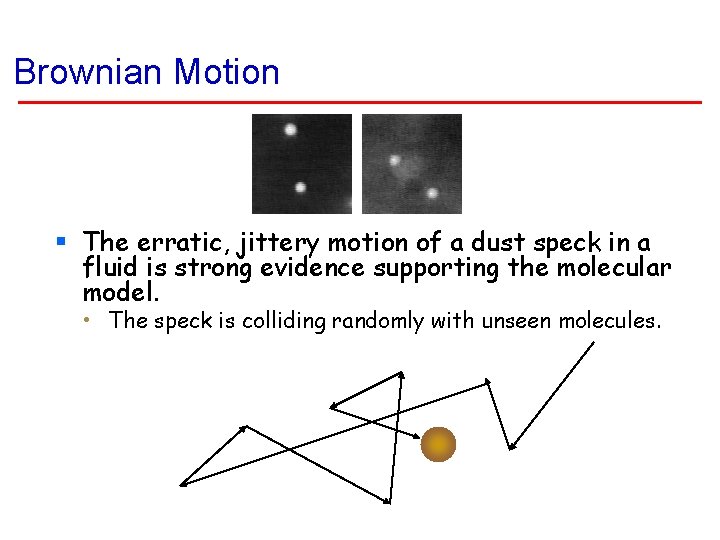
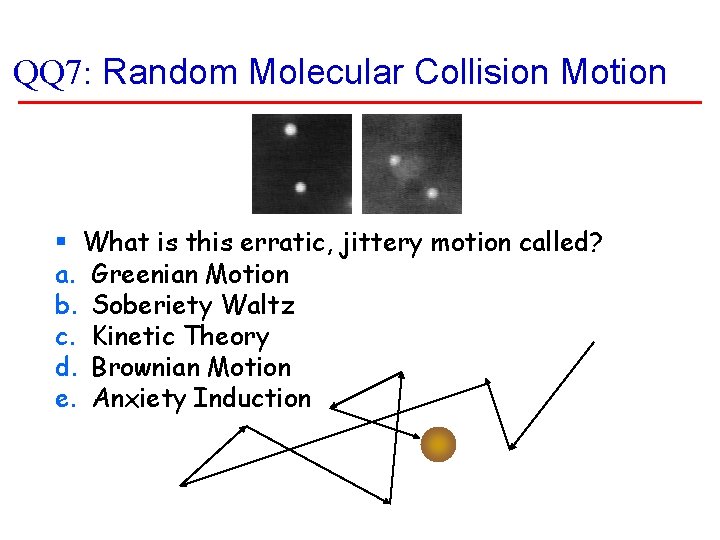
Brownian Motion § The erratic, jittery motion of a dust speck in a fluid is strong evidence supporting the molecular model. • The speck is colliding randomly with unseen molecules.
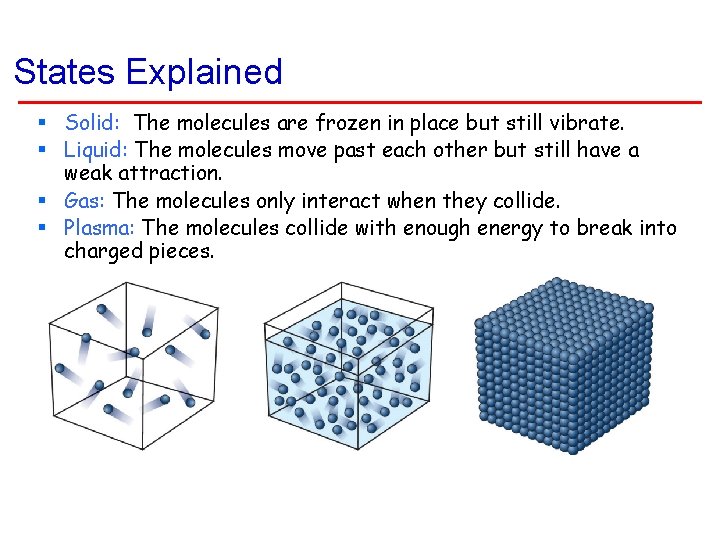
States Explained § Solid: The molecules are frozen in place but still vibrate. § Liquid: The molecules move past each other but still have a weak attraction. § Gas: The molecules only interact when they collide. § Plasma: The molecules collide with enough energy to break into charged pieces.
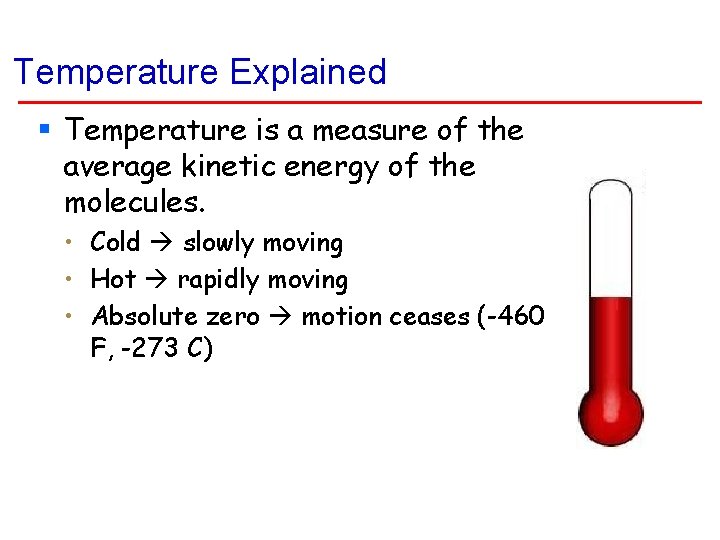
Temperature Explained § Temperature is a measure of the average kinetic energy of the molecules. • Cold slowly moving • Hot rapidly moving • Absolute zero motion ceases (-460 F, -273 C)
Temperature Explained § Example: At room temperature molecules are moving about 1, 000 ft/s
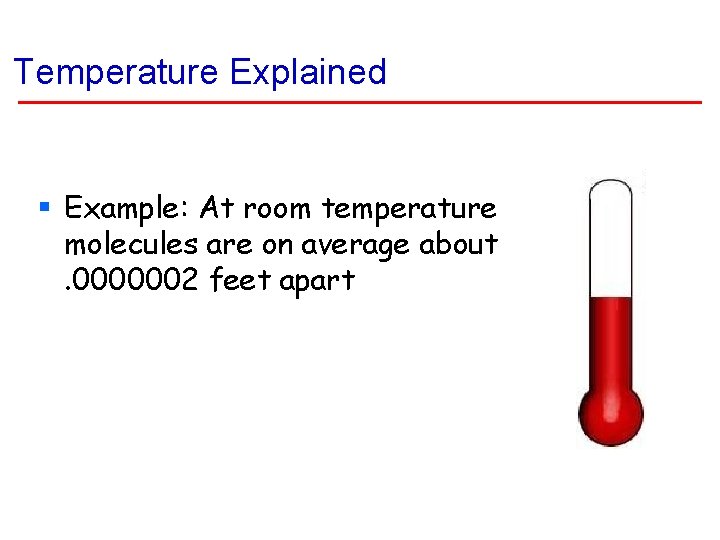
Temperature Explained § Example: At room temperature molecules are on average about. 0000002 feet apart
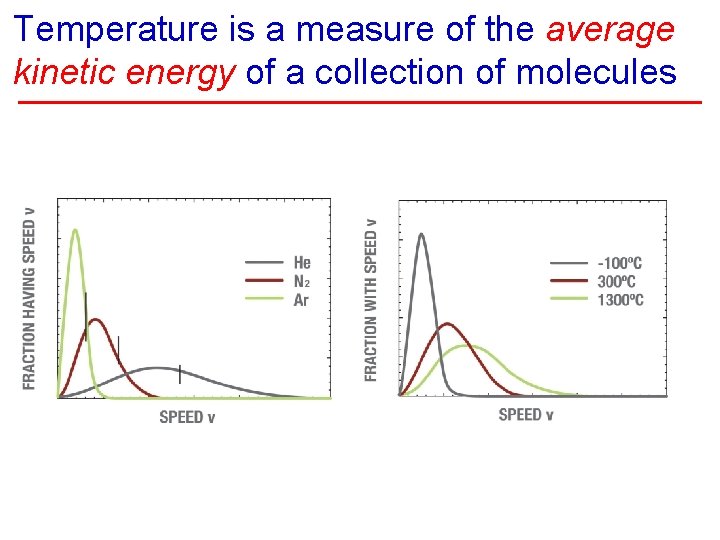
Temperature is a measure of the average kinetic energy of a collection of molecules
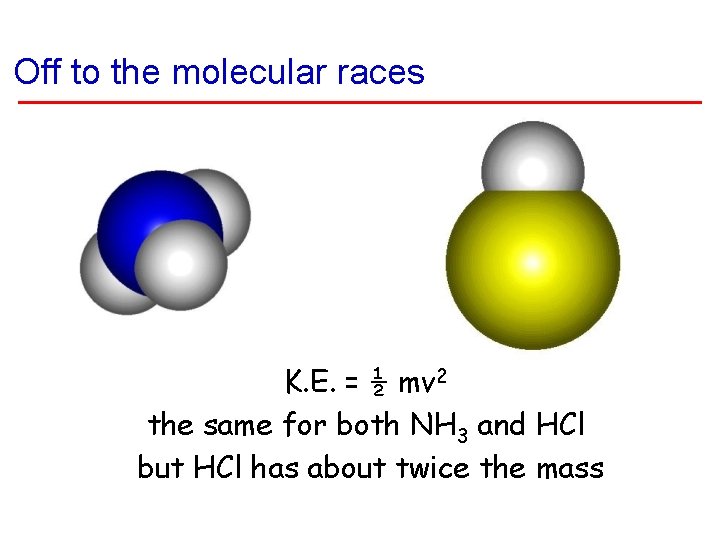
Off to the molecular races K. E. = ½ mv 2 the same for both NH 3 and HCl but HCl has about twice the mass
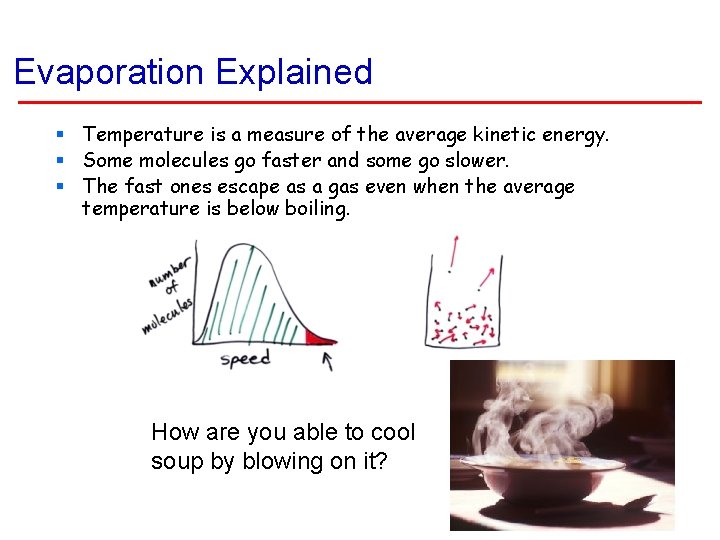
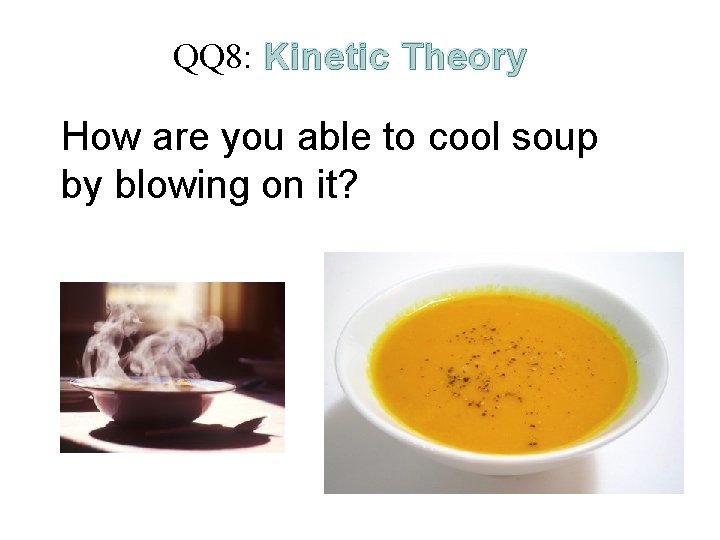
Evaporation Explained § Temperature is a measure of the average kinetic energy. § Some molecules go faster and some go slower. § The fast ones escape as a gas even when the average temperature is below boiling. How are you able to cool soup by blowing on it?
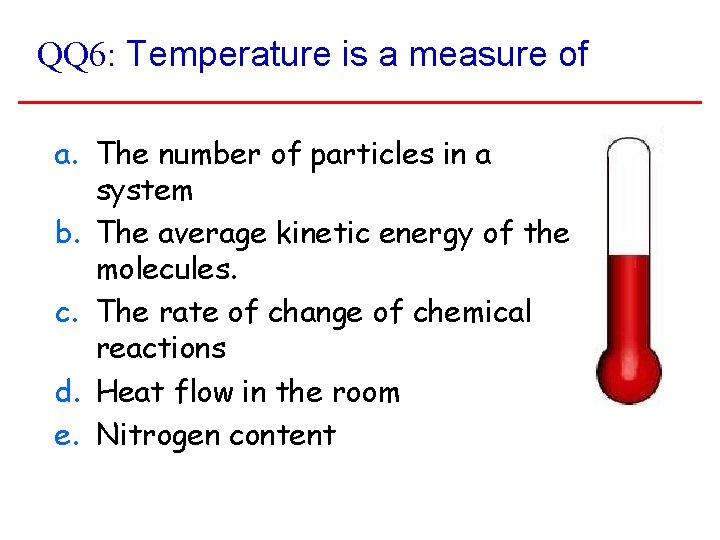
QQ 6: Temperature is a measure of a. The number of particles in a system b. The average kinetic energy of the molecules. c. The rate of change of chemical reactions d. Heat flow in the room e. Nitrogen content
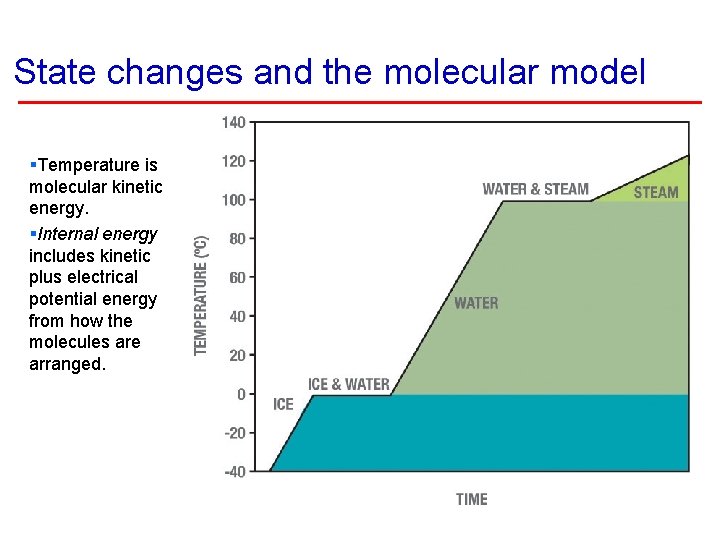
State changes and the molecular model §Temperature is molecular kinetic energy. §Internal energy includes kinetic plus electrical potential energy from how the molecules are arranged.
QQ 7: Random Molecular Collision Motion § What is this erratic, jittery motion called? a. Greenian Motion b. Soberiety Waltz c. Kinetic Theory d. Brownian Motion e. Anxiety Induction
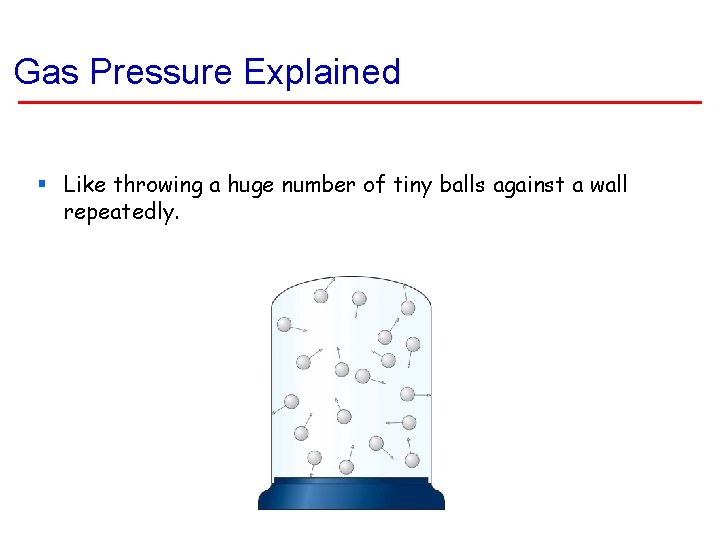
Gas Pressure Explained § Like throwing a huge number of tiny balls against a wall repeatedly.
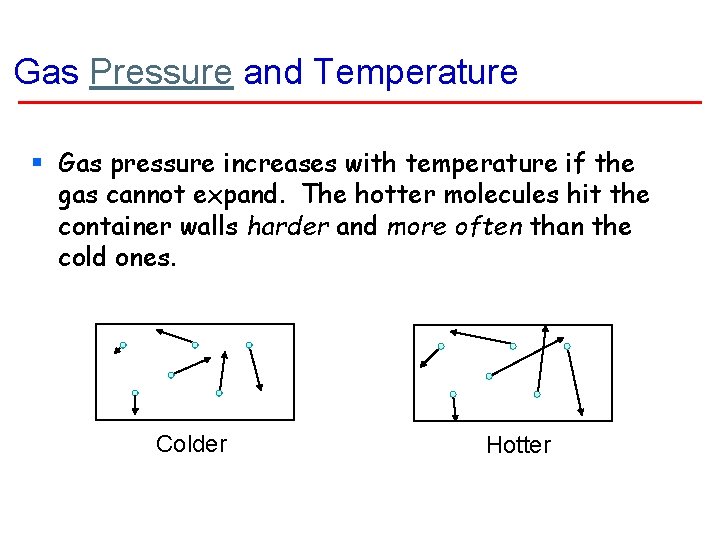
Gas Pressure and Temperature § Gas pressure increases with temperature if the gas cannot expand. The hotter molecules hit the container walls harder and more often than the cold ones. Colder Hotter
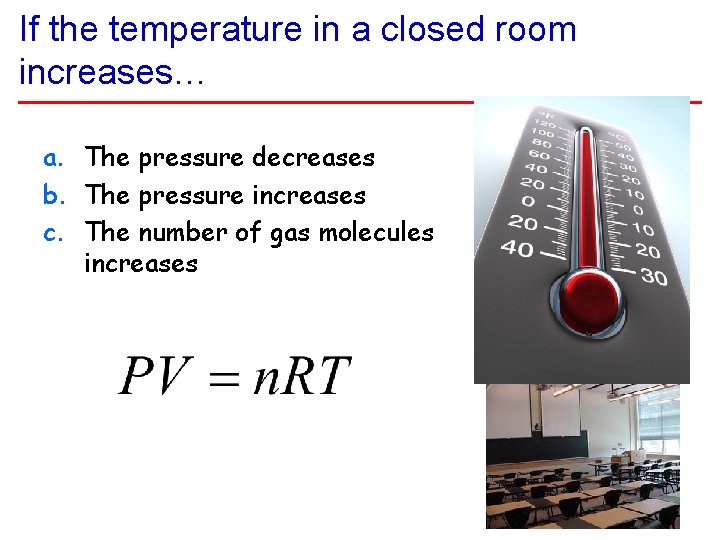
If the temperature in a closed room increases… a. The pressure decreases b. The pressure increases c. The number of gas molecules increases
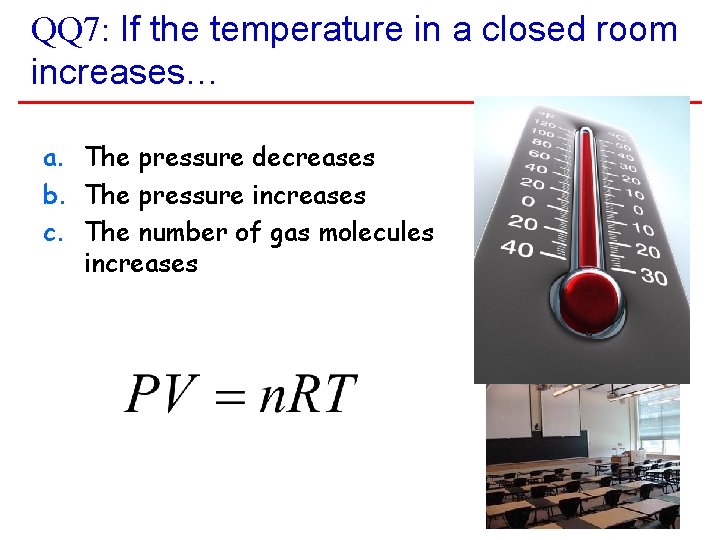
QQ 7: If the temperature in a closed room increases… a. The pressure decreases b. The pressure increases c. The number of gas molecules increases
The Physical Properties of Matter QQ 8: Kinetic Theory How are you able to cool soup by blowing on it?
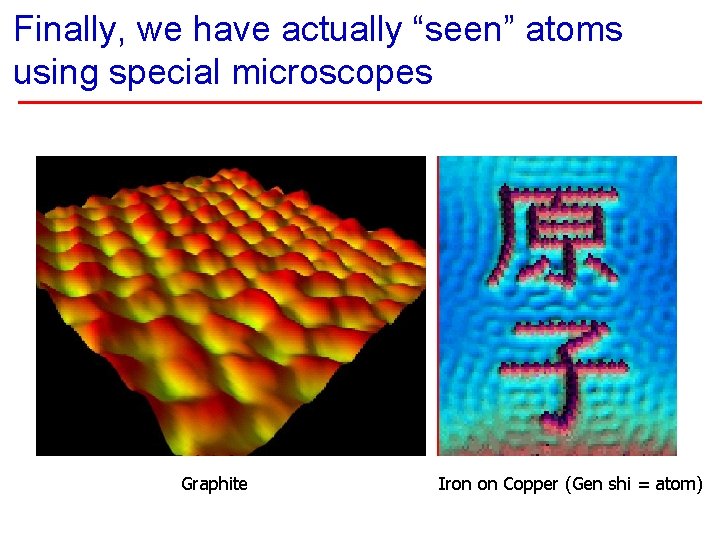
Finally, we have actually “seen” atoms using special microscopes Graphite Iron on Copper (Gen shi = atom)
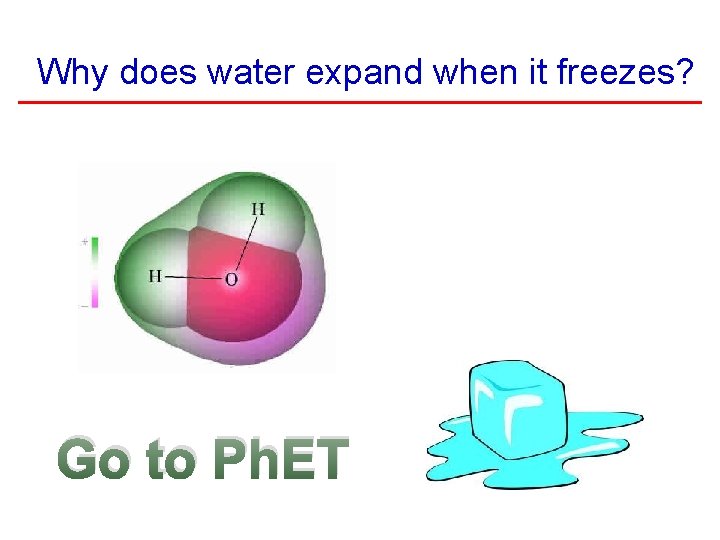
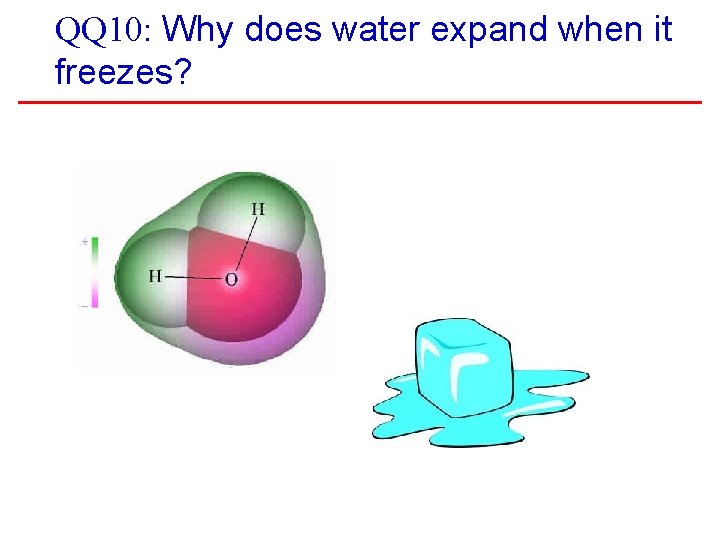
Why does water expand when it freezes? Go to Ph. ET
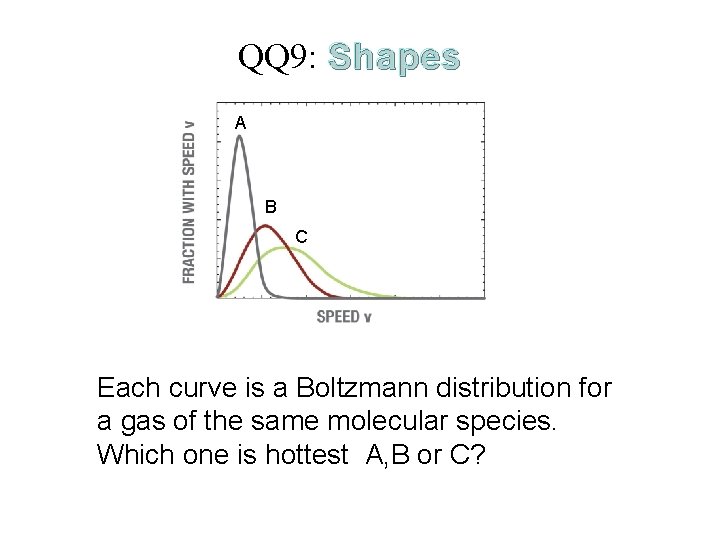
The Physical Properties of Matter QQ 9: Shapes A B C Each curve is a Boltzmann distribution for a gas of the same molecular species. Which one is hottest A, B or C?
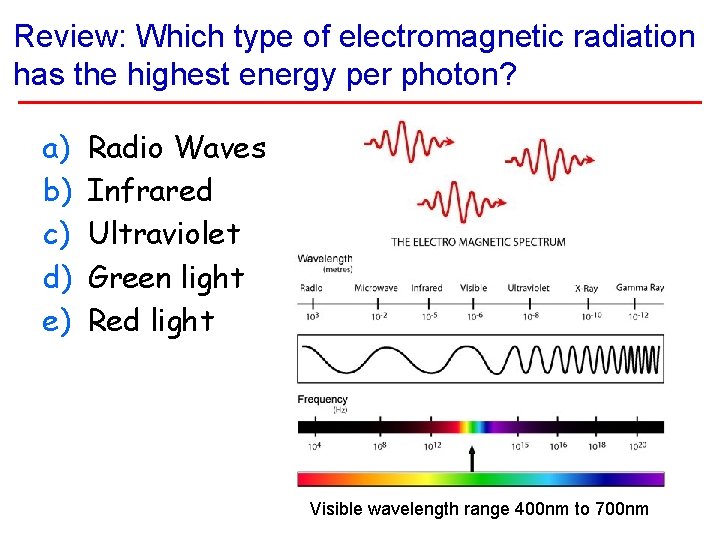
Review: Which type of electromagnetic radiation has the highest energy per photon? a) b) c) d) e) Radio Waves Infrared Ultraviolet Green light Red light Visible wavelength range 400 nm to 700 nm
QQ 10: Why does water expand when it freezes?
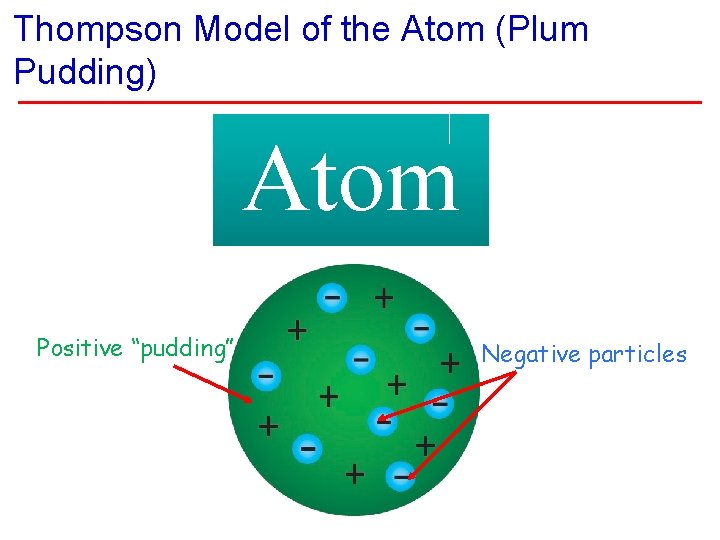
Thompson Model of the Atom (Plum Pudding) Atom Positive “pudding” Negative particles
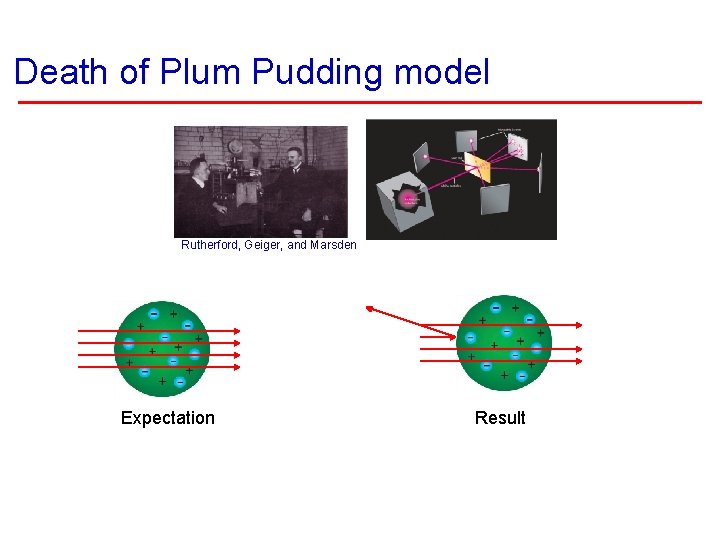
Death of Plum Pudding model Rutherford, Geiger, and Marsden Expectation Result
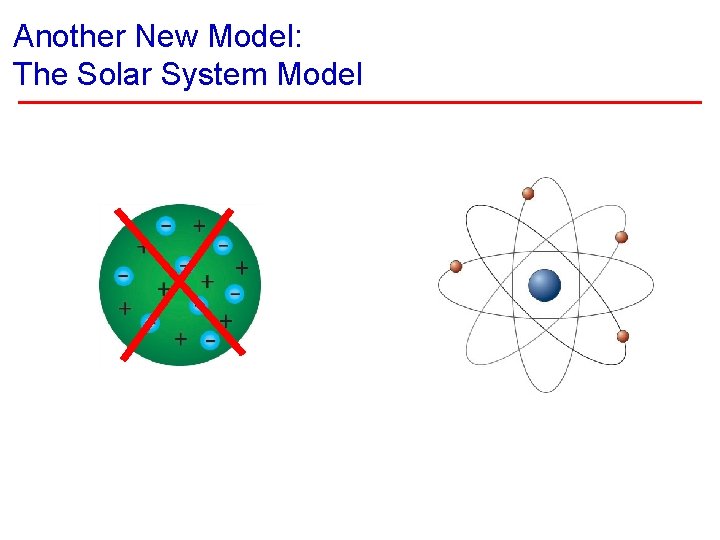
Another New Model: The Solar System Model
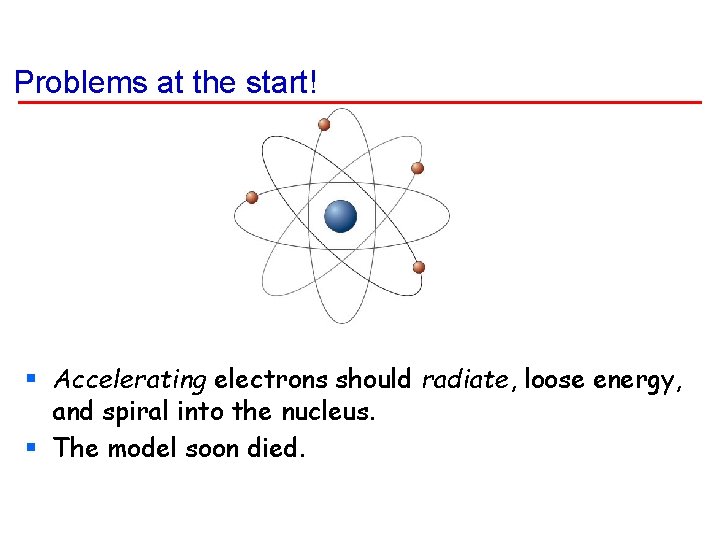
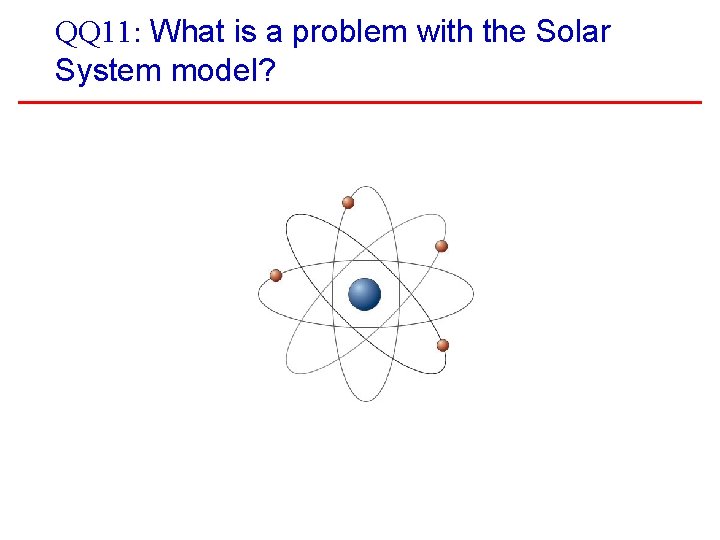
Problems at the start! § Accelerating electrons should radiate, loose energy, and spiral into the nucleus. § The model soon died.
More clues from light spectra Visible wavelength range 400 nm to 700 nm § continuous spectrum -- all colors § discrete spectrum -- only a few specific colors § Discrete absorption spectrum – All colors but a few lines
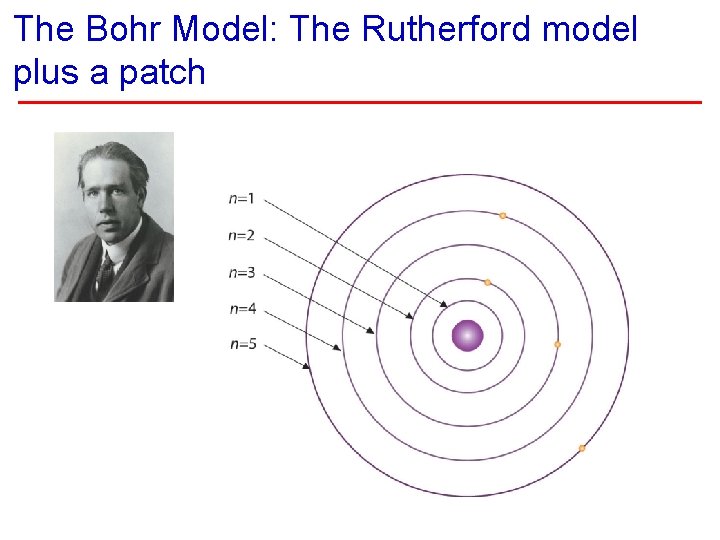
The Bohr Model: The Rutherford model plus a patch
QQ 11: What is a problem with the Solar System model?
Absorption vs. Emission spectra Visible wavelength range 400 nm to 700 nm Absorption Emission
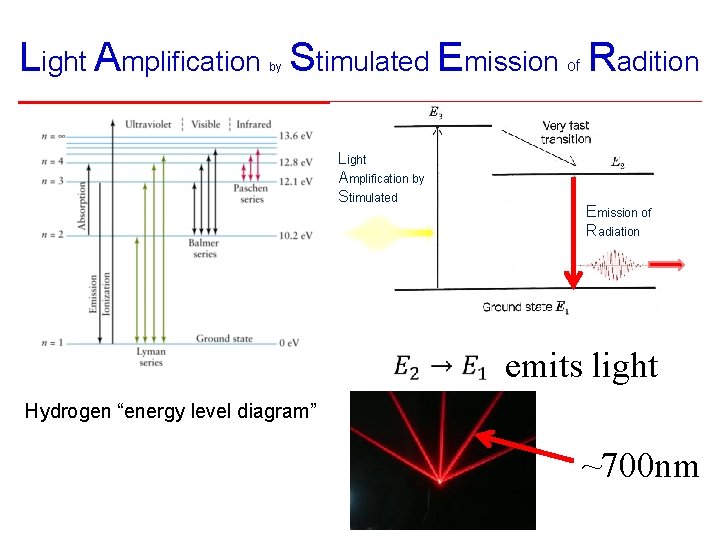
Light Amplification Stimulated Emission Radition of by Light Amplification by Stimulated Emission of Radiation emits light Hydrogen “energy level diagram” ~700 nm
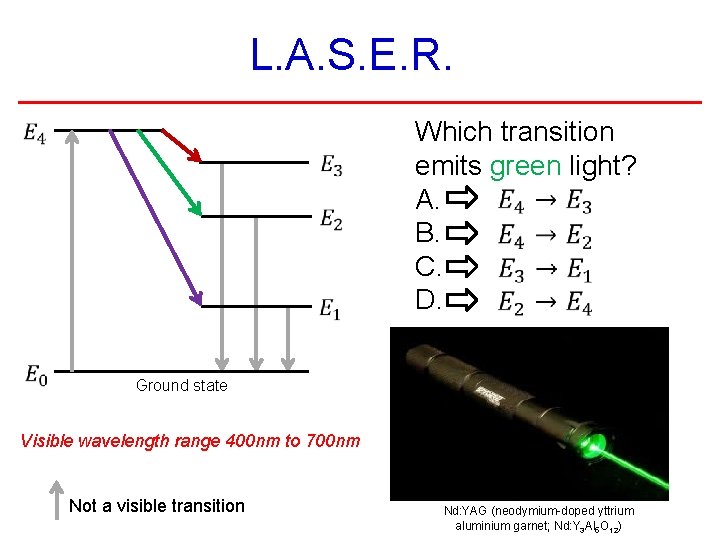
L. A. S. E. R. Which transition emits green light? A. B. C. D. Ground state Visible wavelength range 400 nm to 700 nm Not a visible transition Nd: YAG (neodymium-doped yttrium aluminium garnet; Nd: Y 3 Al 5 O 12)
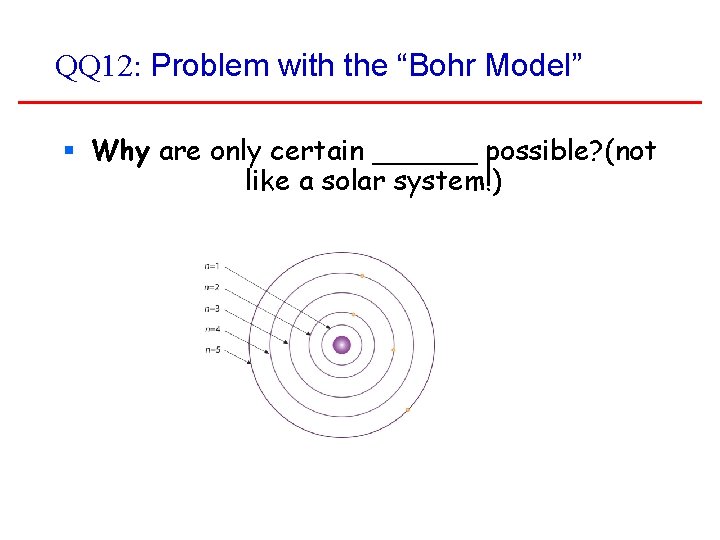
Problems with the “Bohr Model” § Why are only certain orbits possible (not like a solar system!) § Why doesn’t the undisturbed atom radiate? (Why don’t the electrons fall into the nucleus? ) ‘Because Bohr says so’ is not a good answer. So we continue looking!
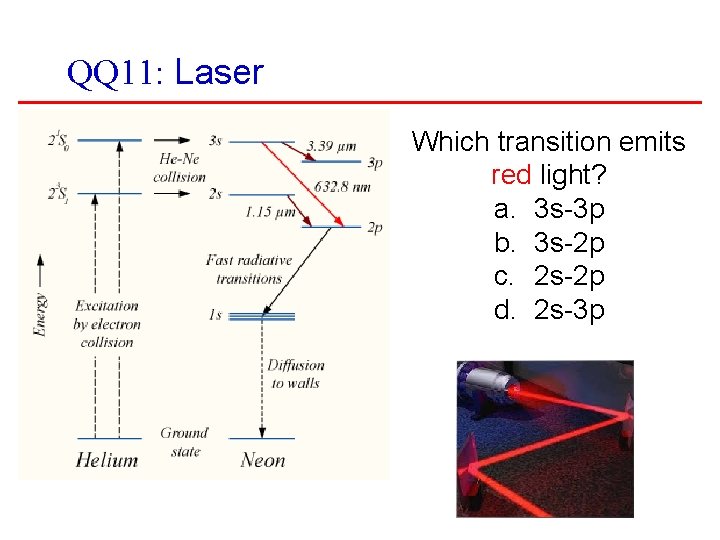
QQ 11: Laser Which transition emits red light? a. 3 s-3 p b. 3 s-2 p c. 2 s-2 p d. 2 s-3 p
QQ 12: Problem with the “Bohr Model” § Why are only certain ______ possible? (not like a solar system!)