
The Electromagnetic Spectrum Least Energy Most Energy What
- Slides: 13
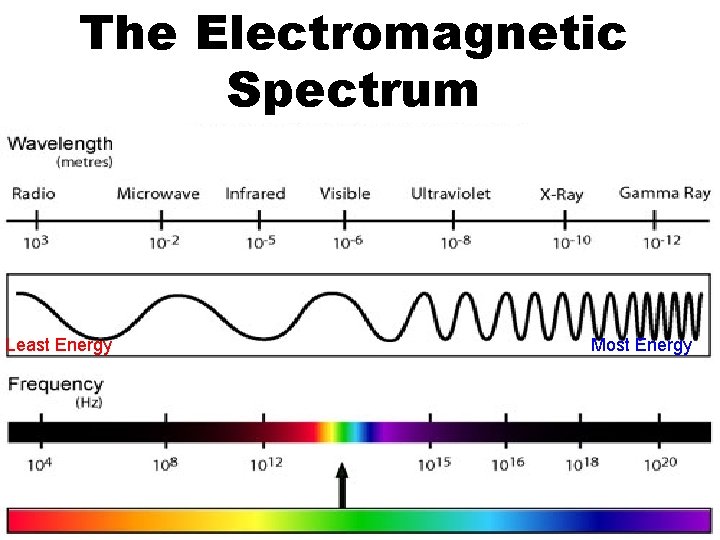
The Electromagnetic Spectrum Least Energy Most Energy
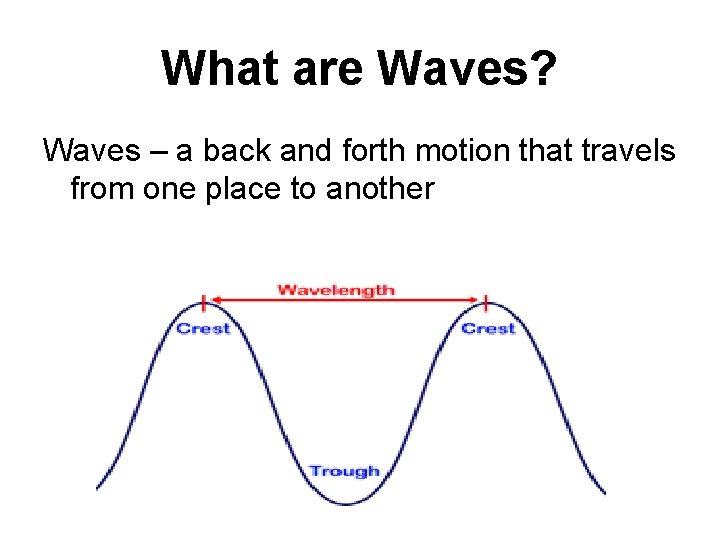
What are Waves? Waves – a back and forth motion that travels from one place to another
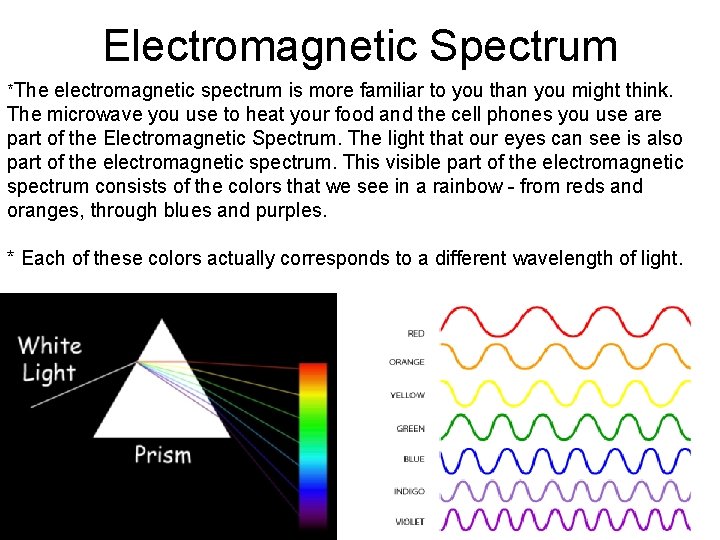
Electromagnetic Spectrum *The electromagnetic spectrum is more familiar to you than you might think. The microwave you use to heat your food and the cell phones you use are part of the Electromagnetic Spectrum. The light that our eyes can see is also part of the electromagnetic spectrum. This visible part of the electromagnetic spectrum consists of the colors that we see in a rainbow - from reds and oranges, through blues and purples. * Each of these colors actually corresponds to a different wavelength of light.
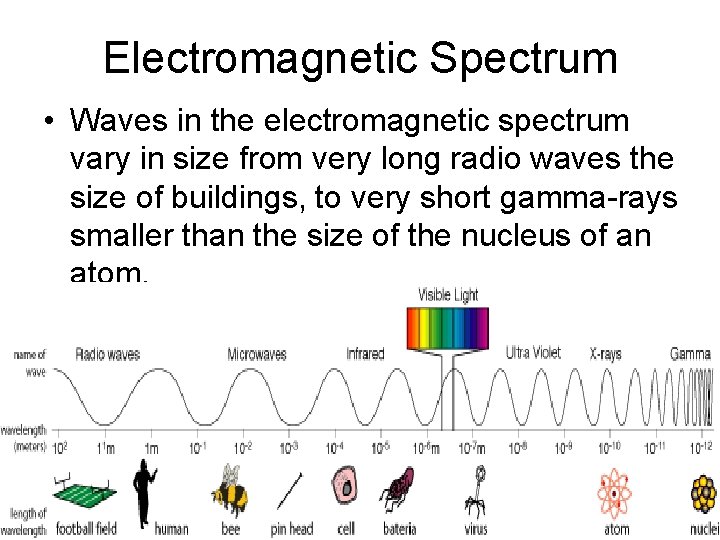
Electromagnetic Spectrum • Waves in the electromagnetic spectrum vary in size from very long radio waves the size of buildings, to very short gamma-rays smaller than the size of the nucleus of an atom.
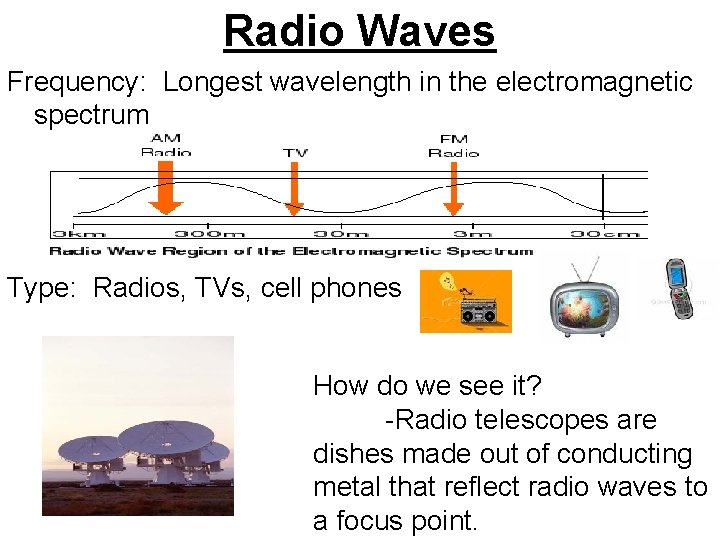
Radio Waves Frequency: Longest wavelength in the electromagnetic spectrum Type: Radios, TVs, cell phones How do we see it? -Radio telescopes are dishes made out of conducting metal that reflect radio waves to a focus point.
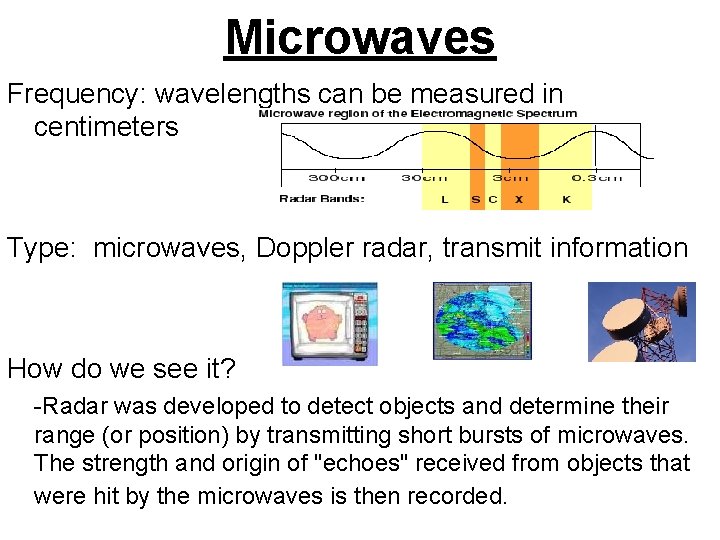
Microwaves Frequency: wavelengths can be measured in centimeters Type: microwaves, Doppler radar, transmit information How do we see it? -Radar was developed to detect objects and determine their range (or position) by transmitting short bursts of microwaves. The strength and origin of "echoes" received from objects that were hit by the microwaves is then recorded.
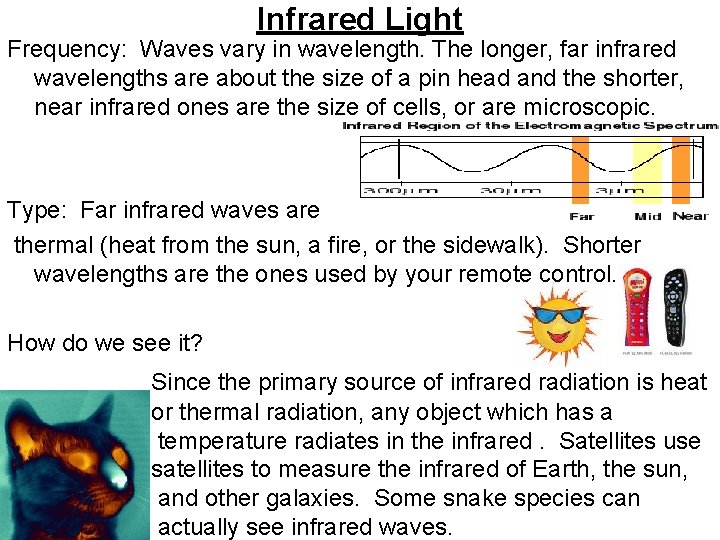
Infrared Light Frequency: Waves vary in wavelength. The longer, far infrared wavelengths are about the size of a pin head and the shorter, near infrared ones are the size of cells, or are microscopic. Type: Far infrared waves are thermal (heat from the sun, a fire, or the sidewalk). Shorter wavelengths are the ones used by your remote control. How do we see it? Since the primary source of infrared radiation is heat or thermal radiation, any object which has a temperature radiates in the infrared. Satellites use satellites to measure the infrared of Earth, the sun, and other galaxies. Some snake species can actually see infrared waves.
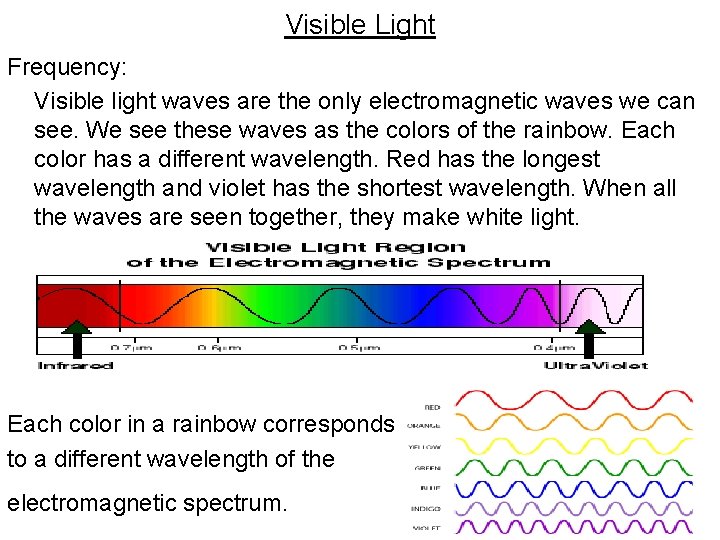
Visible Light Frequency: Visible light waves are the only electromagnetic waves we can see. We see these waves as the colors of the rainbow. Each color has a different wavelength. Red has the longest wavelength and violet has the shortest wavelength. When all the waves are seen together, they make white light. Each color in a rainbow corresponds to a different wavelength of the electromagnetic spectrum.
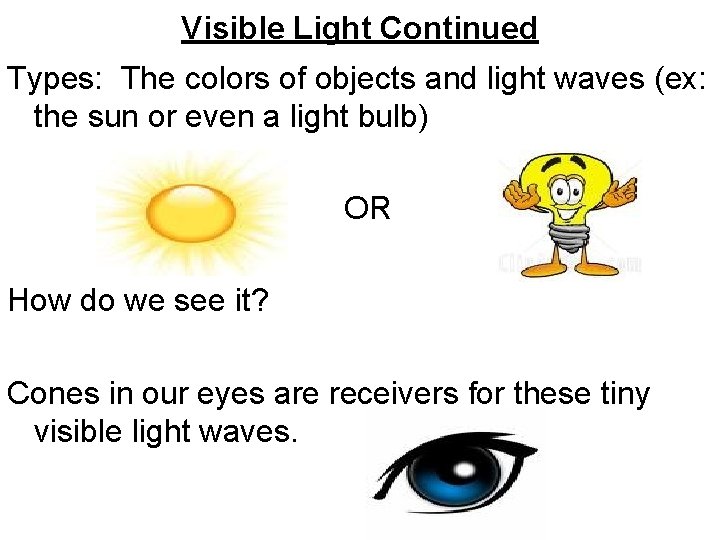
Visible Light Continued Types: The colors of objects and light waves (ex: the sun or even a light bulb) OR How do we see it? Cones in our eyes are receivers for these tiny visible light waves.
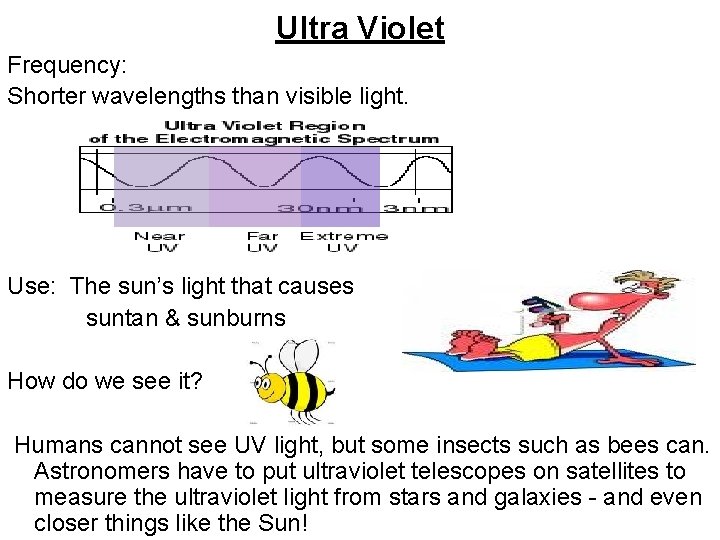
Ultra Violet Frequency: Shorter wavelengths than visible light. Use: The sun’s light that causes suntan & sunburns How do we see it? Humans cannot see UV light, but some insects such as bees can. Astronomers have to put ultraviolet telescopes on satellites to measure the ultraviolet light from stars and galaxies - and even closer things like the Sun!
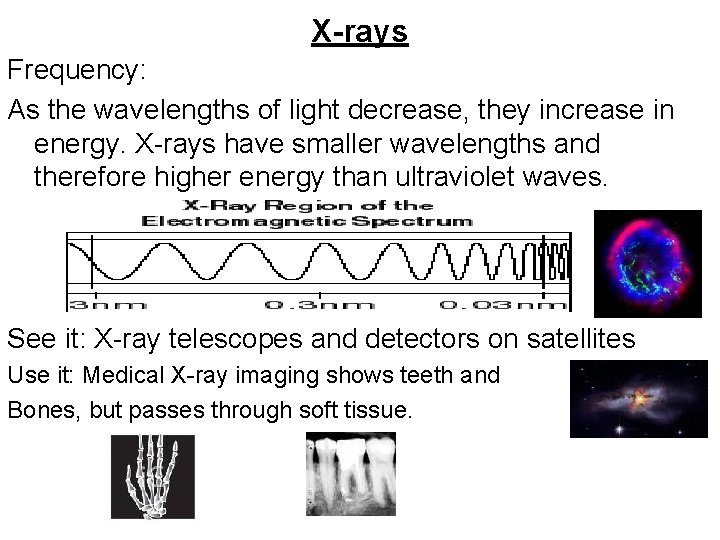
X-rays Frequency: As the wavelengths of light decrease, they increase in energy. X-rays have smaller wavelengths and therefore higher energy than ultraviolet waves. See it: X-ray telescopes and detectors on satellites Use it: Medical X-ray imaging shows teeth and Bones, but passes through soft tissue.
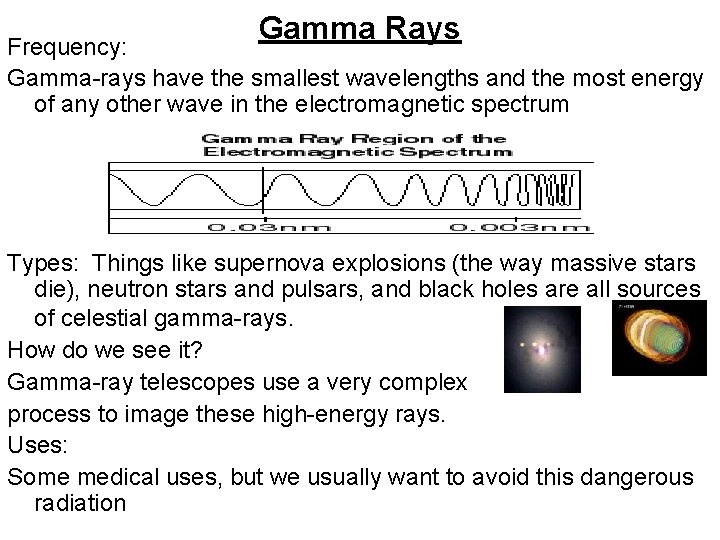
Gamma Rays Frequency: Gamma-rays have the smallest wavelengths and the most energy of any other wave in the electromagnetic spectrum Types: Things like supernova explosions (the way massive stars die), neutron stars and pulsars, and black holes are all sources of celestial gamma-rays. How do we see it? Gamma-ray telescopes use a very complex process to image these high-energy rays. Uses: Some medical uses, but we usually want to avoid this dangerous radiation
Sources • http: //science. hq. nasa. gov/kids/imagers/e ms/index. html