
The electric field in dielectrics Section 6 Dielectrics
- Slides: 12
The electric field in dielectrics Section 6
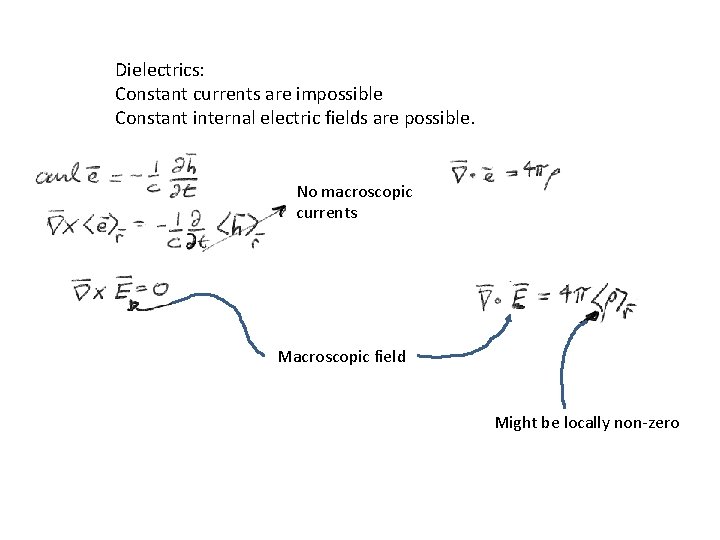
Dielectrics: Constant currents are impossible Constant internal electric fields are possible. No macroscopic currents Macroscopic field Might be locally non-zero
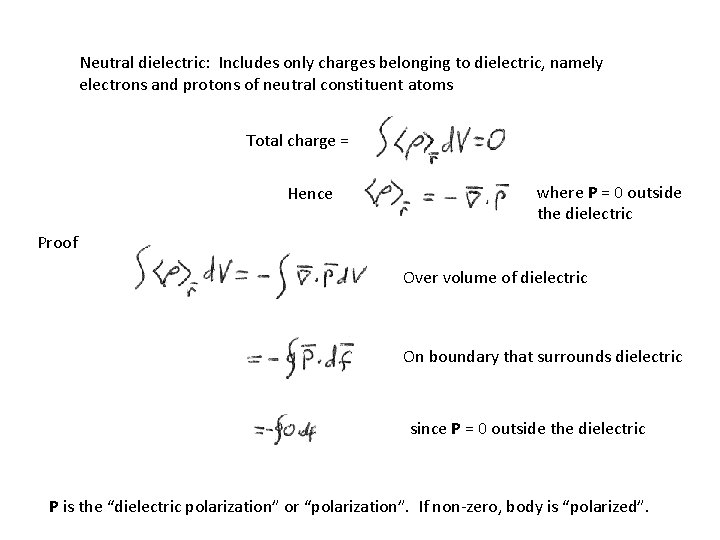
Neutral dielectric: Includes only charges belonging to dielectric, namely electrons and protons of neutral constituent atoms Total charge = Hence where P = 0 outside the dielectric Proof Over volume of dielectric On boundary that surrounds dielectric since P = 0 outside the dielectric P is the “dielectric polarization” or “polarization”. If non-zero, body is “polarized”.
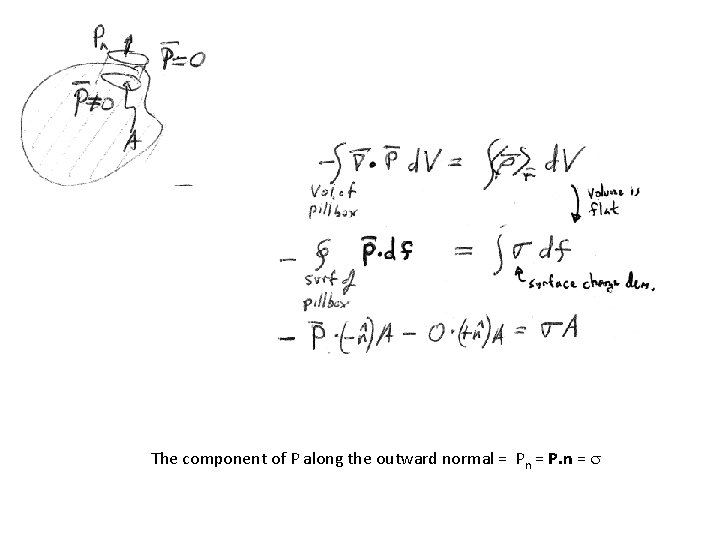
The component of P along the outward normal = Pn = P. n = s
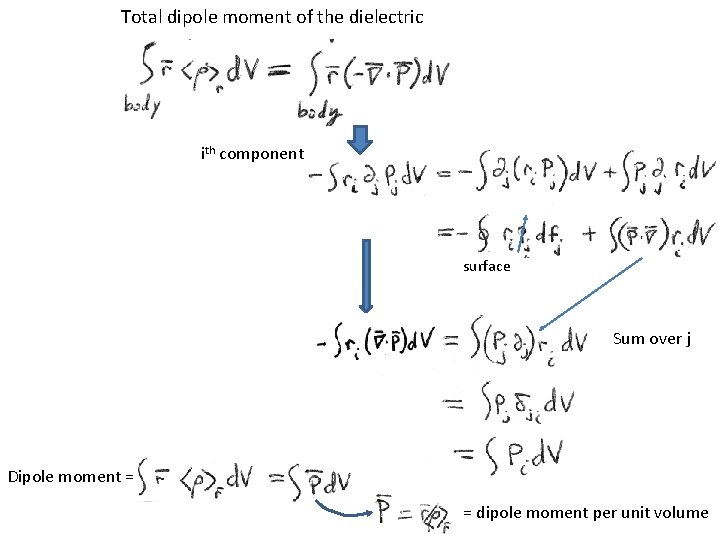
Total dipole moment of the dielectric ith component surface Sum over j Dipole moment = = dipole moment per unit volume
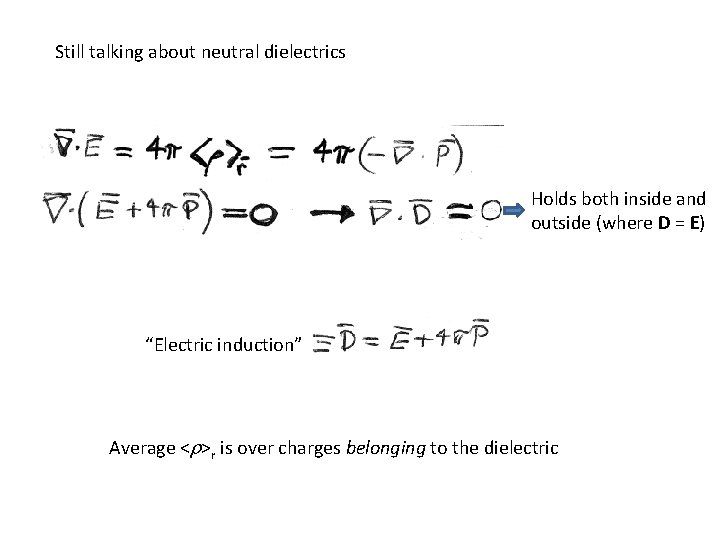
Still talking about neutral dielectrics Holds both inside and outside (where D = E) “Electric induction” Average <r>r is over charges belonging to the dielectric
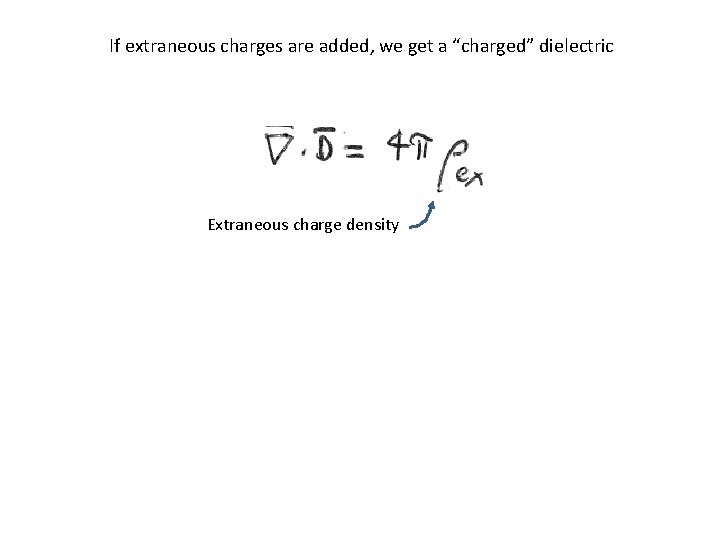
If extraneous charges are added, we get a “charged” dielectric Extraneous charge density
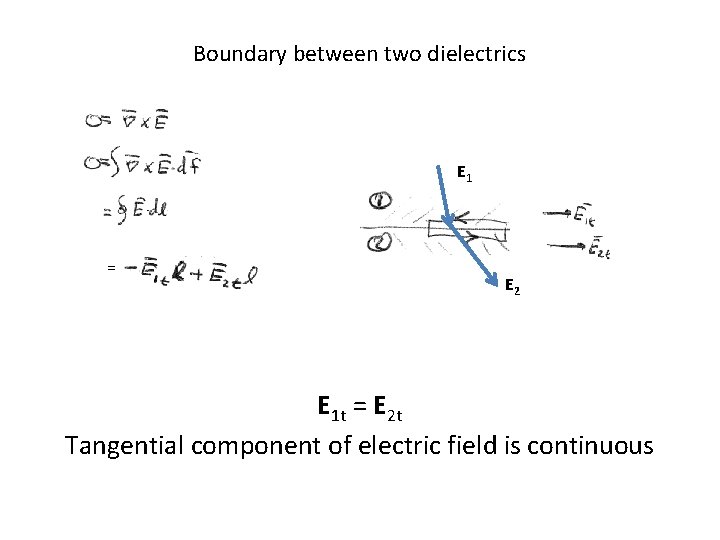
Boundary between two dielectrics E 1 = E 2 E 1 t = E 2 t Tangential component of electric field is continuous
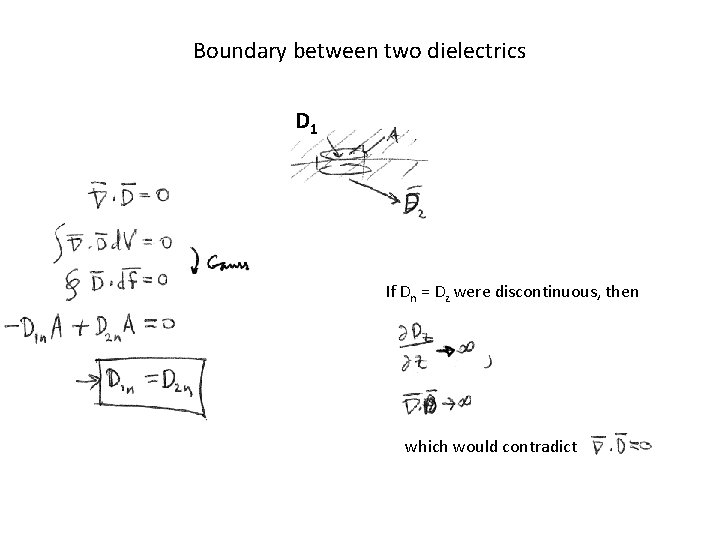
Boundary between two dielectrics D 1 If Dn = Dz were discontinuous, then which would contradict
Boundary between dielectric and conductor • • Et = 0 in the conductor Curl E = 0 still holds Et is continuous Therefore Et = 0 on both sides
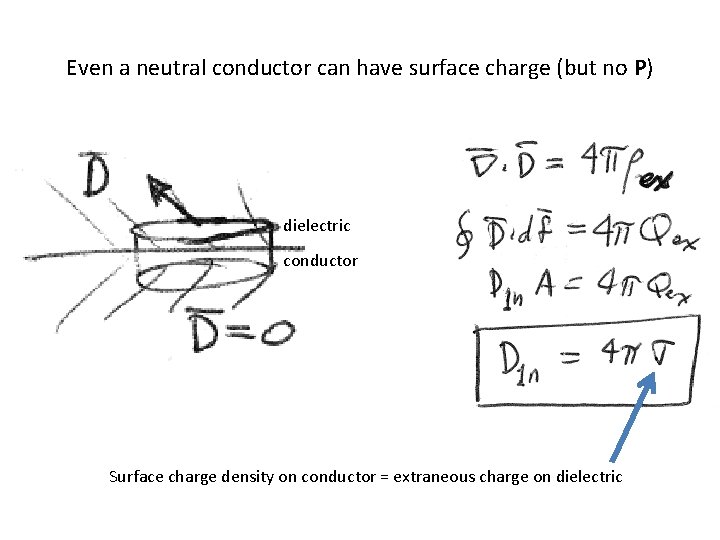
Even a neutral conductor can have surface charge (but no P) dielectric conductor Surface charge density on conductor = extraneous charge on dielectric
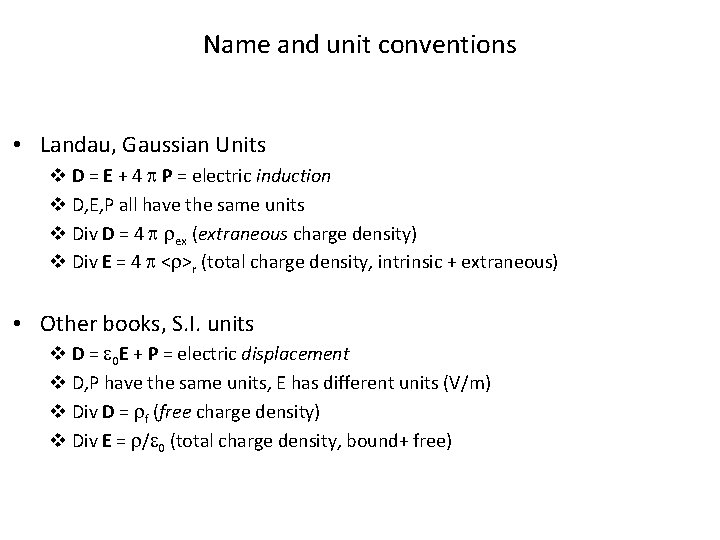
Name and unit conventions • Landau, Gaussian Units v D = E + 4 p P = electric induction v D, E, P all have the same units v Div D = 4 p rex (extraneous charge density) v Div E = 4 p <r>r (total charge density, intrinsic + extraneous) • Other books, S. I. units v D = e 0 E + P = electric displacement v D, P have the same units, E has different units (V/m) v Div D = rf (free charge density) v Div E = r/e 0 (total charge density, bound+ free)