
The Electoral College The Electoral College You have

- Slides: 41
The Electoral College
The Electoral College You have arrived at one of the least understood points in the American political process. As the people vote in the presidential election, they do not cast a vote directly for one of the presidential candidates. They vote, instead, for presidential electors.
Electing the President • The Constitution calls for a presidential election to be held every four years • First one was held in 1789 • In 2016, we held our 57 th presidential election • Unmatched in the history of any other nation in the world • Even during a civil war, two world wars, several economic depressions, and various other crises, the Constitution’s command has been met.
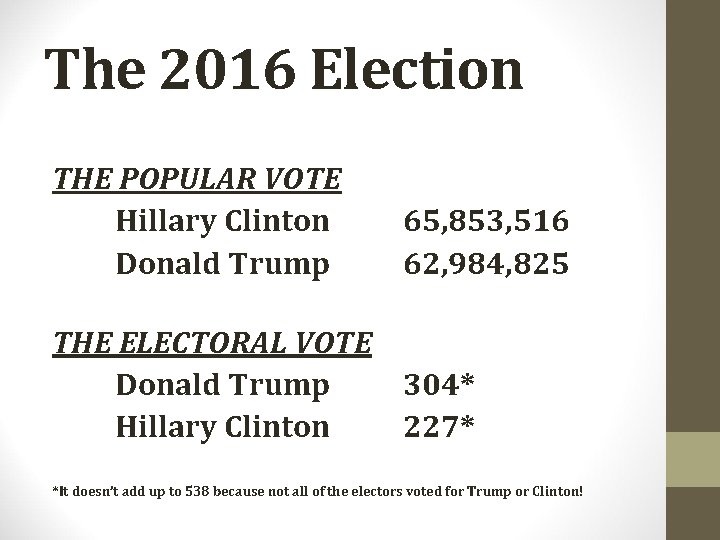
True or False? The candidate with the most votes is elected president. Answer: Not necessarily. Ask Hillary Clinton.
The 2016 Election THE POPULAR VOTE Hillary Clinton Donald Trump 65, 853, 516 62, 984, 825 THE ELECTORAL VOTE Donald Trump 304* Hillary Clinton 227* *It doesn’t add up to 538 because not all of the electors voted for Trump or Clinton!
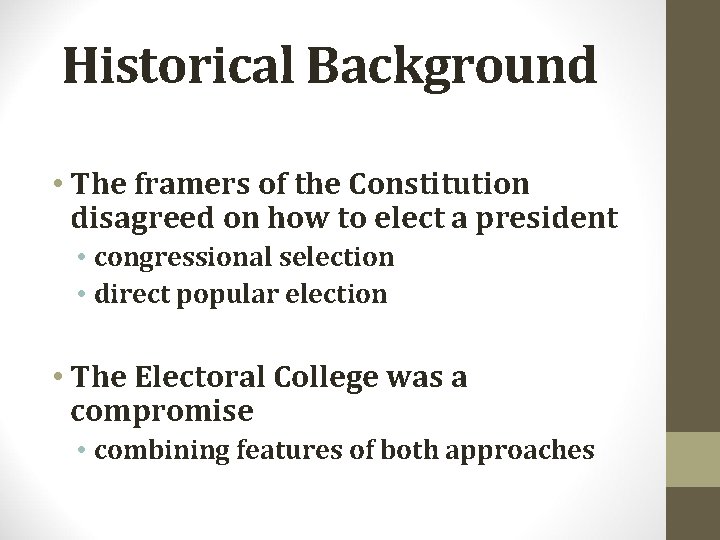
Historical Background • The framers of the Constitution disagreed on how to elect a president • congressional selection • direct popular election • The Electoral College was a compromise • combining features of both approaches
Historical Background • Taken from the Catholic Church selection of the Pope. • In the Roman Catholic Church, the College of Cardinals selects the Pope • Original idea was for the most knowledgeable and informed individuals from each State to select the president based solely on merit and without regard to State of origin or political party
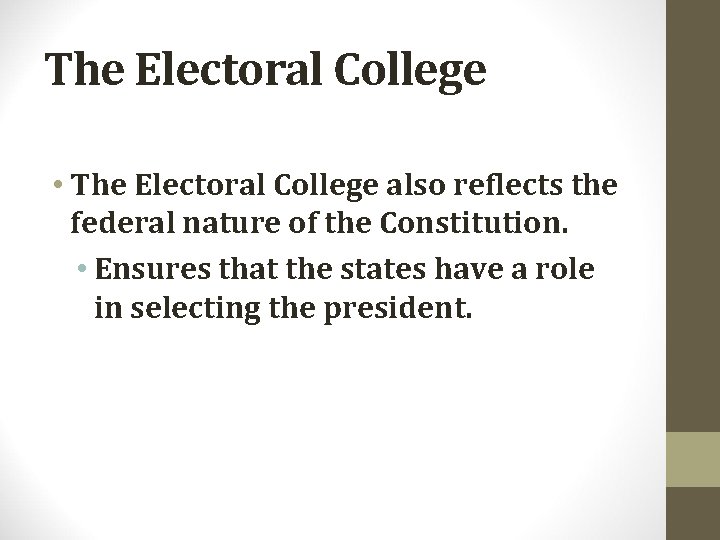
The Electoral College • The Electoral College also reflects the federal nature of the Constitution. • Ensures that the states have a role in selecting the president.
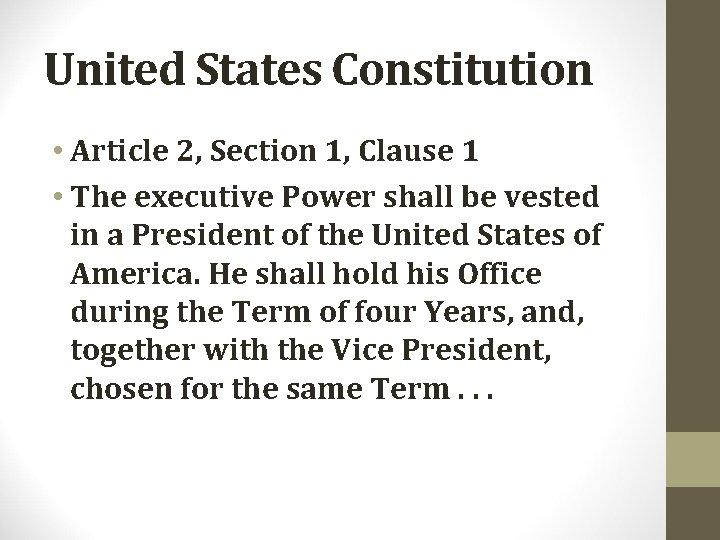
United States Constitution • Article 2, Section 1, Clause 1 • The executive Power shall be vested in a President of the United States of America. He shall hold his Office during the Term of four Years, and, together with the Vice President, chosen for the same Term. . .
United States Constitution • Article 2, Section 1, Clause 2 • Each State shall appoint, in such Manner as the Legislature thereof may direct, a Number of Electors, equal to the whole Number of Senators and Representatives to which the State may be entitled in the Congress: but no Senator or Representative, or Person holding an Office of Trust or Profit under the United States, shall be appointed an Elector.
United States Constitution • Article 2, Section 1, Clause 3 • The Electors shall meet in their respective States, and vote by Ballot for two Persons. . The Person having the greatest Number of Votes shall be the President. . In every Case, after the Choice of the President, the Person having the greatest Number of Votes of the Electors shall be the Vice President. • Modified by the 12 th Amendment
th 12 Amendment • Electors will vote once for President and once for Vice-president
State Electoral Votes • Each state is entitled to as many electoral votes as the sum of its representation • U. S. House of Representatives • U. S. House of Senate • CA: 53 House members plus 2 senators = 55 electoral votes • Total: • • 435 House members 100 senators 3 electors for the District of Columbia (see next slide) = 538 electoral votes
rd 23 Amendment • Gave the District of Columbia 3 electors • D. C. isn’t a state so they don’t have House Reps or Senators
Who are the Electors? • Individuals from each state are selected in each state to officially cast that state’s electoral votes. • Framers anticipated that electors would be state leaders who would exercise good judgment. • Today, party leaders selectors who are typically long-time party activists. • Electors almost always vote for their party’s candidates.
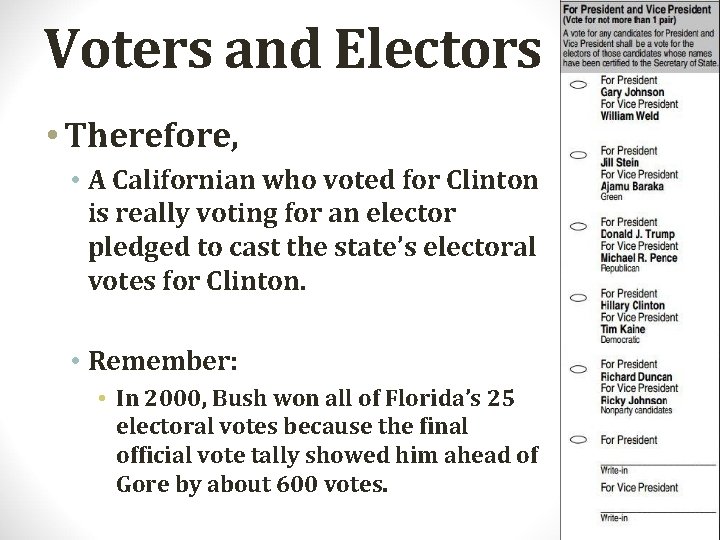
Voters and Electors • Therefore, • A Californian who voted for Clinton is really voting for an elector pledged to cast the state’s electoral votes for Clinton. • Remember: • In 2000, Bush won all of Florida’s 25 electoral votes because the final official vote tally showed him ahead of Gore by about 600 votes.
The Real Election • In December of election year • The electors gather in their respective state capitols to cast ballots for president and vice president. • In January • Congress comes into session • They open the ballots received from each state • They announce the official outcome
What if no one receives a majority? �To win, a candidate needs a majority (50%+1) � 270 electoral votes �If no candidate has a majority: �the House of Representatives selects the president from among the three presidential candidates with the most electoral votes. �If this happens, each state has one vote. �Happened only once - 1824 Congress chose John Quincy Adams over Andrew Jackson and Henry Clay. �The Senate selects the vice president from the top two vice-presidential candidates.
Popular Vote vs. the Electoral Vote • In a close race, the popular vote winner may not win the electoral college. • One candidate may win states by lopsided margins while the other wins states by narrow margins. • Electoral vote winners who lost the popular vote • Trump over Clinton in 2016 • Bush over Gore in 2000 • Benjamin Harrison over Grover Cleveland in 1888 • Rutherford B. Hayes over Samuel Tilden in 1876
Distortion • Even if a candidate wins a state by a mere ONE VOTE, the candidate wins ALL of the state’s electoral votes. • Example: California • Democrat wins 6, 519, 274 • Republican wins 6, 519, 273 • Democrat gets ALL 55 electoral votes
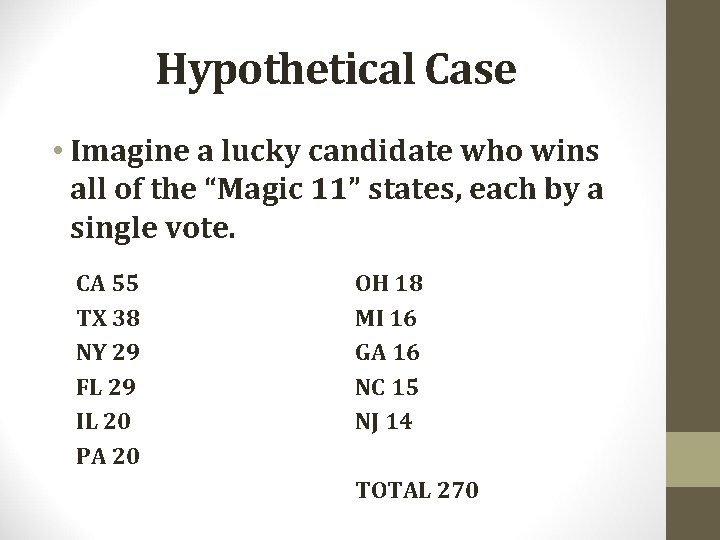
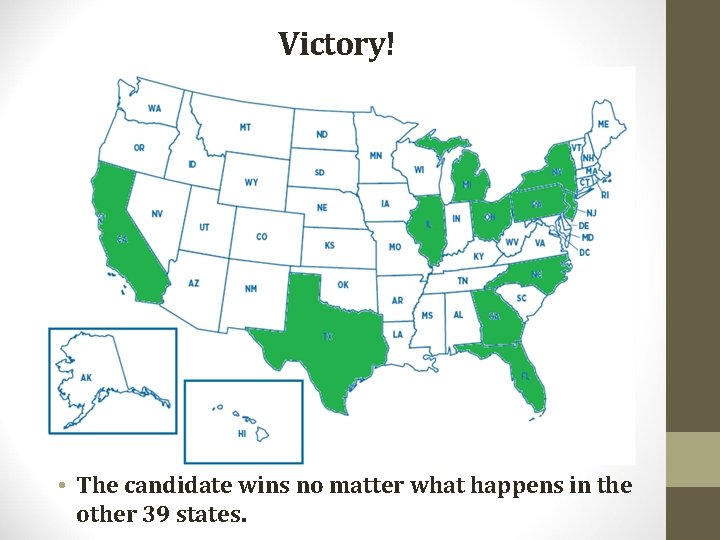
Hypothetical Case • Imagine a lucky candidate who wins all of the “Magic 11” states, each by a single vote. CA 55 TX 38 NY 29 FL 29 IL 20 PA 20 OH 18 MI 16 GA 16 NC 15 NJ 14 TOTAL 270
Victory! • The candidate wins no matter what happens in the other 39 states.
What About the Other 39 States? • Even if the candidate loses by millions of votes in the other 39 states, and therefore has only a minority of the popular vote, the candidate still wins by having captured a majority of electoral votes. • The electoral vote may therefore not match up with the popular vote, and can distort either the outcome or the margin of victory.
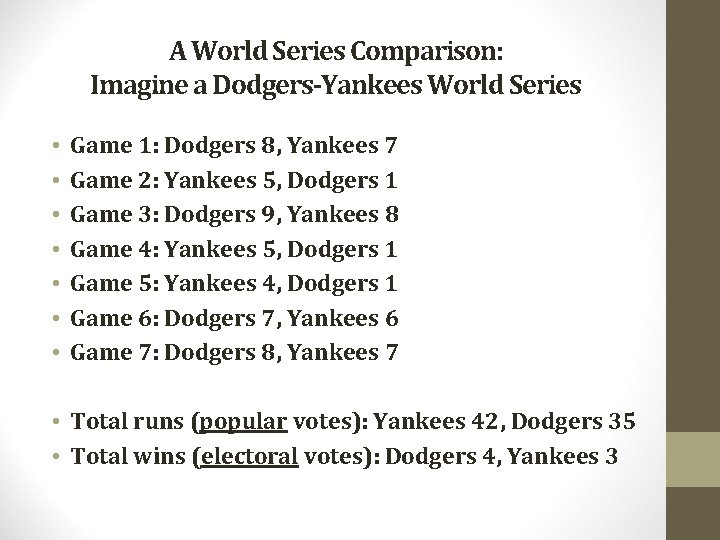
A World Series Comparison: Imagine a Dodgers-Yankees World Series • • Game 1: Dodgers 8, Yankees 7 Game 2: Yankees 5, Dodgers 1 Game 3: Dodgers 9, Yankees 8 Game 4: Yankees 5, Dodgers 1 Game 5: Yankees 4, Dodgers 1 Game 6: Dodgers 7, Yankees 6 Game 7: Dodgers 8, Yankees 7 • Total runs (popular votes): Yankees 42, Dodgers 35 • Total wins (electoral votes): Dodgers 4, Yankees 3
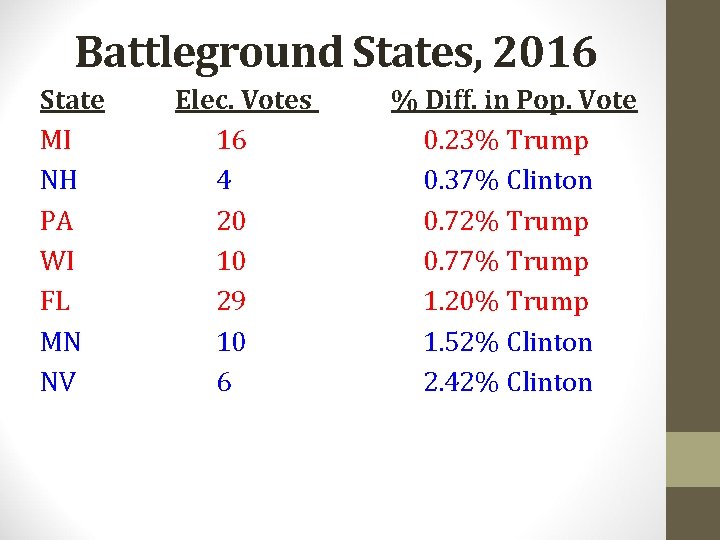
STRATEGY • In a system of direct election, a candidate would simply try to rack up as many popular votes as possible, regardless of where they are. • In the Electoral College system, the candidate instead focuses on swing states. • Trump, for instance spent little time campaigning in CA, but a great deal of time in FL, OH, and PA.
Battleground States, 2016 State MI NH PA WI FL MN NV Elec. Votes 16 4 20 10 29 10 6 % Diff. in Pop. Vote 0. 23% Trump 0. 37% Clinton 0. 72% Trump 0. 77% Trump 1. 20% Trump 1. 52% Clinton 2. 42% Clinton
Winner-Take-All: Recap • Distortion: It does not give an accurate picture of how the people voted. • Strategy: Candidates spend less time campaigning in states where they are particularly strong or weak, and more time in states where the outcome is likely to be close.
Criticisms of the Electoral College • The popular vote winner may lose the presidency. • Electors may vote for persons other than their party’s presidential and vice presidential candidates. • If no candidate receives a majority, Congress will pick the president and vice president.
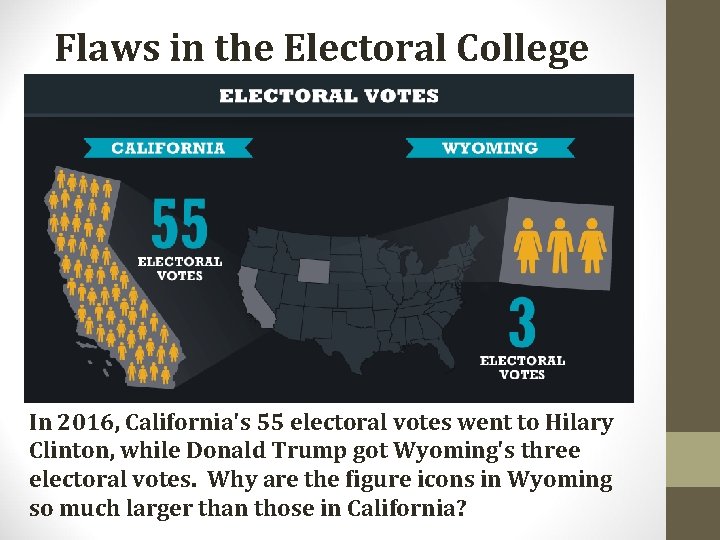
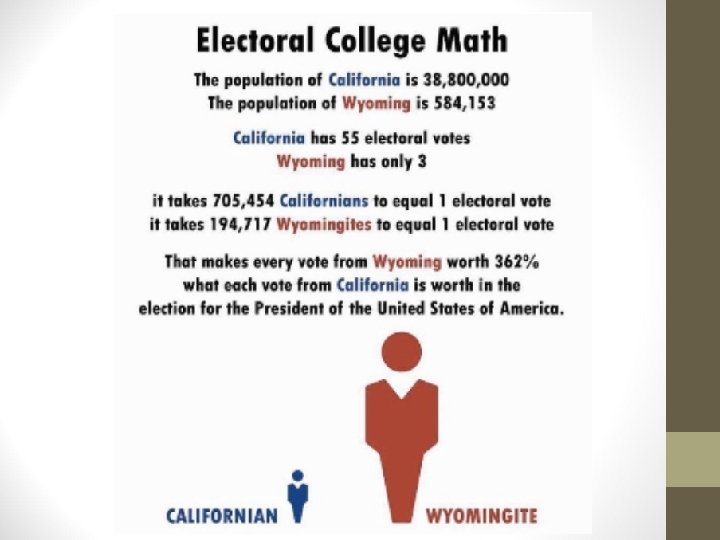
Flaws in the Electoral College In 2016, California's 55 electoral votes went to Hilary Clinton, while Donald Trump got Wyoming's three electoral votes. Why are the figure icons in Wyoming so much larger than those in California?
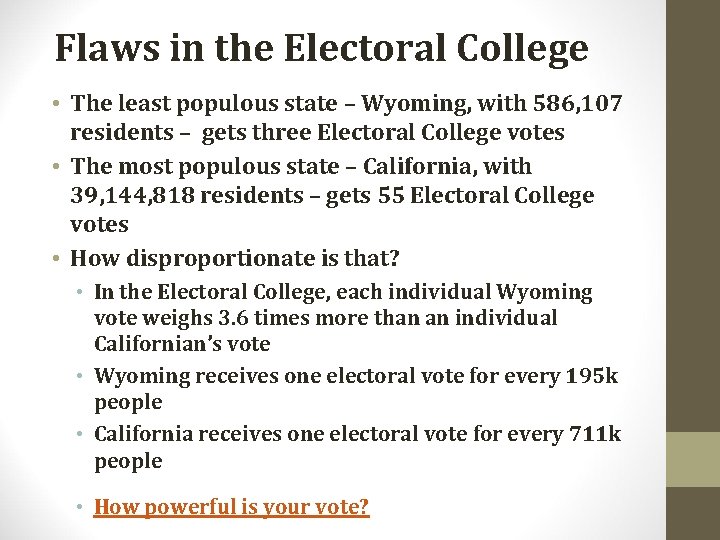
Flaws in the Electoral College • The least populous state – Wyoming, with 586, 107 residents – gets three Electoral College votes • The most populous state – California, with 39, 144, 818 residents – gets 55 Electoral College votes • How disproportionate is that? • In the Electoral College, each individual Wyoming vote weighs 3. 6 times more than an individual Californian’s vote • Wyoming receives one electoral vote for every 195 k people • California receives one electoral vote for every 711 k people • How powerful is your vote?
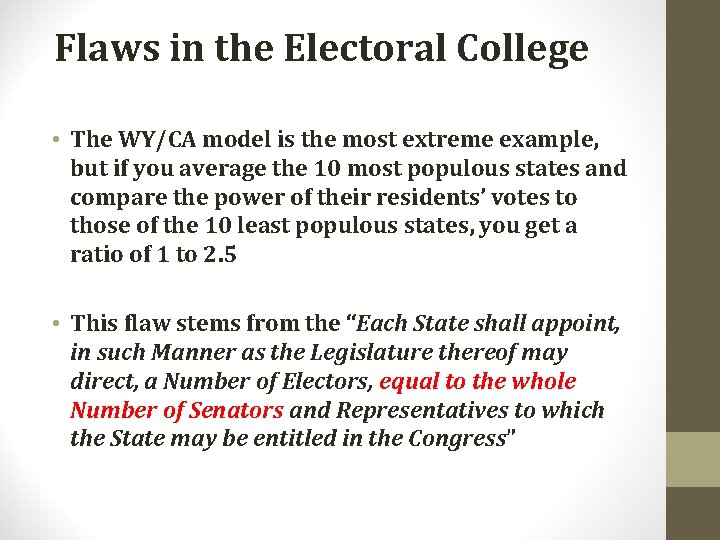
Flaws in the Electoral College • The WY/CA model is the most extreme example, but if you average the 10 most populous states and compare the power of their residents’ votes to those of the 10 least populous states, you get a ratio of 1 to 2. 5 • This flaw stems from the “Each State shall appoint, in such Manner as the Legislature thereof may direct, a Number of Electors, equal to the whole Number of Senators and Representatives to which the State may be entitled in the Congress”
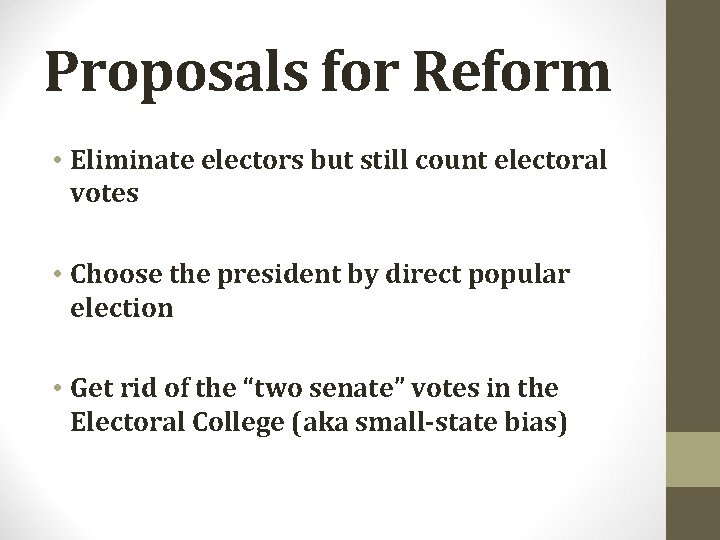
Proposals for Reform • Eliminate electors but still count electoral votes • Choose the president by direct popular election • Get rid of the “two senate” votes in the Electoral College (aka small-state bias)
Review Question How many electors does California have?
Answer California has 55 electors. 53 + 2 = 55.
Review Question Who are electors?
Answer They are individuals selected in each state to officially cast that state’s electoral votes. Electors are typically long-time party activists who are selected by their state party organization as a reward for their loyalty to the party. In most states, electors are officially pledged to support their party’s presidential and vice presidential candidates.
Review Question Does it matter whether a candidate carries a state by a few votes or a lot of votes?
Answer No. A candidate receives all of a state’s electoral votes whether the candidate carries (wins) the state by one vote or a million votes. In every state except Nebraska and Maine, the race is winner take all.
Review Question What is the small state bias?
Answer The Electoral College has a small state bias because every state gets at least three electoral votes regardless of its population. As a result, small states such as Alaska, Wyoming, and South Dakota enjoy a greater percentage of electoral votes than they would merit based strictly on population.