
THE ELECTORAL COLLEGE DEFINITION A group of people
- Slides: 14
THE ELECTORAL COLLEGE
DEFINITION A group of people named by each state legislature to select the President and Vice President
The Electoral College was devised for 3 reasons 1. The framers of the Constitution feared direct democracy. Hamilton and the other founders did not trust the population to make the right choice. “election should be made by men most capable of analyzing the qualities adapted to the station” – James Madison
The Electoral College was devised for 3 reasons 2. The founding fathers wanted to protect the interests of smaller states and rural areas
The Electoral College was devised for 3 reasons 3. The Electoral College helps dilute the effect of votes from densely populated centers which may steer away from the concerns of the rest of the country
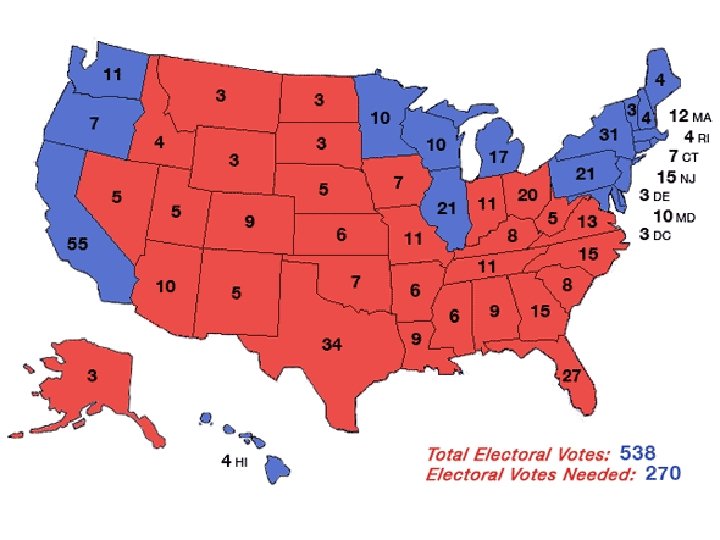
ELECTORS The number of electors for each state is based on # of senators + # of representatives Virginia has 13 Electoral votes, California is worth 55 Electoral votes. All states have a minimum of 3 electoral votes
The party that wins a state elects its entire slate of Electors. This is known as a Winner Take-all System (2 exceptions: Maine & Nebraska)
Candidates must receive a majority of the electoral vote to be declared the President-elect or Vice. President-elect
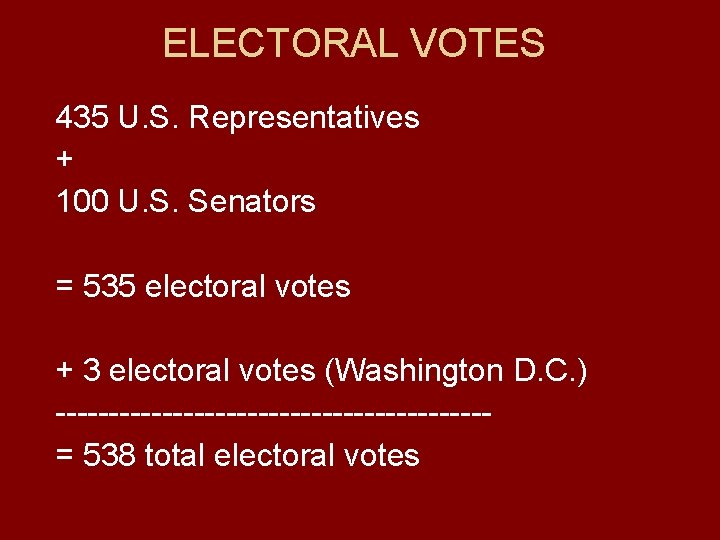
ELECTORAL VOTES 435 U. S. Representatives + 100 U. S. Senators = 535 electoral votes + 3 electoral votes (Washington D. C. ) --------------------= 538 total electoral votes
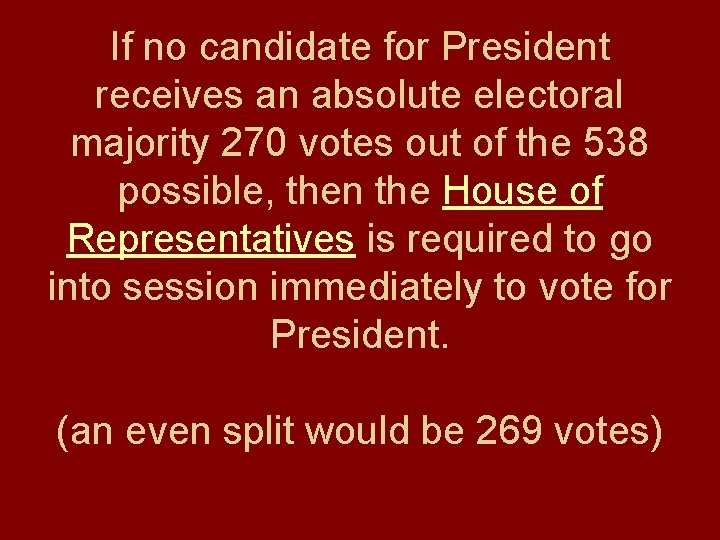
If no candidate for President receives an absolute electoral majority 270 votes out of the 538 possible, then the House of Representatives is required to go into session immediately to vote for President. (an even split would be 269 votes)
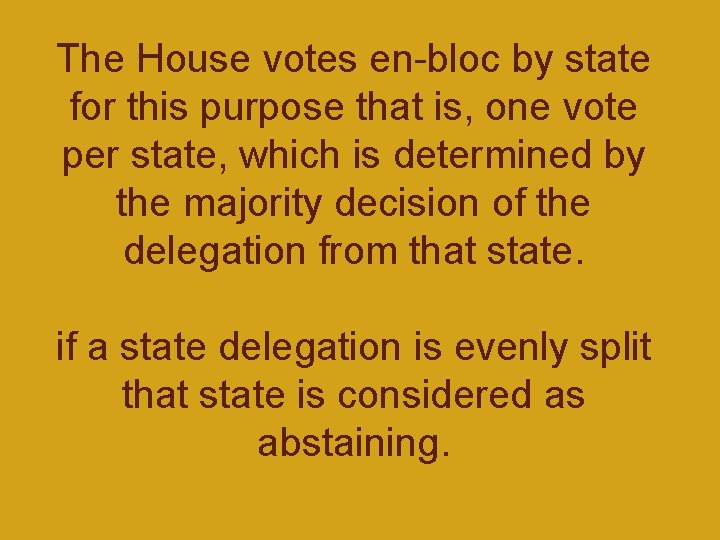
The House votes en-bloc by state for this purpose that is, one vote per state, which is determined by the majority decision of the delegation from that state. if a state delegation is evenly split that state is considered as abstaining.
As of 2015, the House of Representatives has elected the President on two occasions, in 1801 and in 1825.
A faithless elector is one who casts an electoral vote for someone other than whom they have pledged to elect. On 158 occasions, electors have cast their votes for president in a different manner than that prescribed by the legislature of the state they represent.