
The election of 1860 With four candidates running

- Slides: 15
The election of 1860 With four candidates running for president, Abraham Lincoln received only 40% of the popular vote and 180 electoral votes — enough to narrowly win the crowded election. This meant that 60% of the voters selected someone other than Lincoln. With the results tallied, the question was, would the South accept the outcome? A few weeks after the election, South Carolina seceded from the Union.
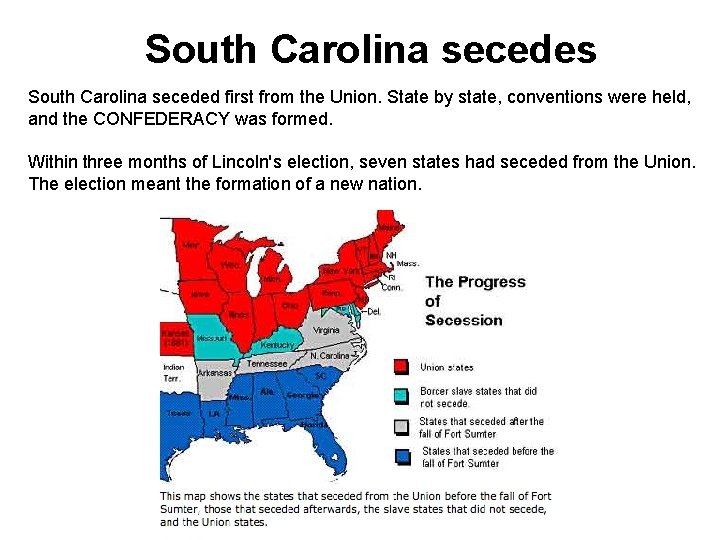
South Carolina secedes South Carolina seceded first from the Union. State by state, conventions were held, and the CONFEDERACY was formed. Within three months of Lincoln's election, seven states had seceded from the Union. The election meant the formation of a new nation.
Attack on Fort Sumter Construction of Fort Sumter was still underway when South Carolina seceded from the Union on December 20, 1860. Despite Charleston’s position as a major port, at the time only two companies of federal troops guarded the harbor. Commanded by Major Robert Anderson (18051871), these companies were stationed at Fort Moultrie, a dilapidated fortification facing the coastline. Recognizing that Fort Moultrie was vulnerable to a land assault, Anderson elected to abandon it for the more easily defensible Fort Sumter on December 26, 1860. South Carolina militia forces would seize the city’s other forts shortly thereafter, leaving Fort Sumter as the lone federal outpost in Charleston.
The First Battle of Bull Run War preparations took some time, so it was not until three months after Fort Sumter that Union and Confederate troops met again at the First Battle of Bull Run in Virginia on July 21, 1861, between Washington, D. C. , and Richmond. Still believing that the war was a trifling matter that would be over quickly, a number of government officials and spectators from both sides came to “observe” the battle, some even packing picnic lunches. By the end of the day, Union forces had lost and were forced to retreat. The loss shocked Northerners out of their complacency and prompted them to prepare more seriously for the struggle ahead. Meanwhile, many Southerners interpreted the victory as an indicator of an early end to the war and as decisive proof that most Northerners didn’t have the will to fight.
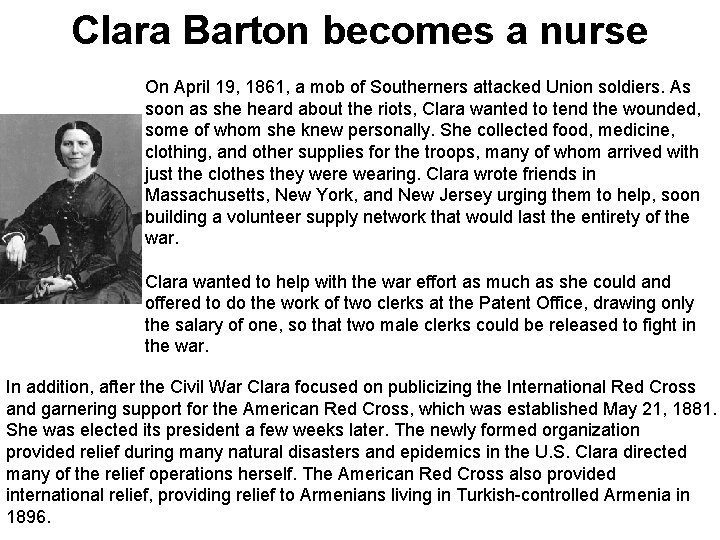
Clara Barton becomes a nurse On April 19, 1861, a mob of Southerners attacked Union soldiers. As soon as she heard about the riots, Clara wanted to tend the wounded, some of whom she knew personally. She collected food, medicine, clothing, and other supplies for the troops, many of whom arrived with just the clothes they were wearing. Clara wrote friends in Massachusetts, New York, and New Jersey urging them to help, soon building a volunteer supply network that would last the entirety of the war. Clara wanted to help with the war effort as much as she could and offered to do the work of two clerks at the Patent Office, drawing only the salary of one, so that two male clerks could be released to fight in the war. In addition, after the Civil War Clara focused on publicizing the International Red Cross and garnering support for the American Red Cross, which was established May 21, 1881. She was elected its president a few weeks later. The newly formed organization provided relief during many natural disasters and epidemics in the U. S. Clara directed many of the relief operations herself. The American Red Cross also provided international relief, providing relief to Armenians living in Turkish-controlled Armenia in 1896.
Antietam Rather than wait around for the enemy to attack him, Lee made an aggressive push into the border states to try to defeat the Union on its own turf. He also hoped that a Confederate victory in Maryland would convince the state legislature to secede. In September 1862, Lee’s army met General George Mc. Clellan’s troops at the Battle of Antietam, which resulted in more than 23, 000 casualties—the bloodiest single day of battle of the entire war. Lee was forced to retreat back to Confederate territory.
The Emancipation Proclamation After the Battle of Antietam in January 1863, Lincoln issued the Emancipation Proclamation freeing all slaves in the Confederacy (not in the border states, for Lincoln did not want to make them angry). Although, reunification, not emancipation, remained Lincoln’s most important goal (he once said, “If I could save the Union without freeing any slave, I would do it; and if I could save it by freeing all the slaves, I would do it; and if I could do it by freeing some and leaving others alone, I would also do that. What I do about slavery and the colored race, I do because I believe it helps to save this Union. ” Despite the priority Lincoln placed on reunification, he knew that a reunified nation would not survive long if slavery still existed. Slavery had been at the root of every major sectional conflict since the 1780 s, and the issue had to be addressed. Even though the Emancipation Proclamation failed to ban slavery in the border states, it did mark the symbolic beginning of the end of slavery every state in the Union.
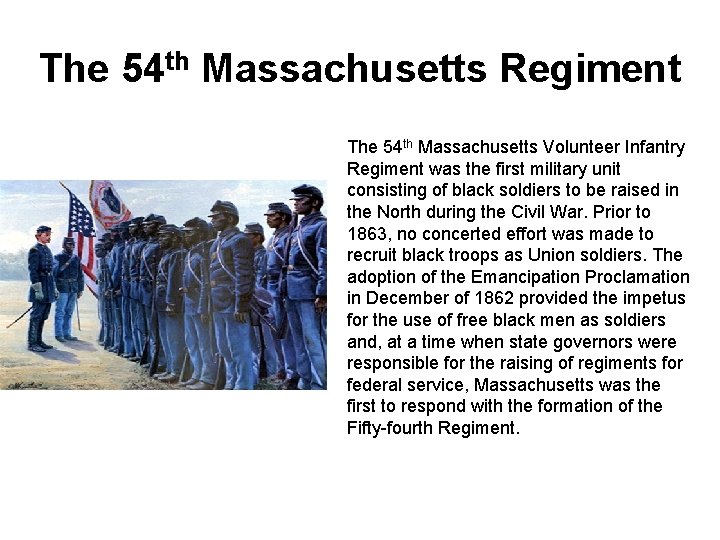
The 54 th Massachusetts Regiment The 54 th Massachusetts Volunteer Infantry Regiment was the first military unit consisting of black soldiers to be raised in the North during the Civil War. Prior to 1863, no concerted effort was made to recruit black troops as Union soldiers. The adoption of the Emancipation Proclamation in December of 1862 provided the impetus for the use of free black men as soldiers and, at a time when state governors were responsible for the raising of regiments for federal service, Massachusetts was the first to respond with the formation of the Fifty-fourth Regiment.
Lincoln calls for a draft During the Civil War, the U. S. Congress passes a conscription act that produces the first wartime draft of U. S. citizens in American history. The act called for registration of all males between the ages of 20 and 45, including aliens with the intention of becoming citizens, by April 1. Exemptions from the draft could be bought for $300 or by finding a substitute draftee. This clause led to bloody draft riots in New York City, where protesters were outraged that exemptions were effectively granted only to the wealthiest U. S. citizens.
NYC Draft Riots In 1863, in the midst of the American Civil War, Congress passed a conscription law making all men between 20 and 45 years of age liable for military service. On July 13, the government’s attempt to enforce the draft in New York City ignited the most destructive civil disturbance in the city’s history. Rioters torched government buildings and, on July 15, fought pitched battles with troops. Conservative contemporary commentators, concerned about an anti-Union plot, claimed that 1, 155 people were killed. In fact, about 300, over half of them policemen and soldiers, were injured, and there were no more than 119 fatalities, most of them rioters. A majority of the rioters were Irish, living in pestilential misery. The spark that ignited their grievances and those of other workingmen and women was the provision in the law that conscription could be avoided by payment of three hundred dollars, an enormous sum only the rich could afford. In a context of wartime inflation, black competition for jobs, and race prejudice among working people, particularly the Irish, New York’s blacks were chosen as scapegoats for long-accumulated grievances. Many innocent blacks were slain and their homes sacked. A Colored Orphan Asylum was razed. In this intersection of ethnic diversity, class antagonism, and racism lay the origins of the draft riots.
Gettysburg The Battle of Gettysburg, Pennsylvania (July 1–July 3, 1863), was the largest battle of the American Civil War as well as the largest battle ever fought in North America, involving around 85, 000 men in the Union’s Army of the Potomac under Major General George Gordon Meade and approximately 75, 000 in the Confederacy’s Army of Northern Virginia, commanded by General Robert Edward Lee. Casualties at Gettysburg totaled 23, 049 for the Union (3, 155 dead, 14, 529 wounded, 5, 365 missing). Confederate casualties were 28, 063 (3, 903 dead, 18, 735 injured, and 5, 425 missing), more than a third of Lee’s army. These largely irreplaceable losses to the South’s largest army, combined with the Confederate surrender of Vicksburg, Mississippi, on July 4, marked what is widely regarded as a turning point—perhaps the turning point—in the Civil War, although the conflict would continue for nearly two more years and witness several more major battles, including Chickamauga, Spotsylvania Courthouse, Mononacy, Nashville, etc.
Vicksburg The Battle of Vicksburg, Mississippi, also called the Siege of Vicksburg, was the culmination of a long land naval campaign by Union forces to capture a key strategic position during the American Civil War. President Abraham Lincoln recognized the significance of the town situated on a 200 -foot bluff above the Mississippi River. He said, "Vicksburg is the key, the war can never be brought to a close until that key is in our pocket. " Capturing Vicksburg would sever the Trans-Mississippi Confederacy from that east of the Mississippi River and open the river to Northern traffic along its entire length. On July 4, Vicksburg surrendered after prolonged siege operations. This was the culmination of one of the most brilliant military campaigns of the war.
Battle Of Atlanta The Battle of Atlanta was fought on July 22, 1864, just southeast of Atlanta, Georgia. Union forces commanded by William T. Sherman, wanting to neutralize the important rail and supply hub, defeated Confederate forces defending the city under John B. Hood. After ordering the evacuation of the city, Sherman burned most of the buildings in the city, military or not. After taking the city, Sherman headed south toward Savannah, beginning his Sherman’s March To The Sea. After leaving the decimated city of Atlanta on November 16, Sherman led his troops on a destructive campaign which concluded with the capture of the port city of Savannah on December 21. It is known for its boldness as well as the sheer destruction inflicted on the south, both to its industry as well as military targets, effectively destroying the Confederate’s capacity to wage war.
Lincoln reelected President On November 4, 1864, Northern voters overwhelmingly endorse the leadership and policies of President Abraham Lincoln when they elect him to a second term. With his re-election, any hope for a negotiated settlement with the Confederacy vanished. Before this, no country had ever held elections during a military emergency. Lincoln himself said, “We can not have free government without elections; and if the rebellion could force us to forego, or postpone a national election, it might fairly claim to have already conquered and ruined us. ” Five months after Lincoln’s reelection, the collapse of the Confederacy was complete.
Lee Surrenders At Appomattox, Virginia, Confederate General Robert E. Lee surrenders his 28, 000 troops to Union General Ulysses S. Grant, effectively ending the American Civil War. Forced to abandon the Confederate capital of Richmond, Virginia, and harassed constantly by Union soldiers, Lee had no other option. General Grant told his officers, “The war is over. The Rebels are our countrymen again. ” Although scattered resistance continued for several weeks, for all practical purposes the Civil War had come to an end.