
The Election of 1800 Jeffersonian Republic Thomas Jefferson
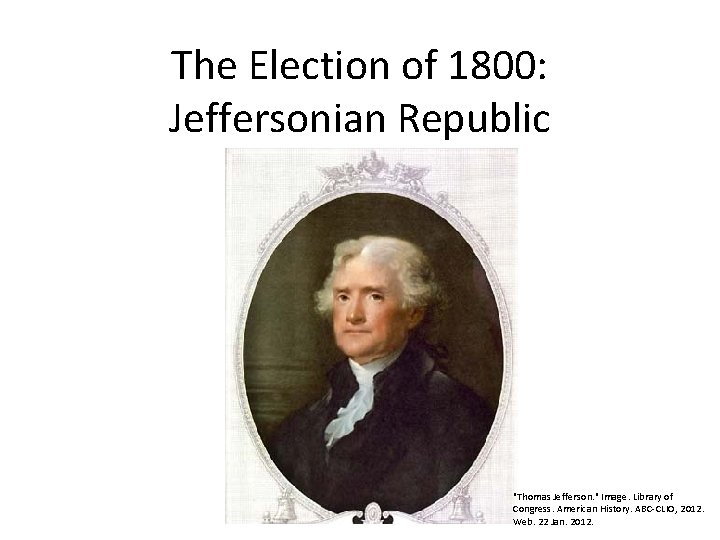
The Election of 1800: Jeffersonian Republic "Thomas Jefferson. " Image. Library of Congress. American History. ABC-CLIO, 2012. Web. 22 Jan. 2012.
Objectives: • Identify the changes Jefferson made to the federal government to impose his Democratic. Republican beliefs on the nation. • Explain the impact of John Marshall’s tenure as Chief Justice of the US • Identify the importance of the Louisiana Purchase.
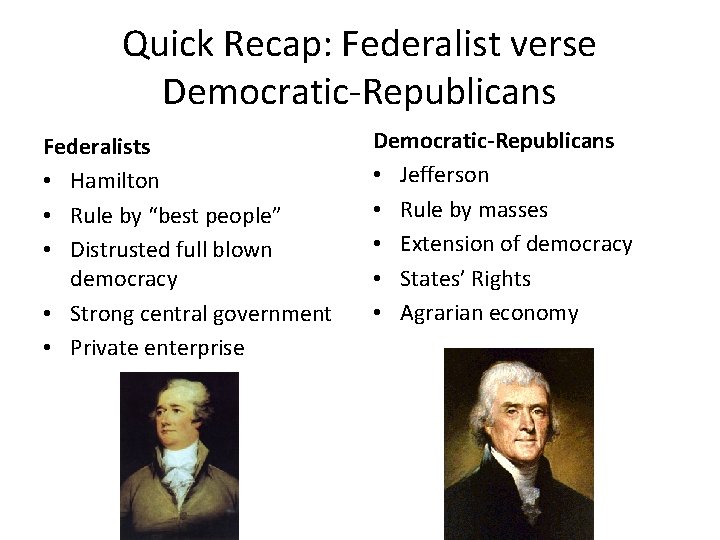
Quick Recap: Federalist verse Democratic-Republicans Federalists • Hamilton • Rule by “best people” • Distrusted full blown democracy • Strong central government • Private enterprise Democratic-Republicans • Jefferson • Rule by masses • Extension of democracy • States’ Rights • Agrarian economy
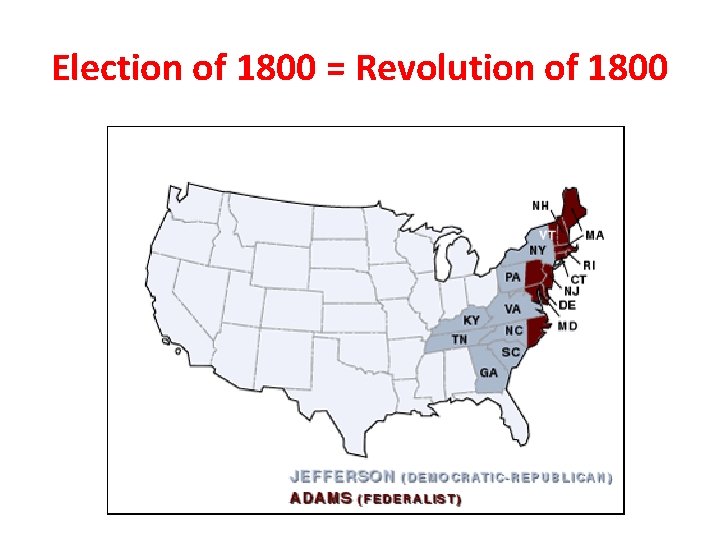
Election of 1800 = Revolution of 1800
Election of 1800: • Adams was defeated by two Democratic. Republican candidates, Thomas Jefferson and Aaron Burr • Jefferson and Burr had same amount of electoral votes • The election went to the House of Representatives and Jefferson won. Hamilton supports Jefferson. • Establishes the 12 th Amendment (1804)
Revolution of 1800 • Republican party in power – Cut taxes – Streamlined federal bureaucracy – Common man should run government – Laissez faire (government stays out of economy) – Reduced size of government, military, and debt
Jefferson’s Actions toward Federalist Policies • Eliminated all internal taxes (including Whiskey tax). • Abandoned Alien & Sedition Acts • Worked toward reducing national debt. • Slashed military spending. • Repealed Judiciary Act of 1801. • National Bank – ironically didn’t touch – Why? – Jefferson realized that national bank was essential for the financial stability of the country!
Judiciary Acts of 1789 & 1801 • Judiciary Act of 1789 – created a Supreme Court with 5 justices + 1 chief Justice (also created lower federal courts). • Judiciary Act of 1801 – passed by Federalists right before Adams left office to enable Adams to pack the courts with more Federalist judges. – “Midnight Judges”
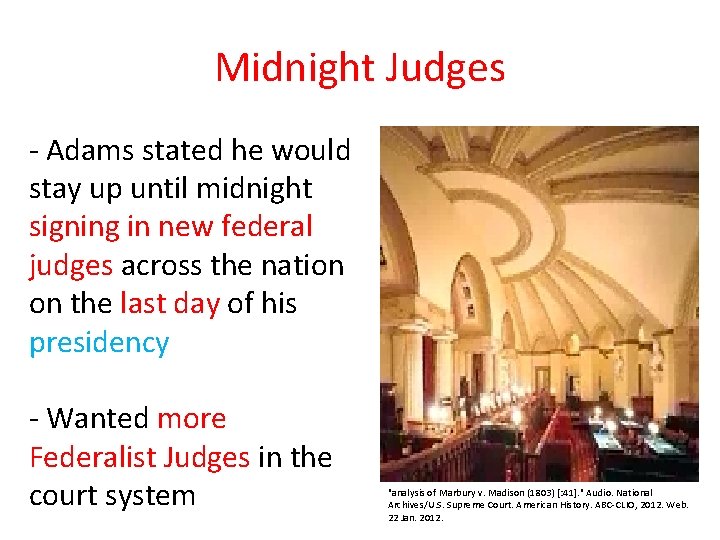
Midnight Judges - Adams stated he would stay up until midnight signing in new federal judges across the nation on the last day of his presidency - Wanted more Federalist Judges in the court system "analysis of Marbury v. Madison (1803) [: 41]. " Audio. National Archives/U. S. Supreme Court. American History. ABC-CLIO, 2012. Web. 22 Jan. 2012.
John Marshall: Chief Justice and Judicial Review – Established the Supreme Court as an independent and influential force in the federal government. • Marbury v. Madison – Judicial Review • Mc. Culloch v. Maryland – National bank branch – Congressional power • Gibbens v. Ogden – Interstate commerce – Congressional power
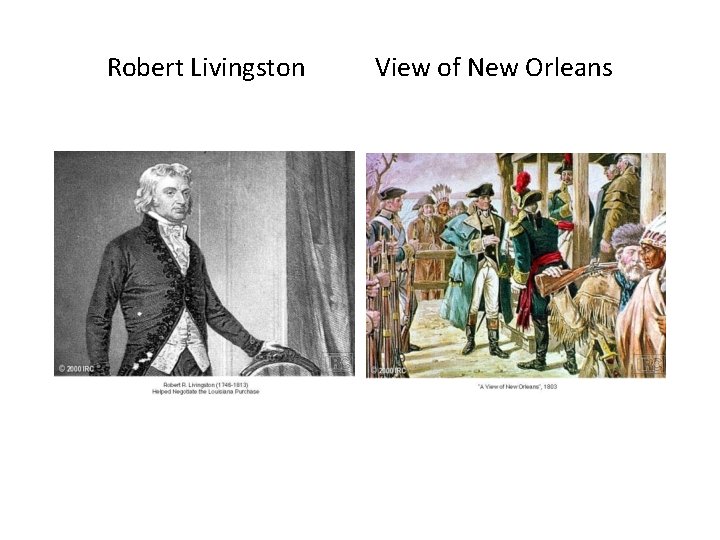
Robert Livingston View of New Orleans
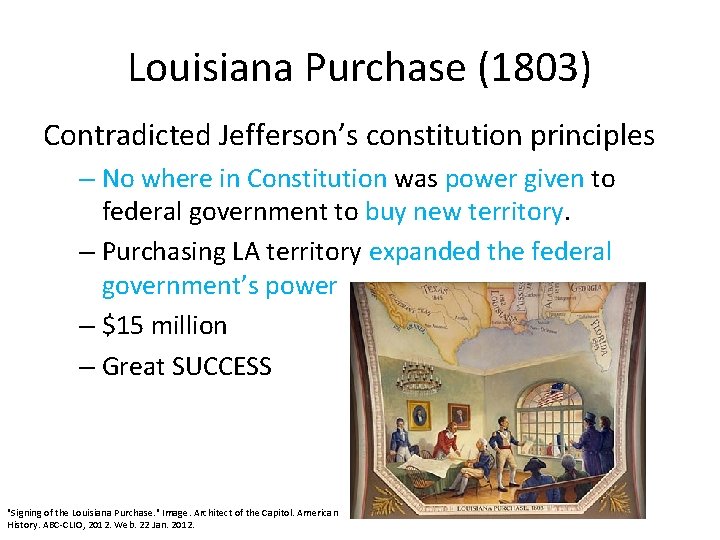
Louisiana Purchase (1803) Contradicted Jefferson’s constitution principles – No where in Constitution was power given to federal government to buy new territory. – Purchasing LA territory expanded the federal government’s power – $15 million – Great SUCCESS "Signing of the Louisiana Purchase. " Image. Architect of the Capitol. American History. ABC-CLIO, 2012. Web. 22 Jan. 2012.
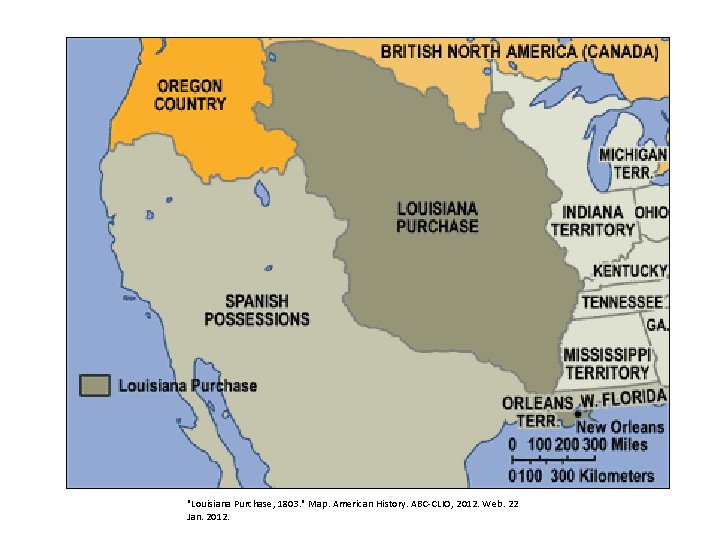
"Louisiana Purchase, 1803. " Map. American History. ABC-CLIO, 2012. Web. 22 Jan. 2012.
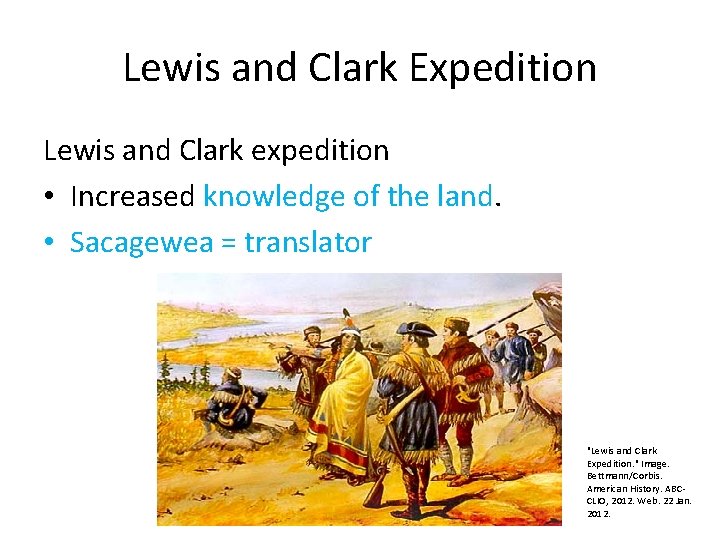
Lewis and Clark Expedition Lewis and Clark expedition • Increased knowledge of the land. • Sacagewea = translator "Lewis and Clark Expedition. " Image. Bettmann/Corbis. American History. ABCCLIO, 2012. Web. 22 Jan. 2012.
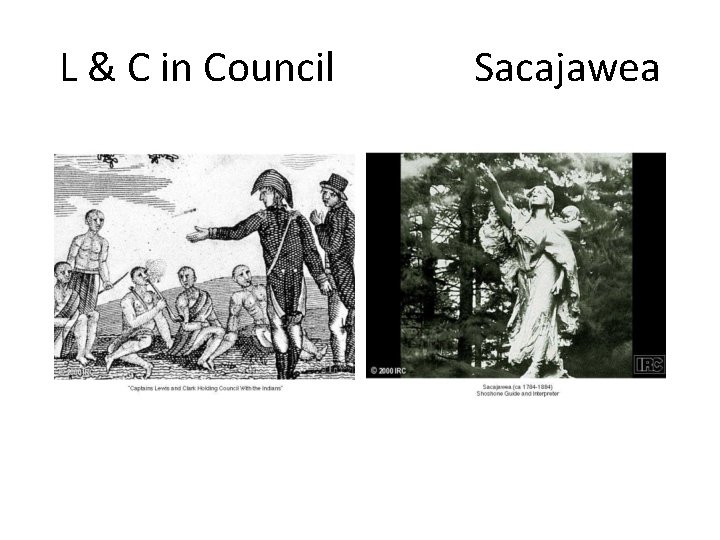
L & C in Council Sacajawea
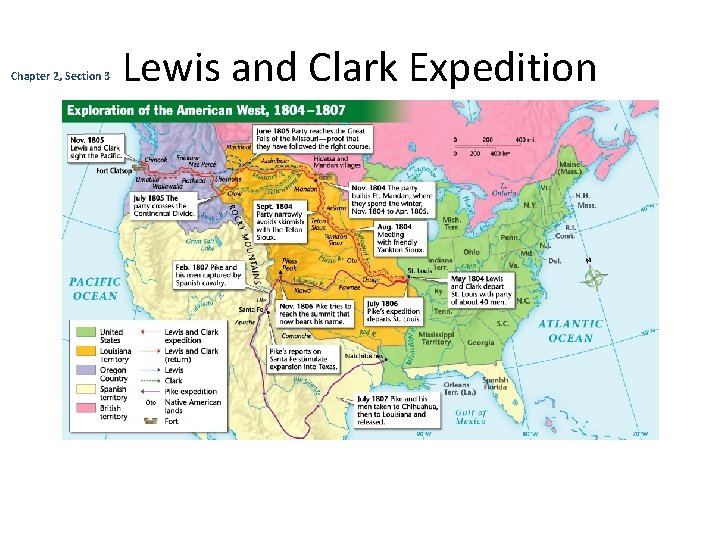
Chapter 2, Section 3 Lewis and Clark Expedition
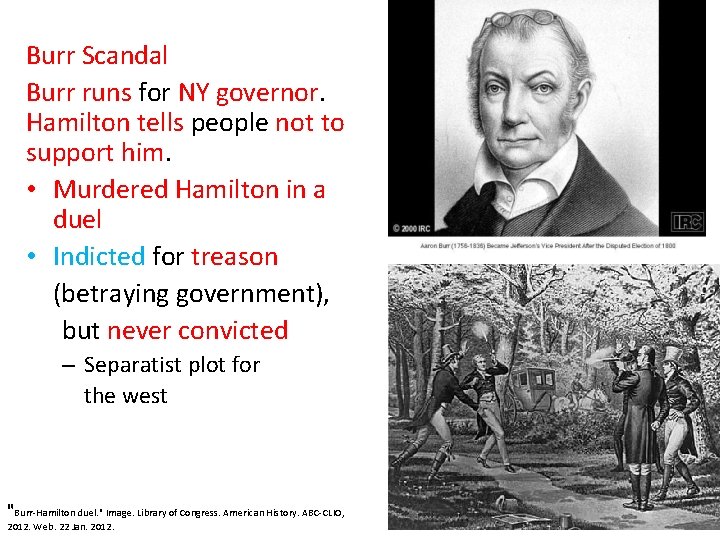
Burr Scandal Burr runs for NY governor. Hamilton tells people not to support him. • Murdered Hamilton in a duel • Indicted for treason (betraying government), but never convicted – Separatist plot for the west "Burr-Hamilton duel. " Image. Library of Congress. American History. ABC-CLIO, 2012. Web. 22 Jan. 2012.
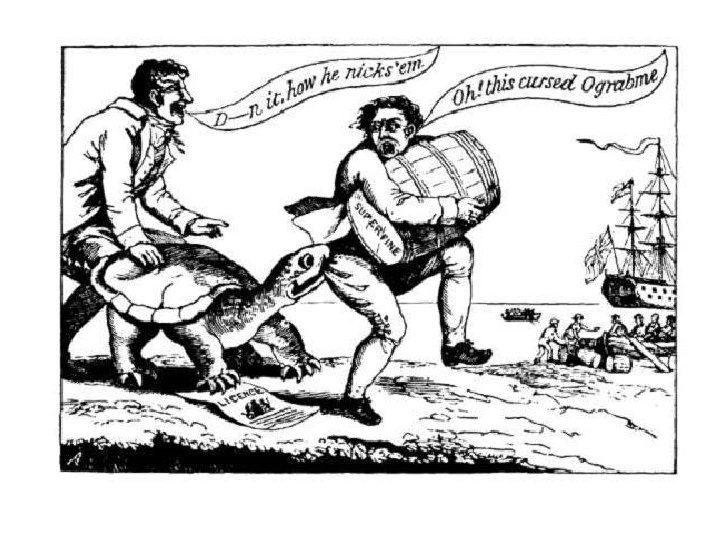
Foreign Policy • Barbary War (1801 -1805) • Jefferson refused to continue the policy of paying for protection against the Barbary pirates (region in N. Africa) • Jefferson sent warships to Mediterranean • Jefferson spent much more on defense than it would have cost him to pay tribute • Impressment – Seizing of ships and sailors • Embargo Act of 1807 – Not allowing trade to prevent impressment
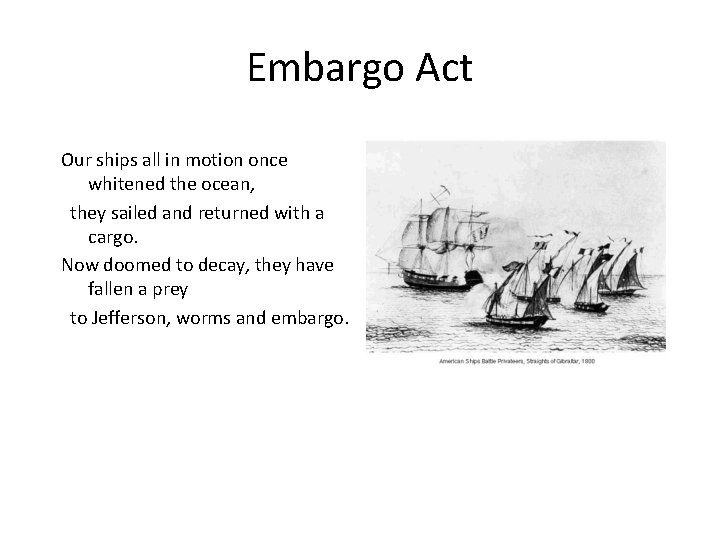
Embargo Act Our ships all in motion once whitened the ocean, they sailed and returned with a cargo. Now doomed to decay, they have fallen a prey to Jefferson, worms and embargo.
Jeffersonian Democracy • He proved that a democrat could maintain a stable administration. By accepting Federalist ideas on public finance, he contributed to prosperity among all classes.
Louisiana Purchase Timeline 1763: • France gave Louisiana to Spain. March 1801: • Napoleon wanted a French empire in North America. So, under pressure, Spain returned Louisiana to France. • Federalists in the United States were alarmed that France now owned Louisiana. They wanted to use force against France. But Jefferson (a Democratic-Republican) sent Robert R. Livingston, the U. S. minister to France to attempt to buy New Orleans. January 1803: • U. S. sent James Monroe to join Livingston and try to buy New Orleans and West Florida from France. April 1803: • Napoleon gave up his dream of an American empire because he was overwhelmed by the slave revolt in Haiti and also wanted to go to war with Britain. • The French offered Livingston and Monroe all of Louisiana (not just New Orleans). Livingston and Monroe signed a treaty. For roughly $15 million, the U. S. acquired some 828, 000 square miles of land, doubling the national territory of the United States. October 1803: • The Senate ratified the treaty and in December the United States acquired the Louisiana Purchase. How do you think Americans feel about this purchase?
Louisiana Purchase Timeline 1763: • France gave Louisiana to Spain. March 1801: • Napoleon wanted a French empire in North America. So, under pressure, Spain returned Louisiana to France. • Federalists in the United States were alarmed that France now owned Louisiana. They wanted to use force against France. But Jefferson (a Democratic-Republican) sent Robert R. Livingston, the U. S. minister to France to attempt to buy New Orleans. January 1803: • U. S. sent James Monroe to join Livingston and try to buy New Orleans and West Florida from France. April 1803: • Napoleon gave up his dream of an American empire because he was overwhelmed by the slave revolt in Haiti and also wanted to go to war with Britain. • The French offered Livingston and Monroe all of Louisiana (not just New Orleans). Livingston and Monroe signed a treaty. For roughly $15 million, the U. S. acquired some 828, 000 square miles of land, doubling the national territory of the United States. October 1803: • The Senate ratified the treaty and in December the United States acquired the Louisiana Purchase. How do you think Americans feel about this purchase?

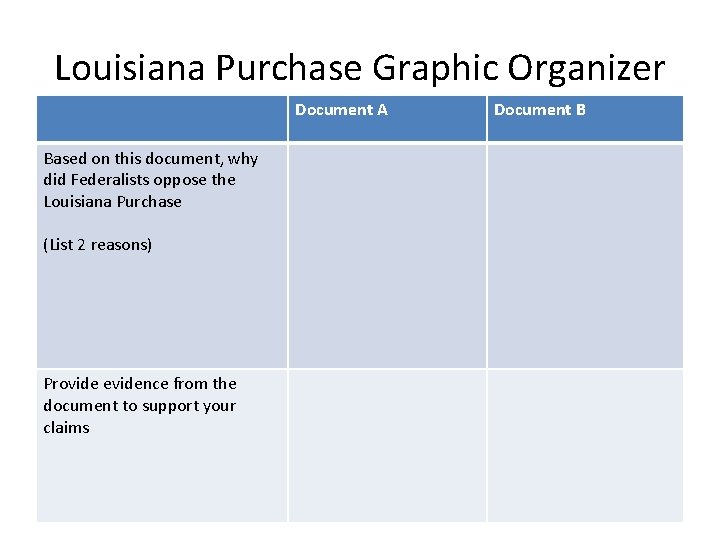
Louisiana Purchase Graphic Organizer Document A Based on this document, why did Federalists oppose the Louisiana Purchase (List 2 reasons) Provide evidence from the document to support your claims Document B
Did Federalists oppose the Louisiana Purchase for practical or political reasons? (In other words, did the Federalists have real concerns, or did they just hate Jefferson? )
- Slides: 27