
The ELD Assessment Portfolio Los Angeles Unified School

- Slides: 33
The ELD Assessment Portfolio Los Angeles Unified School District 6 Instructional Services English Learner Program
Today’s Objectives Establish a common understanding of District policy regarding ELD portfolios n Effectively use ELD Portfolios in conjunction with the Open Court Reading Program for monitoring and updating a student’s ELD level n
Documenting Ongoing ELD Progress Using the Elementary ELD Assessment Portfolio Information from REF-835
What is District Policy on English Language Development? “All elementary teachers with one or more English learners, regardless of program, including those receiving special education services, are to provide a minimum of 20 -30 minutes (Kindergarten) or 30 -45 minutes (Grades 1 -6) of daily ELD standardsbased instruction during the ELD instructional block. ” (Ref-835)
Why do we use the ELD portfolio? n “In order to meet federal and state requirements, teachers must document the ongoing progress of their English learners in the ELD standards. The District’s ELD Assessment Portfolio is a state-approved tool for that purpose and must be made available for examination during district and state compliance reviews. ” (REF-835)
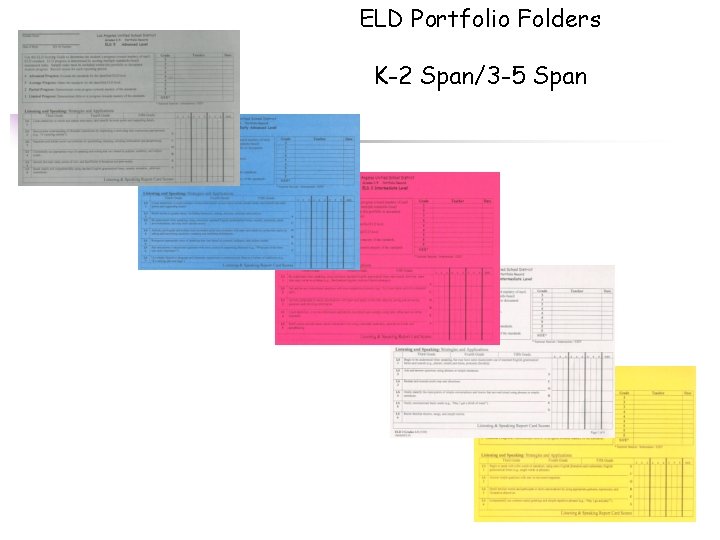
ELD Portfolio Folders K-2 Span/3 -5 Span
II-G n Should all student work be placed in the ELD portfolio? No. The teacher should select assessment/work samples that most accurately represent the student’s current level of performance in listening-speaking, reading and writing. As English learners make progress, work samples that no longer characterize the student’s best work should be replaced with more representative samples. By the time an ELD portfolio is complete, it should contain at least one sample for each domain: listeningspeaking, reading and writing.
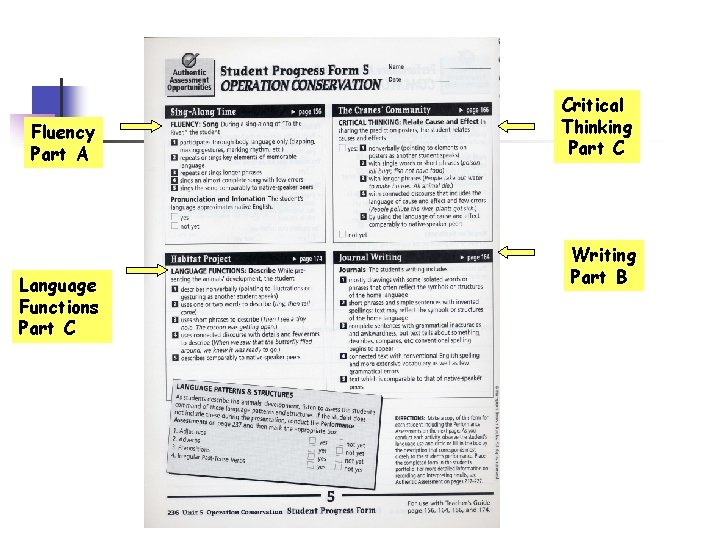
II-I What ELD assessments are required to be included in the ELD portfolio? The following assessments are required: 1. Publisher ELD Assessments End-Of-Unit Assessments from the following state-adopted ELD programs: n Into English! by Hampton Brown
Fluency Part A Language Functions Part C Critical Thinking Part C Writing Part B
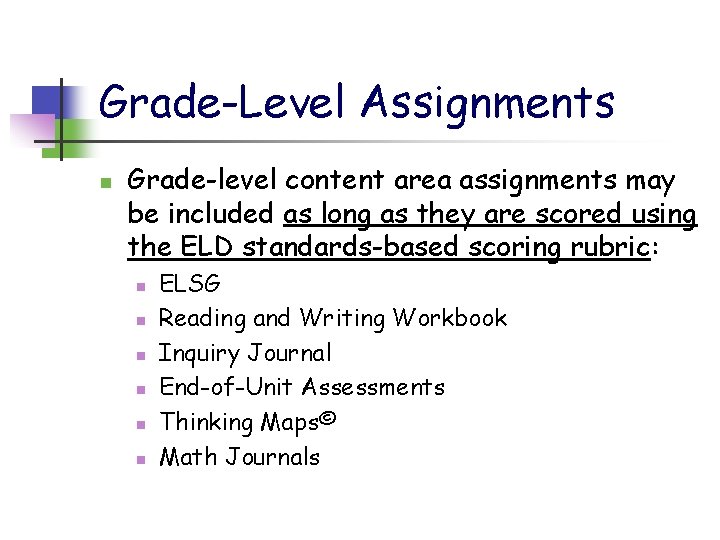
In addition, teachers/grade-level teams may select ELD assessments from the following: 6. Grade-Level Assignments Core content areas assignments may be included as long as they were scored using an ELD standards-based scoring rubric.
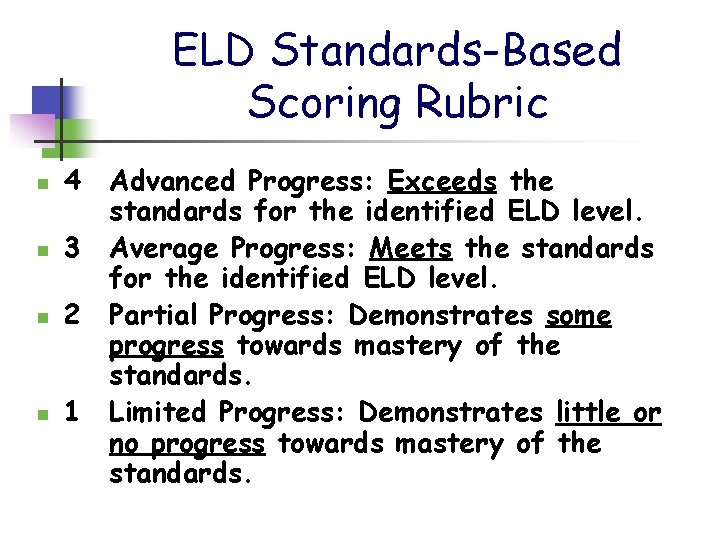
ELD Standards-Based Scoring Rubric n n 4 Advanced Progress: Exceeds the standards for the identified ELD level. 3 Average Progress: Meets the standards for the identified ELD level. 2 Partial Progress: Demonstrates some progress towards mastery of the standards. 1 Limited Progress: Demonstrates little or no progress towards mastery of the standards.
Table Talk – 5 Minutes How do teachers currently connect ELD portfolios to their Language Arts block?
District Benchmarks Moving one level per year is a minimum expectation.
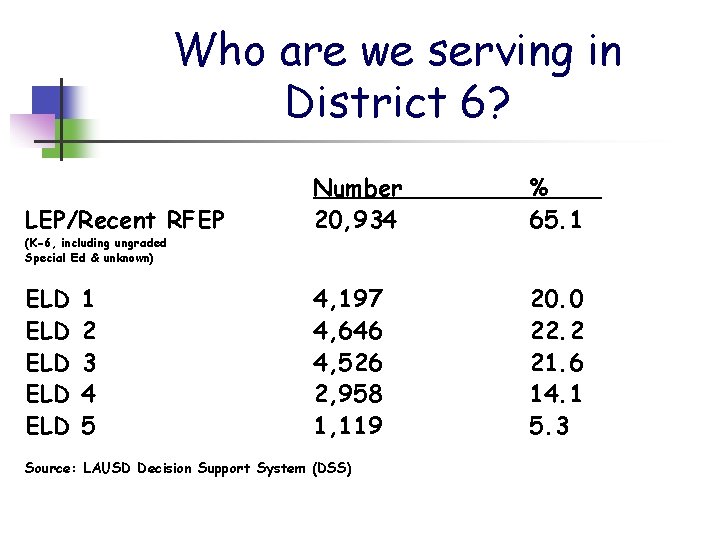
Who are we serving in District 6? LEP/Recent RFEP Number 20, 934 % 65. 1 ELD ELD ELD 4, 197 4, 646 4, 526 2, 958 1, 119 20. 0 22. 2 21. 6 14. 1 5. 3 (K-6, including ungraded Special Ed & unknown) 1 2 3 4 5 Source: LAUSD Decision Support System (DSS)
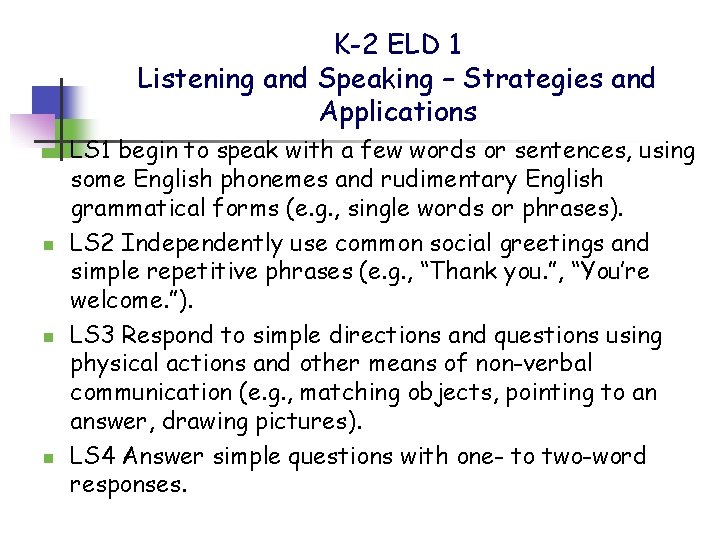
K-2 ELD 1 Listening and Speaking – Strategies and Applications n n LS 1 begin to speak with a few words or sentences, using some English phonemes and rudimentary English grammatical forms (e. g. , single words or phrases). LS 2 Independently use common social greetings and simple repetitive phrases (e. g. , “Thank you. ”, “You’re welcome. ”). LS 3 Respond to simple directions and questions using physical actions and other means of non-verbal communication (e. g. , matching objects, pointing to an answer, drawing pictures). LS 4 Answer simple questions with one- to two-word responses.
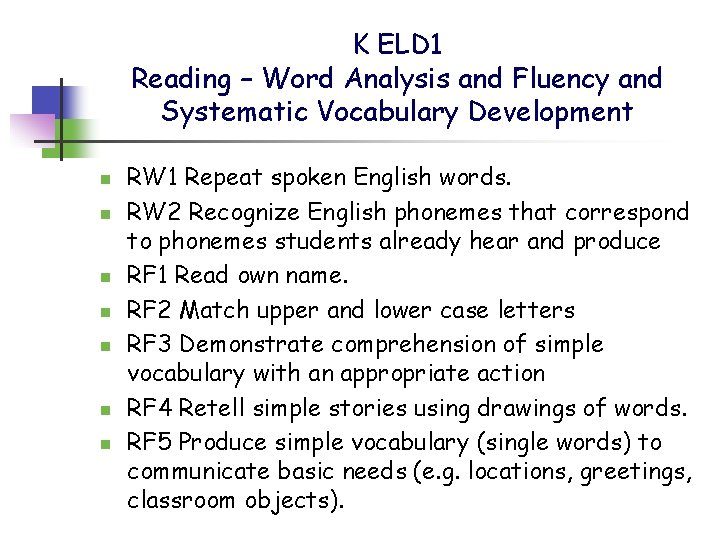
K ELD 1 Reading – Word Analysis and Fluency and Systematic Vocabulary Development n n n n RW 1 Repeat spoken English words. RW 2 Recognize English phonemes that correspond to phonemes students already hear and produce RF 1 Read own name. RF 2 Match upper and lower case letters RF 3 Demonstrate comprehension of simple vocabulary with an appropriate action RF 4 Retell simple stories using drawings of words. RF 5 Produce simple vocabulary (single words) to communicate basic needs (e. g. locations, greetings, classroom objects).
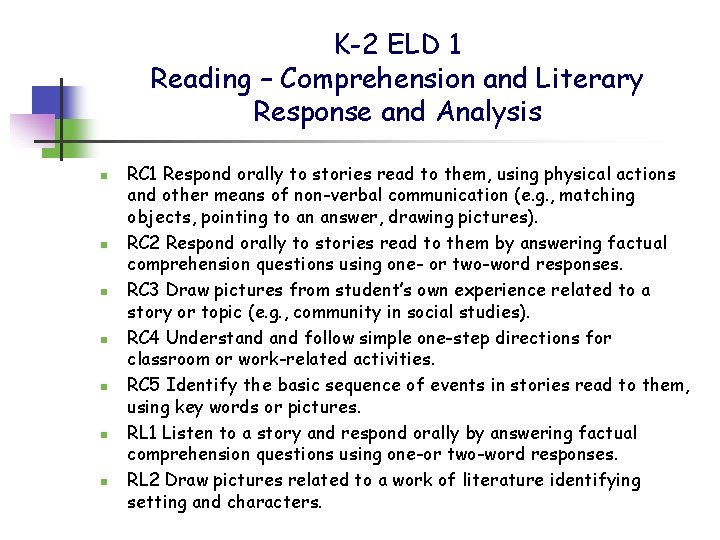
K-2 ELD 1 Reading – Comprehension and Literary Response and Analysis n n n n RC 1 Respond orally to stories read to them, using physical actions and other means of non-verbal communication (e. g. , matching objects, pointing to an answer, drawing pictures). RC 2 Respond orally to stories read to them by answering factual comprehension questions using one- or two-word responses. RC 3 Draw pictures from student’s own experience related to a story or topic (e. g. , community in social studies). RC 4 Understand follow simple one-step directions for classroom or work-related activities. RC 5 Identify the basic sequence of events in stories read to them, using key words or pictures. RL 1 Listen to a story and respond orally by answering factual comprehension questions using one-or two-word responses. RL 2 Draw pictures related to a work of literature identifying setting and characters.
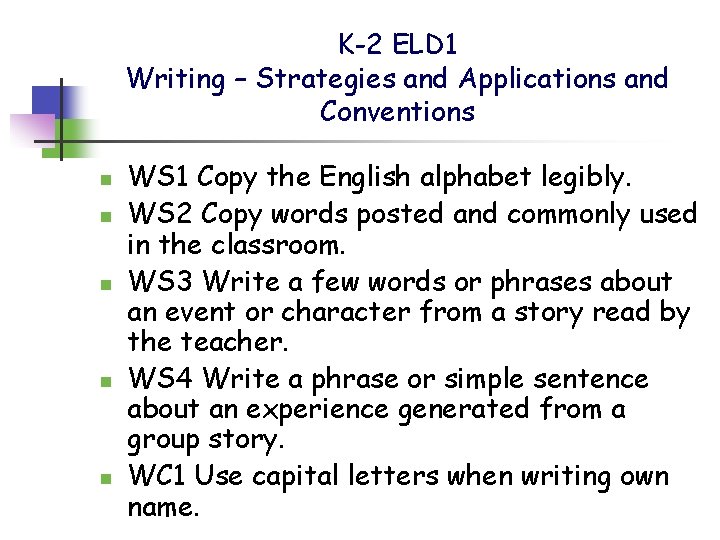
K-2 ELD 1 Writing – Strategies and Applications and Conventions n n n WS 1 Copy the English alphabet legibly. WS 2 Copy words posted and commonly used in the classroom. WS 3 Write a few words or phrases about an event or character from a story read by the teacher. WS 4 Write a phrase or simple sentence about an experience generated from a group story. WC 1 Use capital letters when writing own name.
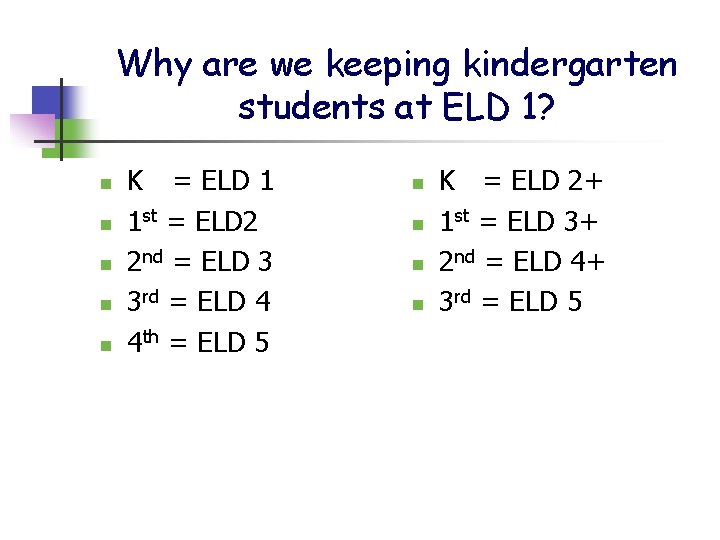
Why are we keeping kindergarten students at ELD 1? n n n K = ELD 1 1 st = ELD 2 2 nd = ELD 3 3 rd = ELD 4 4 th = ELD 5 n n K = ELD 2+ 1 st = ELD 3+ 2 nd = ELD 4+ 3 rd = ELD 5
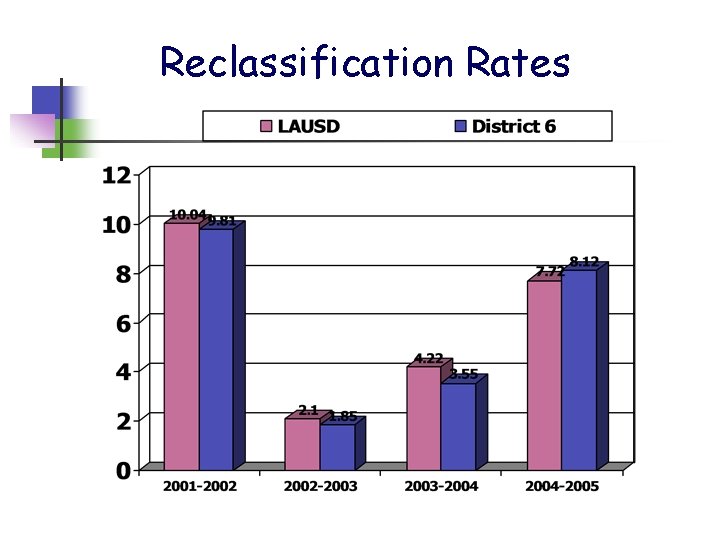
What is our primary goal for English Learners? All English Learners will Reclassify as Fluent English Proficient
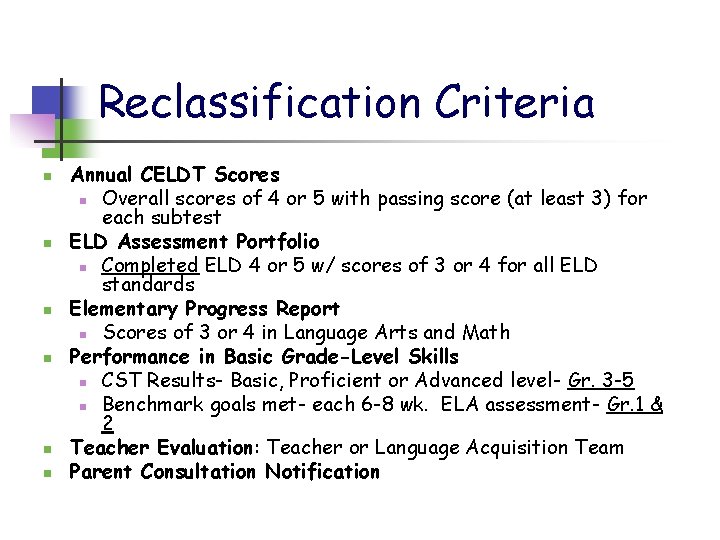
Reclassification Criteria n n n Annual CELDT Scores n Overall scores of 4 or 5 with passing score (at least 3) for each subtest ELD Assessment Portfolio n Completed ELD 4 or 5 w/ scores of 3 or 4 for all ELD standards Elementary Progress Report n Scores of 3 or 4 in Language Arts and Math Performance in Basic Grade-Level Skills n CST Results- Basic, Proficient or Advanced level- Gr. 3 -5 n Benchmark goals met- each 6 -8 wk. ELA assessment- Gr. 1 & 2 Teacher Evaluation: Teacher or Language Acquisition Team Parent Consultation Notification
Reclassification Rates
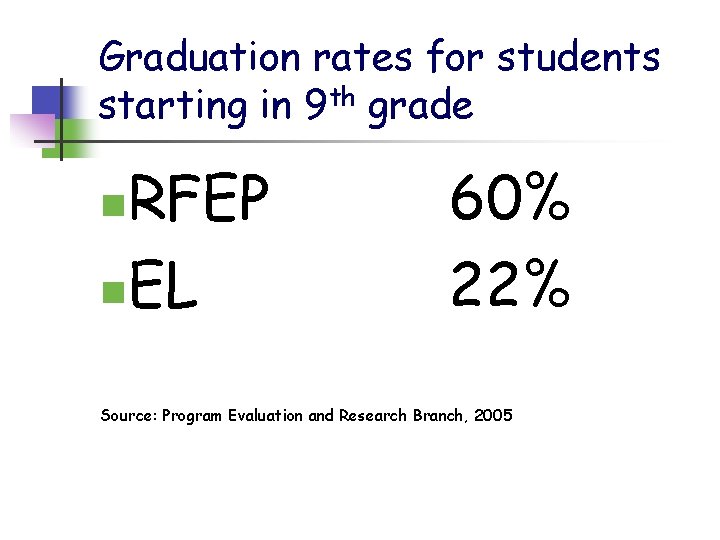
Graduation rates for students starting in 9 th grade RFEP n. EL n 60% 22% Source: Program Evaluation and Research Branch, 2005
Table Talk – 5 Minutes n Based on your school’s DSS report, what could you do to address the needs of those students currently at ELD level 1?
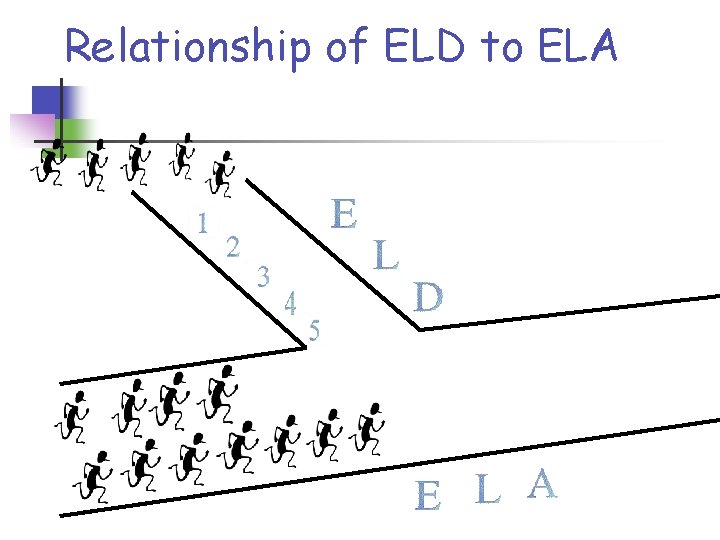
Relationship of ELD to ELA
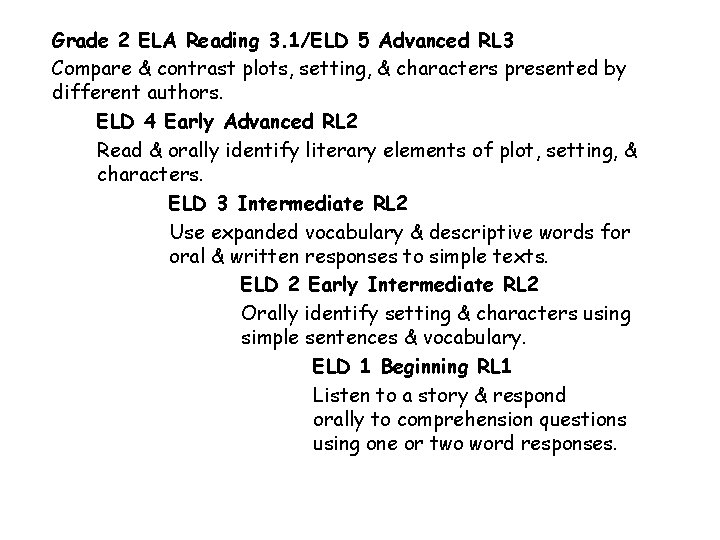
Grade 2 ELA Reading 3. 1/ELD 5 Advanced RL 3 Compare & contrast plots, setting, & characters presented by different authors. ELD 4 Early Advanced RL 2 Read & orally identify literary elements of plot, setting, & characters. ELD 3 Intermediate RL 2 Use expanded vocabulary & descriptive words for oral & written responses to simple texts. ELD 2 Early Intermediate RL 2 Orally identify setting & characters using simple sentences & vocabulary. ELD 1 Beginning RL 1 Listen to a story & respond orally to comprehension questions using one or two word responses.
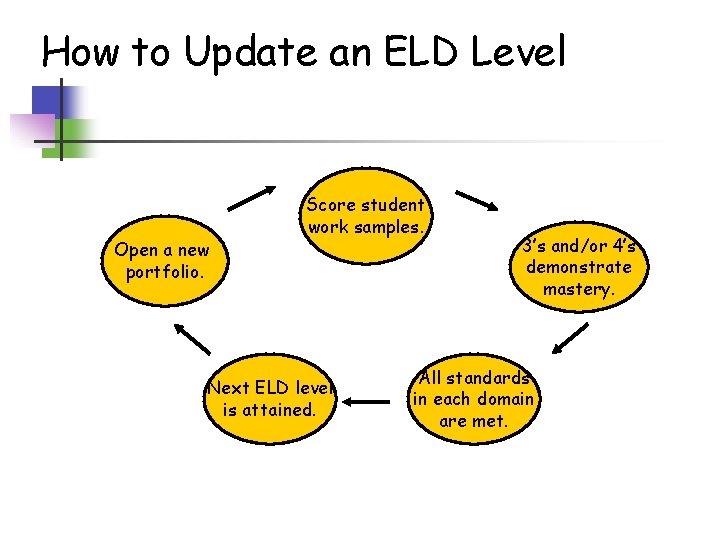
How to Update an ELD Level Open a new portfolio. Score student work samples. Next ELD level is attained. 3’s and/or 4’s demonstrate mastery. All standards in each domain are met.
Grade-Level Assignments n Grade-level content area assignments may be included as long as they are scored using the ELD standards-based scoring rubric: n n n ELSG Reading and Writing Workbook Inquiry Journal End-of-Unit Assessments Thinking Maps© Math Journals
Table Talk -30 Minutes n n Read Irene & Miguel’ s writing pieces and score them according to the descriptors in their respective portfolios. Record their scores on your copy of the portfolios. If you have time after scoring the writing pieces, start looking and the Listening & Speaking and Reading domains and discuss the OCR components that address those descriptors.
Scoring Using the ELD Report Card Scoring Guide n What scores would Irene and Miguel receive for ELD writing for their report cards?
Logistics – Coaches & Coordinators n n n Confer to discuss ELA/ELD overlap in assessments and unit implementation Provide opportunities for grade-level collaboration to assess student work; for example, have teachers bring portfolios to collaborative scoring sessions and score one level Bring portfolios to unit planning meetings and incorporate portfolio assessment opportunities into upcoming OCR unit
ELD + ELA = Academic Success “The potential for learning is not finite or bounded. [English learners] should not be expected to ‘prove themselves linguistically before they can claim their full entitlement. ’ The responsibility for their second language development belongs to the school and ultimately to their teachers. ” - Pauline Gibbons Scaffolding Language, Scaffolding Learning (pg. 138)
Thank You for Your Participation! Need more assistance? Call the District 6 EL Staff: Vicente Lossada, EL Coordinator (323) 278 -3944 Claudia Bermúdez, Elementary EL Advisor (323) 278 -3980 Lenore Medina ELD Expert (323) 278 -3949