
THE EICOSANOIDS PROSTAGLANDINS THROMBOXANES LEUKOTRIENES RELATED COMPOUNDS Assistant
THE EICOSANOIDS: PROSTAGLANDINS, THROMBOXANES, LEUKOTRIENES, & RELATED COMPOUNDS Assistant Professor Dr. Hayder B Sahib 11/26/2020 1
PROSTAGLANDINS • The NSAIDs act by inhibiting the synthesis of prostaglandins. Thus, an understanding of NSAIDs requires comprehension of the actions and biosynthesis of prostaglandins— • unsaturated fatty acid derivatives containing 20 carbons that include a cyclic ring structure. • [Note: These compounds are sometimes referred to as eicosanoids; “eicosa” refers to the 20 carbon atoms. ] 11/26/2020 2
A. Role of prostaglandins as local mediators • Prostaglandins and related compounds are produced in minute quantities by nearly all tissues. • They generally act locally on the tissues, and they are rapidly metabolized to inactive products at their sites of action. • Therefore, the prostaglandins do not circulate in the blood in significant concentrations. • Thromboxanes and leukotrienes are related lipids that are synthesized from the same precursors as the prostaglandins. 11/26/2020 3
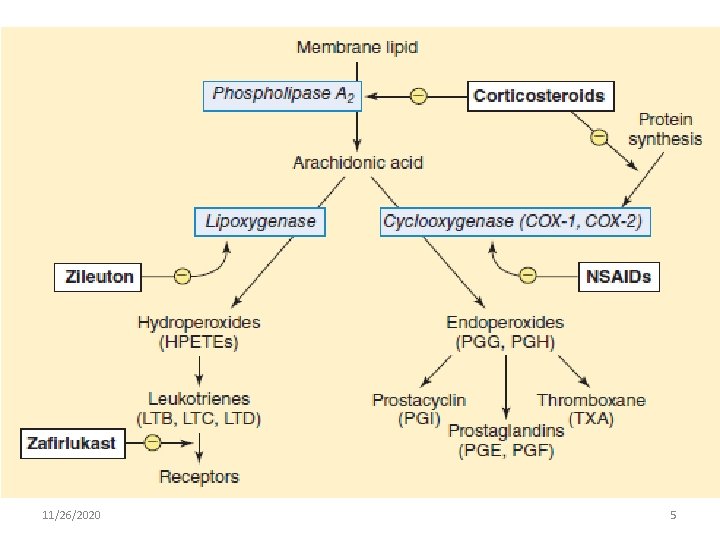
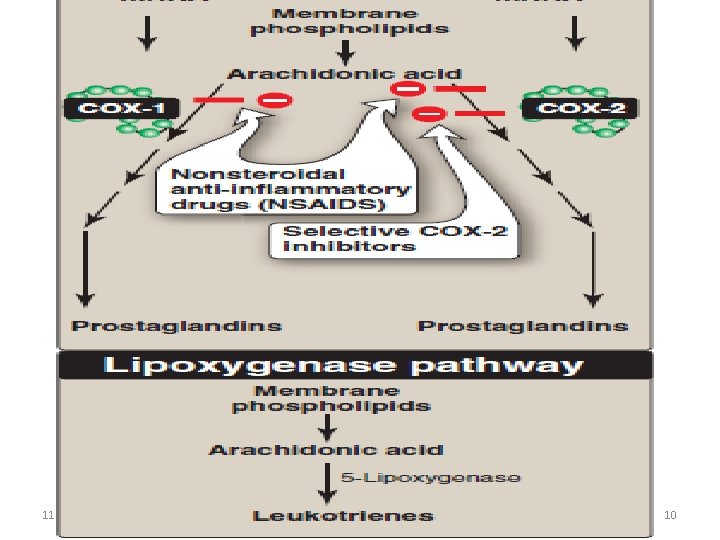
B. Synthesis of prostaglandins • Arachidonic acid is the primary precursor of the prostaglandins and related compounds. • Arachidonic acid is present as a component of the phospholipids of cell membranes. • Tissue phospholipids---PLA 2 ---→arachidonic acid • There are two major pathways in the synthesis of the eicosanoids from arachidonic acid, 1)the cyclooxygenase 2)the lipoxygenase pathways. 11/26/2020 4
11/26/2020 5
1. Cyclooxygenase pathway: All eicosanoids are synthesized via the cyclooxygenase pathway. Two related isoforms of the cyclooxygenase enzymes have been described. • Cyclooxygenase-1 (COX-1) is responsible for the physiologic production of prostanoids, whereas cyclooxygenase-2 (COX-2) causes the elevated production of prostanoids that occurs in sites of chronic disease and inflammation. 1. COX-1 is a constitutive enzyme that regulates normal cellular processes, such as gastric cytoprotection, vascular homeostasis, platelet aggregation, and reproductive and kidney functions. 11/26/2020 6
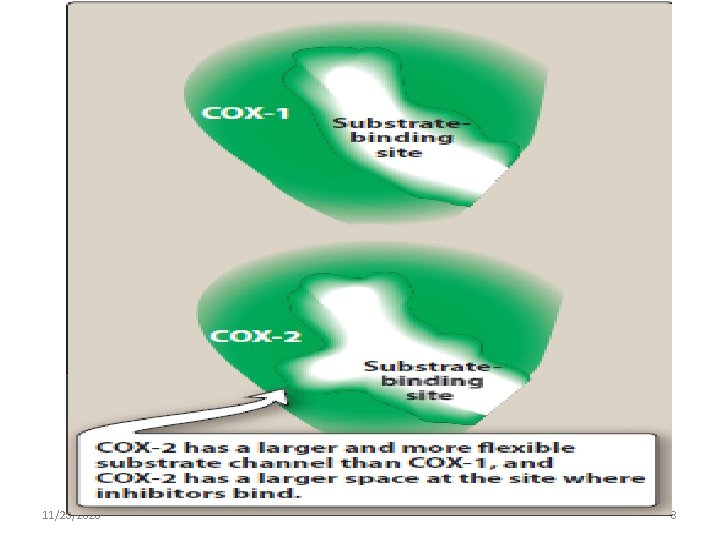
• COX-2 is constitutively expressed in tissues such as the brain, kidney, and bone. • Its expression at other sites is increased during states of chronic inflammation. • Differences in binding site shape have permitted the development of selective COX 2 inhibitors. • COX-2 expression is induced by inflammatory mediators like TNF-α and IL-1 but can also be pharmacologically inhibited by glucocorticoids. 11/26/2020 7
11/26/2020 8
2. Lipoxygenase pathway: • several lipoxygenases can act on arachidonic acid to form leukotrienes • Antileukotriene drugs, such as zileuton, zafirlukast, and montelukast, are treatment options for asthma. 11/26/2020 9
11/26/2020 10
C. Actions of prostaglandins q. Vascular • TXA 2 and PGF 2 are a potent vasoconstrictor. • Vasodilator prostaglandins, especially PGI 2 and PGE 2, promote vasodilation by increasing c. AMP and decreasing smooth muscle intracellular calcium. 11/26/2020 11
q. Gastrointestinal Tract • Most of the prostaglandins and thromboxanes activate gastrointestinal smooth muscle. • Longitudinal muscle is contracted by PGE 2 and PGF 2 • circular muscle is contracted strongly by PGF 2 and weakly by PGI 2, and relaxed by PGE 2. • Administration of either PGE 2 or PGF 2 results in colicky cramps. 11/26/2020 12
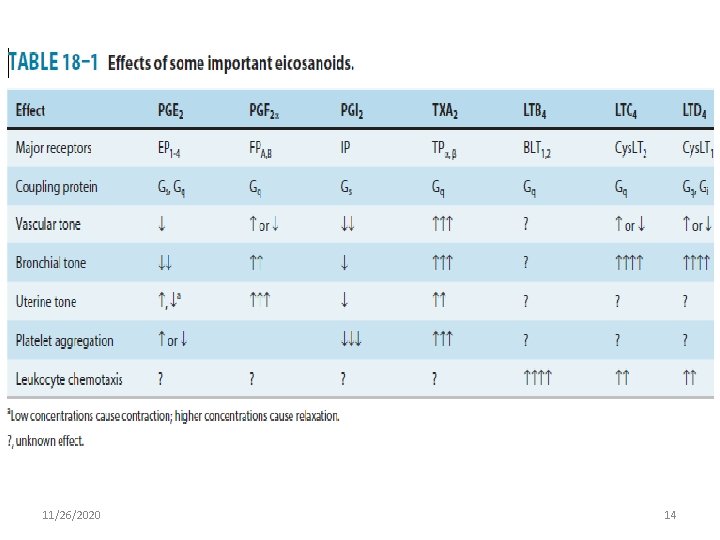
q. Airways Respiratory smooth muscle is relaxed by PGE 2 and PGI 2 and contracted by PGD 2, TXA 2, and PGF 2. The leukotrienes are bronchoconstrictors. q PLATELETS Both PGD 2 and PGI 2 inhibit aggregation. TXA 2 is the major product of platelet COX-1, is a platelet aggregator, and amplifies the effects of other more potent platelet agonists such as thrombin. 11/26/2020 13
11/26/2020 14
D. Therapeutic uses of prostaglandins 1. Prostaglandins have a major role in modulating pain, inflammation, and fever. 2. They also control many physiological functions, such as acid secretion and mucus production in the gastrointestinal (GI) tract, uterine contractions, and renal blood flow. 3. Prostaglandins are also among the chemical mediators that are released in allergic and inflammatory processes. 11/26/2020 15
v Alprostadil • Alprostadil is a PGE 1 that is naturally produced in tissues such as • 1 - seminal vesicles • 2 - cavernous tissues • 3 - the placenta • 4 - the ductus arteriosus of the fetus. • Therapeutically, alprostadil can be used to treat erectile dysfunction , to keep the ductus arteriosus open in neonates with congenital heart conditions until surgery is possible. • PGE 1 maintains the patency of the ductus arteriosus during pregnancy. 11/26/2020 16
v Lubiprostone • Lubiprostone is a PGE 1 derivative indicated for the treatment of chronic idiopathic constipation, opioid-induced constipation, and irritable bowel syndrome with constipation. • It stimulates chloride channels in the luminal cells of the intestinal epithelium, thereby increasing intestinal fluid secretion. • Nausea and diarrhea are the most common side effects of lubiprostone 11/26/2020 17
v Misoprostol • Misoprostol, a PGE 1 analog, is used to protect the mucosal lining of the stomach during chronic NSAID treatment. • Misoprostol interacts with prostaglandin receptors on parietal cells within the stomach, reducing gastric acid secretion. Furthermore, misoprostol has a GI cytoprotective effect by stimulating mucus and bicarbonate production. • Misoprostol is also used off-label in obstetric settings for labor induction, since it increases uterine contractions by interacting with prostaglandin receptors in the uterus. Misoprostol has the potential risk to induce abortion in pregnant women. 11/26/2020 18
v. Prostaglandin F 2α analogs • Bimatoprost, latanoprost , tafluprost , and travoprost are PGF 2α analogs • indicated for the treatment of open-angle glaucoma. By binding to prostaglandin receptors, they increase uveoscleral outflow, reducing intraocular pressure. They are administered as ophthalmic solutions once a day and are as effective as timolol or better in reducing intraocular pressure. • Bimatoprost increases eyelash distinction, length, and darkness and is approved for the treatment of eyelash hypotrichosis. Ocular reactions include blurred vision, iris color change, ocular irritation, and foreign body sensation. 11/26/2020 19
v. Prostacyclin (PGI 2) analogs • Epoprostenol, the pharmaceutical form of naturally occurring prostacyclin, and the synthetic analogs of prostacyclin iloprost and treprostinil are potent pulmonary vasodilators that are used for the treatment of pulmonary arterial hypertension. • Dizziness, headache, flushing, and fainting are the most common adverse effects. • Bronchospasm and cough can also occur after inhalation of iloprost. 11/26/2020 20
q. Female Reproductive Organs • Uterine muscle is contracted by PGF 2α, TXA 2, and low concentrations of PGE 2; PGI 2 and high concentrations of PGE 2 cause relaxation. q. Male Reproductive Organs • Smooth muscle–relaxing prostaglandins such as PGE 1 enhance penile erection by relaxing the smooth muscle of the corpora cavernosa. 11/26/2020 21
- Slides: 21