
The Egyptian NQF Project By Prof Magdy Kassem

The Egyptian NQF Project By Prof. Magdy Kassem President of NAQAAE
Scope l History l Objectives of the Eg- NQF l Outline of the Eg-NQF l General applications of the NQF l Sectorial applications of the NQF( TVET included) l Supporting policies & Tools l What’s next NAQAAE
NQF - Egypt a NAQAAE Responsibility History
Education reform in Egypt >>>>>Driving forces l Mismatch between education system output and labor market demand l Decreasing competitive edge of Egyptian graduates in the regional labor market l Social factors (need to increase access, address illiteracy &leakage from education, … l Current education system defects ( bottle necks & dead ends, overlap of qualifications , no recognition of learning outside the formal context…… NAQAAE

In 2006, As a capstone to the education reform strategy, NAQAAE was established as the sole accrediting body of Egyptian education. NAQAAE
EG NQF >>>>Why NAQAAE l By law mandate: NAQAAE is an authority overarching all levels & types of education. l NAQAAE is responsible for QA of education as well as for ensuring recognition of and confidence in the output of the Egyptian education system. l The law granted NAQAAE the authority to set standards & policies and to develop the tools needed to fulfill its responsibilities. NAQAAE
To carry its responsibilities NAQAAE had to l Set quality assurance & accreditation standards l Set ARS for different specialties and levels of qualifications l The ARS had to be benchmarked against qualification level descriptors (Hence the need to set a NQF emerged) l Establish means for comparability of Egyptian qualifications in quest of their recognition (a NQF needed). NAQAAE
l NAQAAE gathered a task force and worked on a project for an Egyptian NQF development. l The NQF project was submitted to the prime minister and. . . NQF – Egypt was officially assigned to NAQAAE

Purposes of the Eg-NQF
Purposes of the Eg-NQF 1. Setting reference standards for qualification levels based on learning outcomes 2. Acting as a reference to build qualification frameworks for different sectors /sub sectors 3. Serving as a comparability tool for recognition of Egyptian qualifications. NAQAAE

Purposes of the Eg-NQF 4. Linking qualification levels allowing progression from one level to another 5. Linking TVET & the general education systems, promoting level progression and horizontal mobility 6. Guiding QA standards (and ARS) setting both by providers of education and EQA bodies. NAQAAE
Purposes of the Eg-NQF 7. Permitting inter sectorial mobility (with appropriate tools) 8. Providing reference standards to review and enhance standing Eg qualifications, and acting as a benchmark when introducing new qualifications. 9. Assuring public confidence in the outcomes of the EG Q system by meeting societal and employers’ expectations for different Q levels. 10. Fostering LLL and RPL NAQAAE
Outline of the proposed Eg-NQF
Outline of the proposed Eg-NQF l 8 levels described in terms of LO. l Qualifications are measured against these outcomes in order to be placed at a given level. l Levels are ascending, starting at L 1 (equivalent to the general primary certificate) up to L 8 (equivalent to a doctoral degree) NAQAAE

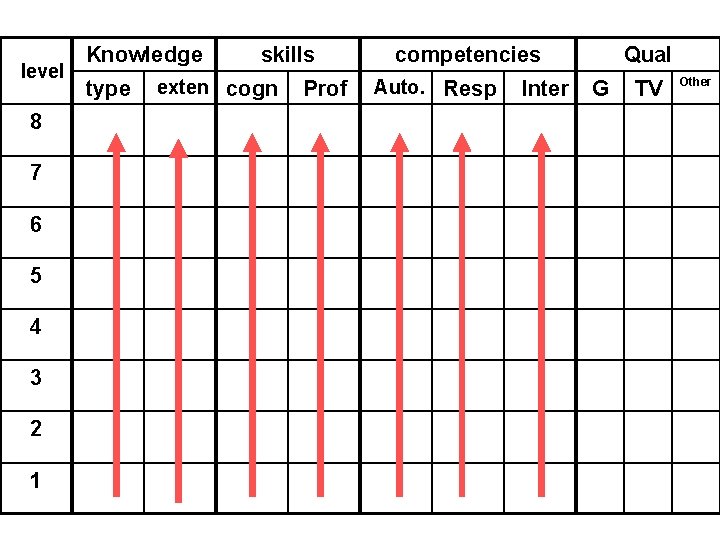
Outline of the proposed Eg-NQF l One or more NQ may fit into a level. l Level descriptors include: • knowledge (extent and type) • skills (cognitive & professional) • competencies ( autonomy, responsibility & interaction) NAQAAE
level 8 7 6 5 4 3 2 1 Knowledge type skills exten cogn Prof competencies Auto. Resp Inter Qual G TV Other
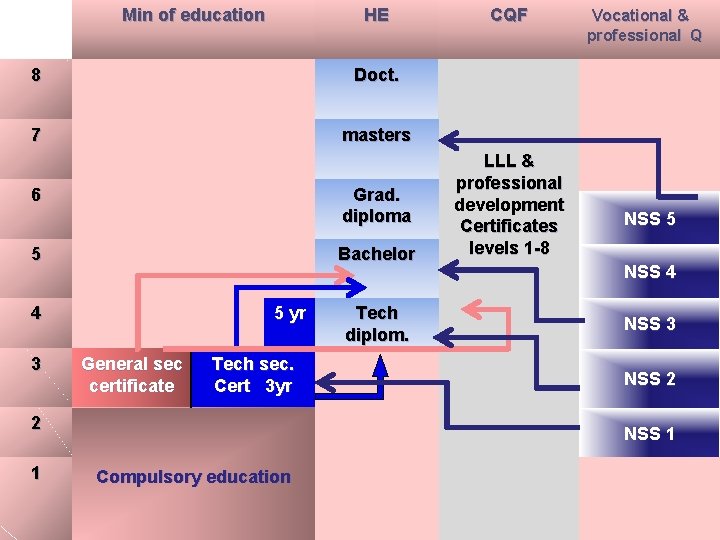
Min of education HE 8 Doct. 7 masters 6 Grad. diploma 5 Bachelor 4 3 5 yr General sec certificate Tech sec. Cert 3 yr 2 1 Tech diplom. CQF LLL & professional development Certificates levels 1 -8 Vocational & professional Q NSS 5 NSS 4 NSS 3 NSS 2 NSS 1 Compulsory education
- Slides: 17