
The Egg Drop Problem solving activity in Reception
The Egg Drop Problem solving activity in Reception May 2016
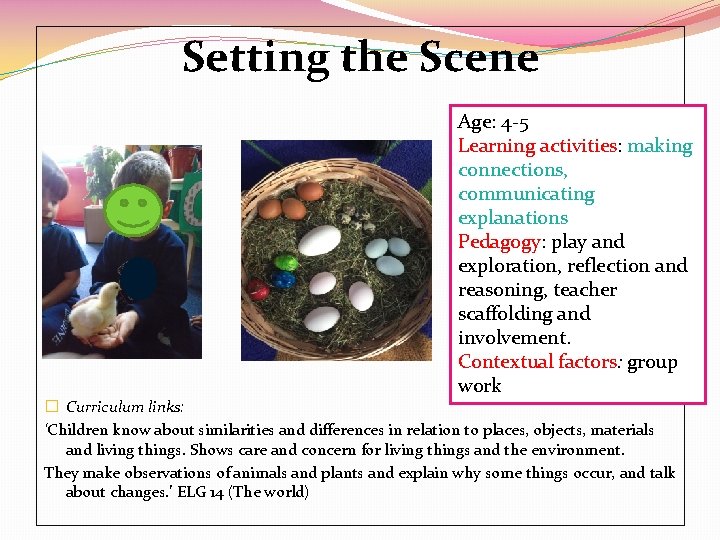
Setting the Scene Age: 4 -5 Learning activities: making connections, communicating explanations Pedagogy: play and exploration, reflection and reasoning, teacher scaffolding and involvement. Contextual factors: group work � Curriculum links: ‘Children know about similarities and differences in relation to places, objects, materials and living things. Shows care and concern for living things and the environment. They make observations of animals and plants and explain why some things occur, and talk about changes. ’ ELG 14 (The world)
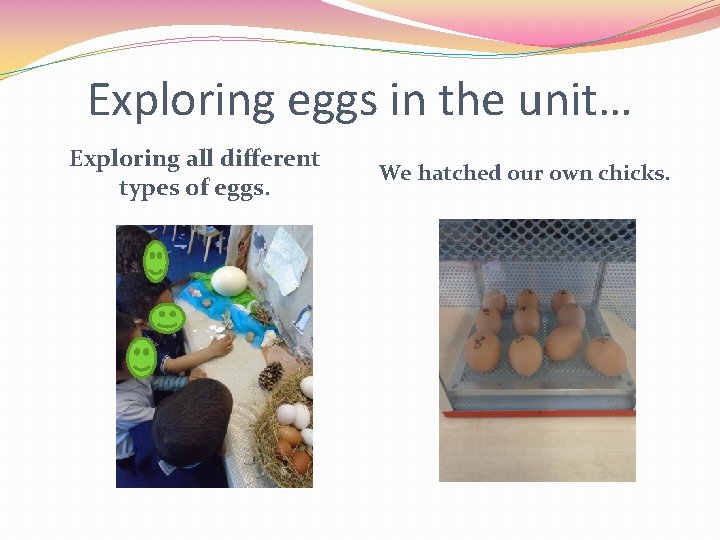
Exploring eggs in the unit… Exploring all different types of eggs. We hatched our own chicks.
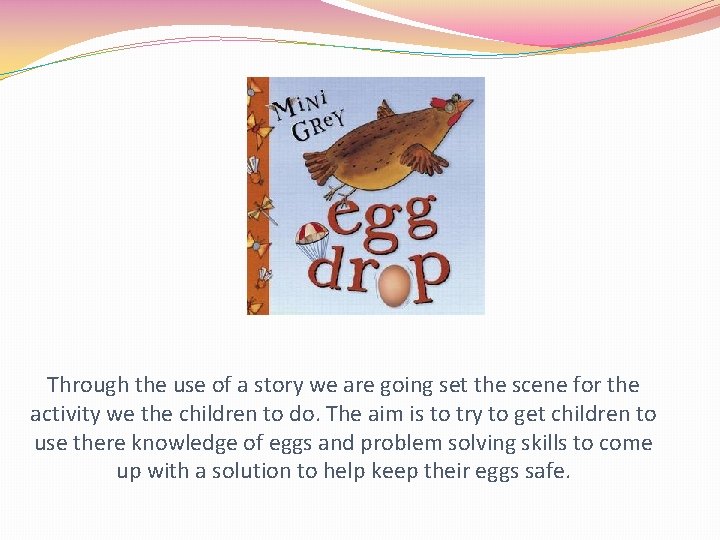
Through the use of a story we are going set the scene for the activity we the children to do. The aim is to try to get children to use there knowledge of eggs and problem solving skills to come up with a solution to help keep their eggs safe.
Rationale The children were already creative and explorative learners in the early years unit, however I observed that their independent learning was often silent. I wanted to encourage talk using skills such as prediction, reasoning and making connections building on the scientific potential in their explorations. (We could see the creative processes they were doing, but it was always silent, we wanted to know what their thought process was)
The implications for my planning and teaching were to foster scientific skills associated with problem solving and reflection and reasoning by offering the children different adult led, scaffolded creative activities to support them in developing and using these skills increasingly independently in their future explorations and investigations.
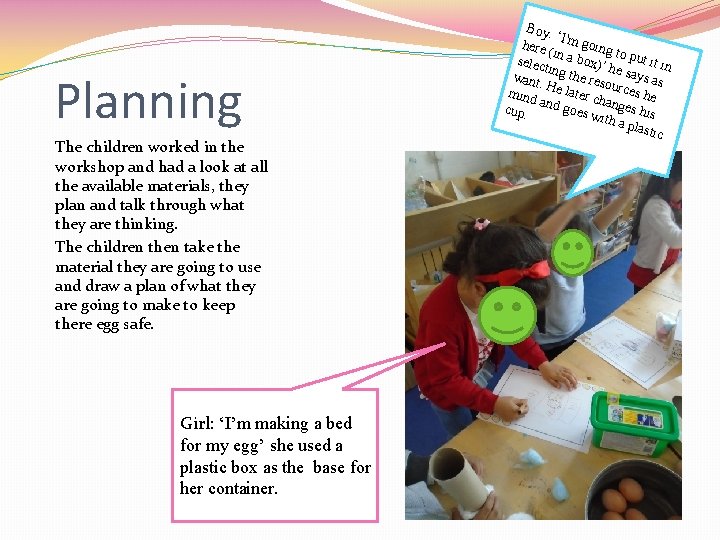
Planning The children worked in the workshop and had a look at all the available materials, they plan and talk through what they are thinking. The children then take the material they are going to use and draw a plan of what they are going to make to keep there egg safe. Girl: ‘I’m making a bed for my egg’ she used a plastic box as the base for her container. Boy: ‘ here I'm going (in a box)’ to put it in selec ti h want ng the res e says as. H o mind e later c urces he ha a cup. nd goes w nges his ith a plasti c
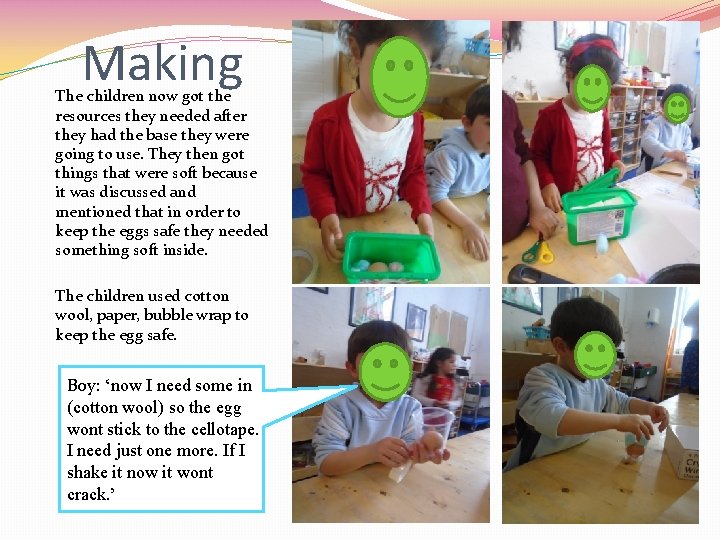
Making The children now got the resources they needed after they had the base they were going to use. They then got things that were soft because it was discussed and mentioned that in order to keep the eggs safe they needed something soft inside. The children used cotton wool, paper, bubble wrap to keep the egg safe. Boy: ‘now I need some in (cotton wool) so the egg wont stick to the cellotape. I need just one more. If I shake it now it wont crack. ’
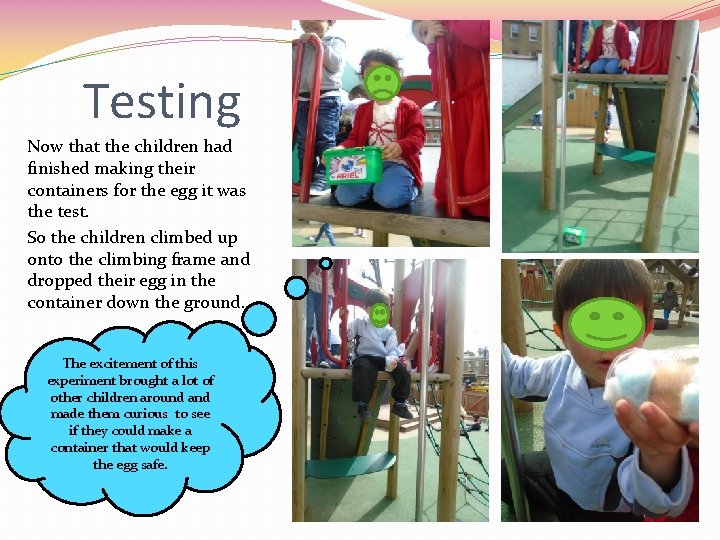
Testing Now that the children had finished making their containers for the egg it was the test. So the children climbed up onto the climbing frame and dropped their egg in the container down the ground. The excitement of this experiment brought a lot of other children around and made them curious to see if they could make a container that would keep the egg safe.
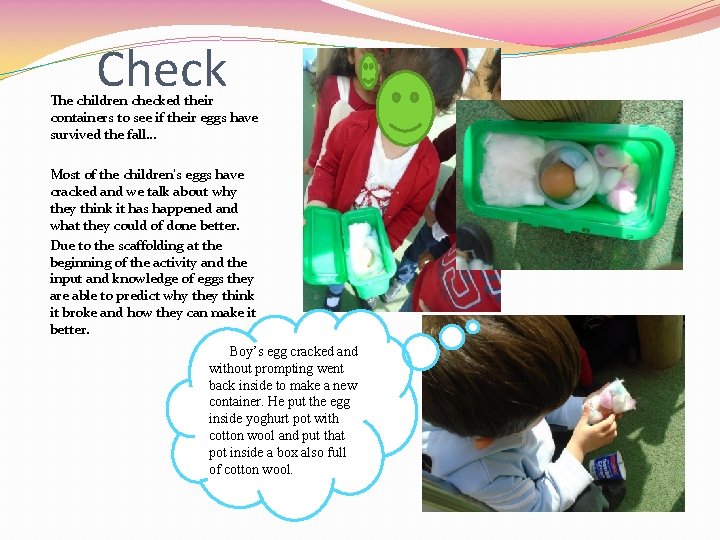
Check The children checked their containers to see if their eggs have survived the fall… Most of the children's eggs have cracked and we talk about why they think it has happened and what they could of done better. Due to the scaffolding at the beginning of the activity and the input and knowledge of eggs they are able to predict why they think it broke and how they can make it better. Boy’s egg cracked and without prompting went back inside to make a new container. He put the egg inside yoghurt pot with cotton wool and put that pot inside a box also full of cotton wool.
Reflections… Looking back at the activity I realise that whilst child initiated learning is a great starting point to begin creative learning and enquiry. Adult led activities have a large role to play if all children are going to develop those creative dispositions such as problem solving, reasoning and reflection.
- Slides: 11