
The Effects of the Absorption of Liquids on
The Effects of the Absorption of Liquids on the Tensile Strength of Fibrous Materials Aaron Perry – Warren Mott Kristian Wilks – Lake Shore
Overview • • • Background Information Purpose Hypothesis Materials Procedure Data and Analysis Perry - Wilks 2
Overview • • Conclusion Experimental Errors Applications Further Research Perry - Wilks 3
Background Information • Tensile strength – Intensive (independent) property – Maximum force that a material can withstand that then causes it to either fracture or break – Measured in Newtons (N) Perry - Wilks 4
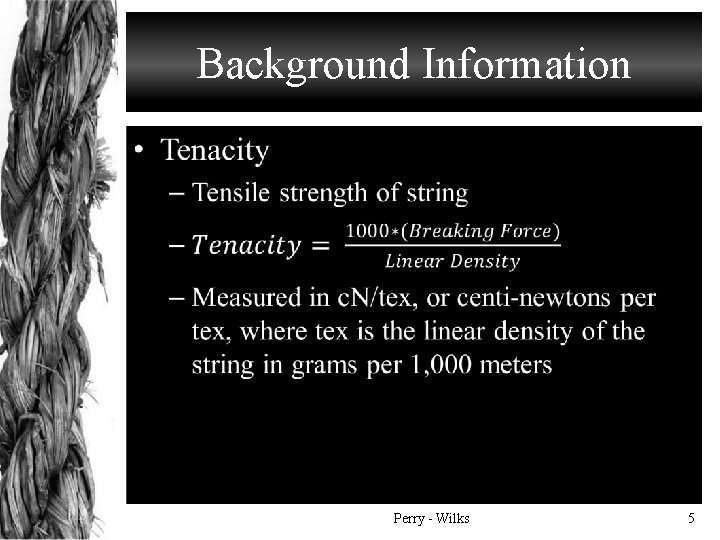
Background Information • Perry - Wilks 5
Background Information • Tenacity Continued – Breaking force measured in Newtons – Linear density is measured in dtex (decitex), or the mass in grams of the string per 10, 000 meters ("Test Methods. ") Perry - Wilks 6
Background Information • Absorption – Process in which a substance permeates another, as in a liquid permeating, or absorbed by a solid (Kamath) – Each different fibrous material has a different rate of absorption of liquids Perry - Wilks 7
Background Information • Viscosity – Measure of liquid’s resistance to flow – Higher viscosity means stronger molecular bonds – Measured in Poise (P) or Pascal seconds (Pa s) – Water = 1. 00 – Vegetable Oil = 26 -84 m. Pa s Perry - Wilks 8
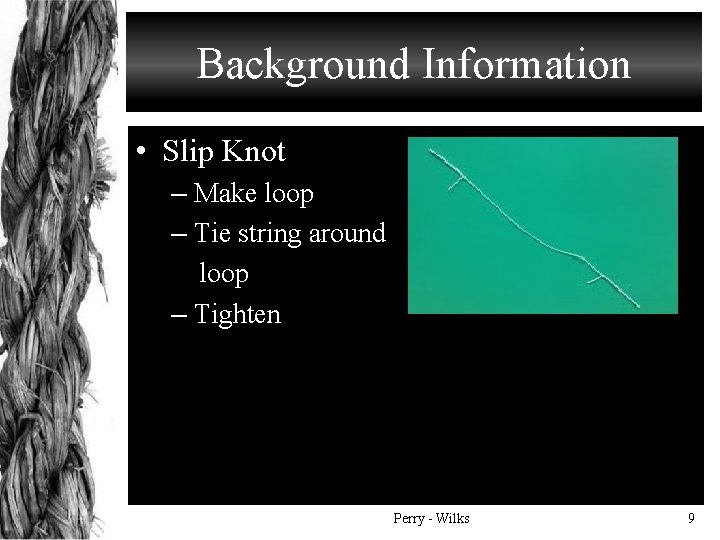
Background Information • Slip Knot – Make loop – Tie string around loop – Tighten Perry - Wilks 9
Purpose • To determine the effect that absorption has on the tensile strength of fibrous materials Perry - Wilks 10
Hypothesis • Crochet thread soaked in vegetable oil will yield the highest tensile strength – Crochet thread is stronger – Vegetable oil is more viscous – Stronger bond Perry - Wilks 11
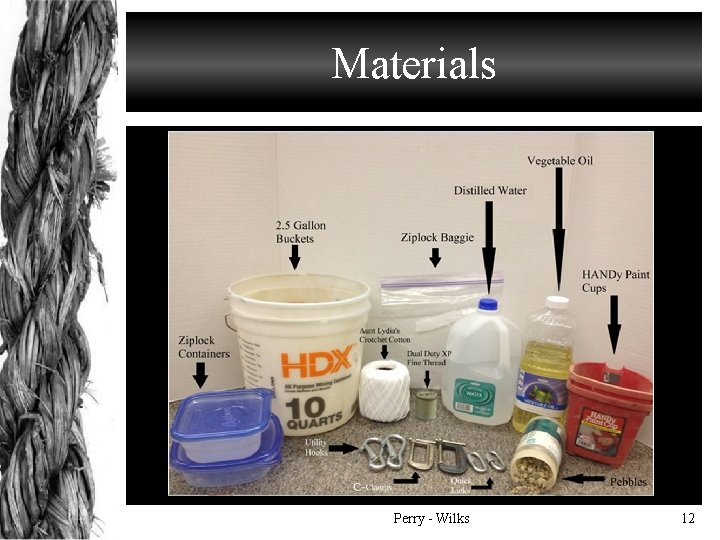
Materials Perry - Wilks 12
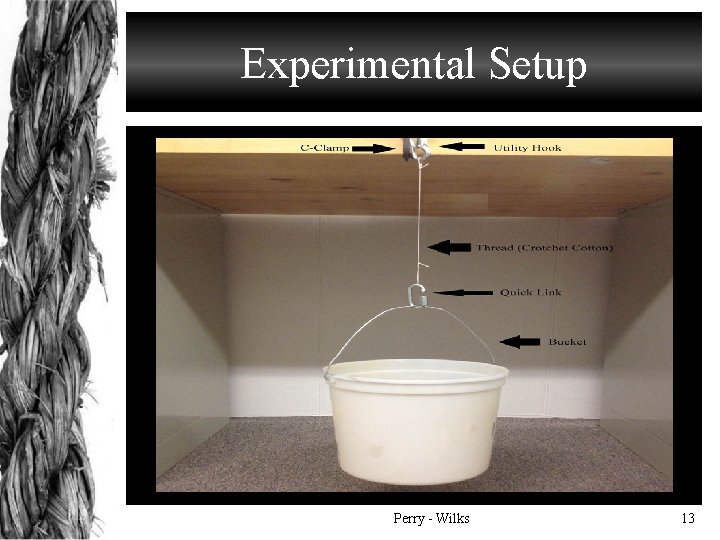
Experimental Setup Perry - Wilks 13

Procedure Perry - Wilks 14
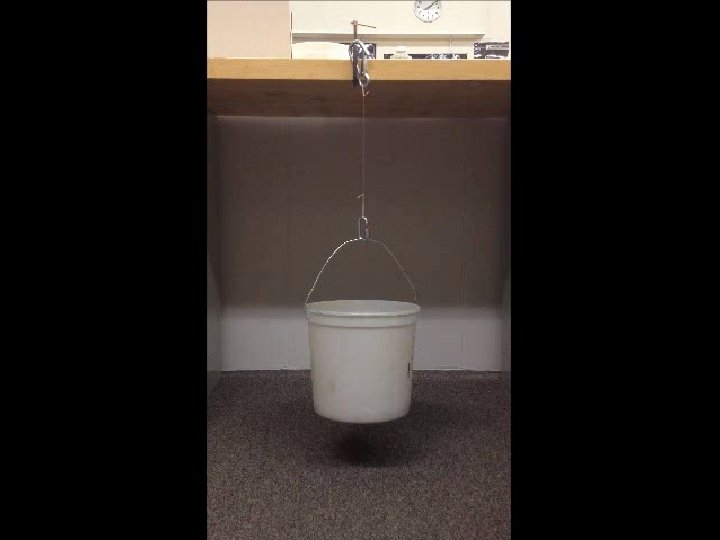
Perry - Wilks 15
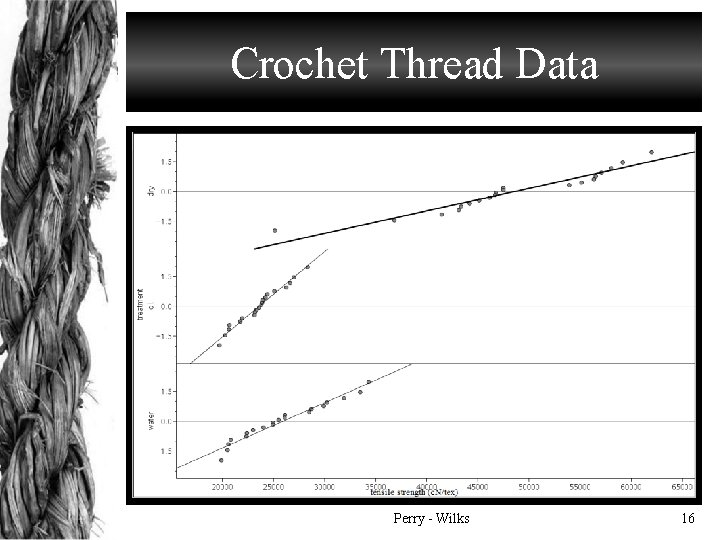
Crochet Thread Data Perry - Wilks 16
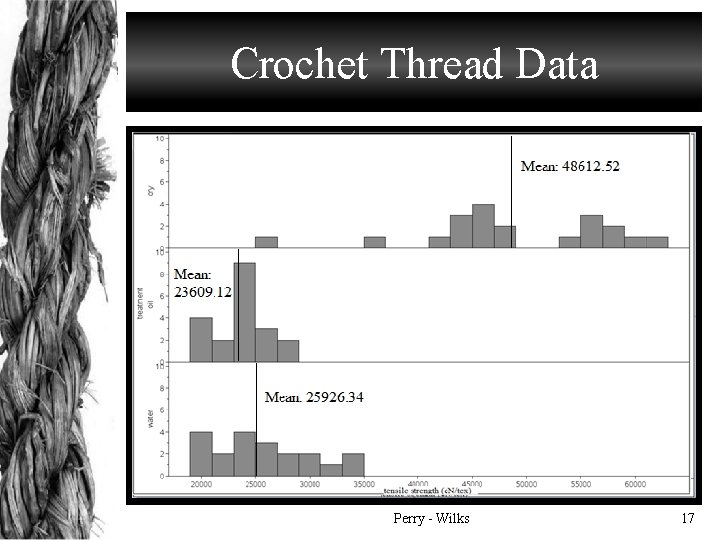
Crochet Thread Data Perry - Wilks 17
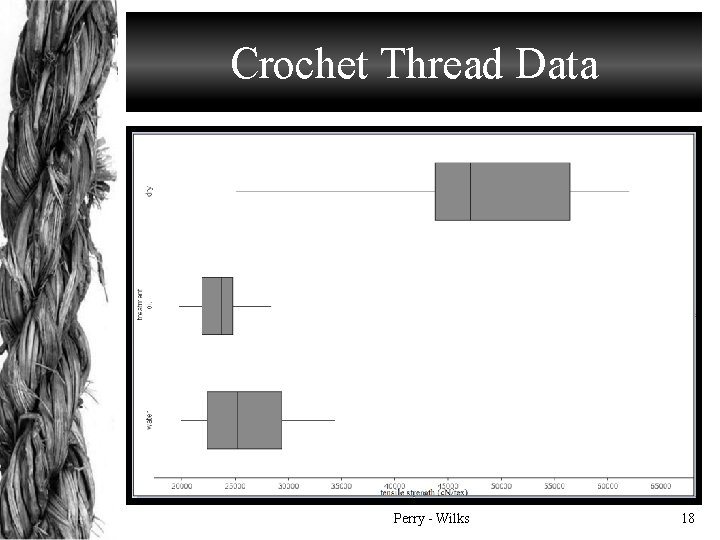
Crochet Thread Data Perry - Wilks 18
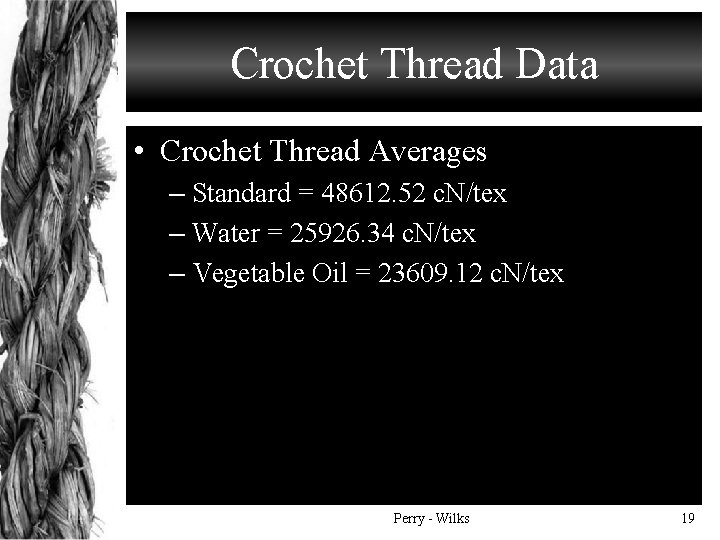
Crochet Thread Data • Crochet Thread Averages – Standard = 48612. 52 c. N/tex – Water = 25926. 34 c. N/tex – Vegetable Oil = 23609. 12 c. N/tex Perry - Wilks 19
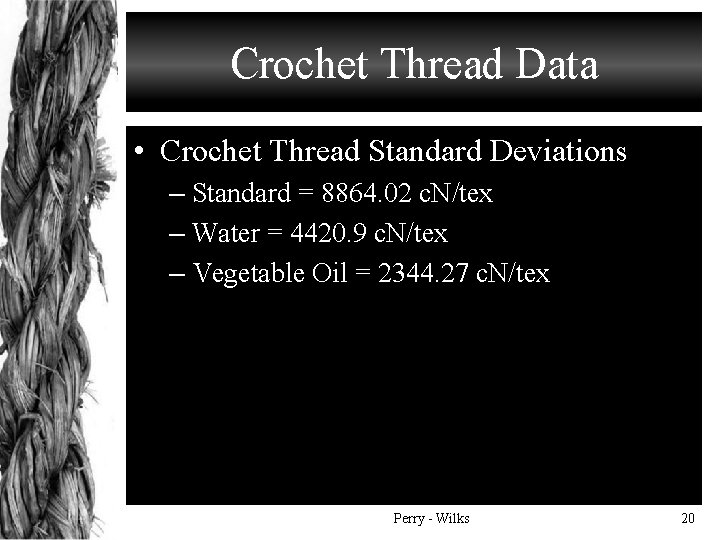
Crochet Thread Data • Crochet Thread Standard Deviations – Standard = 8864. 02 c. N/tex – Water = 4420. 9 c. N/tex – Vegetable Oil = 2344. 27 c. N/tex Perry - Wilks 20
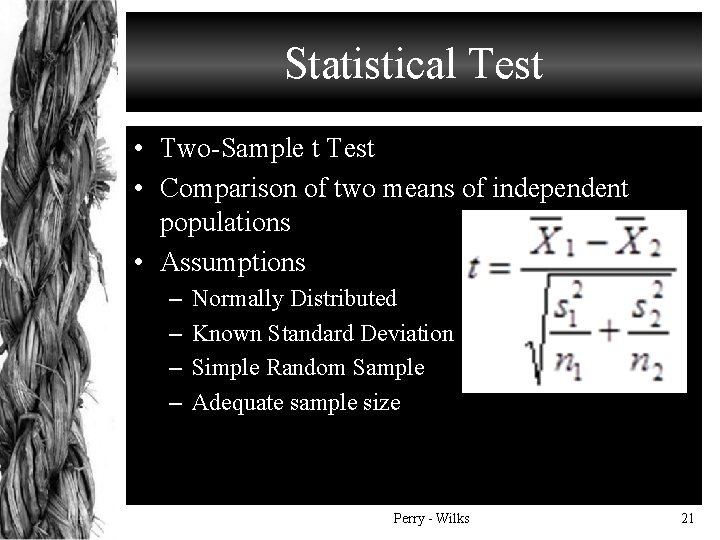
Statistical Test • Two-Sample t Test • Comparison of two means of independent populations • Assumptions – – Normally Distributed Known Standard Deviation Simple Random Sample Adequate sample size Perry - Wilks 21
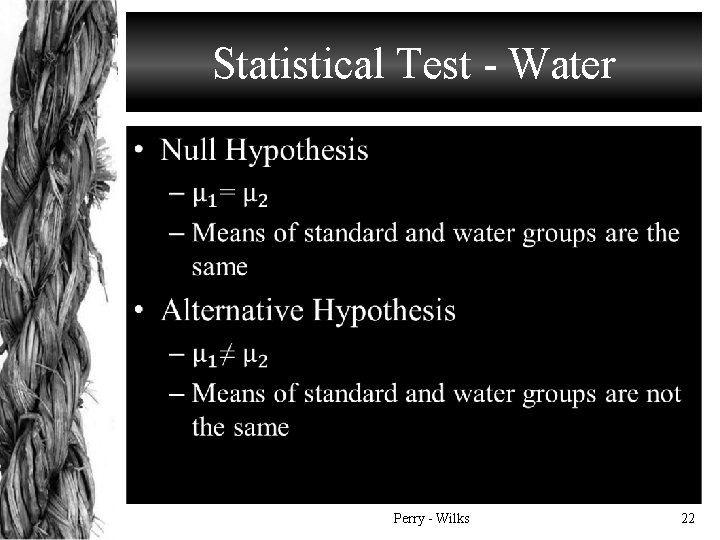
Statistical Test - Water • Perry - Wilks 22
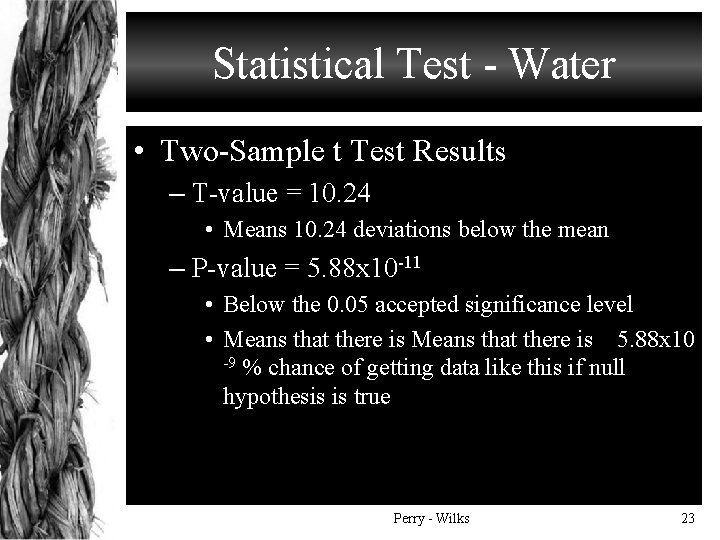
Statistical Test - Water • Two-Sample t Test Results – T-value = 10. 24 • Means 10. 24 deviations below the mean – P-value = 5. 88 x 10 -11 • Below the 0. 05 accepted significance level • Means that there is 5. 88 x 10 -9 % chance of getting data like this if null hypothesis is true Perry - Wilks 23
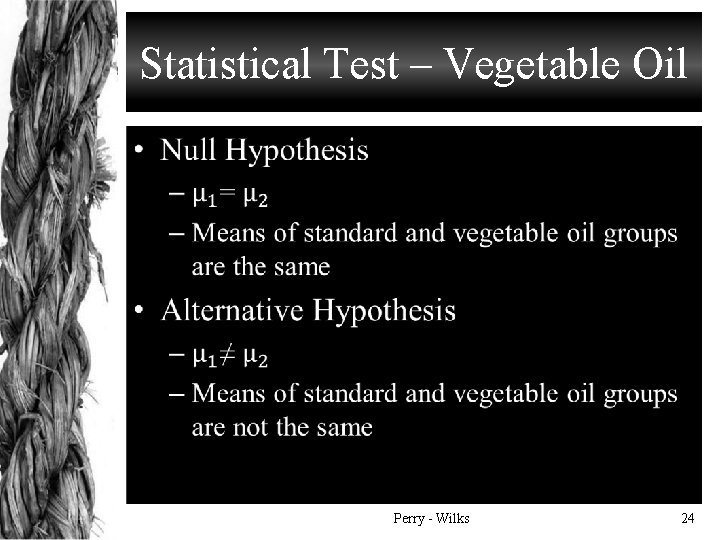
Statistical Test – Vegetable Oil • Perry - Wilks 24
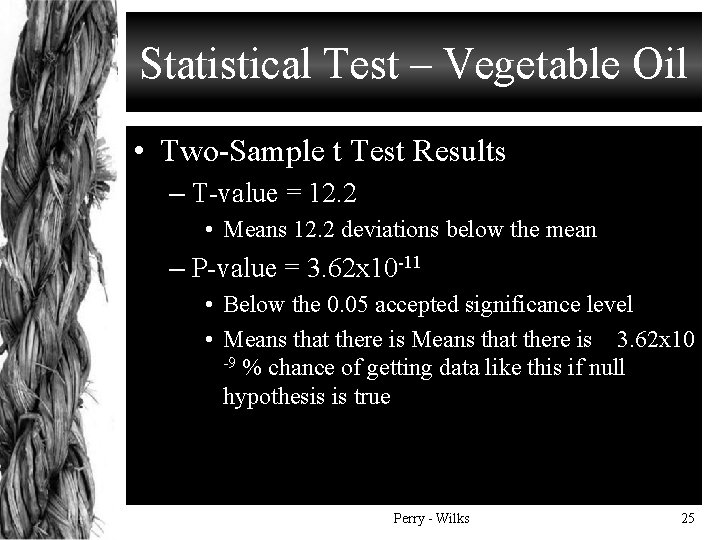
Statistical Test – Vegetable Oil • Two-Sample t Test Results – T-value = 12. 2 • Means 12. 2 deviations below the mean – P-value = 3. 62 x 10 -11 • Below the 0. 05 accepted significance level • Means that there is 3. 62 x 10 -9 % chance of getting data like this if null hypothesis is true Perry - Wilks 25

Fine Sewing Thread Data Perry - Wilks 26
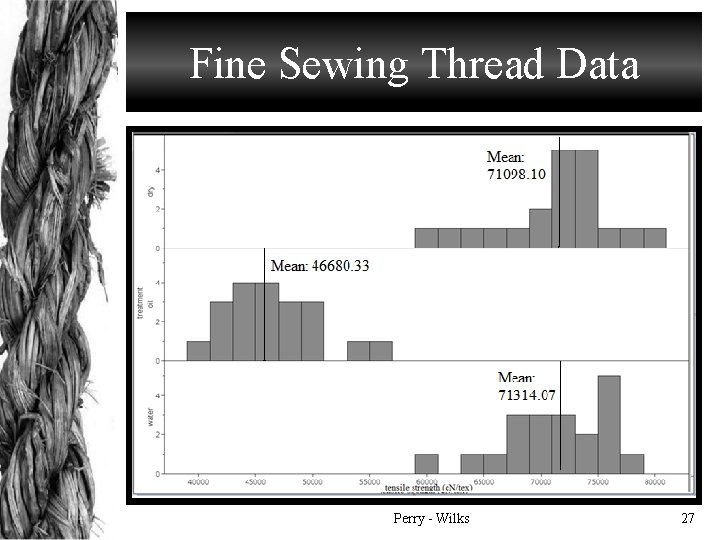
Fine Sewing Thread Data Perry - Wilks 27
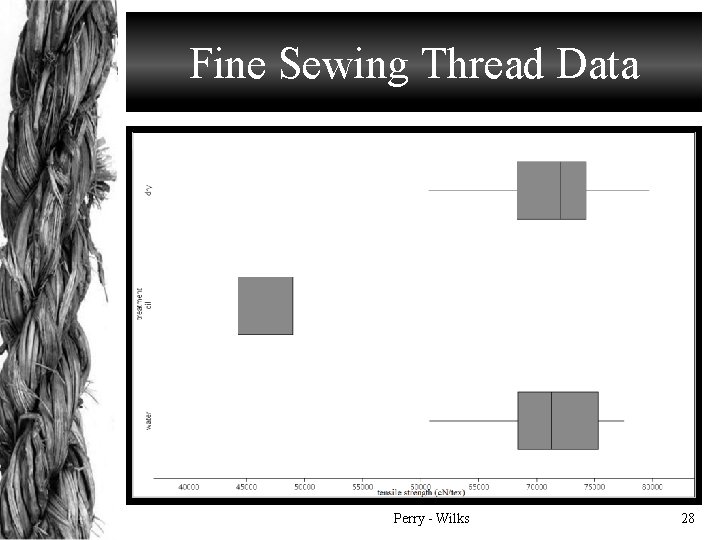
Fine Sewing Thread Data Perry - Wilks 28
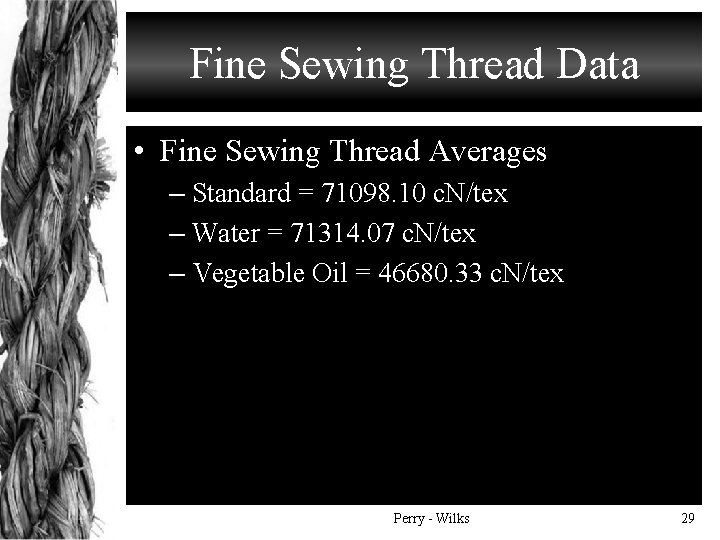
Fine Sewing Thread Data • Fine Sewing Thread Averages – Standard = 71098. 10 c. N/tex – Water = 71314. 07 c. N/tex – Vegetable Oil = 46680. 33 c. N/tex Perry - Wilks 29
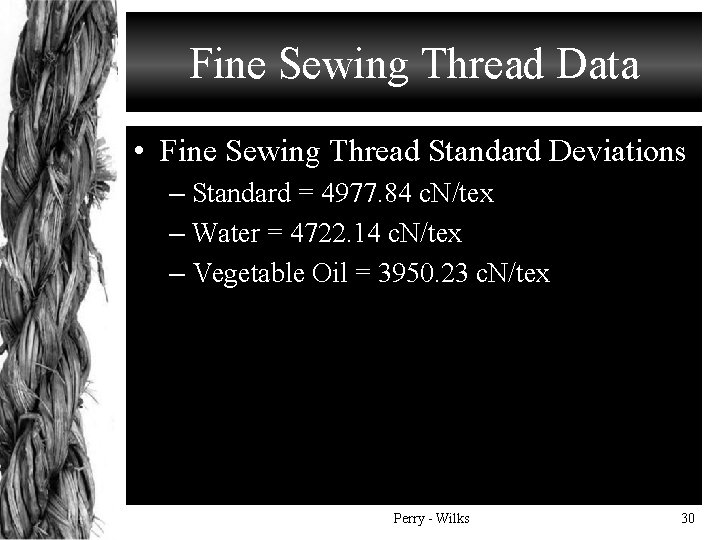
Fine Sewing Thread Data • Fine Sewing Thread Standard Deviations – Standard = 4977. 84 c. N/tex – Water = 4722. 14 c. N/tex – Vegetable Oil = 3950. 23 c. N/tex Perry - Wilks 30
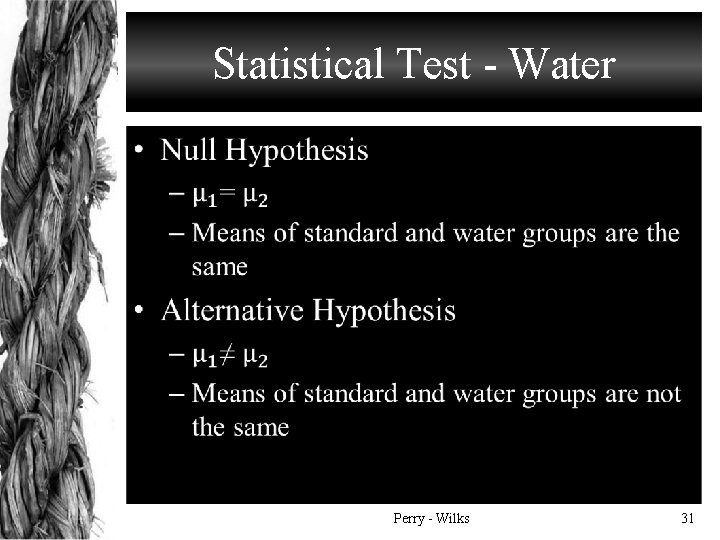
Statistical Test - Water • Perry - Wilks 31
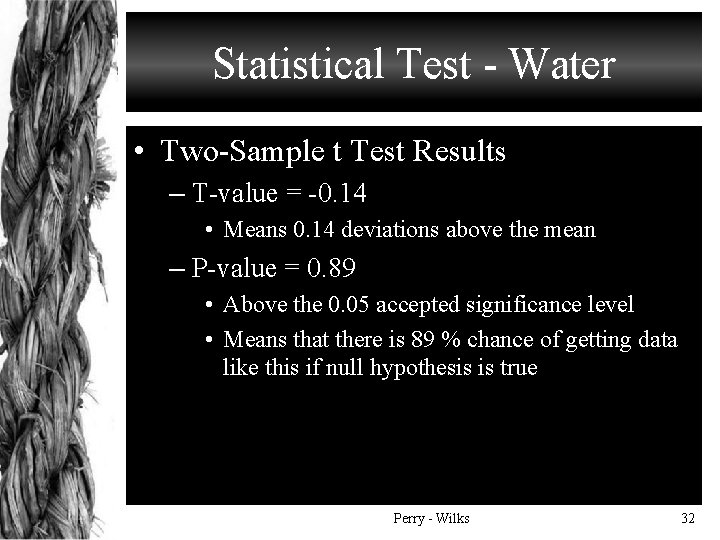
Statistical Test - Water • Two-Sample t Test Results – T-value = -0. 14 • Means 0. 14 deviations above the mean – P-value = 0. 89 • Above the 0. 05 accepted significance level • Means that there is 89 % chance of getting data like this if null hypothesis is true Perry - Wilks 32
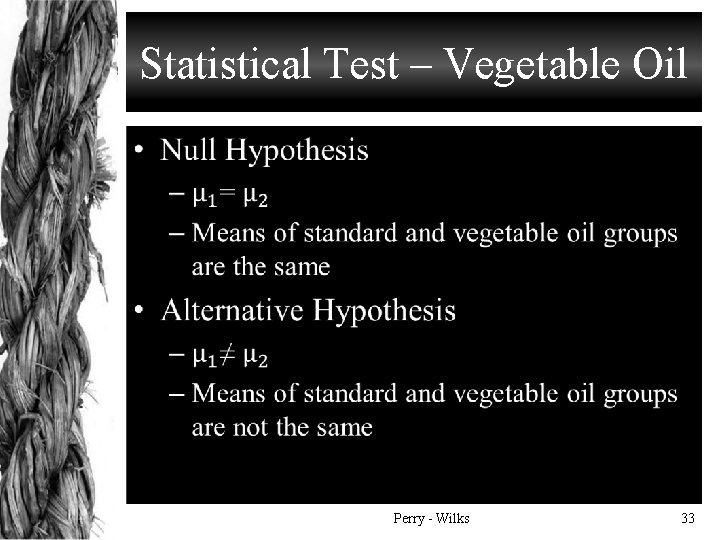
Statistical Test – Vegetable Oil • Perry - Wilks 33
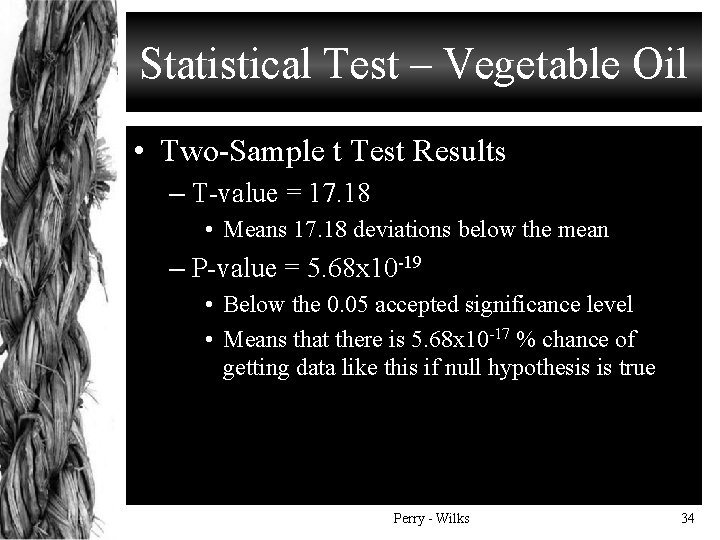
Statistical Test – Vegetable Oil • Two-Sample t Test Results – T-value = 17. 18 • Means 17. 18 deviations below the mean – P-value = 5. 68 x 10 -19 • Below the 0. 05 accepted significance level • Means that there is 5. 68 x 10 -17 % chance of getting data like this if null hypothesis is true Perry - Wilks 34
Conclusion • Problem – To determine the effect that absorption has on the tensile strength of fibrous materials • Standard • Water • Vegetable Oil Perry - Wilks 35
Conclusion • Hypothesis – Crochet thread soaked in vegetable oil will yield the highest tensile strength • Higher Viscosity • Stronger molecular bond Perry - Wilks 36
Conclusion • Hypothesis REJECTED that the crochet thread in vegetable oil would yield the highest tensile strength – P-value of 3. 62 x 10 -11 – No significant evidence Perry - Wilks 37
Overall Conclusion • Highest Tensile Strength – Standard Crochet Thread • 48612. 52 c. N/tex • Lowest Tensile Strength – Vegetable Oil Crochet Thread • 3950. 23 c. N/tex Perry - Wilks 38
Overall Conclusion • Overall… – Vegetable Oil decreased tensile strength the most (by more than half of original) – Water for crochet thread decreased tensile strength (by about half of original) – Water for fine sewing thread had no effect Perry - Wilks 39
Experimental Errors • • Limited / sensitive scales Non-constant addition of weight Spinning of bucket Delayed reaction time when adding weight • Variation in length of materials used Perry - Wilks 40
Experimental Error Solutions • Better / more accurate equipment • Secure bucket • Better weight adding system Perry - Wilks 41
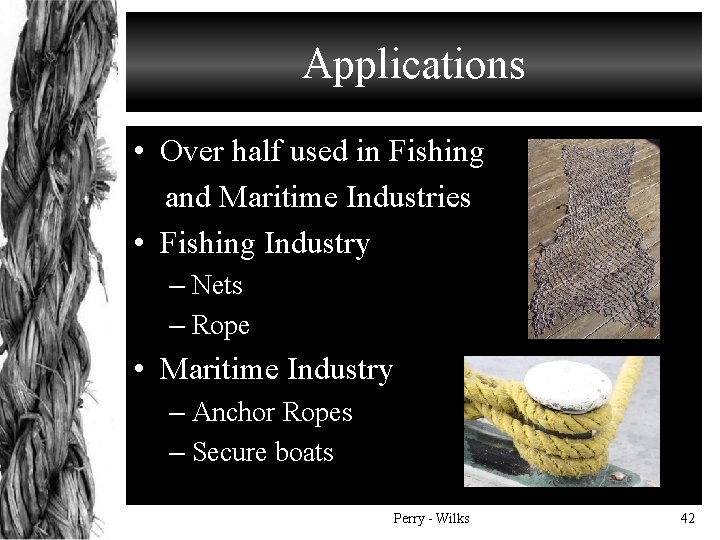
Applications • Over half used in Fishing and Maritime Industries • Fishing Industry – Nets – Rope • Maritime Industry – Anchor Ropes – Secure boats Perry - Wilks 42
Applications • Representative of… – Rope and commonly used fibers – Conditions on the water • Insight into effect on tensile strength of ropes exposed to water and oils Perry - Wilks 43
Further Research • Use other liquids – Mercury – Acids – Water vs. Salt Water • Fibrous Materials – Multiple strands – Stronger materials – Synthetic vs. natural fibers Perry - Wilks 44
Acknowledgements • Mrs. Cybulski • Mr. Mc. Millan Perry - Wilks 45
Sources • Words Perry - Wilks 46

Any Questions? Perry - Wilks 47
THE END Perry - Wilks 48

YOU SHALL NOT PASS Perry - Wilks 49
STAHP Perry - Wilks 50

WHAT ARE YOU DOING? ! Perry - Wilks 51
STAHP Perry - Wilks 52
- Slides: 52