
The Effects of Story Maps to Support Reading
- Slides: 1
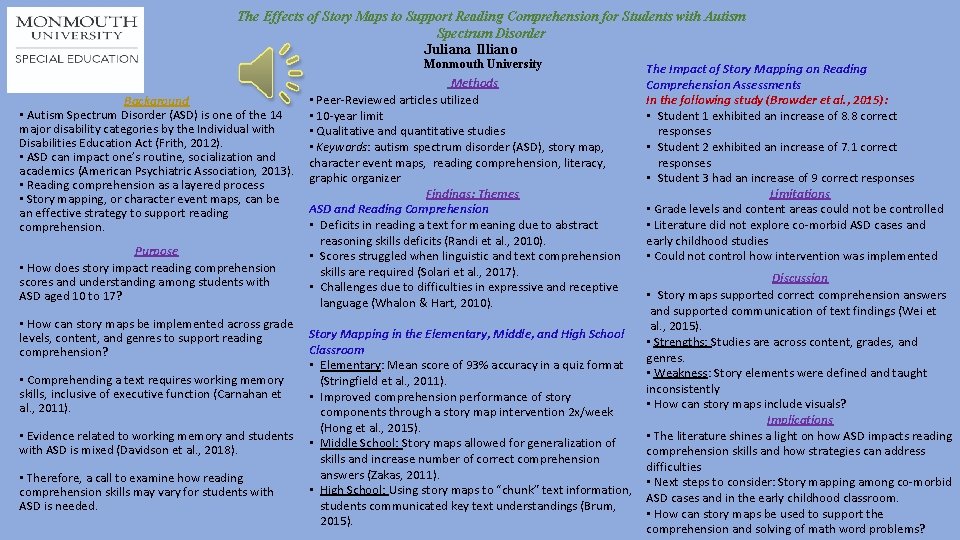
The Effects of Story Maps to Support Reading Comprehension for Students with Autism Spectrum Disorder Juliana Illiano Background • Autism Spectrum Disorder (ASD) is one of the 14 major disability categories by the Individual with Disabilities Education Act (Frith, 2012). • ASD can impact one’s routine, socialization and academics (American Psychiatric Association, 2013). • Reading comprehension as a layered process • Story mapping, or character event maps, can be an effective strategy to support reading comprehension. Purpose • How does story impact reading comprehension scores and understanding among students with ASD aged 10 to 17? • How can story maps be implemented across grade levels, content, and genres to support reading comprehension? • Comprehending a text requires working memory skills, inclusive of executive function (Carnahan et al. , 2011). • Evidence related to working memory and students with ASD is mixed (Davidson et al. , 2018). • Therefore, a call to examine how reading comprehension skills may vary for students with ASD is needed. Monmouth University Methods • Peer-Reviewed articles utilized • 10 -year limit • Qualitative and quantitative studies • Keywords: autism spectrum disorder (ASD), story map, character event maps, reading comprehension, literacy, graphic organizer Findings: Themes ASD and Reading Comprehension • Deficits in reading a text for meaning due to abstract reasoning skills deficits (Randi et al. , 2010). • Scores struggled when linguistic and text comprehension skills are required (Solari et al. , 2017). • Challenges due to difficulties in expressive and receptive language (Whalon & Hart, 2010). Story Mapping in the Elementary, Middle, and High School Classroom • Elementary: Mean score of 93% accuracy in a quiz format (Stringfield et al. , 2011). • Improved comprehension performance of story components through a story map intervention 2 x/week (Hong et al. , 2015). • Middle School: Story maps allowed for generalization of skills and increase number of correct comprehension answers (Zakas, 2011). • High School: Using story maps to “chunk” text information, students communicated key text understandings (Brum, 2015). The Impact of Story Mapping on Reading Comprehension Assessments In the following study (Browder et al. , 2015): • Student 1 exhibited an increase of 8. 8 correct responses • Student 2 exhibited an increase of 7. 1 correct responses • Student 3 had an increase of 9 correct responses Limitations • Grade levels and content areas could not be controlled • Literature did not explore co-morbid ASD cases and early childhood studies • Could not control how intervention was implemented Discussion • Story maps supported correct comprehension answers and supported communication of text findings (Wei et al. , 2015). • Strengths: Studies are across content, grades, and genres. • Weakness: Story elements were defined and taught inconsistently • How can story maps include visuals? Implications • The literature shines a light on how ASD impacts reading comprehension skills and how strategies can address difficulties • Next steps to consider: Story mapping among co-morbid ASD cases and in the early childhood classroom. • How can story maps be used to support the comprehension and solving of math word problems?