
The Effects of Process Variability 35 E 00100

The Effects of Process Variability 35 E 00100 Service Operations and Strategy #3 Fall 2015
Topics on Variability basics n Measure of variability n Process variability n Flow variability n Key points The corrupting influence of variability n Factory physics “laws” n Batching n Serial system n Parallel system n Transfer batching n Ways to improve operations n Key points Useful material: Hopp, W. & Spearman, M. (2000), Factory Physics, Chapters 8, 9 and 15. 3 35 E 00100 Service Operations and Strategy #3 2 Aalto/BIZ Logistics
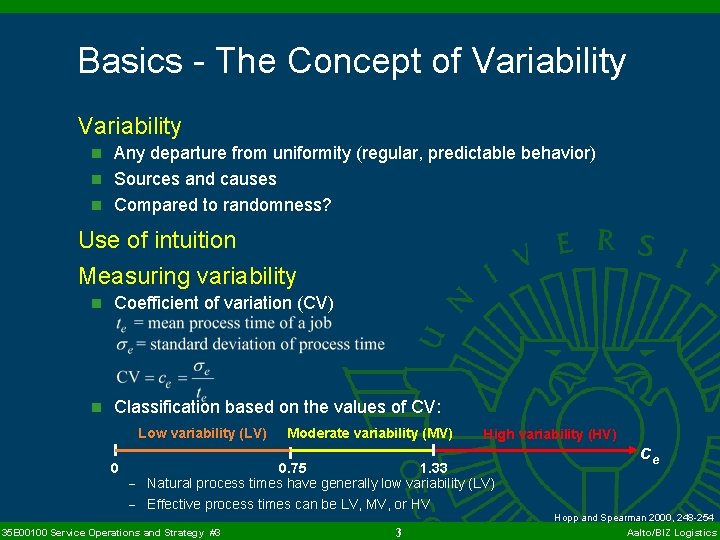
Basics - The Concept of Variability n Any departure from uniformity (regular, predictable behavior) n Sources and causes n Compared to randomness? Use of intuition Measuring variability n Coefficient of variation (CV) n Classification based on the values of CV: Low variability (LV) 0 Moderate variability (MV) High variability (HV) 0. 75 1. 33 - Natural process times have generally low variability (LV) - Effective process times can be LV, MV, or HV 35 E 00100 Service Operations and Strategy #3 3 ce Hopp and Spearman 2000, 248 -254 Aalto/BIZ Logistics
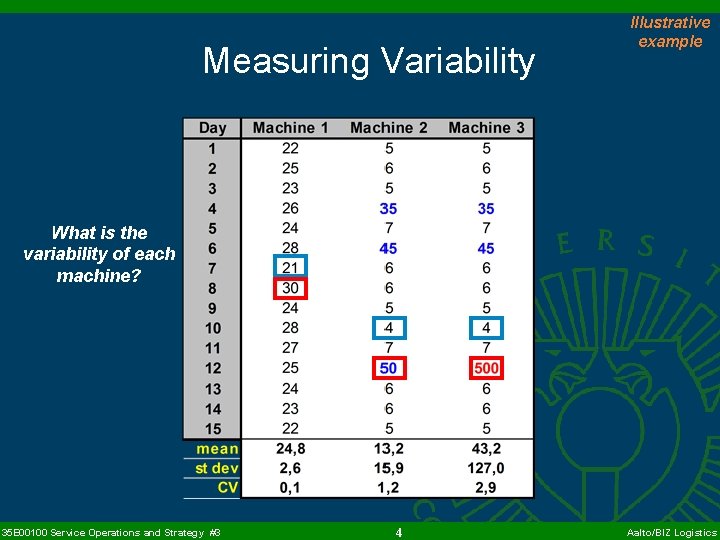
Measuring Variability Illustrative example What is the variability of each machine? 35 E 00100 Service Operations and Strategy #3 4 Aalto/BIZ Logistics

Natural Variability without explicitly analyzed cause(s) Sources in process n Operator pace n Material fluctuations n Product type (if not explicitly considered) n Product quality Observation n Natural process variability is usually in the low variability category 35 E 00100 Service Operations and Strategy #3 5 Hopp and Spearman 2000, 255 Aalto/BIZ Logistics
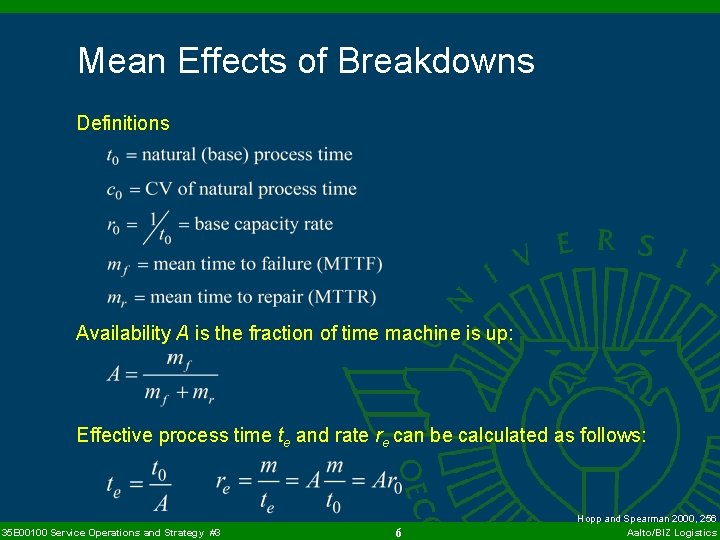
Mean Effects of Breakdowns Definitions Availability A is the fraction of time machine is up: Effective process time te and rate re can be calculated as follows: 35 E 00100 Service Operations and Strategy #3 6 Hopp and Spearman 2000, 256 Aalto/BIZ Logistics
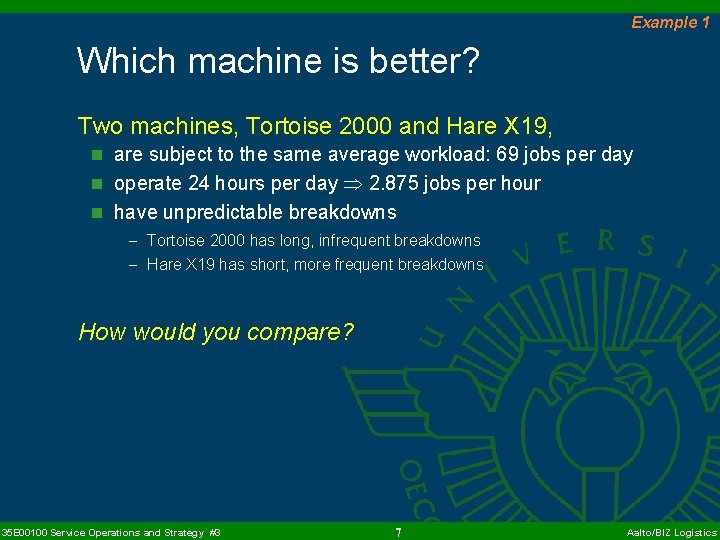
Example 1 Which machine is better? Two machines, Tortoise 2000 and Hare X 19, n are subject to the same average workload: 69 jobs per day n operate 24 hours per day 2. 875 jobs per hour n have unpredictable breakdowns - Tortoise 2000 has long, infrequent breakdowns - Hare X 19 has short, more frequent breakdowns How would you compare? 35 E 00100 Service Operations and Strategy #3 7 Aalto/BIZ Logistics
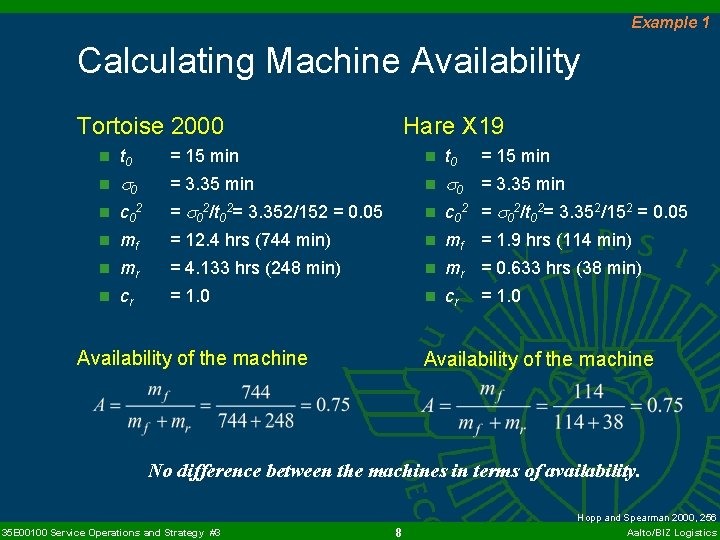
Example 1 Calculating Machine Availability Tortoise 2000 n t 0 = 15 min n t 0 = 3. 35 min n = 15 min n c 02 = 02/t 02= 3. 352/152 = 0. 05 0 = 3. 35 min n c 02 = 02/t 02= 3. 352/152 = 0. 05 n mf = 12. 4 hrs (744 min) n mf = 1. 9 hrs (114 min) n mr = 4. 133 hrs (248 min) n mr = 0. 633 hrs (38 min) n cr = 1. 0 n 0 Hare X 19 Availability of the machine No difference between the machines in terms of availability. 35 E 00100 Service Operations and Strategy #3 8 Hopp and Spearman 2000, 256 Aalto/BIZ Logistics
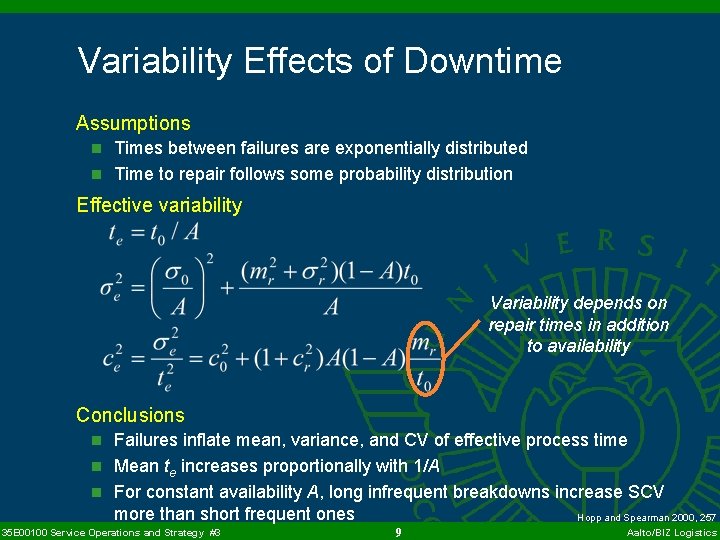
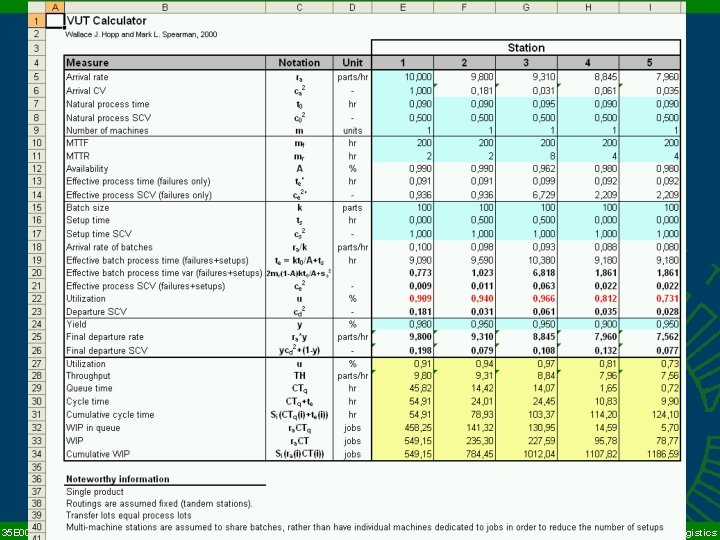
Variability Effects of Downtime Assumptions n Times between failures are exponentially distributed n Time to repair follows some probability distribution Effective variability Variability depends on repair times in addition to availability Conclusions n Failures inflate mean, variance, and CV of effective process time n Mean te increases proportionally with 1/A n For constant availability A, long infrequent breakdowns increase SCV more than short frequent ones 35 E 00100 Service Operations and Strategy #3 9 Hopp and Spearman 2000, 257 Aalto/BIZ Logistics
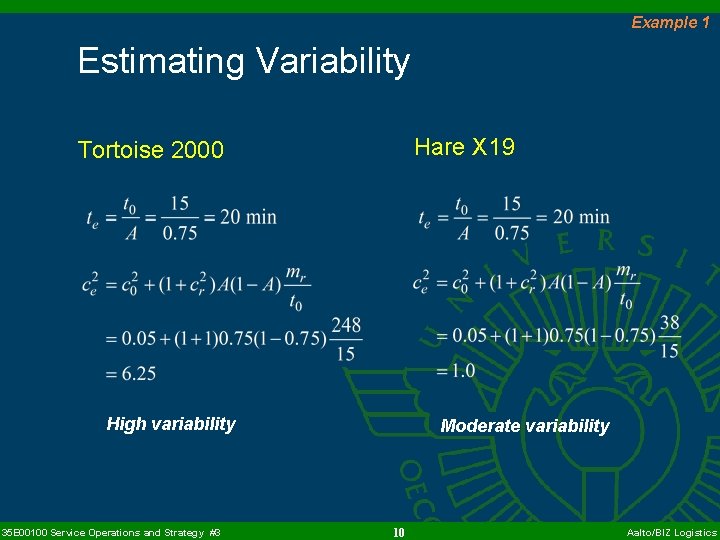
Example 1 Estimating Variability Hare X 19 Tortoise 2000 High variability 35 E 00100 Service Operations and Strategy #3 Moderate variability 10 Aalto/BIZ Logistics
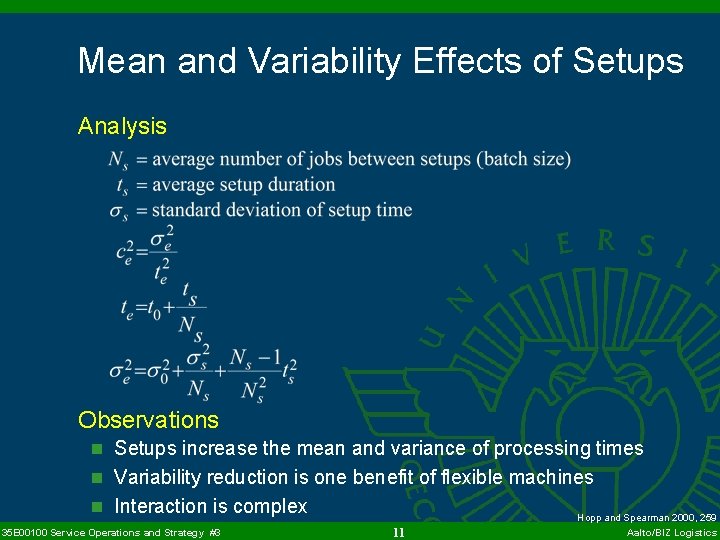
Mean and Variability Effects of Setups Analysis Observations n Setups increase the mean and variance of processing times n Variability reduction is one benefit of flexible machines n Interaction is complex 35 E 00100 Service Operations and Strategy #3 11 Hopp and Spearman 2000, 259 Aalto/BIZ Logistics
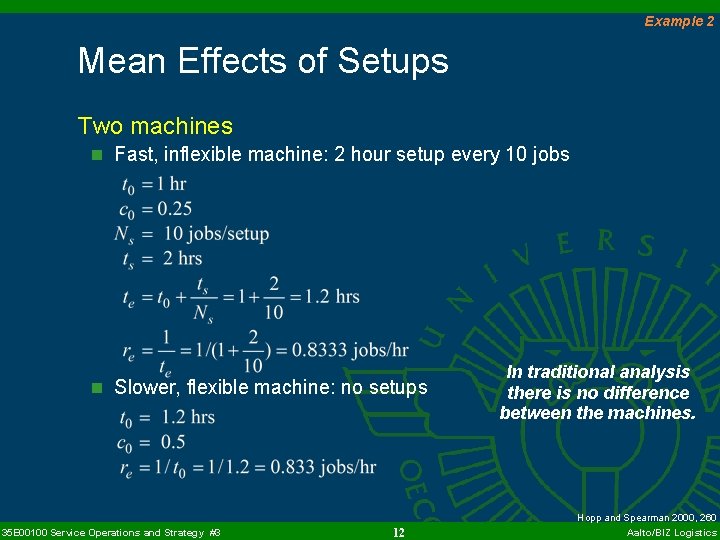
Example 2 Mean Effects of Setups Two machines n Fast, inflexible machine: 2 hour setup every 10 jobs n Slower, flexible machine: no setups 35 E 00100 Service Operations and Strategy #3 12 In traditional analysis there is no difference between the machines. Hopp and Spearman 2000, 260 Aalto/BIZ Logistics
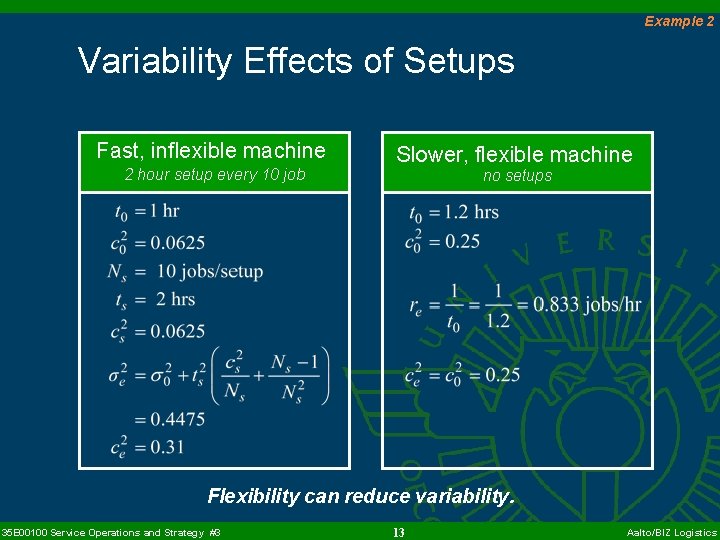
Example 2 Variability Effects of Setups Fast, inflexible machine 2 hour setup every 10 job Slower, flexible machine no setups Flexibility can reduce variability. 35 E 00100 Service Operations and Strategy #3 13 Aalto/BIZ Logistics
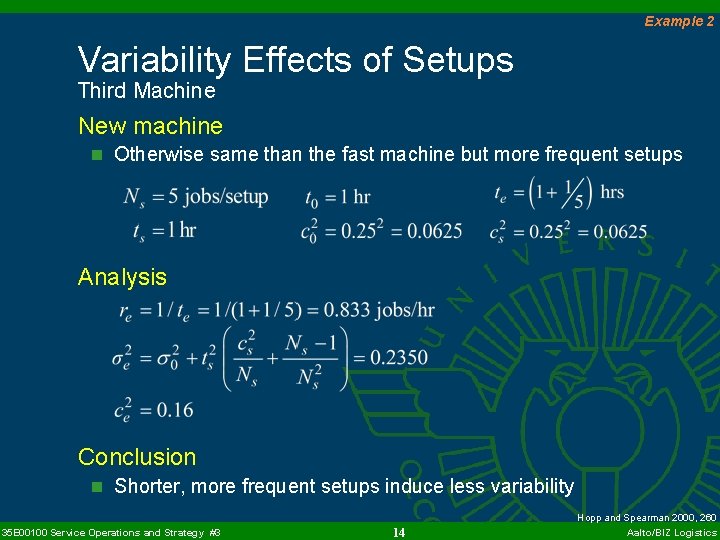
Example 2 Variability Effects of Setups Third Machine New machine n Otherwise same than the fast machine but more frequent setups Analysis Conclusion n Shorter, more frequent setups induce less variability 35 E 00100 Service Operations and Strategy #3 14 Hopp and Spearman 2000, 260 Aalto/BIZ Logistics
Inflators of Process Variability Sources e. g. n Operator unavailability n Batching n Material unavailability n Recycle Effects of process variability n Inflate the mean processing time te n Inflate the CV of te - Effective process variability can be LV, MV, or HV 35 E 00100 Service Operations and Strategy #3 15 Aalto/BIZ Logistics
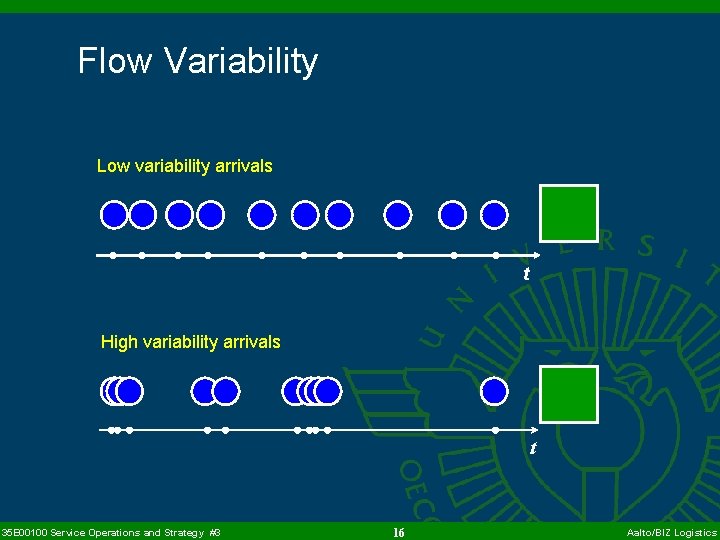
Flow Variability Low variability arrivals t High variability arrivals t 35 E 00100 Service Operations and Strategy #3 16 Aalto/BIZ Logistics

Propagation of Variability ra(i) ca 2(i) re(i) i ce 2(i) rd(i) = ra(i+1) cd 2(i) = ca 2(i+1) re(i+1) i+1 ce 2(i+1) Departure SCV in single machine station where station utilization u is given by u = rate Departure SCV in multi-machine station 35 E 00100 Service Operations and Strategy #3 17 Departure variance depends on arrival variance and process variance Hopp and Spearman 2000, 262 Aalto/BIZ Logistics
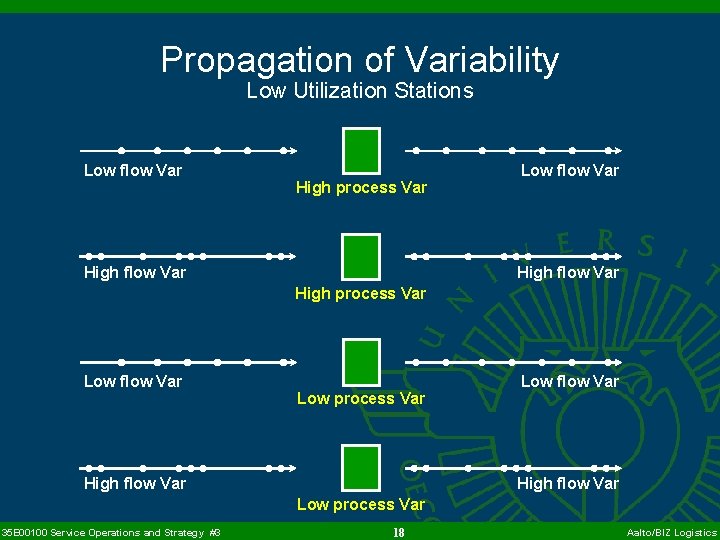
Propagation of Variability Low Utilization Stations Low flow Var High process Var High flow Var Low flow Var High process Var Low flow Var Low process Var High flow Var Low flow Var High flow Var Low process Var 35 E 00100 Service Operations and Strategy #3 18 Aalto/BIZ Logistics
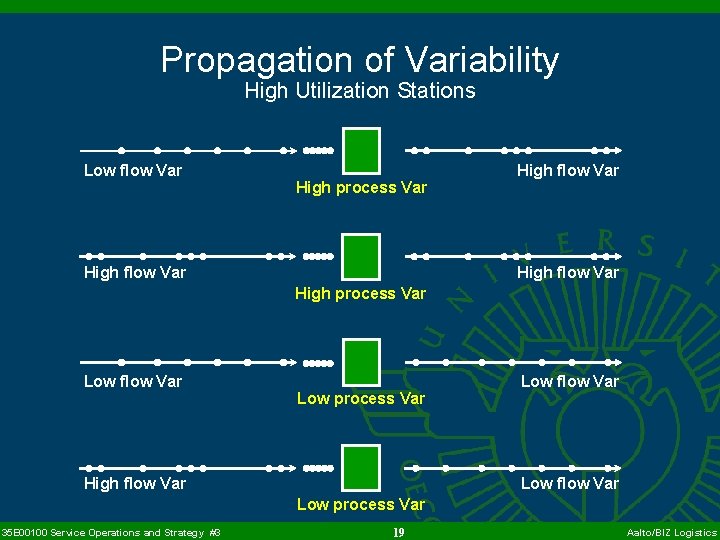
Propagation of Variability High Utilization Stations Low flow Var High process Var High flow Var High process Var Low flow Var Low process Var High flow Var Low process Var 35 E 00100 Service Operations and Strategy #3 19 Aalto/BIZ Logistics
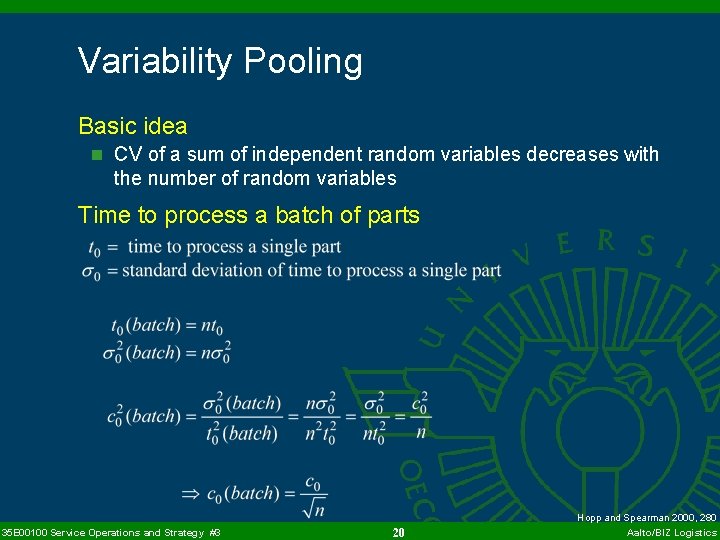
Variability Pooling Basic idea n CV of a sum of independent random variables decreases with the number of random variables Time to process a batch of parts 35 E 00100 Service Operations and Strategy #3 20 Hopp and Spearman 2000, 280 Aalto/BIZ Logistics
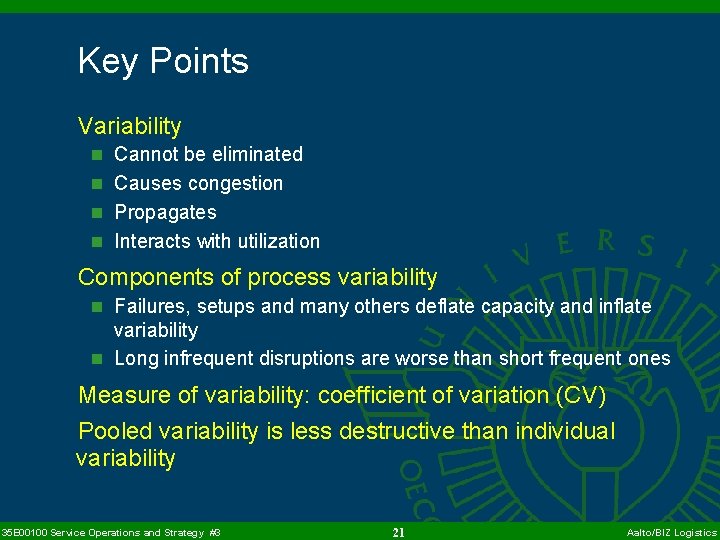
Key Points Variability n Cannot be eliminated n Causes congestion n Propagates n Interacts with utilization Components of process variability n Failures, setups and many others deflate capacity and inflate variability n Long infrequent disruptions are worse than short frequent ones Measure of variability: coefficient of variation (CV) Pooled variability is less destructive than individual variability 35 E 00100 Service Operations and Strategy #3 21 Aalto/BIZ Logistics
35 E 00100 Service Operations and Strategy #3 22 Aalto/BIZ Logistics
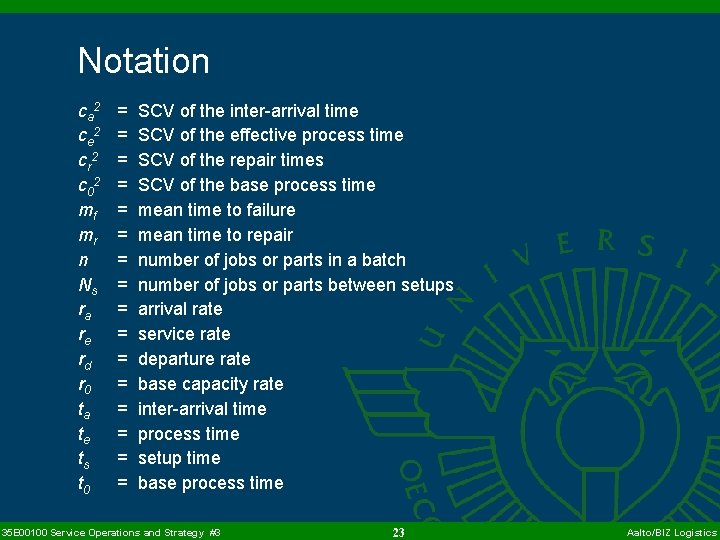
Notation ca 2 ce 2 cr 2 c 02 mf mr n Ns ra re rd r 0 ta te ts t 0 = = = = SCV of the inter-arrival time SCV of the effective process time SCV of the repair times SCV of the base process time mean time to failure mean time to repair number of jobs or parts in a batch number of jobs or parts between setups arrival rate service rate departure rate base capacity rate inter-arrival time process time setup time base process time 35 E 00100 Service Operations and Strategy #3 23 Aalto/BIZ Logistics
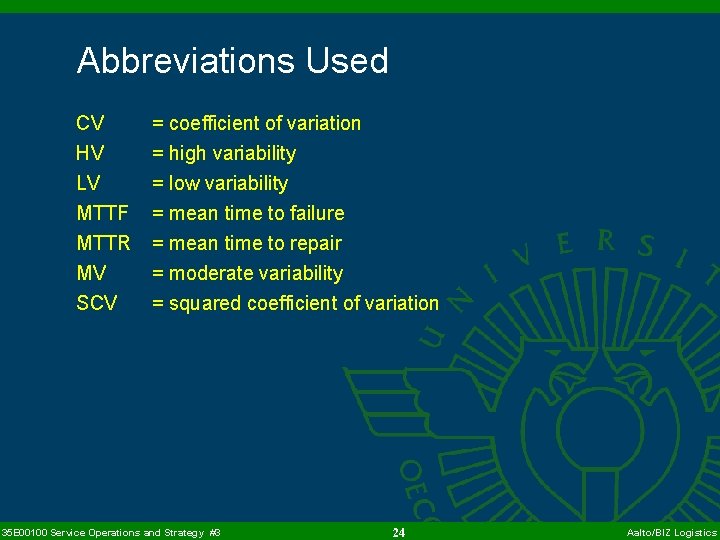
Abbreviations Used CV HV LV MTTF MTTR MV SCV = coefficient of variation = high variability = low variability = mean time to failure = mean time to repair = moderate variability = squared coefficient of variation 35 E 00100 Service Operations and Strategy #3 24 Aalto/BIZ Logistics

The Corrupting Influence of Variability
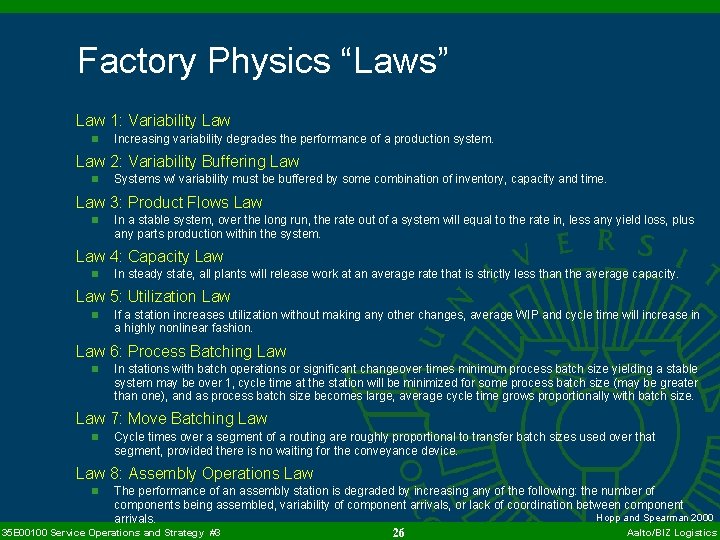
Factory Physics “Laws” Law 1: Variability Law n Increasing variability degrades the performance of a production system. Law 2: Variability Buffering Law n Systems w/ variability must be buffered by some combination of inventory, capacity and time. Law 3: Product Flows Law n In a stable system, over the long run, the rate out of a system will equal to the rate in, less any yield loss, plus any parts production within the system. Law 4: Capacity Law n In steady state, all plants will release work at an average rate that is strictly less than the average capacity. Law 5: Utilization Law n If a station increases utilization without making any other changes, average WIP and cycle time will increase in a highly nonlinear fashion. Law 6: Process Batching Law n In stations with batch operations or significant changeover times minimum process batch size yielding a stable system may be over 1, cycle time at the station will be minimized for some process batch size (may be greater than one), and as process batch size becomes large, average cycle time grows proportionally with batch size. Law 7: Move Batching Law n Cycle times over a segment of a routing are roughly proportional to transfer batch sizes used over that segment, provided there is no waiting for the conveyance device. Law 8: Assembly Operations Law The performance of an assembly station is degraded by increasing any of the following: the number of components being assembled, variability of component arrivals, or lack of coordination between component Hopp and Spearman 2000 arrivals. 35 E 00100 Service Operations and Strategy #3 Aalto/BIZ Logistics 26 n
”Law 1” Variability Law Increasing variability degrades the performance of a production system. For example: n Higher demand variability requires more safety stock for same level of customer service. n Higher cycle time variability requires longer lead time quotes to attain the same level of on-time delivery. 35 E 00100 Service Operations and Strategy #3 27 Hopp and Spearman 2000, 294 -295 Aalto/BIZ Logistics

”Law 2” Variability Buffering Law Systems with variability must be buffered by some combination of inventory, capacity, and time. Is variability always harmful? 35 E 00100 Service Operations and Strategy #3 28 Hopp and Spearman 2000, 295 -296 Aalto/BIZ Logistics
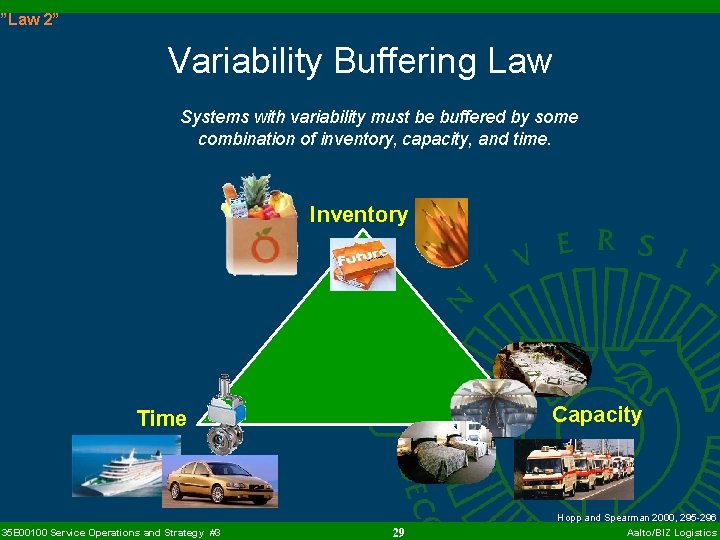
”Law 2” Variability Buffering Law Systems with variability must be buffered by some combination of inventory, capacity, and time. Inventory Capacity Time 35 E 00100 Service Operations and Strategy #3 29 Hopp and Spearman 2000, 295 -296 Aalto/BIZ Logistics
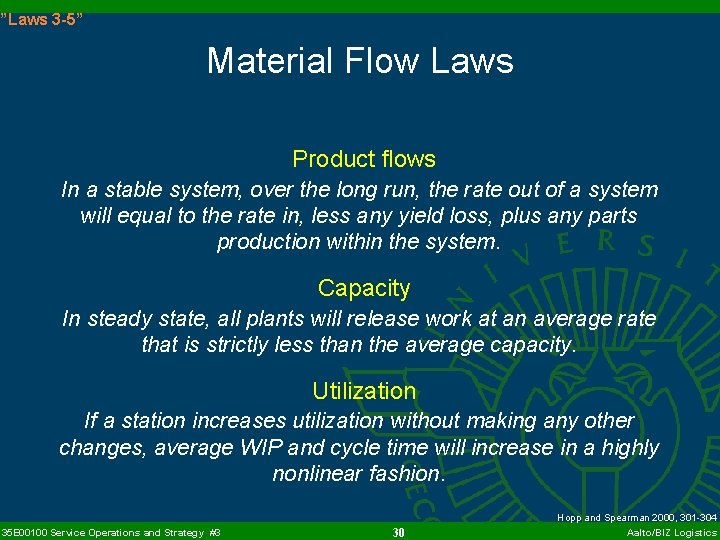
”Laws 3 -5” Material Flow Laws Product flows In a stable system, over the long run, the rate out of a system will equal to the rate in, less any yield loss, plus any parts production within the system. Capacity In steady state, all plants will release work at an average rate that is strictly less than the average capacity. Utilization If a station increases utilization without making any other changes, average WIP and cycle time will increase in a highly nonlinear fashion. 35 E 00100 Service Operations and Strategy #3 30 Hopp and Spearman 2000, 301 -304 Aalto/BIZ Logistics
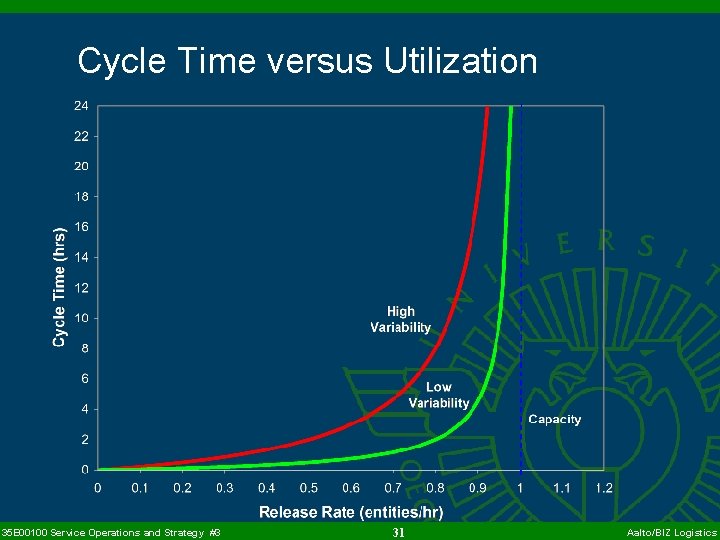
Cycle Time versus Utilization 35 E 00100 Service Operations and Strategy #3 31 Aalto/BIZ Logistics

”Law 6” Process Batching Law In stations with batch operations or significant changeover times n The minimum process batch size that yields a stable system may be greater than one. n Cycle time at the station will be minimized for some process batch size, which may be greater than one. n As process batch size becomes large, average cycle time grows proportionally with batch size. Hopp and Spearman 2000, 306 35 E 00100 Service Operations and Strategy #3 32 Aalto/BIZ Logistics
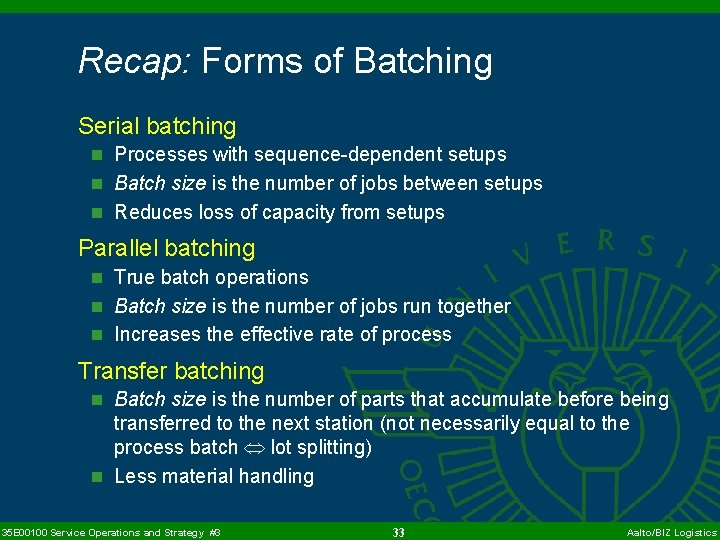
Recap: Forms of Batching Serial batching n Processes with sequence-dependent setups n Batch size is the number of jobs between setups n Reduces loss of capacity from setups Parallel batching n True batch operations n Batch size is the number of jobs run together n Increases the effective rate of process Transfer batching n Batch size is the number of parts that accumulate before being transferred to the next station (not necessarily equal to the process batch lot splitting) n Less material handling 35 E 00100 Service Operations and Strategy #3 33 Aalto/BIZ Logistics
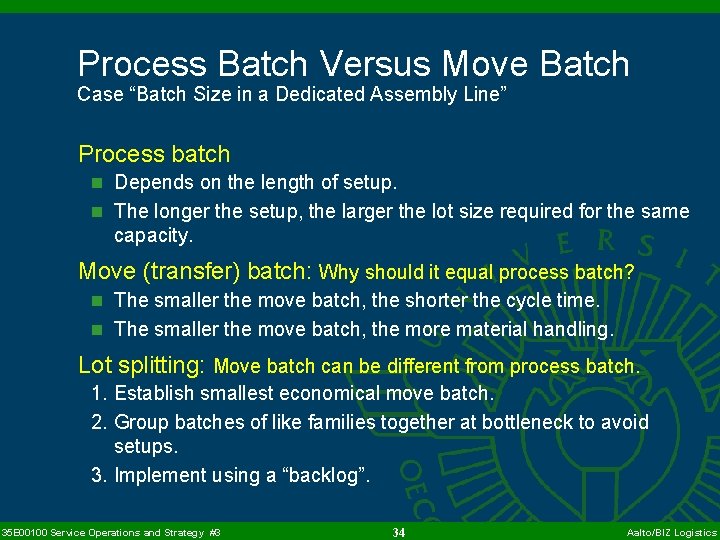
Process Batch Versus Move Batch Case “Batch Size in a Dedicated Assembly Line” Process batch n Depends on the length of setup. n The longer the setup, the larger the lot size required for the same capacity. Move (transfer) batch: Why should it equal process batch? n The smaller the move batch, the shorter the cycle time. n The smaller the move batch, the more material handling. Lot splitting: Move batch can be different from process batch. 1. Establish smallest economical move batch. 2. Group batches of like families together at bottleneck to avoid setups. 3. Implement using a “backlog”. 35 E 00100 Service Operations and Strategy #3 34 Aalto/BIZ Logistics
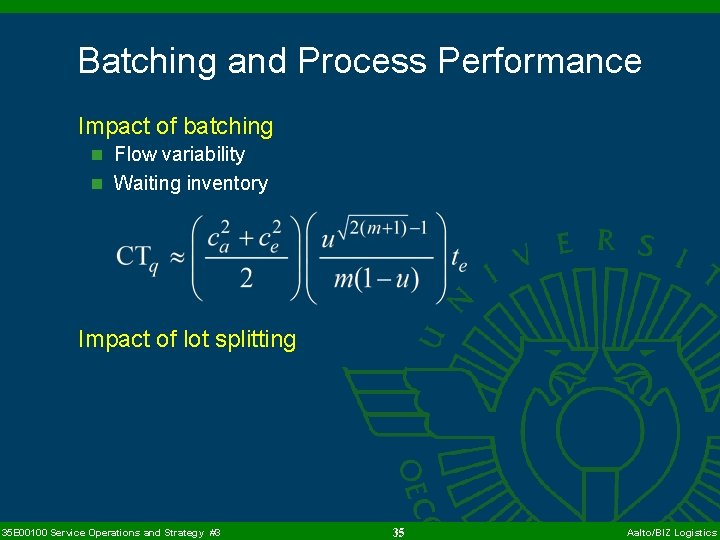
Batching and Process Performance Impact of batching n Flow variability n Waiting inventory Impact of lot splitting 35 E 00100 Service Operations and Strategy #3 35 Aalto/BIZ Logistics
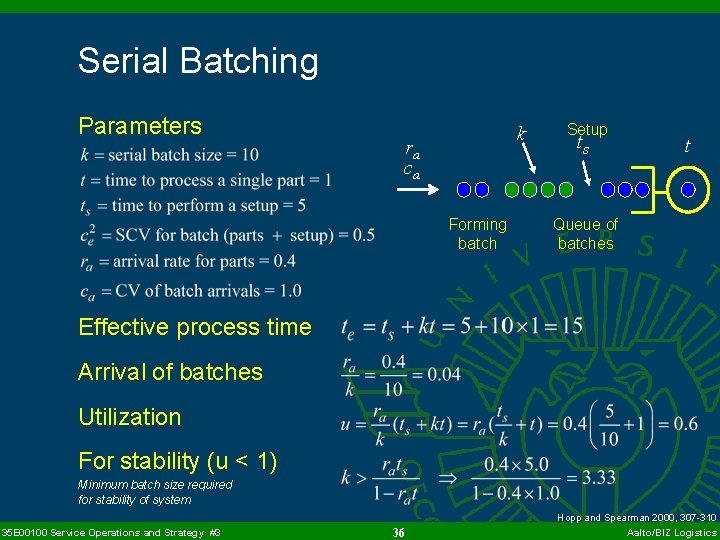
Serial Batching Parameters k ra ca Forming batch Setup ts t Queue of batches Effective process time Arrival of batches Utilization For stability (u < 1) Minimum batch size required for stability of system 35 E 00100 Service Operations and Strategy #3 36 Hopp and Spearman 2000, 307 -310 Aalto/BIZ Logistics
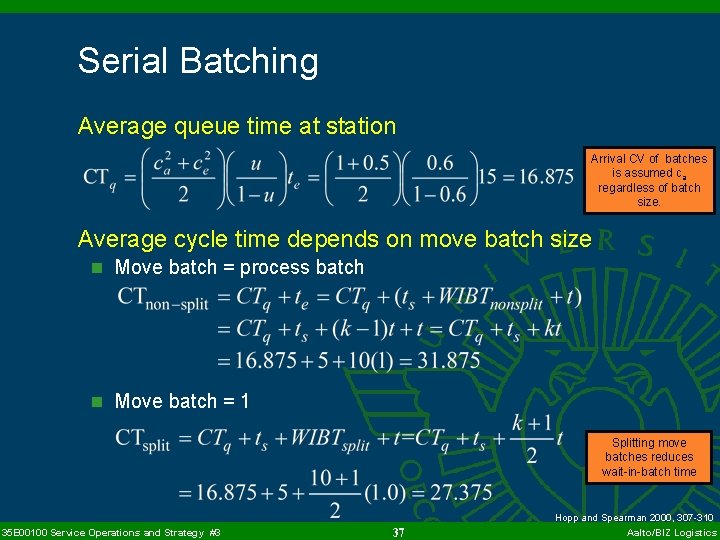
Serial Batching Average queue time at station Arrival CV of batches is assumed ca regardless of batch size. Average cycle time depends on move batch size n Move batch = process batch n Move batch = 1 Splitting move batches reduces wait-in-batch time 35 E 00100 Service Operations and Strategy #3 37 Hopp and Spearman 2000, 307 -310 Aalto/BIZ Logistics
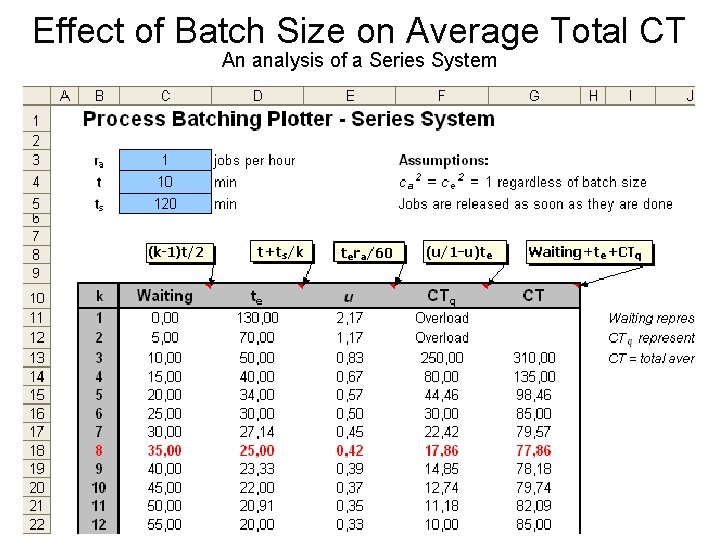
Effect of Batch Size on Average Total CT An analysis of a Series System 38
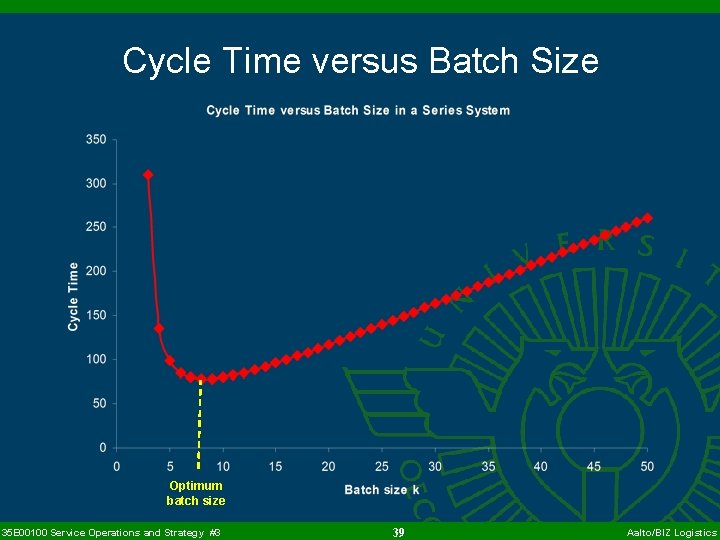
Cycle Time versus Batch Size Optimum batch size 35 E 00100 Service Operations and Strategy #3 39 Aalto/BIZ Logistics
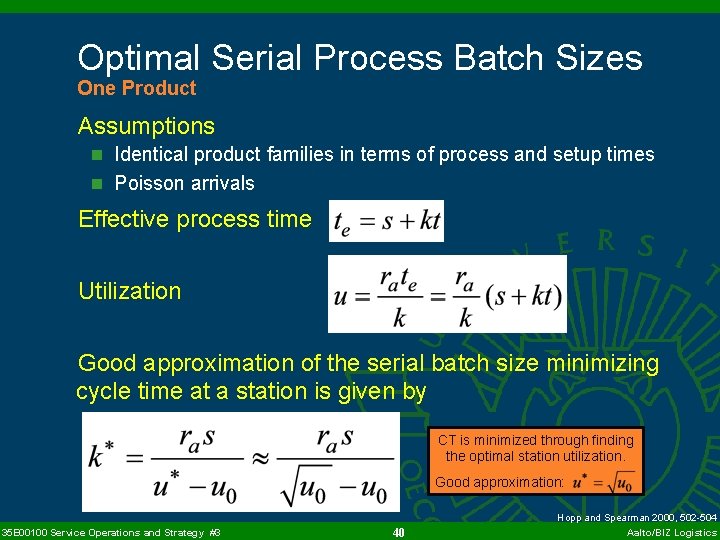
Optimal Serial Process Batch Sizes One Product Assumptions n Identical product families in terms of process and setup times n Poisson arrivals Effective process time Utilization Good approximation of the serial batch size minimizing cycle time at a station is given by CT is minimized through finding the optimal station utilization. Good approximation: 35 E 00100 Service Operations and Strategy #3 40 Hopp and Spearman 2000, 502 -504 Aalto/BIZ Logistics

Optimal Serial Process Batch Sizes Multiple Products Assumptions n Multiple products n Poisson arrivals Eff. process time Utilization Good approximation of the serial batch size minimizing cycle time at a station is given by 35 E 00100 Service Operations and Strategy #3 41 Hopp and Spearman 2000, 504 -507 Aalto/BIZ Logistics
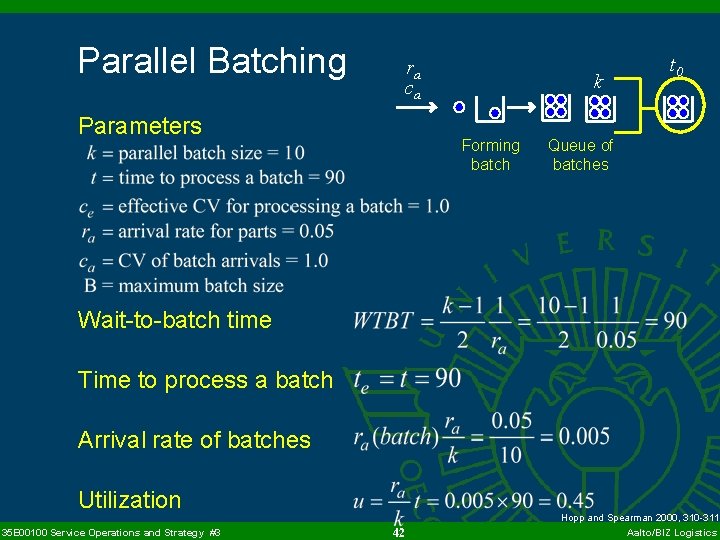
Parallel Batching ra ca Parameters k Forming batch t 0 Queue of batches Wait-to-batch time Time to process a batch Arrival rate of batches Utilization 35 E 00100 Service Operations and Strategy #3 42 Hopp and Spearman 2000, 310 -311 Aalto/BIZ Logistics
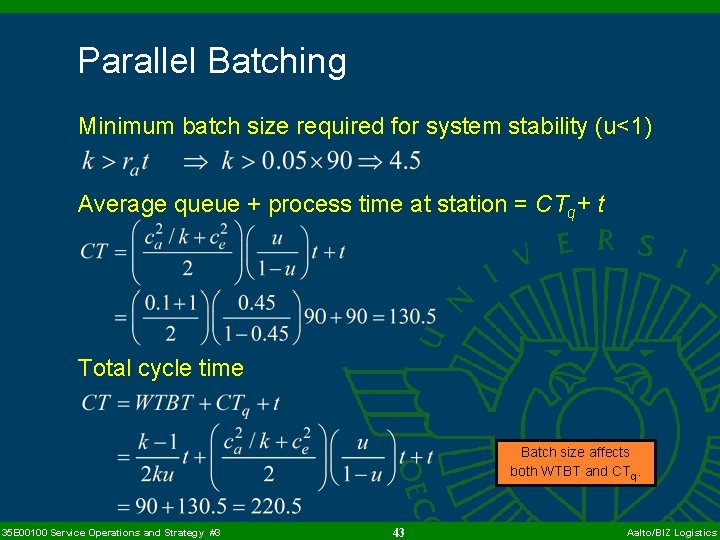
Parallel Batching Minimum batch size required for system stability (u<1) Average queue + process time at station = CTq+ t Total cycle time Batch size affects both WTBT and CTq. 35 E 00100 Service Operations and Strategy #3 43 Aalto/BIZ Logistics
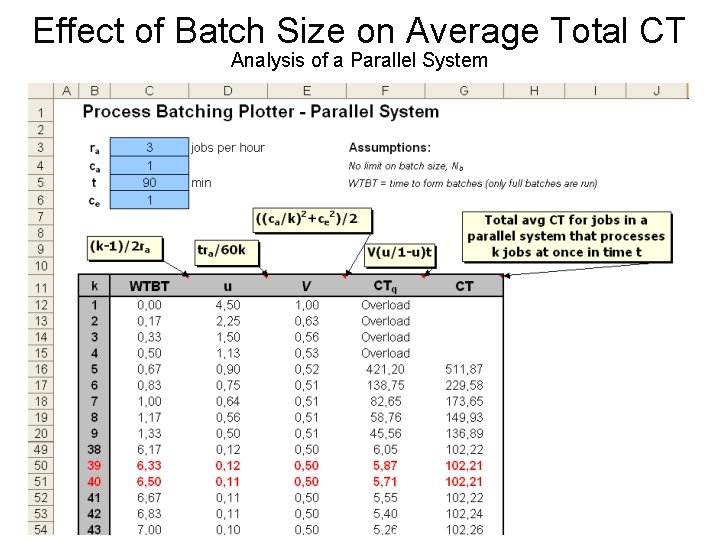
Effect of Batch Size on Average Total CT Analysis of a Parallel System 44
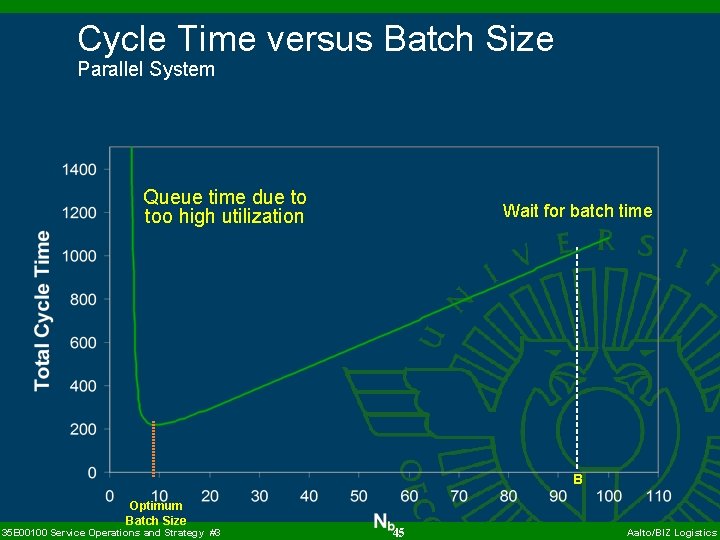
Cycle Time versus Batch Size Parallel System Queue time due to too high utilization Wait for batch time B Optimum Batch Size 35 E 00100 Service Operations and Strategy #3 45 Aalto/BIZ Logistics
”Law 7” Move Batching Law Cycle times over a segment of a routing are roughly proportional to transfer batch sizes used over that segment, provided there is no waiting for the conveyance device. Insights n Queuing for conveyance device can offset cycle time reduction from reduced move batch size. n Move batching intimately related to material handling and layout decisions. 35 E 00100 Service Operations and Strategy #3 46 Hopp and Spearman 2000, 312 Aalto/BIZ Logistics
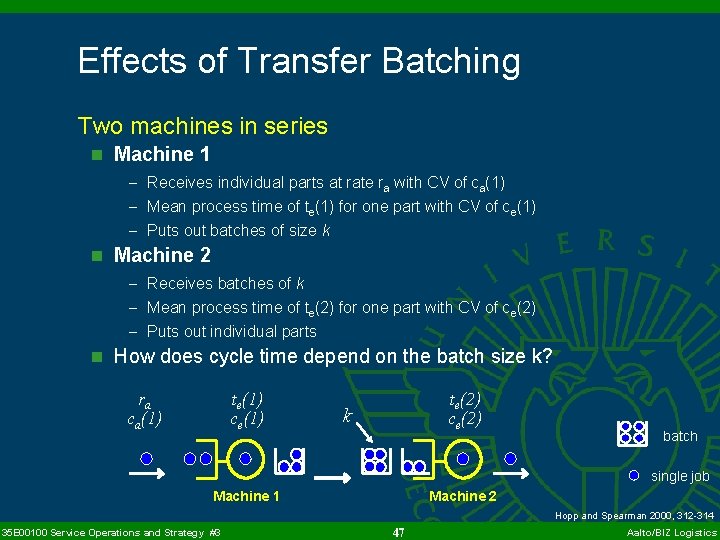
Effects of Transfer Batching Two machines in series n Machine 1 - Receives individual parts at rate ra with CV of ca(1) - Mean process time of te(1) for one part with CV of ce(1) - Puts out batches of size k n Machine 2 - Receives batches of k - Mean process time of te(2) for one part with CV of ce(2) - Puts out individual parts n How does cycle time depend on the batch size k? ra ca(1) te(1) ce(1) te(2) ce(2) k batch single job Machine 1 Machine 2 Hopp and Spearman 2000, 312 -314 35 E 00100 Service Operations and Strategy #3 47 Aalto/BIZ Logistics

Transfer Batching – Machine 1 n Average time forming the batch: 1 st part waits (k-1)(1/ra), last part does not wait. n Average time after batching: n Average total time spent at the 1 st station: n Time between output of individual parts into the batch: ta n Time between output of batches of size k: kta n Variance of inter-output times of parts is cd 2(1)ta 2, where By definition CV cd 2(1)= d 2/ta 2 Departures are independent variances add n Variance of batches of size k: 35 E 00100 Service Operations and Strategy #3 48 Hopp and Spearman 2000, 312 -314 Aalto/BIZ Logistics
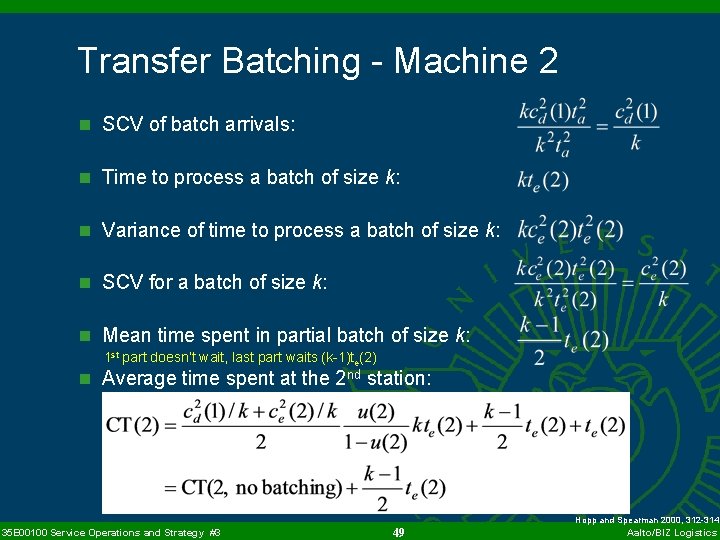
Transfer Batching - Machine 2 n SCV of batch arrivals: n Time to process a batch of size k: n Variance of time to process a batch of size k: n SCV for a batch of size k: n Mean time spent in partial batch of size k: 1 st part doesn’t wait, last part waits (k-1)te(2) n Average time spent at the 2 nd station: Hopp and Spearman 2000, 312 -314 35 E 00100 Service Operations and Strategy #3 49 Aalto/BIZ Logistics
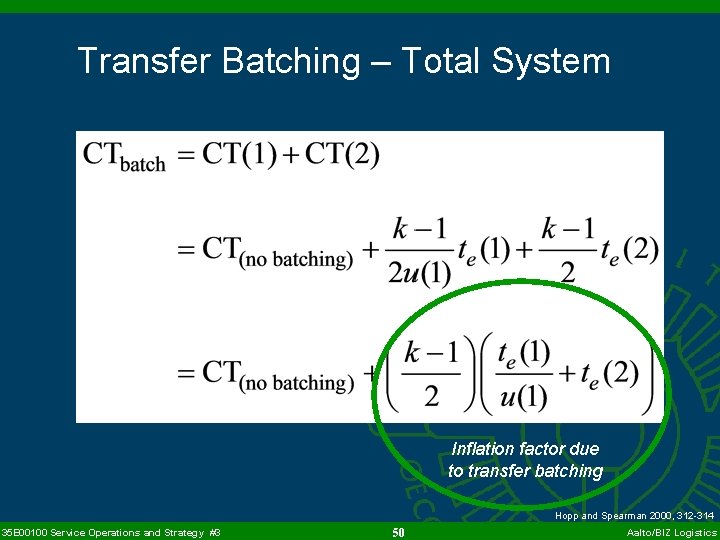
Transfer Batching – Total System Inflation factor due to transfer batching Hopp and Spearman 2000, 312 -314 35 E 00100 Service Operations and Strategy #3 50 Aalto/BIZ Logistics
”Law 8” Assembly Operations Law The performance of an assembly station is degraded by increasing any of the following n The number of components being assembled n Variability of component arrivals n Lack of coordination between component arrivals Hopp and Spearman 2000, 315 -316 35 E 00100 Service Operations and Strategy #3 51 Aalto/BIZ Logistics
Ways to Improve Operations 1. Increase throughput 2. Reduce queue time 3. Reduce batching delay 4. Reduce matching delay 5. Improve customer service 35 E 00100 Service Operations and Strategy #3 52 Hopp and Spearman 2000, 324 -32 Aalto/BIZ Logistics
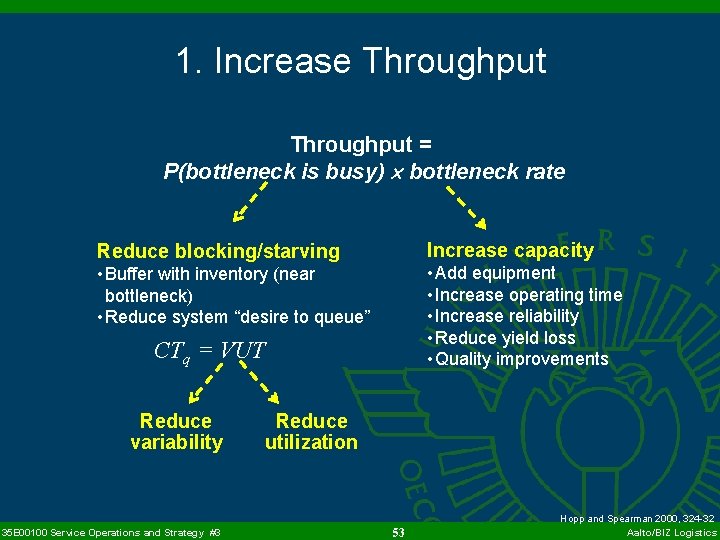
1. Increase Throughput = P(bottleneck is busy) bottleneck rate Increase capacity Reduce blocking/starving • Add equipment • Increase operating time • Increase reliability • Reduce yield loss • Quality improvements • Buffer with inventory (near bottleneck) • Reduce system “desire to queue” CTq = VUT Reduce variability 35 E 00100 Service Operations and Strategy #3 Reduce utilization 53 Hopp and Spearman 2000, 324 -32 Aalto/BIZ Logistics
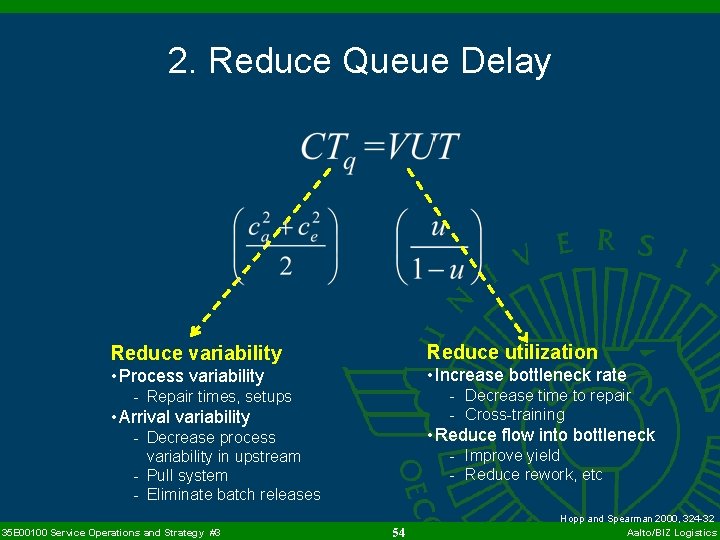
2. Reduce Queue Delay Reduce variability Reduce utilization • Process variability • Increase bottleneck rate - Decrease time to repair - Cross-training - Repair times, setups • Arrival variability • Reduce flow into bottleneck - Decrease process variability in upstream - Pull system - Eliminate batch releases 35 E 00100 Service Operations and Strategy #3 - Improve yield - Reduce rework, etc 54 Hopp and Spearman 2000, 324 -32 Aalto/BIZ Logistics
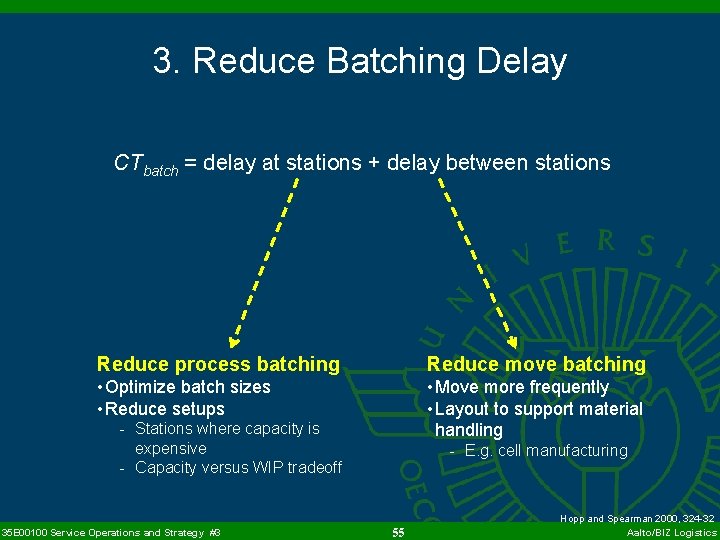
3. Reduce Batching Delay CTbatch = delay at stations + delay between stations Reduce process batching Reduce move batching • Optimize batch sizes • Reduce setups • Move more frequently • Layout to support material handling - Stations where capacity is expensive - Capacity versus WIP tradeoff 35 E 00100 Service Operations and Strategy #3 - E. g. cell manufacturing 55 Hopp and Spearman 2000, 324 -32 Aalto/BIZ Logistics
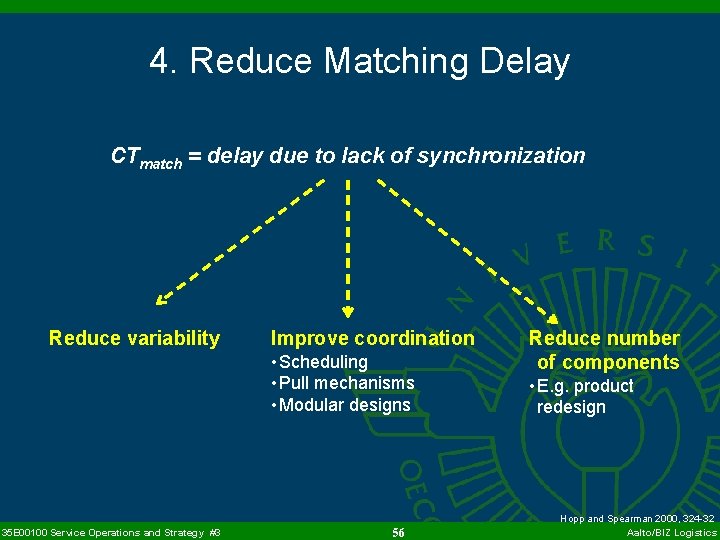
4. Reduce Matching Delay CTmatch = delay due to lack of synchronization Reduce variability Improve coordination • Scheduling • Pull mechanisms • Modular designs 35 E 00100 Service Operations and Strategy #3 56 Reduce number of components • E. g. product redesign Hopp and Spearman 2000, 324 -32 Aalto/BIZ Logistics
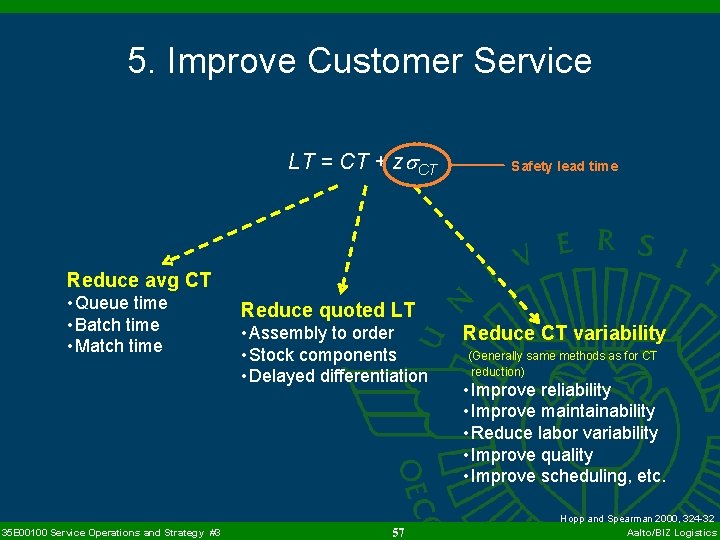
5. Improve Customer Service LT = CT + z CT Safety lead time Reduce avg CT • Queue time • Batch time • Match time 35 E 00100 Service Operations and Strategy #3 Reduce quoted LT • Assembly to order • Stock components • Delayed differentiation 57 Reduce CT variability (Generally same methods as for CT reduction) • Improve reliability • Improve maintainability • Reduce labor variability • Improve quality • Improve scheduling, etc. Hopp and Spearman 2000, 324 -32 Aalto/BIZ Logistics
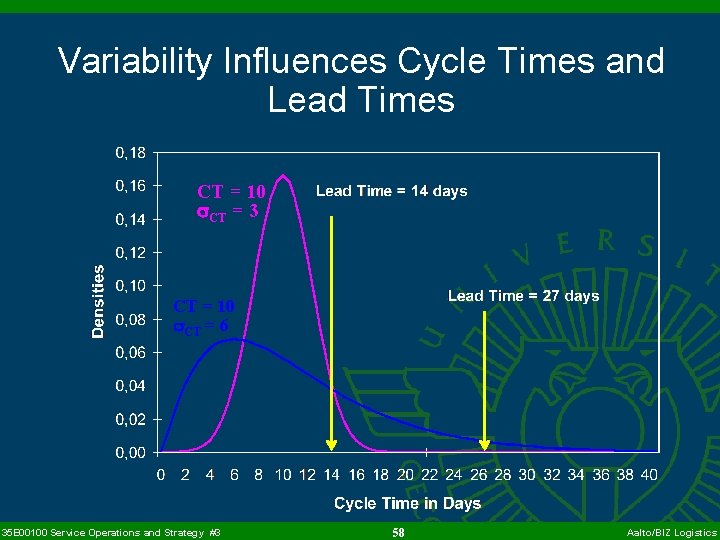
Variability Influences Cycle Times and Lead Times CT = 10 CT = 3 CT = 10 CT = 6 35 E 00100 Service Operations and Strategy #3 58 Aalto/BIZ Logistics
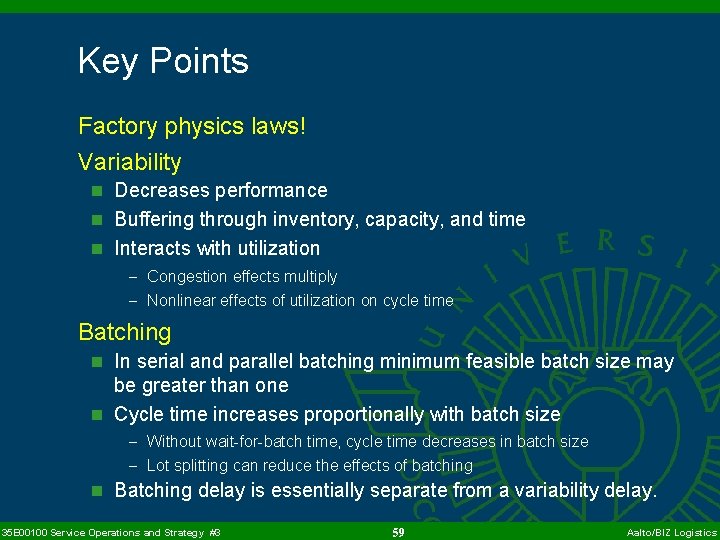
Key Points Factory physics laws! Variability n Decreases performance n Buffering through inventory, capacity, and time n Interacts with utilization - Congestion effects multiply - Nonlinear effects of utilization on cycle time Batching n In serial and parallel batching minimum feasible batch size may be greater than one n Cycle time increases proportionally with batch size - Without wait-for-batch time, cycle time decreases in batch size - Lot splitting can reduce the effects of batching n Batching delay is essentially separate from a variability delay. 35 E 00100 Service Operations and Strategy #3 59 Aalto/BIZ Logistics
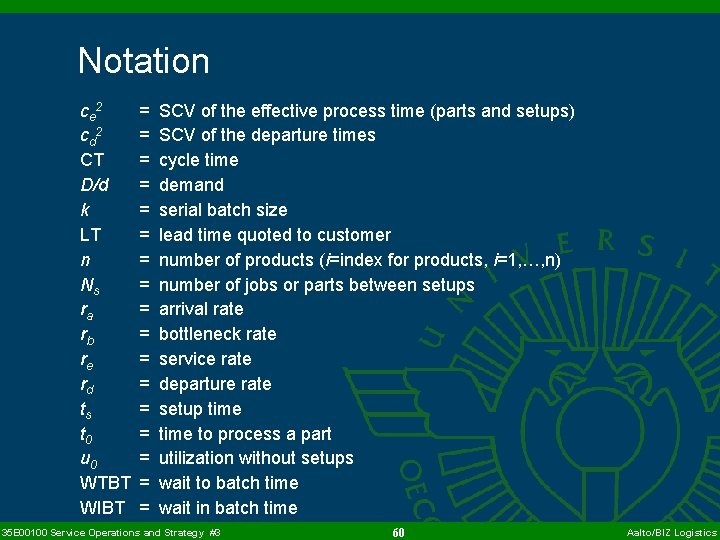
Notation ce 2 cd 2 CT D/d k LT n Ns ra rb re rd ts t 0 u 0 WTBT WIBT = = = = = SCV of the effective process time (parts and setups) SCV of the departure times cycle time demand serial batch size lead time quoted to customer number of products (i=index for products, i=1, …, n) number of jobs or parts between setups arrival rate bottleneck rate service rate departure rate setup time to process a part utilization without setups wait to batch time wait in batch time 35 E 00100 Service Operations and Strategy #3 60 Aalto/BIZ Logistics
- Slides: 60