
The Effects of Heavy Backpacks on Postural and
The Effects of Heavy Backpacks on Postural and Spinal Health Given by: Winn Sams, D. C.
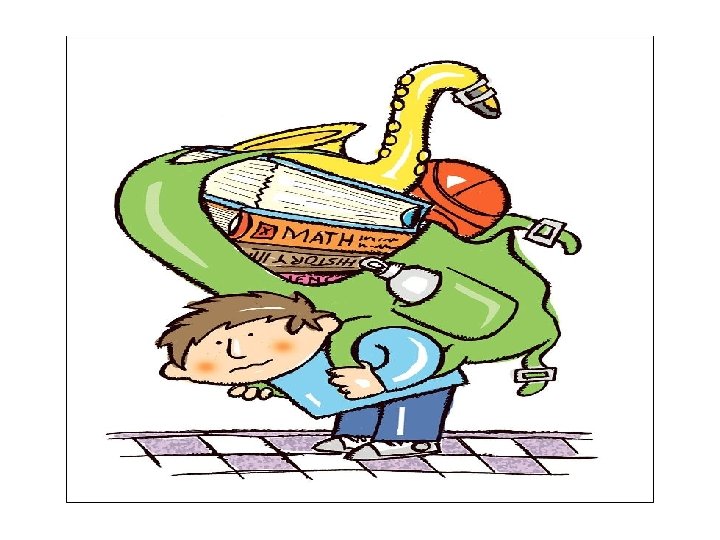
Not a new issue A study published in the journal SPINE in 2003 (1) surveyed over 1100 kids aged between 12 and 18 years old and found almost 75% of them had back pain that was associated with backpack use. Similarly, a study published in 2006 in the journal of Pediatric Orthopaedics (2) found that the weights of students' backpacks seemed directly proportional to the likelihood of back pain.

What is the maximum weight limit? • American Chiropractic Association recommends no more than 10% of a child’s body weight. • The following studies also support no more than 10%: - https: //www. ncbi. nlm. nih. gov/pubmed/20023607 - https: //www. ncbi. nlm. nih. gov/pubmed/26413545 - https: //www. ncbi. nlm. nih. gov/pubmed/25911845 - https: //www. ncbi. nlm. nih. gov/pubmed/24619606
Apply this to a young child whose spine is still developing: Adults wearing backpacks with loads of 26 pounds for just 10 minutes experienced an almost 50 percent decrease in blood flow through large and small vessels in their upper bodies in a study conducted by the University of California, San Diego's department of orthopaedic surgery. Washington Post; Monday, April 7, 2008;
The Effect of Backpacks on the Lumbar Spine in Children: A Standing Magnetic Resonance Imaging Study Journal Article/Spine v More than 90 percent of U. S. children carry backpacks, typically with weights equal to 10 to 22 percent of their body weight. v The results suggest that heavy backpacks cause compression of the spinal disks and increased spinal curvature, both of which are related to back pain reported by the children. Although the children were wearing the backpack straps over both shoulders when the MRI scans were performed, the researchers note that spinal curvature could be even greater if the backpack was carried over one shoulder—as many children do. v "Low back pain in children may be worsened by discogenic [disc-related] or postural changes, " Dr. Neuschwander and colleagues write. This could have long-term implications, as children with back pain are at increased risk of having back pain as adults.

School children's backpacks, back pain and back pathologies Arch Dis Child archdischild-2011 -301253 Published Online First: 10 March 2012 v 1403 school children were analyzed, aged 12 -17. v Of these, 61. 4% had backpacks exceeding 10% of their body weight. v One in four students said they had experienced back pain for more than 15 days during the previous year. The most common problem was scoliosis, or curvature of the spine, which was diagnosed in 70 percent of the students with back pain. Low back pain and continuous and involuntary muscle contraction were also common problems. v Those carrying the heaviest backpacks had a 50% higher risk of back pain and a 42% higher risk of back pathology. v Girls presented a higher risk of back pain compared with boys. v Findings posted in Archives of Childhood Diseases.

Further studies on posture, gait and body mechanics changes from wearing too heavy of a backpack. v Effects of backpack load position on spatiotemporal parameters and trunk forward leanhttp: //www. gaitposture. com/article/S 0966 -6362%2808%2900157 -4/abstract v Effects of backpack carriage on foot–ground relationship in children during upright stance- http: //www. gaitposture. com/article/S 0966 -6362(10)00388 -7/abstract? cc=y= v Influence of the Weight of a School Backpack on Spinal Curvature in the Sagittal Plane of Seven-Year-Old Children- https: //www. ncbi. nlm. nih. gov/pubmed/26413545 v Backpack Weight and Musculoskeletal Symptoms in Secondary School Studentshttps: //www. ncbi. nlm. nih. gov/pmc/articles/PMC 3481694/ Many more on my site, www. bacsupport. com, under “Resources”.

Clear enough?
Tel Aviv Study Released February 21, 2013 Recent study determined that the “pressure of heavy loads carried on the back have the potential to damage the soft tissues of the shoulder, causing microstructural damage to the nerves. ” American Friends of Tel Aviv University (2013, February 21).

So, heavy backpacks don’t cause damage? What research has shown so far with backpack weighing more than 10% of a child’s body weight: v Contribute to curvatures of the spine (scoliosis) and decreased intervertebral disc space. v Lumbar asymmetry. v. Higher risks of back pain and pathologies. v Altered gait, posture and body mechanics. v Potential damage to the soft tissue of the shoulder, with concurrent microstructual damage to the nerves.

Need More Proof? Just so happens……. .
Global Burden of Disease 2010 highlights the pressing need to prevent, treat spinal and musculoskeletal disorders. WHO, NIH and many other prominent health research programs across the globe recently (January 2013) released their findings in the Global Burden of Disease 2010 Project, which listed musculoskeletal issues (meaning back pain) as the second leading cause of disability worldwide!
Forward Head Carriage
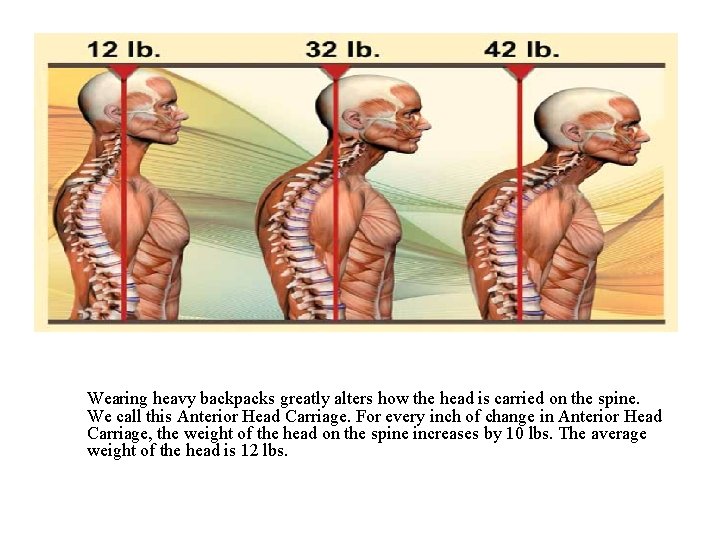
Anterior Head Carriage Wearing heavy backpacks greatly alters how the head is carried on the spine. We call this Anterior Head Carriage. For every inch of change in Anterior Head Carriage, the weight of the head on the spine increases by 10 lbs. The average weight of the head is 12 lbs.
According to Kapandji (Physiology of the Joints, Volume III), for every inch your head moves forwards, it gains 10 pounds in weight, as far as the muscles in your upper back and neck are concerned, because they have to work that much harder to keep the head (chin) from dropping onto your chest. This also forces the suboccipital muscles (they raise the chin) to remain in constant contraction, putting pressure on the 3 Suboccipital nerves. This nerve compression may cause headaches at the base of the skull. Pressure on the suboccipital nerves can also mimic sinus (frontal) headaches. Rene Cailliet M. D. , famous medical author and former director of the department of physical medicine and rehabilitation at the University of Southern California states: “Head in forward posture can add up to thirty pounds of abnormal leverage on the cervical spine. This can pull the entire spine out of alignment. Forward head posture (FHP) may result in the loss of 30% of vital lung capacity. These breath -related effects are primarily due to the loss of the cervical lordosis, which blocks the action of the hyoid muscles, especially the inferior hyoid responsible for helping lift the first rib during inhalation. ”
Persistent forward head posture (a. k. a “hyperkyphotic posture”) puts compressive loads upon the upper thoracic vertebra, and is also associated with the development of Upper Thoracic Hump, which can devolve into Dowager Hump when the vertebra develop compression fractures (anterior wedging). A recent study found this hyperkyphotic posture was associated with a 1. 44 greater rate of mortality.
Subluxations- A Chiropractic Perspective
Some basic understanding first. We all can agree our spines are meant to…. . v Move. v Be dynamic and adaptive. v Protect our nervous system ( brain, spinal cord and nerves). v Provide a structural conduit for the nervous system to communicate to all parts of our body. v Allow ligaments and muscles places to attach and originate. v Express connectivity.
Nervous System Defined Gray’s Anatomy states that the “. . . function (of the nervous system) is to control and coordinate all the other organs and structures and to relate the individual to its environment. ” Important note: Environment includes INTERNAL and EXTERNAL!
Vertebral Subluxation Complex “In reference to segmental neurospinal dysfunction, it is important to appreciate that at least for the purpose of this paper, a vertebral subluxation is not just a strict mechanical displacement of a vertebra. It is more accurately termed a vertebral subluxation complex (VSC) to encompass all the involved elements including functions and structures. A significant component in this complex is intersegmental articular mechanical dysfunction. This may comprise aberrant movement, fixation (hypomobility) or hypermobility between adjacent facets, as well as articular muscular and ligamentous changes triggering neural firing of mechanoreceptors, proprioceptors, effectively nociceptive noxious input. “
Vertebral Subluxation Complex “The VSC would then include disturbances of these structures and their function, especially their effect upon articular physiology (function) and the integral neurophysiology. Inflammatory and circulatory disturbances of the articular environment could also be associated. It is this total pathophysiological complex that would provide the opportunity through which manual intervention by way of a vertebral adjustment may be directed in order to influence internal body physiology. ”
Vertebral Subluxation Complex In other words, the nervous system is a vast communication system that carries electrical impulses (messages) to and from every cell, organ and system in the body. It is imperative that the bones and nerves exiting the spine (segments) be in proper alignment so there is no to little resistance for the “messages” to be received by the destination and then sent back to the brain for evaluation. Constant internal homeostasis.
Vertebral Subluxation Complex “There is increasing evidence that manual therapies may trigger a cascade of cellular, biomechanical, neural and/or extracellular events as the body adapts to the external stress. Collectively (the research suggests) that spinal manipulation can alter the activity of nearby mechanical sensitive neurons. . . and in turn can lead to responses by the central and autonomic nervous systems. . . (which) may in turn lead to observed changes in circulating levels of various neuropeptides and regulatory proteins. ” Rome, Peter L. , Neurovertebral Influence Upon the Autonomic Nervous System: Some of the Somato-Autonomic Evidence To Date, Chiropr J Aust 2009; 39: 2 -17
Information expanded…. . • In addition to the vast amount of information being channeled back and forth to the brain via the Nervous System, there are countless forms of programming and messages that have been downloaded as truths over the years. • 5% of these are conscious, which are creative (wishes and desires) and 95% are Subconcious ( habits/programming).
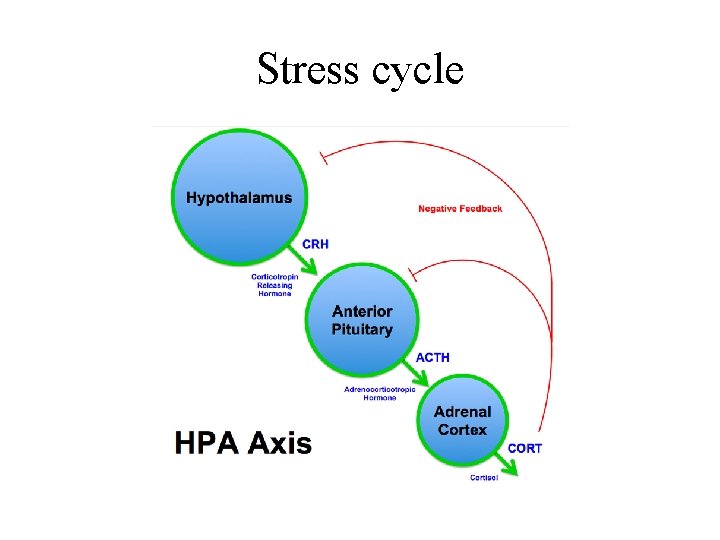
Stress cycle
Take home messages v External stimuli (heavy backpacks) affect internal messaging/programming to adapt to the repeated message(s) of the external environment. Keeps body in constant state of stress. v Change the external environment to support a new internal environment. v Internal balance will translate into a healthier external balance. v Health starts on the inside. v Proper alignment of the spine allows for better communication and expression. Less stress because systems working as intended. Less internal fires to put out!
Alignments Feel Good! “A literature review (Holder and Blum, 1995) revealed only vertebrates have an opiate receptor brain reward cascade mechanism; therefore, in spite of opioid peptides found in invertebrates, only vertebrates express a wellbeing state. In this instance the common denominator is the spine and spinal cord. If the spine is allowed to express itself without interference (minus subluxations), the vertebrate can express a state of well-being at its greatest potential. Consequently, the ability of the limbic system to function and express itself without interference requires a subluxation free spine. " - From: The Role of the Spinal Dura Mater in Spinal Subluxation; Nick Hodgson 2007 (This may be why people under regular chiropractic care also tend to be the happiest with their healthcare decisions).

Psychological Health
In a 2014 study, entitled “The Burden of Guilt: Heavy Backpacks, Light Snacks, and Enhanced Morality” ( http: //www. apa. org/pubs/journals/features/xge-a 0031769. pdf), the authors found these findings: v. Participants who wore a heavy backpack experienced higher levels of guilt compared to those who wore a light backpack. v Wearing a heavy backpack affected participants’ behavior. Specifically, it led them to be more likely to choose healthy snacks over guilt-inducing ones and boring tasks over fun ones. v Participants who wore a lighter backpack tended to cheat less. v Demonstrated that participants processed guilty stimuli more fluently when experiencing physical weight. v The body is closely connected to emotional processing. v When individuals experience guilt, a sense of heaviness is associated with the experience; when individuals feel heavy, the bodily experience of weight leads them to feel guiltier.
What can we do to help? v. Design a classroom experiment to monitor backpack weight. v Know how to wear backpacks correctly. v See a Chiropractor.

A Global Issue

Any Questions?
- Slides: 35