
THE EFFECTS OF COGNITIVE AND EMOTIONAL TRUST ON





- Slides: 71
THE EFFECTS OF COGNITIVE AND EMOTIONAL TRUST ON MOBILE PAYMENT ADOPTION: A TRUST TRANSFER PERSPECTIVE Direct quote from: Gong, X. , Zhang, K. Z. K. , Zhao, S. J. , and Lee, M. K. O. 2016. "The Effects of Cognitive and Emotional Trust on Mobile Payment Adoption: A Trust Transfer Perspective, " The 20 th Pacific Asia Conference on Information Systems (PACIS), Chia-Yi, Taiwan, pp. 1 -14, Paper 350. (Online Publication, URL: http: //aisel. aisnet. org/pacis 2016/2350). Professor : Dr. Celeste Ng Reporters : 1056218 Daniel 1056232 Ralph Note: there are some translations and additional materials added to this presentation by the students (=reporters) to enhance reader/audience understanding in the classroom.
Abstract(1/2) Building consumers’ trust and facilitating their usage intentions are crucial for mobile payment (MP) service providers. Drawing upon the two primary bodies of literature, the trust transfer theory and trust-based acceptance model, this study employs a trust-centric lens with a balanced cognitive and emotional perspective to investigate MP adoption. The model considers not only how cognitive and emotional trust affect consumers’ usage intention of MP, but also how to build cognitive and emotional trust through the trust transfer mechanism.
Abstract(2/2) We conduct a field survey with 273 responses to test the model. The results indicate that emotional trust in MP has a much stronger effect on consumers’ intention to use, while cognitive trust in MP has both direct and indirect effects on intention to use. Our findings also suggest that cognitive and emotional trust can transfer from web payment to MP. In addition, perceived entitativity between the web and mobile payment increases cognitive and emotional trust in MP. Limitations, implications for theory and practice will be discussed.
Introduction(1/9) Mobile payment (MP) services, as one of the most critical drivers for successful mobile commerce, play a key role in today’s electronic commercial transactions (Yang et al. 2012). According to the Internet Data Corporation (IDC) report, worldwide purchase volume over mobile devices will exceed $1 trillion by 2017 (IDC 2012). In this context, MP implantation has become a high priority for companies to expand their business in online environments. MP is a natural evolution of web payment. It allows consumers to adopt mobile terminals such as mobile phones to conduct payment with the help of wireless technologies (Kim et al. 2010).
Introduction(2/9) Compared with offline payment and traditional web payment (e. g. , through desktop computers), MP helps consumers pay for bills, goods, or services anytime, from almost anywhere. However, MP has not received wide adoption among consumers (Zhou 2013). Many Internet users still hesitate to use it due to the lack of trust in MP (Lu et al. 2011), such as security concerns (57%) and privacy concerns (48%) (e. Marketer 2015). Consequently, building consumers’ trust in MP remains a major challenge to many practitioners.
Introduction(3/9) Given the importance of trust in MP adoption, scholars have been shedding light on consumers’ trust building (Kim et al. 2009; Chandra et al. 2010; Lin 2011; Lu et al. 2011; Zhou 2013). Nevertheless, these studies mainly focus on trust from the cognitive perspective. For example, Kim et al. (2009) proposed that personal propensity to trust, structural assurance, and firm reputation are important antecedents of initial cognitive trust in MP. Zhou (2013) argued that information quality, system quality, and service quality of MP are positively associated with consumers’ trusting beliefs. In contrast, research on emotional trust building in MP adoption is hardly investigated.
Introduction(4/9) We believe that the lack of research on this issue can hamper our understanding of trust decisions and MP adoption behavior. On one hand, individuals’ online experience includes both cognitive and emotional aspects. This implies that MP adoption may not be a purely cognitive trust decision. Emotional feelings may have an impact on one’s choices (Derbaix 1995). On the other hand, Komiak and Benbasat (2004, 2006) posited that at the individual level, consumers’ trust decisions usually involve both reasoning and feeling, which should be a combination of cognitive and emotional trust.
Introduction(5/9) MP services are generally transited from the successful web payment services (Lu et al. 2011). Thus, consumers’ trust about MP is not simply established based on users’ direct perceptions toward MP. Prior research indicates that individuals’ trust toward the reputable web services is likely to be transferred to their evaluations of mobile services via the trust transfer mechanism (Sun et al. 2014). Given that MP services are finance-related mobile services, which are prone to information eavesdropping and hacker attack than other mobile services (Zhou 2013). Trust transfer may face more challenges during this web-mobile payment transition setting. In fact, despite having successful experience in implementing web payment services, many firms still struggle to extend consumers’ trust to corresponding MP services (Lu et al. 2011).
Introduction(6/9) An important reason may lie in the fact that they fail to build a close relationship between MP services with their predecessor, web payment services. Recent research posited that trust transfer is less likely to take place if the webmobile service relationship is weak (Wang et al. 2013). To theoretically investigate the role of web-mobile payment relationship in trust building, we herein propose the concept of perceived entitativity to delineate the relationship between web payment and MP. Perceived entitativity is defined as an individual’s perception regard a group of entities being bonded together, more specifically, with two dimensions: perceived business tie and perceived similarity (Stewart 2003; Wang et al. 2013).
Introduction(7/9) In sum, the objective of this study is to employ a trust-centric lens with a balanced cognitive and emotional perspective to investigate MP adoption via the trust transfer mechanism. We include the role of perceived entitativity to enrich insights in the trust transfer process. We therefore develop a research model to address our research objective. More specially, we identify five factors to explicate the trust transfer process: cognitive trust in web payment, emotional trust in web payment, perceived entitativity, cognitive trust in MP, and emotional trust in MP.
Introduction(7/9) We also refer to the trust-based acceptance model developed by Komiak and Benbasat (2006) to demonstrate how cognitive and emotional trust in MP play their mediating roles in the process of MP adoption. This trust-based acceptance model has also been employed to delineate the belief–attitude–intention process of consumers’ online shopping adoption behavior (Zhang et al. 2014).
Introduction(9/9) The rest of this article is organized as follows. In the next section, previous literature on the trust transfer theory and trust-based acceptance model are reviewed. Then, we propose the research model and hypotheses. Next, we empirically analyze the model by conducting an online survey. Finally, the limitations, theoretical implications, and practical implications are discussed.
THEORETICAL BACKGROUND Trust Transfer Theory(1/5) The trust transfer theory has been widely used by information systems (IS) researchers to explain consumer trust building (Stewart 2003). This theory is based on the assumption that an individual’s trust toward a trusted source can be shifted to are relatively unknown target if the unknown target is perceived to be related to the trusted source (Lim et al. 2006). According to theory, trust transference depends on the individual’s assessment of the relationship between the target and source (Belanche et al. 2014; Wang et al. 2013). When the trust or identifies a close relationship between the trusted source and the target, then trust transfer is likely to occur.
THEORETICAL BACKGROUND Trust Transfer Theory(2/5) Previous studies on trust transfer can be grouped into two streams. The first stream of research stresses that trust in target can be established through transference from several different trusted sources. An important underlying assumption in this stream is that the trustor believes there are close relationships between the target and the various sources. For instance, In Teo et al. 's (2008) study, trust in technology and trust in government are proposed as key sources to develop consumer trust in egovernment website. Kim (2008) suggested that trust in the trustee is largely influenced by general assessments of other proof sources toward the trustee, such as third-party review, reputation, and word of mouth.
THEORETICAL BACKGROUND Trust Transfer Theory(3/5) In a similar vein, Bock et al. (2012) posited that perceived structural assurance, word-of-mouth, and offline trust are all important sources/antecedents of online trust. In the first stream, many scholars primarily shed light on investigating different trust sources, with little research focus on the relationship between the target and the source. Note that trust transfer is less likely to take place if the source-target relationship is weak. As Stewart (2003 p. 6) claimed, trust transfer ―may occur based on a communication process in which either the target or a trusted third party exerts direct influence on the trustor, or be based on a cognitive process in which the mere knowledge of the relationship between the target and another source of trust induces transfer.
THEORETICAL BACKGROUND Trust Transfer Theory(4/5) Based on this concern, the second research stream emphasizes that trust in target may be influenced by trust in source as well as the source-target relationship. For example, Delgado. Ballester and Hernández-Espallardo (2008) found that perceived degree of similarity with well-known brands increases consumers’ trust of an unknown online brand. Lee et al. (2014) posited that perceived business tie between a new website and trust in the source website will be positively associated with trust in the new website.
THEORETICAL BACKGROUND Trust Transfer Theory(5/5) Similar findings can also be found in the research of Stewart (2003, 2006) and Wang et al (2013). In this study, we follow the second stream of research by examining trust in source (i. e. cognitive and emotional trust in web payment) and the relationship between the source and the target (i. e. perceived entitativity). Then, we investigate how they may influence trust in target (i. e. cognitive and emotional trust in MP).
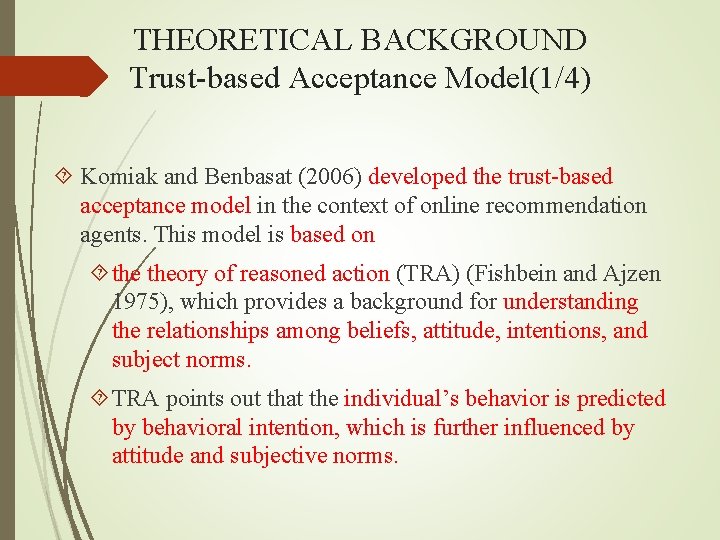
THEORETICAL BACKGROUND Trust-based Acceptance Model(1/4) Komiak and Benbasat (2006) developed the trust-based acceptance model in the context of online recommendation agents. This model is based on theory of reasoned action (TRA) (Fishbein and Ajzen 1975), which provides a background for understanding the relationships among beliefs, attitude, intentions, and subject norms. TRA points out that the individual’s behavior is predicted by behavioral intention, which is further influenced by attitude and subjective norms.
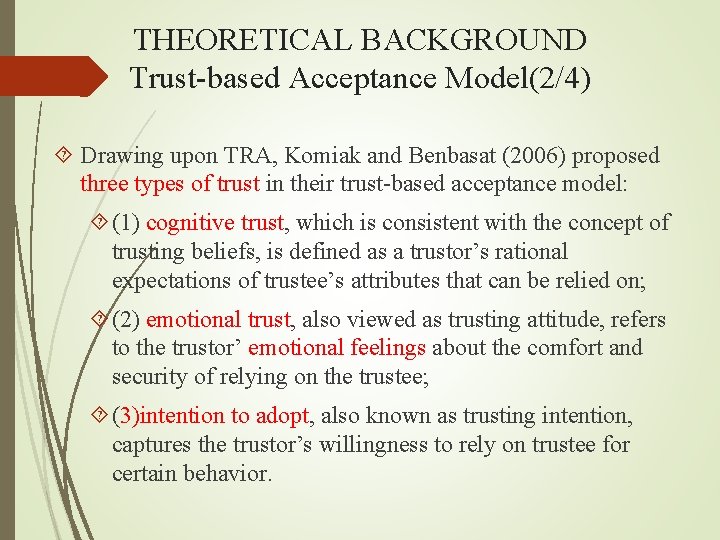
THEORETICAL BACKGROUND Trust-based Acceptance Model(2/4) Drawing upon TRA, Komiak and Benbasat (2006) proposed three types of trust in their trust-based acceptance model: (1) cognitive trust, which is consistent with the concept of trusting beliefs, is defined as a trustor’s rational expectations of trustee’s attributes that can be relied on; (2) emotional trust, also viewed as trusting attitude, refers to the trustor’ emotional feelings about the comfort and security of relying on the trustee; (3)intention to adopt, also known as trusting intention, captures the trustor’s willingness to rely on trustee for certain behavior.
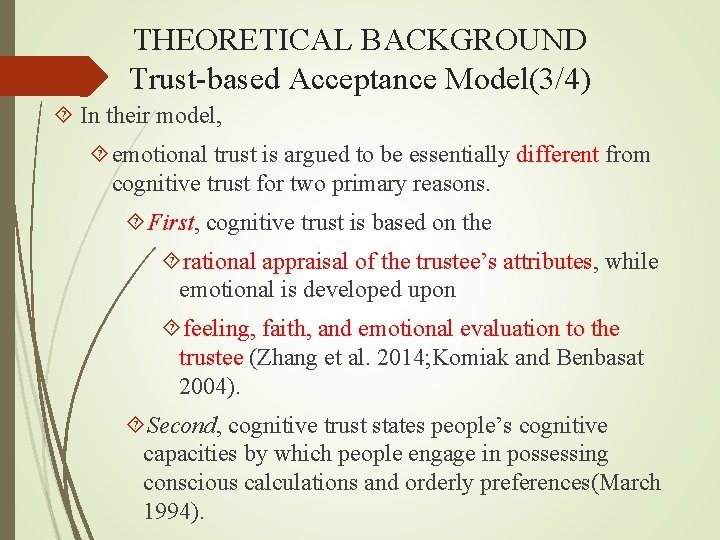
THEORETICAL BACKGROUND Trust-based Acceptance Model(3/4) In their model, emotional trust is argued to be essentially different from cognitive trust for two primary reasons. First, cognitive trust is based on the rational appraisal of the trustee’s attributes, while emotional is developed upon feeling, faith, and emotional evaluation to the trustee (Zhang et al. 2014; Komiak and Benbasat 2004). Second, cognitive trust states people’s cognitive capacities by which people engage in possessing conscious calculations and orderly preferences(March 1994).
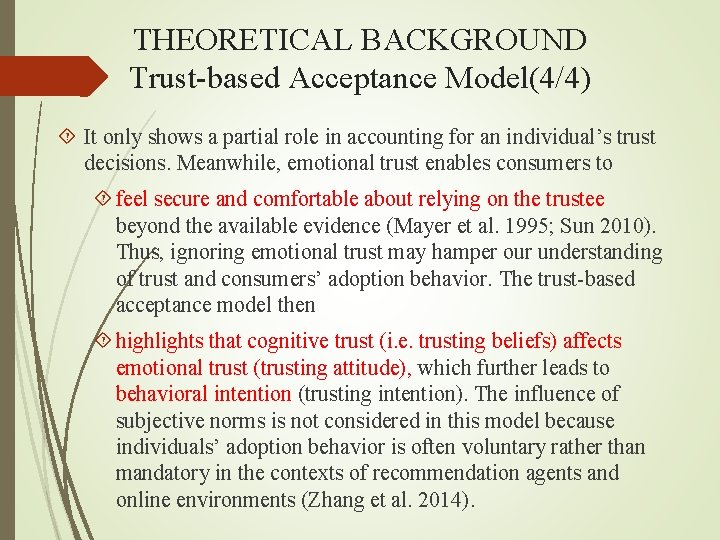
THEORETICAL BACKGROUND Trust-based Acceptance Model(4/4) It only shows a partial role in accounting for an individual’s trust decisions. Meanwhile, emotional trust enables consumers to feel secure and comfortable about relying on the trustee beyond the available evidence (Mayer et al. 1995; Sun 2010). Thus, ignoring emotional trust may hamper our understanding of trust and consumers’ adoption behavior. The trust-based acceptance model then highlights that cognitive trust (i. e. trusting beliefs) affects emotional trust (trusting attitude), which further leads to behavioral intention (trusting intention). The influence of subjective norms is not considered in this model because individuals’ adoption behavior is often voluntary rather than mandatory in the contexts of recommendation agents and online environments (Zhang et al. 2014).
RESEARCH MODEL AND HYPHOTHESES(1) Figure 1 depicts the research model of this study. We draw from Komiak and Benbasat's (2006) trust-based acceptance model to propose that cognitive and emotional trust in MP will place important impacts on intention to use MP. Cognitive trust in MP is also expected to positively affect emotional trust in MP. Then, we refer to the trust transfer theory and suggest that cognitive trust in web payment and perceived entitativity will be positively associated with cognitive trust in MP, whereas emotional trust in MP will be predicted by emotional trust in web payment and perceived entitativity.
RESEARCH MODEL AND HYPHOTHESES(2)
RESEARCH MODEL AND HYPHOTHESES Cognitive and Emotional Trust in Mobile Payment(1/3) The relationships among cognitive trust, emotional trust, and intention to use MP are drawn upon Komiak and Benbasat's (2006) trust-based acceptance model. In this research, we adopt intention to use MP to denote consumers’ trusting intention of willing to rely on mobile terminals to conduct payment for bills, goods, and services. We define cognitive trust in MP as consumers’ rational expectations that MP services have attributes to be relied upon (Mc. Knight et al. 2002; Zhang et al. 2014). Note that transactions conducted in mobile networks and devices are more vulnerable than those in traditional online environments (Lu et al. 2011). Thus, MP is often with greater uncertainty and risk (Zhou 2013). A high level of cognitive trust thus means that a consumer believes MP services have the capability to provide trustworthy and safe financial services. Such trusting beliefs will help the consumer mitigate risk and increase usage intention. Based on these considerations, we posit that: H 1: Cognitive trust in MP is positively associated with intention to use MP.
RESEARCH MODEL AND HYPHOTHESES Cognitive and Emotional Trust in Mobile Payment(2/3) Based on prior research (Sun 2010), we define emotional trust as a consumer’s feelings of comfort and security about relying on mobile terminals to conduct payments. Emotional trust captures an individual’s evaluation of affective feelings about relying on the trustee. Thus, it can be viewed as a trusting attitude toward adoption behavior (Komiak and Benbasat 2006). Following the TRA, an individual’s behavioral intention (trusting intention) will be predicted by attitude (e. g. , emotional trust) (Fishbein and Ajzen 1975). In other words, if a consumer has a high level of emotional trust in MP, then s/he will be more likely to adopt it. The following hypothesis is proposed: H 2: Emotional trust in MP is positively associated with intention to use MP.
RESEARCH MODEL AND HYPHOTHESES Cognitive and Emotional Trust in Mobile Payment(3/3) According to the study of Komiak and Benbasat (2006), emotional trust may be developed based on consumers’ cognitive trust. As mentioned earlier, a high level of cognitive trust means that consumers believe relying on MP will receive trustworthy and reliable financial services. Consumers with such trusting beliefs are likely to invoke a sense of higher security and comfort about relying on MP (Sun 2010). This is also consistent with TRA, which posits that beliefs produce significant effects on attitude. Therefore, we expect that consumers’ cognitive trust in MP places a positive effect on their emotional trust in MP. The following hypothesis is proposed: H 3: Cognitive trust in MP is positively associated with emotional trust in MP.
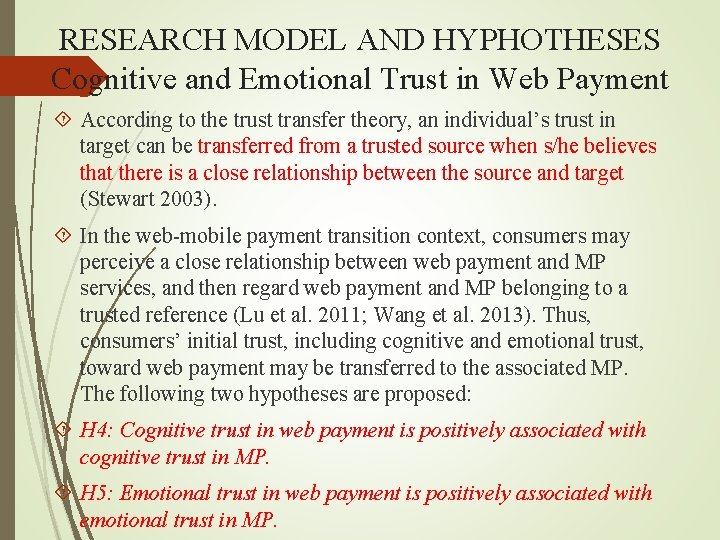
RESEARCH MODEL AND HYPHOTHESES Cognitive and Emotional Trust in Web Payment According to the trust transfer theory, an individual’s trust in target can be transferred from a trusted source when s/he believes that there is a close relationship between the source and target (Stewart 2003). In the web-mobile payment transition context, consumers may perceive a close relationship between web payment and MP services, and then regard web payment and MP belonging to a trusted reference (Lu et al. 2011; Wang et al. 2013). Thus, consumers’ initial trust, including cognitive and emotional trust, toward web payment may be transferred to the associated MP. The following two hypotheses are proposed: H 4: Cognitive trust in web payment is positively associated with cognitive trust in MP. H 5: Emotional trust in web payment is positively associated with emotional trust in MP.
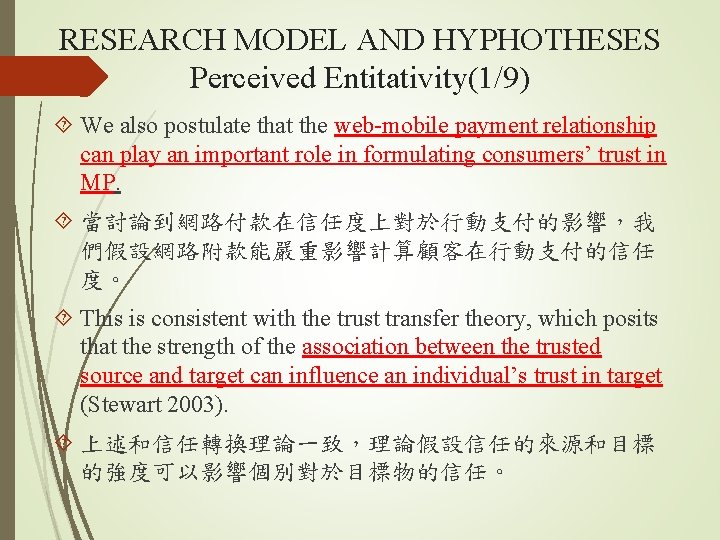
RESEARCH MODEL AND HYPHOTHESES Perceived Entitativity(1/9) We also postulate that the web-mobile payment relationship can play an important role in formulating consumers’ trust in MP. 當討論到網路付款在信任度上對於行動支付的影響,我 們假設網路附款能嚴重影響計算顧客在行動支付的信任 度。 This is consistent with the trust transfer theory, which posits that the strength of the association between the trusted source and target can influence an individual’s trust in target (Stewart 2003). 上述和信任轉換理論一致,理論假設信任的來源和目標 的強度可以影響個別對於目標物的信任。
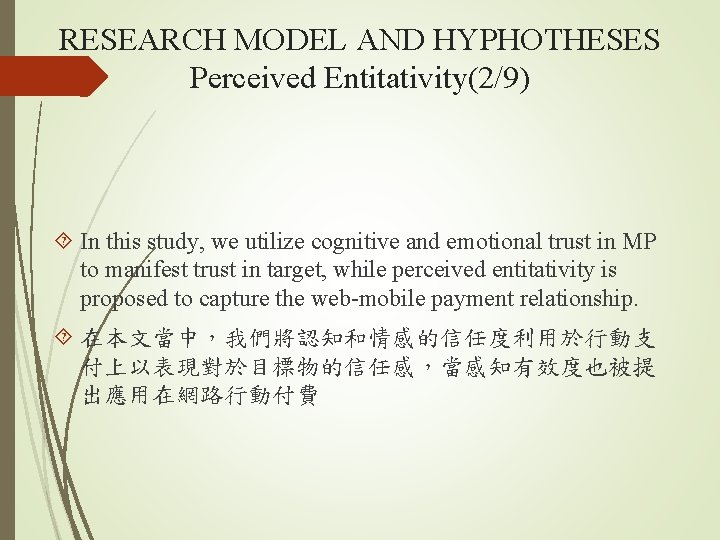
RESEARCH MODEL AND HYPHOTHESES Perceived Entitativity(2/9) In this study, we utilize cognitive and emotional trust in MP to manifest trust in target, while perceived entitativity is proposed to capture the web-mobile payment relationship. 在本文當中,我們將認知和情感的信任度利用於行動支 付上以表現對於目標物的信任感,當感知有效度也被提 出應用在網路行動付費
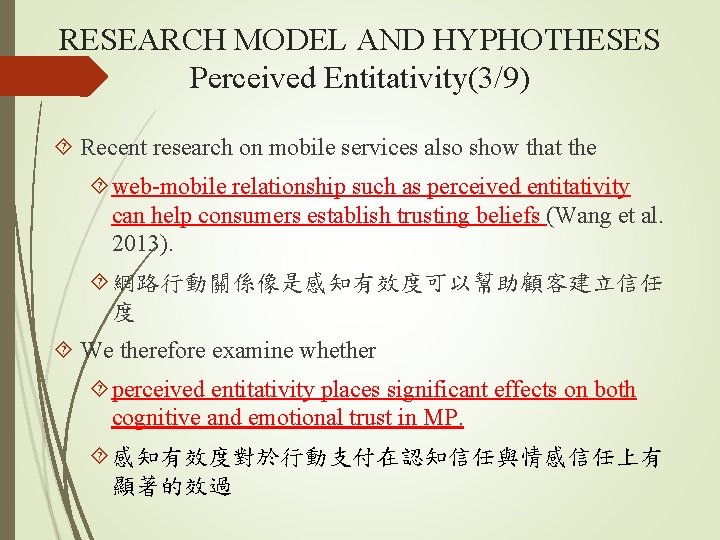
RESEARCH MODEL AND HYPHOTHESES Perceived Entitativity(3/9) Recent research on mobile services also show that the web-mobile relationship such as perceived entitativity can help consumers establish trusting beliefs (Wang et al. 2013). 網路行動關係像是感知有效度可以幫助顧客建立信任 度 We therefore examine whether perceived entitativity places significant effects on both cognitive and emotional trust in MP. 感知有效度對於行動支付在認知信任與情感信任上有 顯著的效過
RESEARCH MODEL AND HYPHOTHESES Perceived Entitativity(4/9) Perceived entitativity refers to the overall evaluation of the association between web payment and MP, which makes people establish alike perceptions about them. 感知相同度參考網路付款與行動付款之間整體的評價, 這可以讓人們建立相同的感受。 We conceptualize perceived entitativity as having internal and external components: perceived similarity and business tie. 我們將感知相同分為內/外部兩種元素以概念化 感知相仿與企業關係
RESEARCH MODEL AND HYPHOTHESES Perceived Entitativity(5/9) In this study, perceived similarity captures the “internal” relationship between web payment and MP because they share certain same innate features, whereas 感知相似度則是網路付款與行動支付的內部關係因為 他們先天的特性 perceived business tie captures the “external” relationship between web payment and MP as they share certain external cues. 感知企業關係則是網路付款與行動支付的外部關係因 為外部線索
RESEARCH MODEL AND HYPHOTHESES Perceived Entitativity(6/9) Previous studies show that the greater perception of entitativity between an relatively unknown target and a trusted source in a unit group, the higher initial trusting beliefs about the unknown target (Stewart 2006; Lim et al. 2006). 在一個團體當中,未知的目標與信任的來源感知相同 越大,則會對未知目標有較高的信任感。 Thus, we expect when consumers perceive a high level of entitativity between the trusted web payment and relatively unknown MP, they will be more likely to increase cognitive trust in MP. 因此我們期待當顧客對於信任的網路付款與未知的行 動付款有較高的感知相同時,他們會增加對於行動付 款的認知信任度。
RESEARCH MODEL AND HYPHOTHESES Perceived Entitativity(7/9) In addition, a high level of perceived entitativity indicates that individuals believe there is a close relatedness between the trusted source and the unknown target (Sun et al. 2014). 高感知相同指出信任的來源與未知的目標有強烈的相 關性。 Perceived “relatedness” is more likely to invoke a sense of comfort and security about the target (Komiak and Benbasat 2006). 感知的相關性則像是從調用一些舒適與安全感到目標
RESEARCH MODEL AND HYPHOTHESES Perceived Entitativity(8/9) From this perspective, if a consumer has positive experience or feelings (i. e. emotional trust) about using web payment services, then s/he will be more likely to feel comfortable and secure toward the new MP services that have similar operation interfaces or belong to a same company. 若是對於網路付款顧客有正面的經驗與感受,他會對 於行動支付感覺舒適與安全。
RESEARCH MODEL AND HYPHOTHESES Perceived Entitativity(9/9) The following two hypotheses are proposed: H 6: Perceived entitativity is positively associated with cognitive trust in MP. 感知相同與行動支付的認知信任有正相關 H 7: Perceived entitativity is positively associated with emotional trust in MP. 感知相同與行動支付的情感信任有正相關
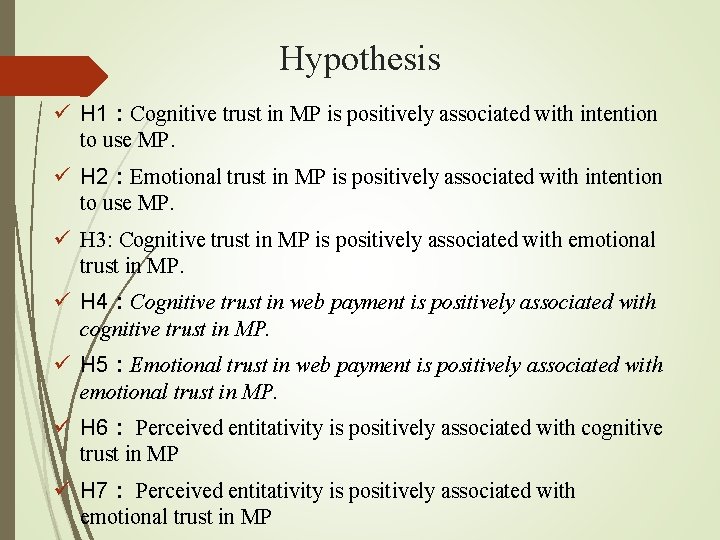
Hypothesis ü H 1:Cognitive trust in MP is positively associated with intention to use MP. ü H 2:Emotional trust in MP is positively associated with intention to use MP. ü H 3: Cognitive trust in MP is positively associated with emotional trust in MP. ü H 4:Cognitive trust in web payment is positively associated with cognitive trust in MP. ü H 5:Emotional trust in web payment is positively associated with emotional trust in MP. ü H 6: Perceived entitativity is positively associated with cognitive trust in MP ü H 7: Perceived entitativity is positively associated with emotional trust in MP
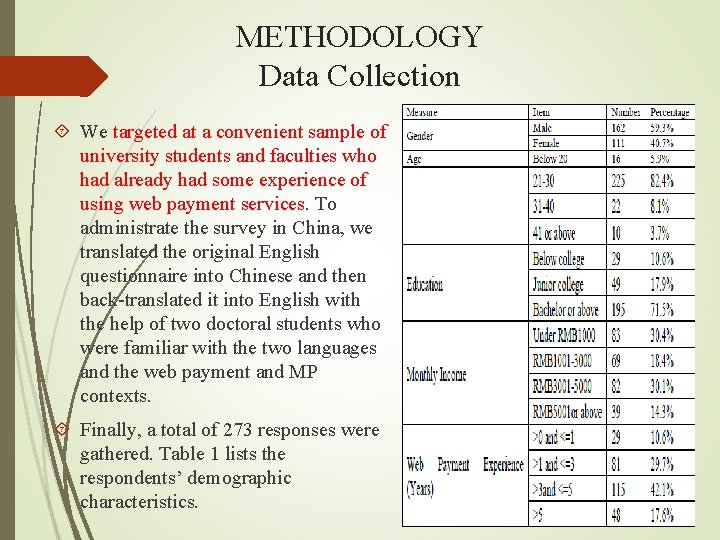
METHODOLOGY Data Collection We targeted at a convenient sample of university students and faculties who had already had some experience of using web payment services. To administrate the survey in China, we translated the original English questionnaire into Chinese and then back-translated it into English with the help of two doctoral students who were familiar with the two languages and the web payment and MP contexts. Finally, a total of 273 responses were gathered. Table 1 lists the respondents’ demographic characteristics.
METHODOLOGY Data Measures All items were measured with 7 -point Likert scales, from “ 1=strongly disagree” to “ 7=strongly agree”. We slightly modified the wording of the items to fit the MP context. Table 2 lists the measurement items and their sources.
METHODOLOGY Data Analysis and Result We used partial least squares (PLS) to analyze the research model. PLS is suitable for the data analysis of the current study for two reasons (Chin et al. 2003). First, PLS is a component-based structural equation modeling approach which requires a relatively small sample size. Second, it is appropriate for dealing with formative constructs and exploratory analysis. We followed the two-step analytical procedures: the measurement model and the structural model (Hair et al. 2006).
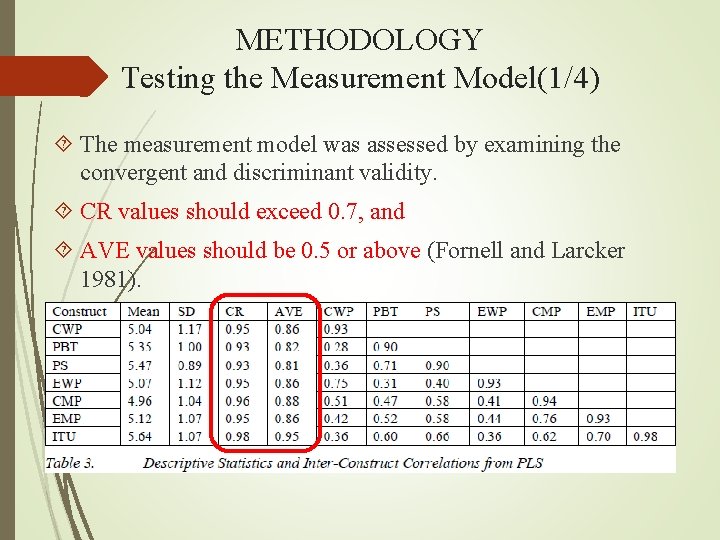
METHODOLOGY Testing the Measurement Model(1/4) The measurement model was assessed by examining the convergent and discriminant validity. CR values should exceed 0. 7, and AVE values should be 0. 5 or above (Fornell and Larcker 1981).
METHODOLOGY Testing the Measurement Model(2/4)
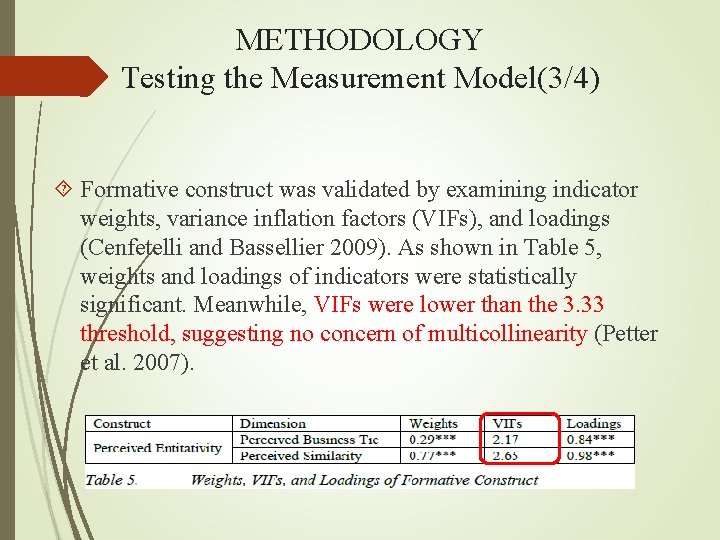
METHODOLOGY Testing the Measurement Model(3/4) Formative construct was validated by examining indicator weights, variance inflation factors (VIFs), and loadings (Cenfetelli and Bassellier 2009). As shown in Table 5, weights and loadings of indicators were statistically significant. Meanwhile, VIFs were lower than the 3. 33 threshold, suggesting no concern of multicollinearity (Petter et al. 2007).
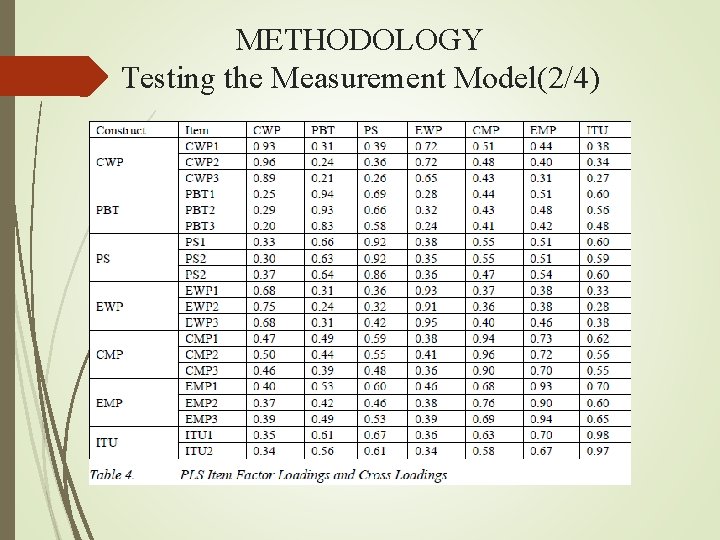
METHODOLOGY Testing the Measurement Model(4/4) Considering the relatively high correlations between constructs, we further examined the common method bias and multicollinerarity. As recommend by Podsakoff et al. (2003), we first examined the Harman’s single factor test. multicollinearity was not a significant problem for the present study.
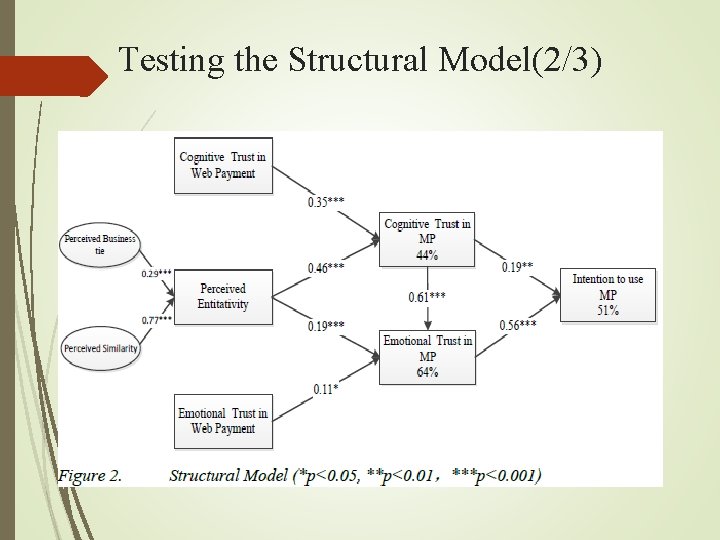
Testing the Structural Model(1/3) The PLS results of the structural model were reported in Figure 2. The results showed that cognitive (β =0. 19, t =2. 77) and emotional trust in MP (β =0. 56, t =8. 93) had significant effects on intention to use MP. It also indicated that emotional trust in MP posited a stronger effect than cognitive trust in MP. H 1 and H 2 were thus supported. The results also showed that cognitive trust in MP was predicted by cognitive trust in web payment (β =0. 35, t =4. 69) and perceived entitativity (β =0. 46, t =7. 61), indicating that H 4 and H 6 were supported. Cognitive trust in MP (β =0. 61, t =11. 87), perceived entitativity (β =0. 19, t =4. 26), and emotional trust in web payment (β =0. 11, t =2. 37) were found to be positively associated with emotional trust in MP. Hence, H 3, H 5, and H 7 were supported.
Testing the Structural Model(2/3)
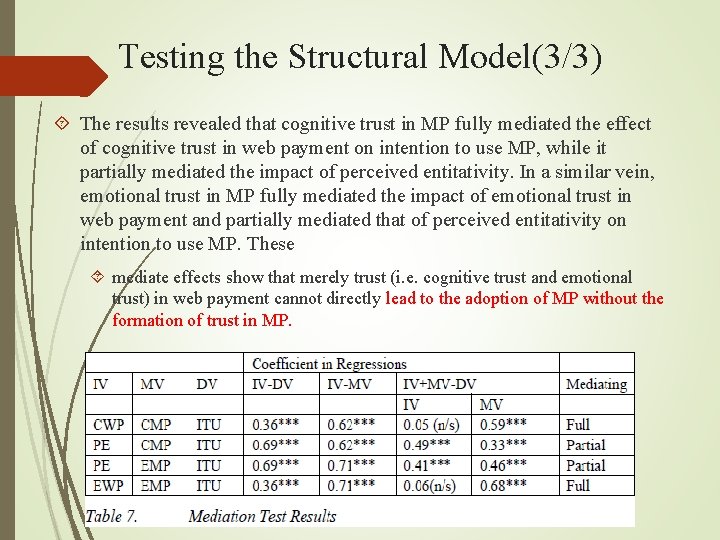
Testing the Structural Model(3/3) The results revealed that cognitive trust in MP fully mediated the effect of cognitive trust in web payment on intention to use MP, while it partially mediated the impact of perceived entitativity. In a similar vein, emotional trust in MP fully mediated the impact of emotional trust in web payment and partially mediated that of perceived entitativity on intention to use MP. These mediate effects show that merely trust (i. e. cognitive trust and emotional trust) in web payment cannot directly lead to the adoption of MP without the formation of trust in MP.
DISCUSSIONS(1/3) Drawing upon the trust transfer theory and Komiak and Benbasat's (2006) trust-based acceptance model, this study employs a trust-centric perspective to investigate consumer trust building in the context of MP adoption. 我們應用「信任轉移理論」與「以信任為基礎的接受模 型」,我們研究以信任為中心去調查客戶的行動支付信 任
DISCUSSIONS(2/3) Our results support the view that besides cognitive trust, emotional trust in MP is also important in affecting consumers’ intention to use MP. More importantly, 認知信任與情感信任在行動支付強烈的影響客戶使用 行動支付的意願 emotional trust in MP is determined by cognitive trust in MP and emotional trust in web payment, as well as perceived similarity. 行動支付上的認知信任與網路支付的情感信任由行動 支付的情感信任決定
DISCUSSIONS(3/3) These results confirm that both cognitive and emotional trust can be transferred from web payment to MP. 認知信任與情感信任可以由網路支付轉移到行動支付 Perceived entitativity of the web-mobile payment relationship can positively affect the two types of trust in MP. 網路支付的感知有效度對於行動支付的兩種信任模式 都有正向的影響
DISCUSSIONS Limitations and Future Research(1/3) Before we discuss the implications of this study, it is important to highlight its limitations. First, we invited a relatively small sample in China to participate in our research. Many of the respondents were university students or faculties. Scholars may generalize the findings of this research in different regional settings with a larger sample size. However, care should be taken for the influence of different cultural backgrounds
DISCUSSIONS Limitations and Future Research(2/3) Second, as our study primarily focuses on the trust transfer mechanism from one source (web payment) to one target (MP), 我們的研究專注在來源(網路支付)到目標(行動支付) 的信任轉移 we only examine the effects of emotional trust in web payment, perceived similarity, and cognitive trust in MP on emotional trust in MP. 我們僅有檢測對於網路支付的情感信任、感知有效度 以及行動支付上的認知信任與情感信任
DISCUSSIONS Limitations and Future Research(3/3) Given the important role of emotional trust in consumer decision-making, future studies could empirically examine other valid mechanisms to build consumers’ emotional trust in MP. 情感信任對於顧客在做決定有很重要的影響,未來的研 究可以專注在檢驗其他有效的機制去建立顧客在行動支 付的情感信任
DISCUSSIONS Implication for Theory(1/10) First, this study extends the trust transfer theory with a balanced cognitive and emotional perspective in the context of MP adoption. 這份研究在認知與情感上的透式取的平衡延伸了信任 轉移理論應用在行動支付上 The literature has documented that, in general, consumers’ trusting beliefs (i. e. cognitive trust) can be transferred from a trusted source to a relatively unknown target by virtue of their association with one another (Stewart 2006; Lim et al. 2006; Teo et al. 2008). 文獻紀錄了顧客信任的優點可以由信任的來源轉移到 未知的目標
DISCUSSIONS Implication for Theory(2/10) Our study is among the first to address this theoretical gap in the context of MP adoption. We develop and empirically verify our theoretical model to demonstrate that emotional trust in web payment will positively influence emotional trust in MP, which further increases consumers’ intention to use MP. 網路支付的情感信任對於行動支付的情感信任會有正 向的影響,並進而增加消費者使用行動支付的意願
DISCUSSIONS Implication for Theory(3/10) Second, this study identifies three factors, namely emotional trust in web payment, 網路支付的情感信任 perceived entitativity, and 感知有效度 cognitive trust in MP, that predict emotional trust in MP. 行動支付的認知信任,以預測行動支付的情感信任
DISCUSSIONS Implication for Theory(4/10) Second, This finding advances our understanding of how to build emotional trust in online settings. 這發現增進了我們瞭解如何建立情感信任 In consistent, existing studies mainly focus on the mechanism of how to develop cognitive trust, with a lack of research emphasis on emotional trust building. 現有的研究專注在如何建立感知信任,缺乏了情感信 任的建立
DISCUSSIONS Implication for Theory(5/10) Further, in the relatively scare literature, scholars only suggest that trusting beliefs (i. e. , cognitive trust) such as integrity, competence, and benevolence may be important for shaping emotional trust (Komiak and Benbasat 2004; Zhang et al. 2014). 學者儘建議信任的理念像是誠信、權限與仁慈都是將情 感信任成形的重要因素
DISCUSSIONS Implication for Theory(6/10) Komiak and Benbasat (2006 pp. 943) contended that “emotional trust includes a person’s evaluation of cognitive beliefs, 情感信任的評價 his or her gut feeling and faith, and 他的感受與理念 his or her evaluation of emotional reactions to the trustee. 他對於受託人情緒反應的評價
DISCUSSIONS Implication for Theory(7/10) Thus, emotional trust can be either rational or (理性的) irrational. ”(不理性的) From this perspective, the influence of cognitive trust on emotional trust may only explain the “rational” part of emotional trust, while its “irrational” part is still untouched. 認知信任在情感信任上僅能解釋情感信任理性的部分, 而不理性的部份能未能觸及 Based on these concerns, our findings add to the existing literature by demonstrating that emotional trust in source and perceived entitativity are key factors of building emotional trust in target.
DISCUSSIONS Implication for Theory(8/10) In the MP context, especially at the early stage of MP adoption, individuals are generally uncertain about whether MP is safe to use, thus 不確定行動支付安全與否 emotional trust may be more likely to be transferred from reputable web payment services. 情感信任通常來自於對於網路支付服務商的良好信譽
DISCUSSIONS Implication for Theory(9/10) Third, this study is among the first to investigate the roles of emotional trust in MP on consumers’ intention to use MP. Our findings indicate that (1) emotional trust in MP posits a significant effect; 行動支付在情感信任度假設有重大的影響 (2) its effect is much stronger than that of cognitive trust in MP; and 他的影響比起行動支付的認知信任更為重大
DISCUSSIONS Implication for Theory(10/10) Third, (3) it fully mediates the effect of emotional trust in web payment on MP adoption, while partially mediating the effect of perceived entitativity. 他充分的調節了網路支付的情感信任對於行動支 付的影響,當部分中介了感知有效度的影響 We expect that these findings make useful contributions to the extant MP adoption literature. 我們期待這份發現可以有用地貢獻在現存的行動支付相 關文獻
DISCUSSIONS Implication for Practice(1/2) First, the importance of the trust transfer mechanism in MP adoption suggests that service providers should take advantage of the trust built in web payment services. 行動支付的信任轉換機制建議服務提供者應該利用網 路支付服務在信任上的優勢
DISCUSSIONS Implication for Practice(2/2) Second, while it remains important for MP service providers to focus on building consumers’ cognitive trust, 提醒行動支付服務提供者專注在建立顧客認知信任的重要 性 they should allocate their trust-building resources more strategically to improve emotional trust of consumers. 他門應該分配他們的信任建立來源更為有戰術性以增進顧 客的情感信任
2. Describe whether the paper is related to the MIS field. And explain the contributions of that paper in the MIS field(1/3) It’s appears that MP has something to do with phoneapplications or web-browser payment which highly emphasize trust transfer in MIS. MP trust transfer involves security and development of cognitive and emotional trust in MP (comfortable) that eventually will lead to the desirable outcomes which is the intention to use construct.
2. Describe whether the paper is related to the MIS field. And explain the contributions of that paper in the MIS field(2/3) Building confidence on mobile device through the trust transfer theory explains the importance involvement of MIS within the trust source. Trusted source obtain well-developed MIS structure that perceive secure device. In this way, the relationship between trusted MIS structure can influence unknown targets.
2. Describe whether the paper is related to the MIS field. And explain the contributions of that paper in the MIS field(3/3) This paper has proofed that the cognitive and emotion trust can be successfully transferred from web-payment to mobile -payment. I think if any company focus more on webpayment it will ultimately make use of the conclusion that the paper provided. Therefore, I think they will have competitive advantage while they are trying to provide the service in mobile-payment. Also in terms of market, it will increase their speed of market much better than before, and generate more opportunities with larger margin on sales.
3. How would you use the findings or the contributions found in the paper in the future? And, why do you think so? (1/2) Since emotional trust in MP is more significantly higher than cognitive trust then, we think it is best to focus more on emotional trust in MP in the future, especially in the process of implementing the MP applications (interface). This is mainly to incorporate all the traits of emotional trust, for example; there are some positive and negative traits such as responsible and irresponsible towards consumer satisfaction within the specified application (interface). Probably negative emotional traits may not be considered as significant results.
3. How would you use the findings or the contributions found in the paper in the future? And, why do you think so? The paper has made a conclusion that the consumer will have intention to use mobile-payment while they have the trust in cognitive and emotion, and the emotion trust’s affection is much more than the cognitive one. Thus, I will try to find out much more factors on how to build emotion trust to make the mobile payment service provider earn more profit than before.
The End