
The Effects of Childhood Abuse and Trauma Those
The Effects of Childhood Abuse and Trauma
Those who don’t experience abuse… • People whose integrity has not been damaged in childhood, who were protected, respected, and treated with honesty by their parents, will be--both in their youth and adulthood-intelligent, responsive, empathetic, and highly sensitive. They will take pleasure in life and will not feel any need to hurt others or themselves. They will use their power to defend themselves but not to attack others • They will not be able to do otherwise than to respect and protect those weaker than themselves, including their children, because this is what they have learned from their own experience and because it is this knowledge (and not the experience of cruelty) that has been stored up inside them from the beginning.
• After you're born, the greatest impact on the brain you'll have as an adult comes from the _______you have in the ______of your life. At its best, the right learning opportunities and a nurturing childhood can give the basis for a ____________adult. • On the other end, stress and trauma during development, such as that endured during physical abuse or lack of parental involvement, can have lasting _____________. 3
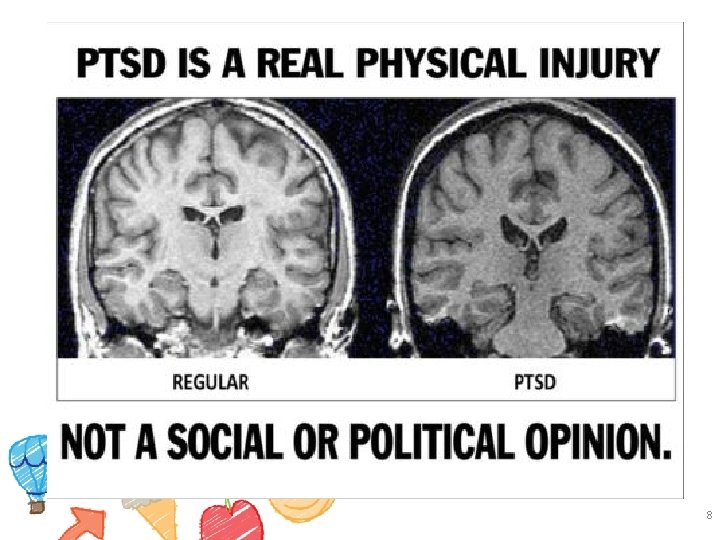
Those who do experience childhood abuse… 1) Brain Physically Changes 1) 2) 3) Parts of the brain have been shown to ____ or decrease in volume ________does not develop the same as a normal brain ______brain (controls emotions, primitive feelings) tends to _______ - Leads to reacting in a flight/freeze way even to ______situations
Those who do experience childhood abuse… 1) Brain Physically Changes 1) _____struggles to develop, affecting ________ “The longer the maltreatment, the smaller the brain and corpus callosum and the lower the child’s IQ. ” -Cohen, Perel, De. Bellis, et al. (2002) 2) 3) Left and right hemispheres are less connected – can lead to radical shifts in _____ and __________ personalities, _______, and other mental disorders are more likely to develop in abused children
Those who do experience childhood abuse… 2) Emotional Impact Childhood stress seems to cause ______ changes ______ that make the children less able to cope with high levels of _________later in life. Children who are abused early are flooded with stress hormones like adrenaline and ______, impacting on how the brain develops and the stress regulation method. This in turn impacts on the hippocampus, the area which controls feelings, meaning that adult survivors will be more likely to be 1) highly _________ 2) have difficulties with______and emotions 3) Struggle with violence and ________
Those who do experience childhood abuse… 2) Emotional Impact continued… 1) _________________ symptoms are displayed (flashbacks, avoidance, _____, fight or flight, ___________, etc. ) 2) Helplessness 3) __________ issues 4) be prone to _______, anxiety, _______ and _______
8
Those who do experience childhood abuse… 3) Behavioural Development Impact - - Stress can set off a ripple of hormonal changes that permanently wire a child's brain to cope with a malevolent world (Teicher, 2002). Through this chain of events, _____ and _____ pass from generation to generation (Teicher, 2002).
Those who do experience childhood abuse… 3) Behavioural Development Impact continued… • Aggressive, oppositional , ______, prone to “rages” • Antisocial, _____, Inability to _____ others, isolation • _______ behavior problems (SA), Early sexual activity, _________, promiscuity • _________avoidance
Those who do experience childhood abuse… 4) Social Problems • Poor _______ skills, Socially immature, Inability to function “________” in some social settings • Poor social ______________ • Difficulty understanding complex ________ • Poor boundaries • Withdrawal, Resist affection • Passive, _________________
Those who do experience childhood abuse… 4) Social Problems continued… • Longitudinal studies following children who were abused and neglected as children showed that these traumatic • • experiences increase the risk for _________ Substance Abuse – ______, drug abuse is common __________ describes the process whereby women who were sexually abused as children frequently find themselves in abusive, dangerous situations, or relationships as adults. __________ Family violence and abuse continued – the _________________
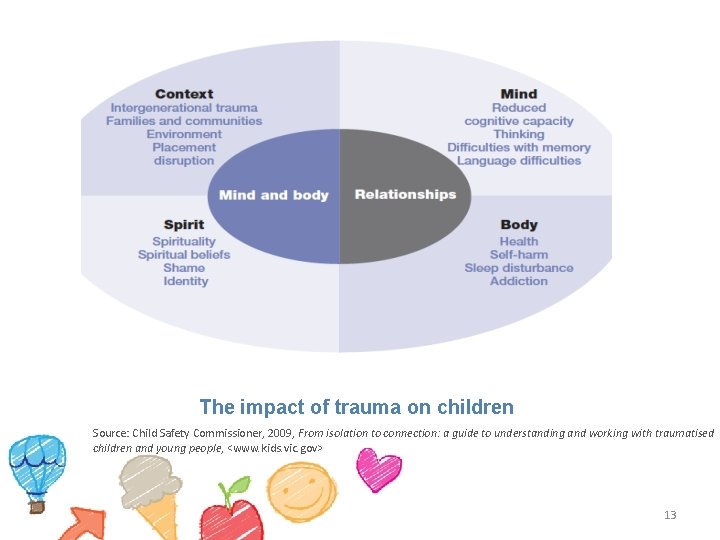
The impact of trauma on children Source: Child Safety Commissioner, 2009, From isolation to connection: a guide to understanding and working with traumatised children and young people, <www. kids. vic. gov> 13
The effect of trauma on children Children who experience horrible external events may experience emotional harm or psychic trauma. Left untreated, all but the mildest of childhood trauma can have an impact on the child Source: American Academy of Child and Adolescent Psychiatry, Your Child – Childhood Trauma and Its Effects, <www. aacap. org> It is important to remember that abuse, neglect and other trauma have different impacts on different children − and that while we have to take seriously the negative impacts of trauma we cannot underestimate the strength of human resilience Source: Child Safety Commissioner, 2009, From isolation to connection: a guide to understanding and working with traumatised children and young people, <www. kids. vic. gov>.
But What About Resilience? • “The individual is the product of all of his or her experiences, not early experiences alone. ” – Sroufe, Carlston, Levy, & Egeland (1999)
http: //www. livescience. com/18453 -child-abusebrain. html http: //www. google. ca/url? sa=t&rct=j&q=&esrc=s &source=web&cd=4&ved=0 CDs. QFj. AD&url=http% 3 A%2 F%2 Fwww. nctsnet. org%2 Fnctsn_assets%2 Fpp t%2 Fpowerpoints%2 FAbuse_Dev_Impact. ppt&ei= Gopi. Vee 7 ENKpog. SZx 4 Ho. Bg&usg=AFQj. CNGa. YTT_ fj. ALh 2 GQni 4 P 7 H 1 VUUz_9 w&bvm=bv. 93990622, d. c. GU&cad=rja http: //www. asca. org. au/About/Resources/Impacton-the-physiology-of-the-brain. aspx
- Slides: 16