
The Effectiveness of Manual Circumlaryngeal Therapy in Future






- Slides: 16
The Effectiveness of Manual Circumlaryngeal Therapy in Future Elite Professional Voice Users Evelien D’haeseleer, Sofie Claeys, Kristiane Van Lierde Department of Speech, Language, and Hearing Sciences Ghent University
Elite professional voice users • Voice users where even a slight vocal difficulty causes serious consequences • Musical performers (and students) – Special and vulnerable group for developing voice disorders • High vocal load of the speaking and singing voice • High physical load • Not enough vocal and physical rest • Future professional voice users – At risk for developing poor vocal quality (Timmermans et al. 2002) • How can vocal quality be optimized? Introduction
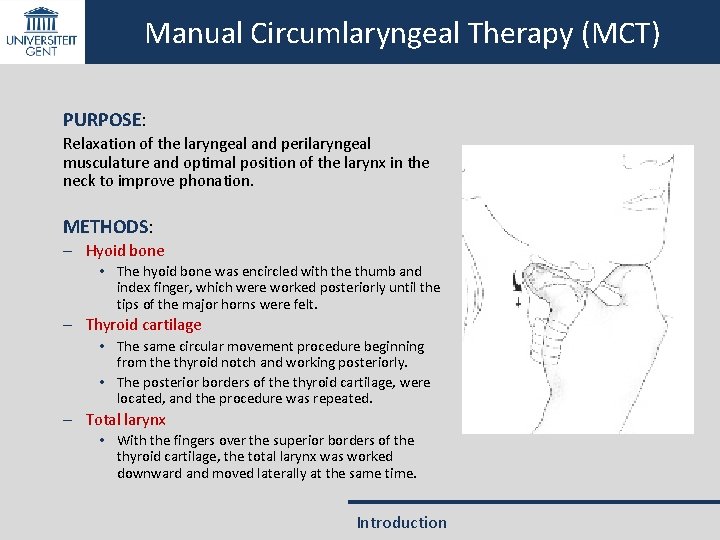
Manual Circumlaryngeal Therapy (MCT) PURPOSE: Relaxation of the laryngeal and perilaryngeal musculature and optimal position of the larynx in the neck to improve phonation. METHODS: – Hyoid bone • The hyoid bone was encircled with the thumb and index finger, which were worked posteriorly until the tips of the major horns were felt. – Thyroid cartilage • The same circular movement procedure beginning from the thyroid notch and working posteriorly. • The posterior borders of the thyroid cartilage, were located, and the procedure was repeated. – Total larynx • With the fingers over the superior borders of the thyroid cartilage, the total larynx was worked downward and moved laterally at the same time. Introduction
Effectiveness MCT is effective in patients with hyperfunctional voice disorders. (Roy et al. , 1993; Roy et al. , 1997; Van Lierde et al. , 2004) – Aronson (1990): manual therapy is the primary approach for patients with musculoskeletal tension disorders. – MCT is more effective compared to breathing exercises in patients with muscle tension dysphonia. (Van Lierde et al. , 2008) What is the impact of MCT on the vocal quality of (healthy) musical performers (students) Purpose of this study Introduction
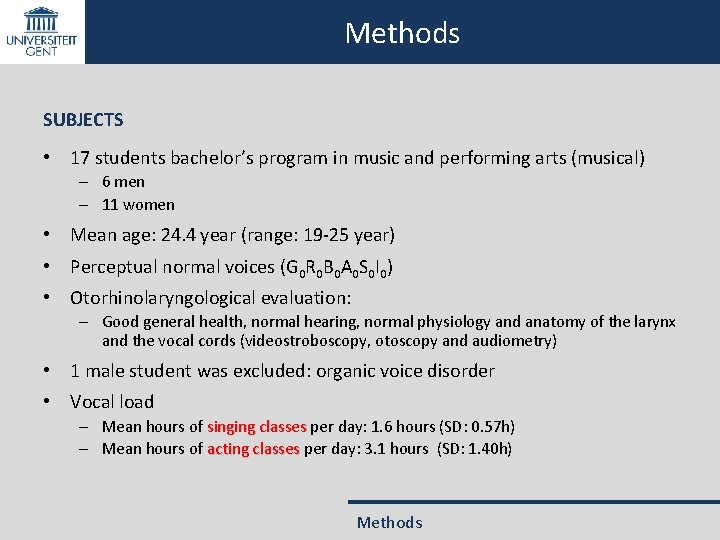
Methods SUBJECTS • 17 students bachelor’s program in music and performing arts (musical) – 6 men – 11 women • Mean age: 24. 4 year (range: 19 -25 year) • Perceptual normal voices (G 0 R 0 B 0 A 0 S 0 I 0) • Otorhinolaryngological evaluation: – Good general health, normal hearing, normal physiology and anatomy of the larynx and the vocal cords (videostroboscopy, otoscopy and audiometry) • 1 male student was excluded: organic voice disorder • Vocal load – Mean hours of singing classes per day: 1. 6 hours (SD: 0. 57 h) singing classes – Mean hours of acting classes per day: 3. 1 hours (SD: 1. 40 h) acting classes Methods
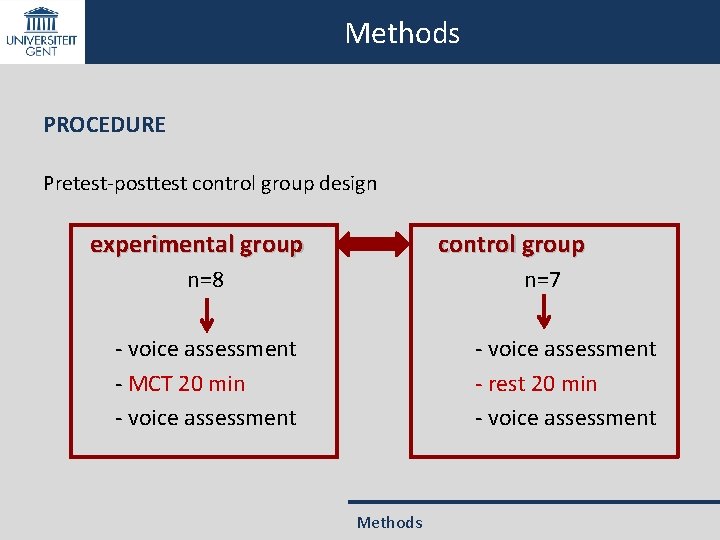
Methods PROCEDURE Pretest-posttest control group design experimental group control group n=8 n=7 - voice assessment - MCT 20 min - voice assessment - rest 20 min - voice assessment Methods
Methods OBJECTIVE VOICE ASSESSMENT – Aerodynamic measurement • Maximal phonation time (s) – Voice Range Profile • Highest intensity, Ihigh(d. B) • Lowest intensity, Ilow (d. B) • Highest frequency, Fhigh (Hz) • Lowest frequency, Flow (Hz) – Acoustic analysis • F 0 • Jitter (%) • Shimmer (%) • NHR Dysphonia Severity Index -5 Methods +5
Methods SUBJECTIVE VOICE ASSESSMENT • Questionnaire: The subjects were asked whether – the quality of the speaking and singing voice was worse, better, or the same as before the MCT. – speaking was more difficult, easier, or the same as before. – the vocal range was smaller, larger, or the same as before. – the sensations in the throat and the larynx after MCT were painful, open, the same, other. – therapy itself was painful, not pleasant, no sensations, pleasant, other. Methods
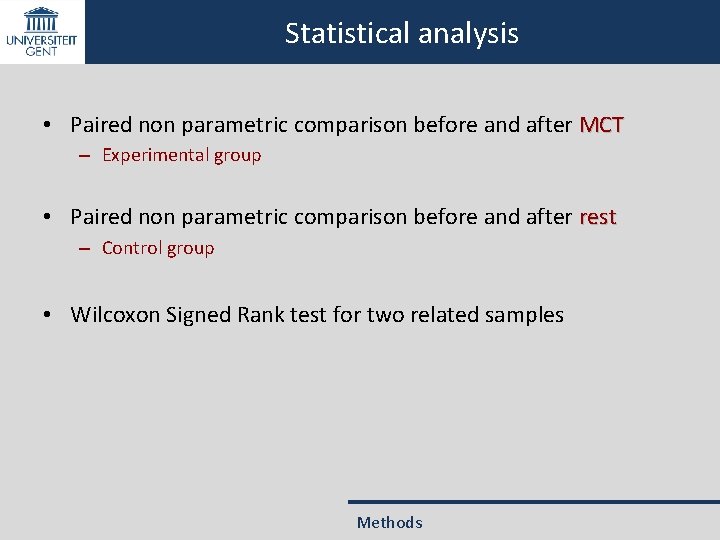
Statistical analysis • Paired non parametric comparison before and after MCT – Experimental group • Paired non parametric comparison before and after rest – Control group • Wilcoxon Signed Rank test for two related samples Methods
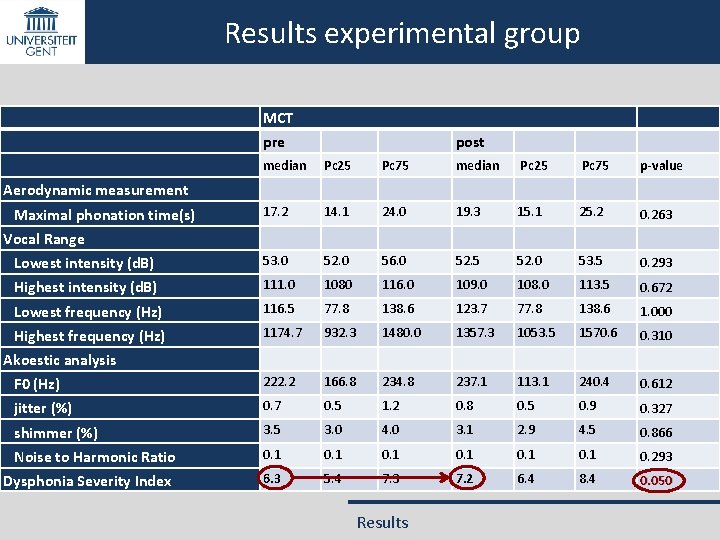
Results experimental group MCT pre post median Pc 25 Pc 75 median Pc 25 Pc 75 p-value 17. 2 14. 1 24. 0 19. 3 15. 1 25. 2 0. 263 Lowest intensity (d. B) 53. 0 52. 0 56. 0 52. 5 52. 0 53. 5 0. 293 Highest intensity (d. B) 111. 0 1080 116. 0 109. 0 108. 0 113. 5 0. 672 Lowest frequency (Hz) 116. 5 77. 8 138. 6 123. 7 77. 8 138. 6 1. 000 Highest frequency (Hz) 1174. 7 932. 3 1480. 0 1357. 3 1053. 5 1570. 6 0. 310 F 0 (Hz) 222. 2 166. 8 234. 8 237. 1 113. 1 240. 4 0. 612 jitter (%) 0. 7 0. 5 1. 2 0. 8 0. 5 0. 9 0. 327 shimmer (%) 3. 5 3. 0 4. 0 3. 1 2. 9 4. 5 0. 866 Noise to Harmonic Ratio Dysphonia Severity Index 0. 1 0. 293 6. 3 5. 4 7. 3 7. 2 6. 4 8. 4 0. 050 Aerodynamic measurement Maximal phonation time(s) Vocal Range Akoestic analysis Results
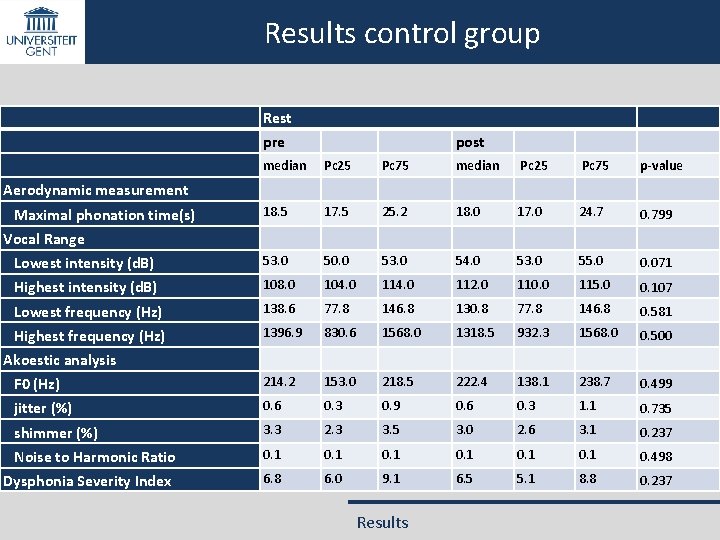
Results control group Rest pre post median Pc 25 Pc 75 median Pc 25 Pc 75 p-value 18. 5 17. 5 25. 2 18. 0 17. 0 24. 7 0. 799 Lowest intensity (d. B) 53. 0 50. 0 53. 0 54. 0 53. 0 55. 0 0. 071 Highest intensity (d. B) 108. 0 104. 0 112. 0 110. 0 115. 0 0. 107 Lowest frequency (Hz) 138. 6 77. 8 146. 8 130. 8 77. 8 146. 8 0. 581 Highest frequency (Hz) 1396. 9 830. 6 1568. 0 1318. 5 932. 3 1568. 0 0. 500 F 0 (Hz) 214. 2 153. 0 218. 5 222. 4 138. 1 238. 7 0. 499 jitter (%) 0. 6 0. 3 0. 9 0. 6 0. 3 1. 1 0. 735 shimmer (%) 3. 3 2. 3 3. 5 3. 0 2. 6 3. 1 0. 237 Noise to Harmonic Ratio Dysphonia Severity Index 0. 1 0. 498 6. 0 9. 1 6. 5 5. 1 8. 8 0. 237 Aerodynamic measurement Maximal phonation time(s) Vocal Range Akoestic analysis Results
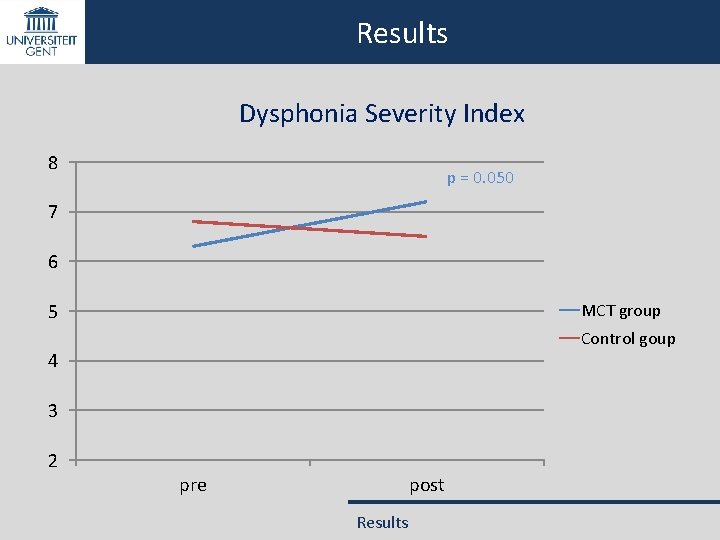
Results Dysphonia Severity Index 8 p = 0. 050 7 6 5 MCT group Control goup 4 3 2 pre post Results
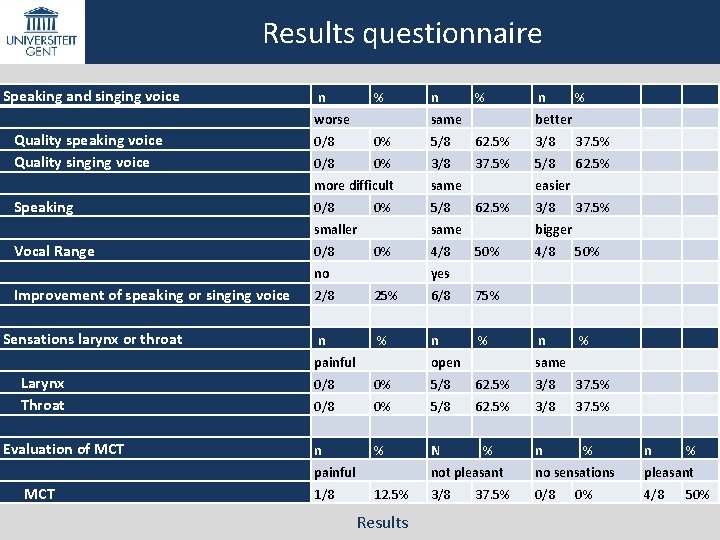
Results questionnaire Speaking and singing voice n % worse Quality speaking voice Quality singing voice Speaking 62. 5% 3/8 37. 5% 0/8 0% 3/8 37. 5% 5/8 62. 5% more difficult same 0/8 5/8 0% 0/8 4/8 easier 62. 5% same 0% better 5/8 37. 5% bigger 50% 4/8 50% yes 2/8 25% 6/8 75% n % n % open same 0/8 0% 5/8 62. 5% 3/8 37. 5% n % N painful MCT % 0% painful Larynx Throat Evaluation of MCT n 0/8 no Improvement of speaking or singing voice Sensations larynx or throat % same smaller Vocal Range n 1/8 12. 5% Results % not pleasant no sensations pleasant 3/8 0/8 4/8 37. 5% 0% 50%
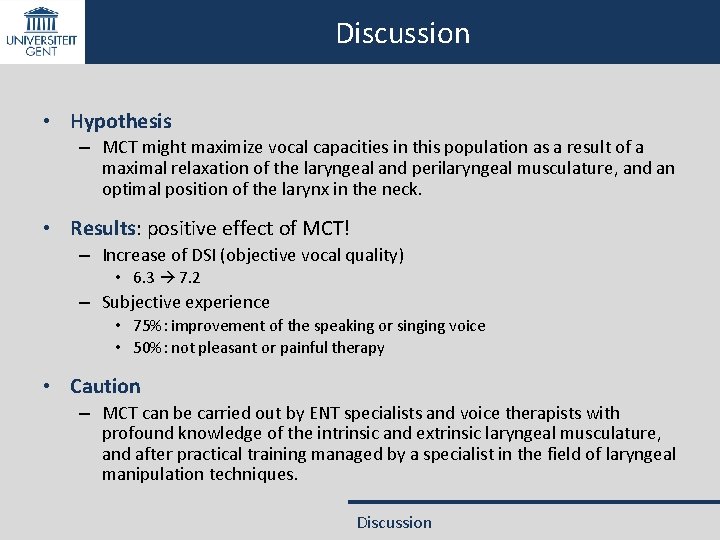
Discussion • Hypothesis – MCT might maximize vocal capacities in this population as a result of a maximal relaxation of the laryngeal and perilaryngeal musculature, and an optimal position of the larynx in the neck. • Results: positive effect of MCT! – Increase of DSI (objective vocal quality) • 6. 3 7. 2 – Subjective experience • 75%: improvement of the speaking or singing voice • 50%: not pleasant or painful therapy • Caution – MCT can be carried out by ENT specialists and voice therapists with profound knowledge of the intrinsic and extrinsic laryngeal musculature, and after practical training managed by a specialist in the field of laryngeal manipulation techniques. Discussion
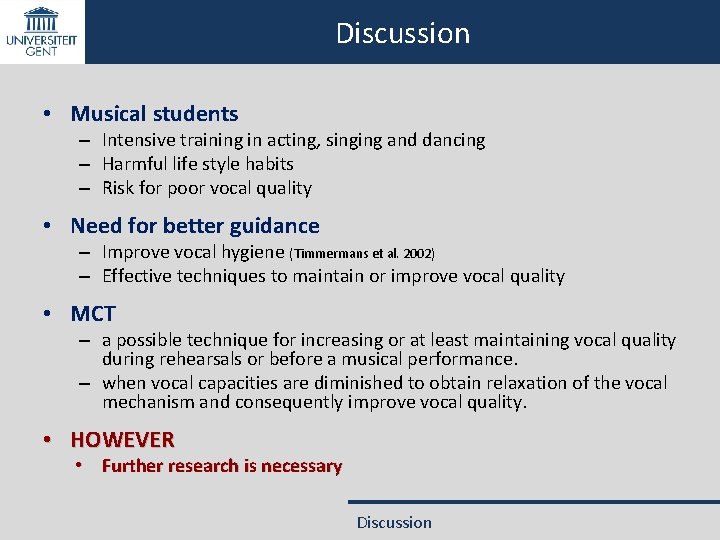
Discussion • Musical students – Intensive training in acting, singing and dancing – Harmful life style habits – Risk for poor vocal quality • Need for better guidance – Improve vocal hygiene (Timmermans et al. 2002) – Effective techniques to maintain or improve vocal quality • MCT – a possible technique for increasing or at least maintaining vocal quality during rehearsals or before a musical performance. – when vocal capacities are diminished to obtain relaxation of the vocal mechanism and consequently improve vocal quality. • HOWEVER • Further research is necessary Discussion
Thank you for your attention