
The effectiveness of different motor learning strategies to
- Slides: 1
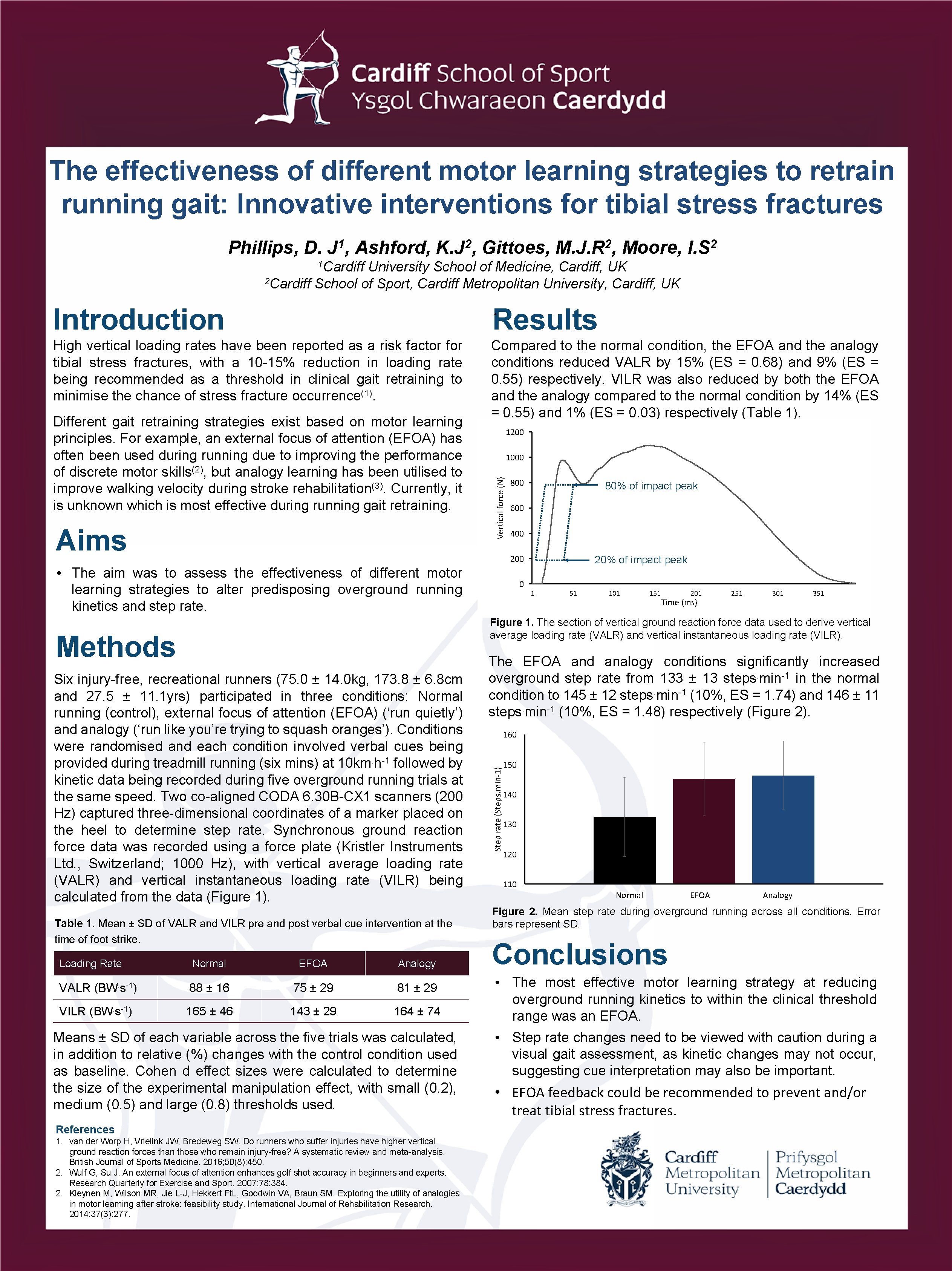
The effectiveness of different motor learning strategies to retrain running gait: Innovative interventions for tibial stress fractures Phillips, D. 1 J, Ashford, 2 K. J , Gittoes, 2 M. J. R , Moore, 2 I. S 1 Cardiff University School of Medicine, Cardiff, UK 2 Cardiff School of Sport, Cardiff Metropolitan University, Cardiff, UK Introduction Results High vertical loading rates have been reported as a risk factor for tibial stress fractures, with a 10 -15% reduction in loading rate being recommended as a threshold in clinical gait retraining to minimise the chance of stress fracture occurrence(1). Compared to the normal condition, the EFOA and the analogy conditions reduced VALR by 15% (ES = 0. 68) and 9% (ES = 0. 55) respectively. VILR was also reduced by both the EFOA and the analogy compared to the normal condition by 14% (ES = 0. 55) and 1% (ES = 0. 03) respectively (Table 1). Aims 1200 1000 Vertical force (N) Different gait retraining strategies exist based on motor learning principles. For example, an external focus of attention (EFOA) has often been used during running due to improving the performance of discrete motor skills(2), but analogy learning has been utilised to improve walking velocity during stroke rehabilitation(3). Currently, it is unknown which is most effective during running gait retraining. 800 80% of impact peak 600 400 200 • The aim was to assess the effectiveness of different motor learning strategies to alter predisposing overground running kinetics and step rate. 0 20% of impact peak 1 51 101 151 201 Time (ms) 251 301 351 Figure 1. The section of vertical ground reaction force data used to derive vertical average loading rate (VALR) and vertical instantaneous loading rate (VILR). Six injury-free, recreational runners (75. 0 ± 14. 0 kg, 173. 8 ± 6. 8 cm and 27. 5 ± 11. 1 yrs) participated in three conditions: Normal running (control), external focus of attention (EFOA) (‘run quietly’) and analogy (‘run like you’re trying to squash oranges’). Conditions were randomised and each condition involved verbal cues being provided during treadmill running (six mins) at 10 km. h-1 followed by kinetic data being recorded during five overground running trials at the same speed. Two co-aligned CODA 6. 30 B-CX 1 scanners (200 Hz) captured three-dimensional coordinates of a marker placed on the heel to determine step rate. Synchronous ground reaction force data was recorded using a force plate (Kristler Instruments Ltd. , Switzerland; 1000 Hz), with vertical average loading rate (VALR) and vertical instantaneous loading rate (VILR) being calculated from the data (Figure 1). Table 1. Mean ± SD of VALR and VILR pre and post verbal cue intervention at the time of foot strike. Loading Rate Normal EFOA Analogy VALR (BW. s-1) 88 ± 16 75 ± 29 81 ± 29 VILR (BW. s-1) 165 ± 46 143 ± 29 164 ± 74 Means ± SD of each variable across the five trials was calculated, in addition to relative (%) changes with the control condition used as baseline. Cohen d effect sizes were calculated to determine the size of the experimental manipulation effect, with small (0. 2), medium (0. 5) and large (0. 8) thresholds used. References 1. van der Worp H, Vrielink JW, Bredeweg SW. Do runners who suffer injuries have higher vertical ground reaction forces than those who remain injury-free? A systematic review and meta-analysis. British Journal of Sports Medicine. 2016; 50(8): 450. 2. Wulf G, Su J. An external focus of attention enhances golf shot accuracy in beginners and experts. Research Quarterly for Exercise and Sport. 2007; 78: 384. 2. Kleynen M, Wilson MR, Jie L-J, Hekkert Ft. L, Goodwin VA, Braun SM. Exploring the utility of analogies in motor learning after stroke: feasibility study. International Journal of Rehabilitation Research. 2014; 37(3): 277. The EFOA and analogy conditions significantly increased overground step rate from 133 ± 13 steps. min-1 in the normal condition to 145 ± 12 steps. min-1 (10%, ES = 1. 74) and 146 ± 11 steps. min-1 (10%, ES = 1. 48) respectively (Figure 2). 160 Step rate (Steps. min-1) Methods 150 140 130 120 110 Normal EFOA Analogy Figure 2. Mean step rate during overground running across all conditions. Error bars represent SD. Conclusions • The most effective motor learning strategy at reducing overground running kinetics to within the clinical threshold range was an EFOA. • Step rate changes need to be viewed with caution during a visual gait assessment, as kinetic changes may not occur, suggesting cue interpretation may also be important. • EFOA feedback could be recommended to prevent and/or treat tibial stress fractures.