
THE EFFECTIVENESS OF A CREATIVITY COURSE ON DEVELOPING


- Slides: 31
创新能力培养课程对学生的创造力思维提升 的有效性分析 THE EFFECTIVENESS OF A CREATIVITY COURSE ON DEVELOPING CHINESE DESIGN STUDENTS’ CREATIVE THINKING 朱花 2018. 10. 24
研究目的 Research Purpose l 调查研究创新能力培养课程教学的有效性 The purpose of this study is to investigate the overall effectiveness of a creativity course in developing creative thinking in Chinese university design students.
研究问题 Research Question • 1. 一个学期的创造性思维培养课程对于学生总体创造 力思维的影响 • 1. Can a one-semester creativity training course produce gains in overall creativity scores measured by standard tests of creativity in Chinese design students, compared to the scores obtained by students who do not take the course?
研究问题 Research Question • 2. 一个学期的课程对于学生五大创作力思维维度的影 响 • 2. Can a one-semester creativity training course improve fluency, originality, elaboration, abstractness of titles, and resistance to premature closure scores on the standard tests of creativity in a group of design students, compared to the scores obtained by students who do not take the course?
研究方法 Methodology
Methodology • 采用了准实验,前测与后测的设计方案 • This study uses quasi-experimental, pretestposttest design.
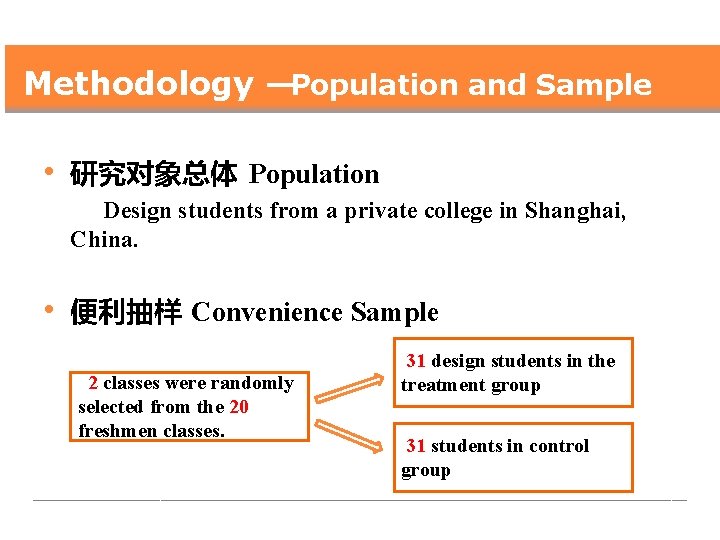
Methodology —Population and Sample • 研究对象总体 Population Design students from a private college in Shanghai, China. • 便利抽样 Convenience Sample 2 classes were randomly selected from the 20 freshmen classes. 31 design students in the treatment group 31 students in control group
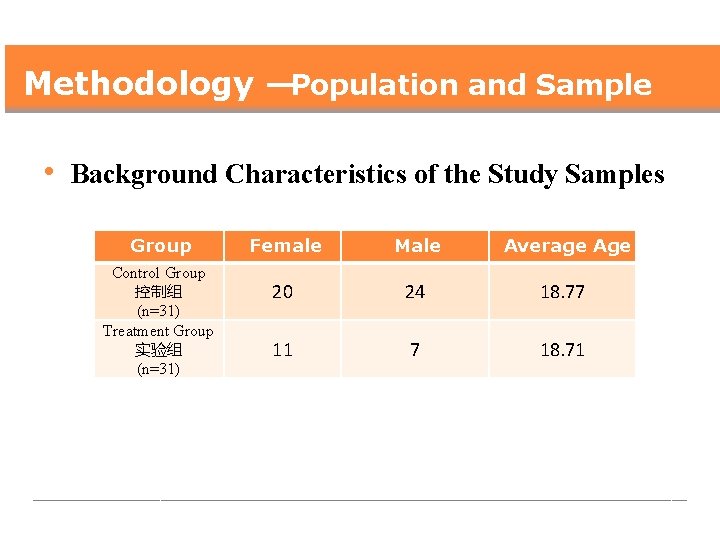
Methodology —Population and Sample • Background Characteristics of the Study Samples Group Control Group 控制组 (n=31) Treatment Group 实验组 (n=31) Female Male Average Age 20 24 18. 77 11 7 18. 71
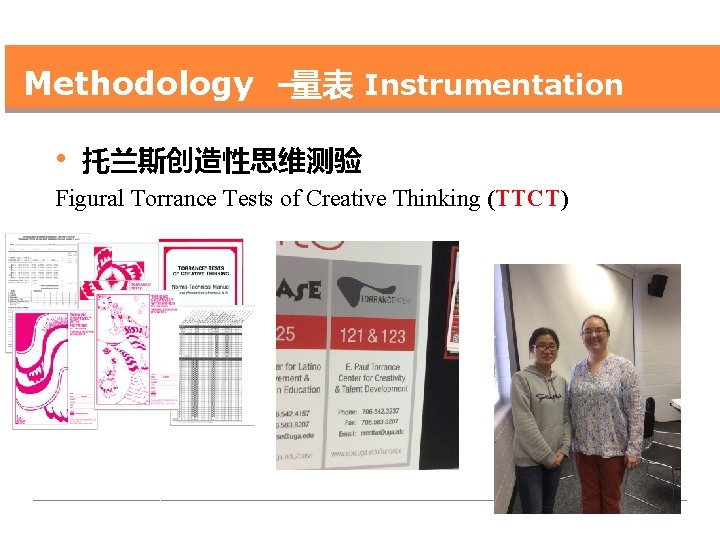
Methodology — 量表 Instrumentation • 托兰斯创造性思维测验 Figural Torrance Tests of Creative Thinking (TTCT)
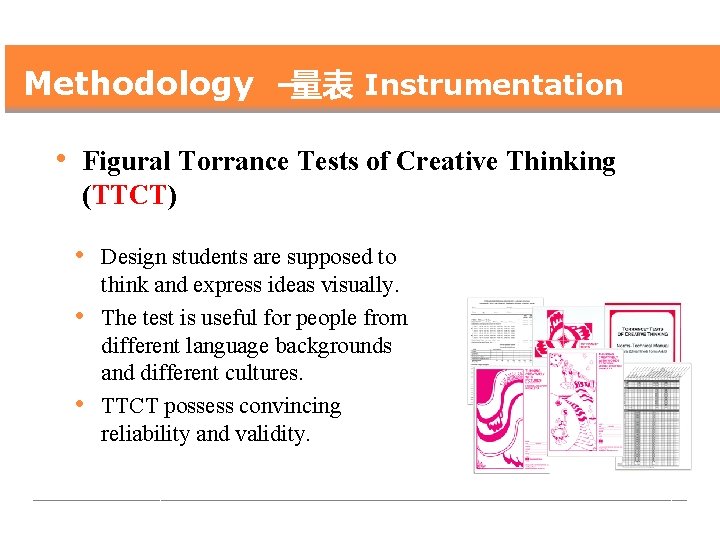
Methodology — 量表 Instrumentation • Figural Torrance Tests of Creative Thinking (TTCT) • Design students are supposed to • • think and express ideas visually. The test is useful for people from different language backgrounds and different cultures. TTCT possess convincing reliability and validity.
Methodology-实验步骤 Procedures Group Pre-test Treatment Control Group TTCT-Figural Form A Not taking creativity course TTCT-Figural Form B Treatment Group TTCT-Figural Form A Taking creativity course TTCT-Figural Form B Fall semester (September 2014) Post-test December 2014
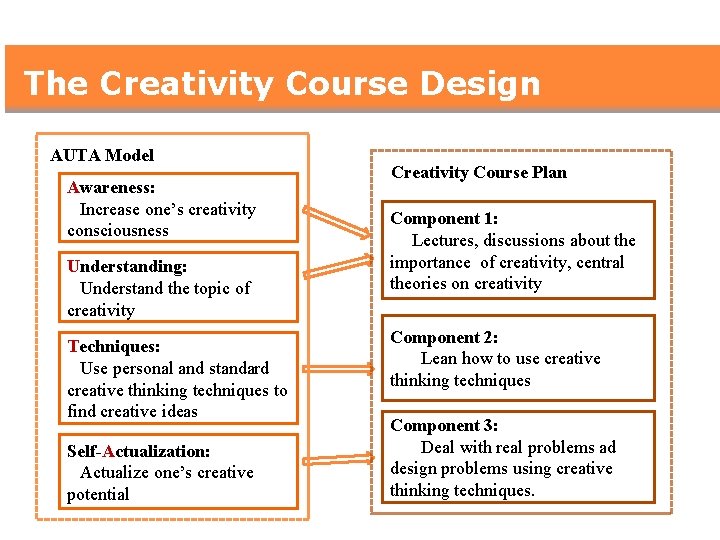
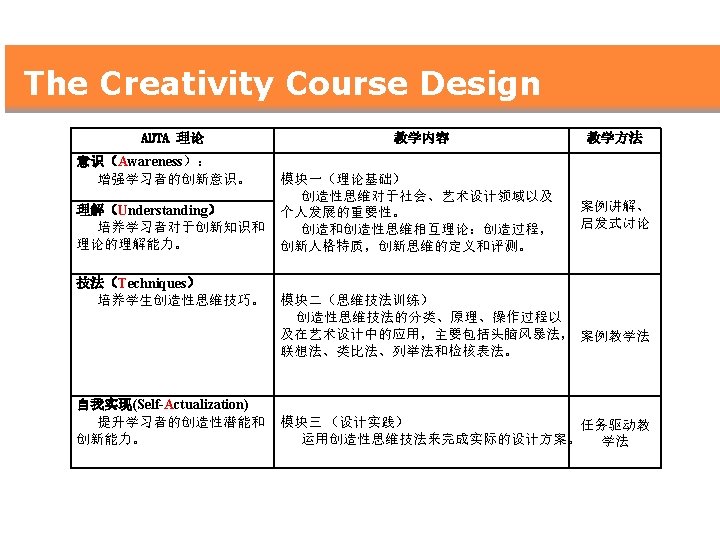
The Creativity Course Design AUTA Model Awareness: Increase one’s creativity consciousness Understanding: Understand the topic of creativity Techniques: Use personal and standard creative thinking techniques to find creative ideas Self-Actualization: Actualize one’s creative potential Creativity Course Plan Component 1: Lectures, discussions about the importance of creativity, central theories on creativity Component 2: Lean how to use creative thinking techniques Component 3: Deal with real problems ad design problems using creative thinking techniques.
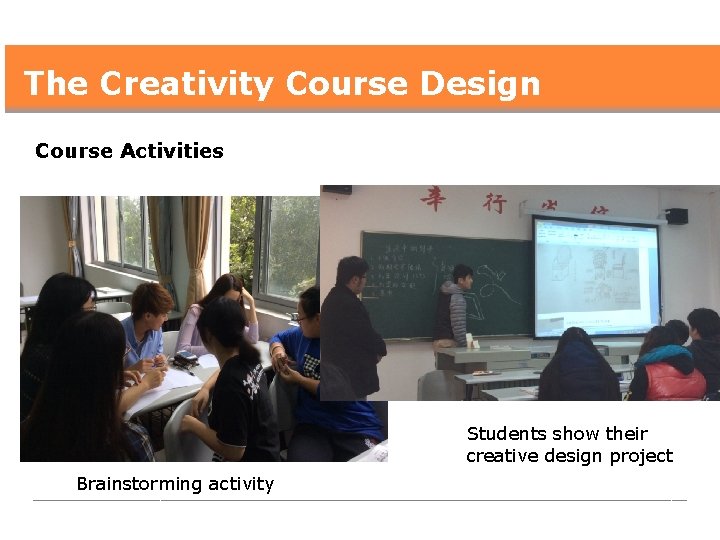
The Creativity Course Design Course Activities Students show their creative design project Brainstorming activity
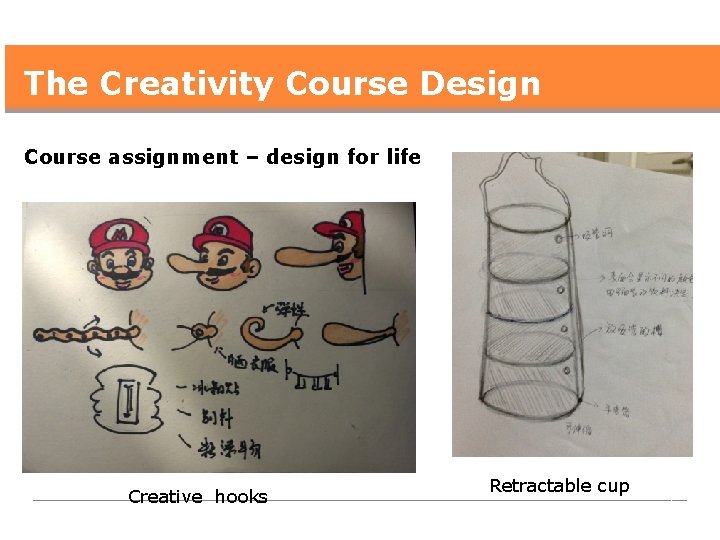
The Creativity Course Design Course assignment – design for life Creative hooks Retractable cup
结论 Results
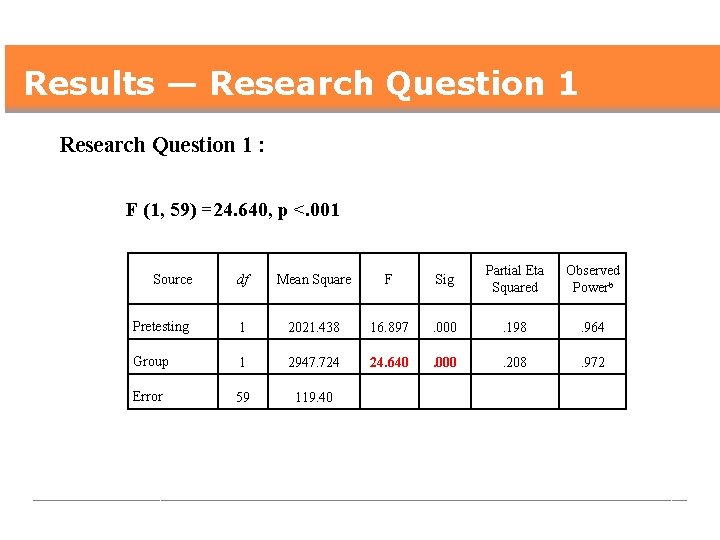
Results — Research Question 1 : 一个学期的创新思维培养课程对于学生创造性思维能力 提升的总体影响? Analysis of Covariance (协方差分析 ANCOVA) is used. Dependent variable Creativity Index of TTCT in the post test Independent variable Whether or not the student participates in the creativity course Covariate variable Creativity Index of TTCT in the pre test
Results — Research Question 1 : F (1, 59) =24. 640, p <. 001 Source df Mean Square F Sig Partial Eta Squared Observed Powerb Pretesting 1 2021. 438 16. 897 . 000 . 198 . 964 Group 1 2947. 724 24. 640 . 000 . 208 . 972 Error 59 119. 40
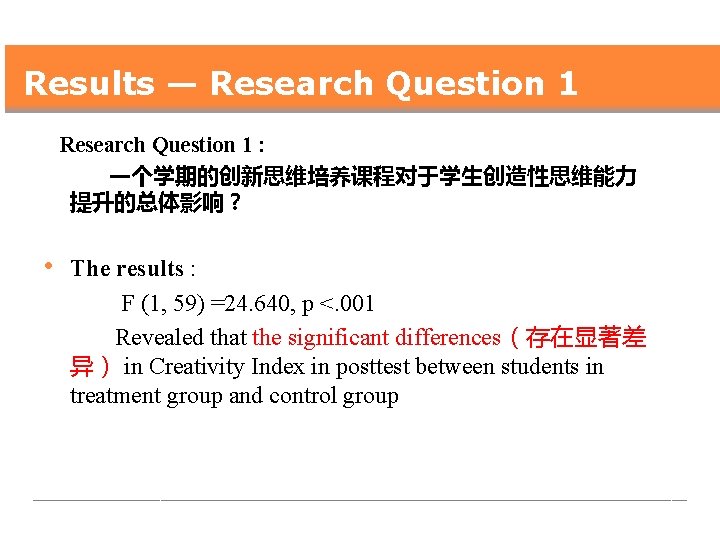
Results — Research Question 1 : 一个学期的创新思维培养课程对于学生创造性思维能力 提升的总体影响? • The results : F (1, 59) =24. 640, p <. 001 Revealed that the significant differences(存在显著差 异) in Creativity Index in posttest between students in treatment group and control group
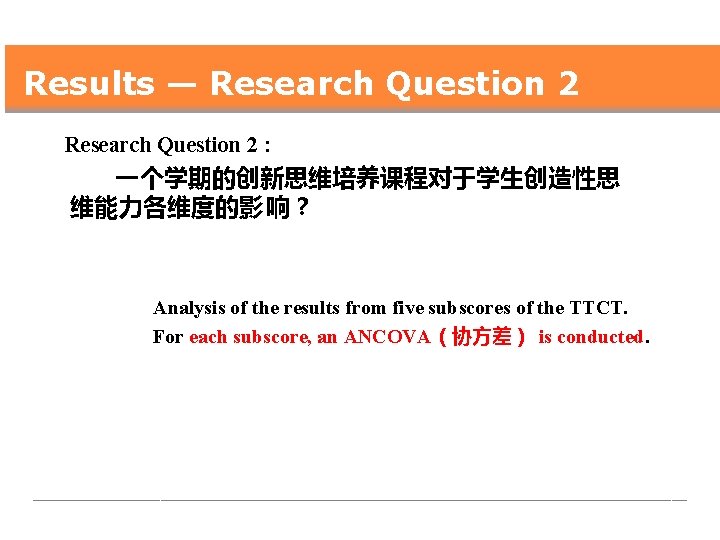
Results — Research Question 2 : 一个学期的创新思维培养课程对于学生创造性思 维能力各维度的影 响? Analysis of the results from five subscores of the TTCT. For each subscore, an ANCOVA(协方差) is conducted.
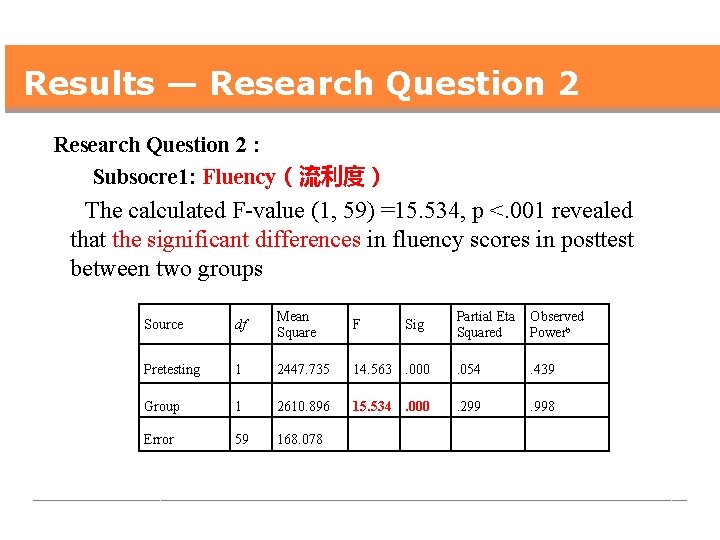
Results — Research Question 2 : Subsocre 1: Fluency(流利度) The calculated F-value (1, 59) =15. 534, p <. 001 revealed that the significant differences in fluency scores in posttest between two groups Source df Mean Square F Partial Eta Squared Observed Powerb Pretesting 1 2447. 735 14. 563. 000 . 054 . 439 Group 1 2610. 896 15. 534. 000 . 299 . 998 Error 59 168. 078 Sig
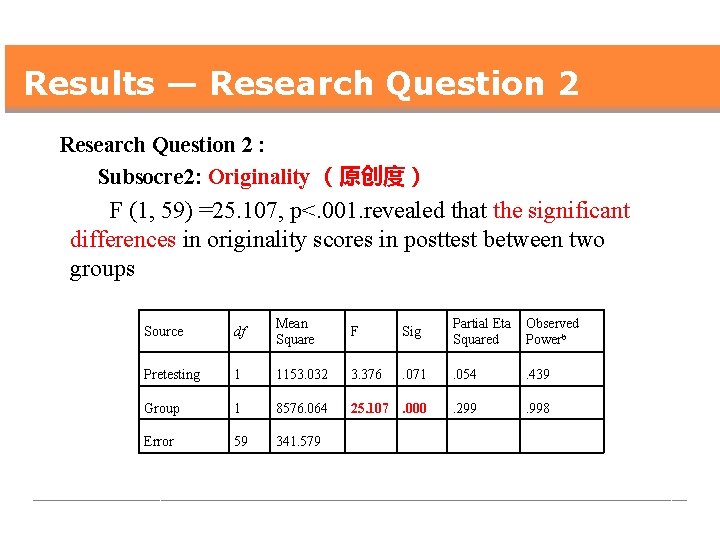
Results — Research Question 2 : Subsocre 2: Originality (原创度) F (1, 59) =25. 107, p<. 001. revealed that the significant differences in originality scores in posttest between two groups Source df Mean Square F Sig Partial Eta Squared Observed Powerb Pretesting 1 1153. 032 3. 376 . 071 . 054 . 439 Group 1 8576. 064 25. 107. 000 . 299 . 998 Error 59 341. 579
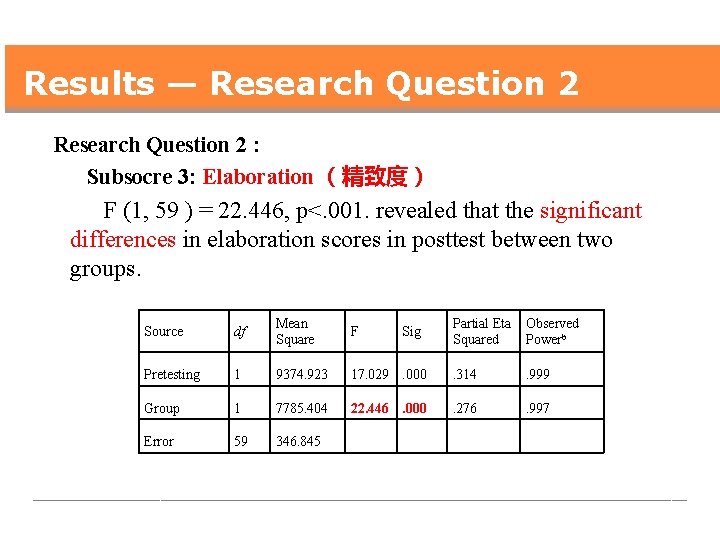
Results — Research Question 2 : Subsocre 3: Elaboration (精致度) F (1, 59 ) = 22. 446, p<. 001. revealed that the significant differences in elaboration scores in posttest between two groups. Source df Mean Square F Partial Eta Squared Observed Powerb Pretesting 1 9374. 923 17. 029. 000 . 314 . 999 Group 1 7785. 404 22. 446. 000 . 276 . 997 Error 59 346. 845 Sig
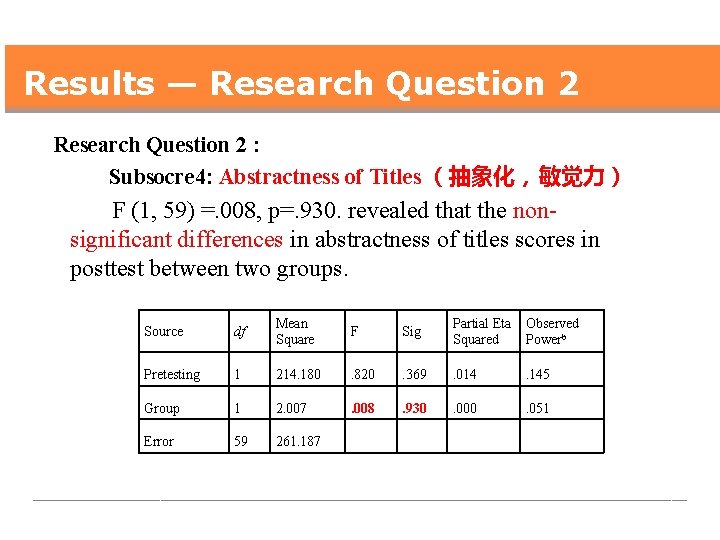
Results — Research Question 2 : Subsocre 4: Abstractness of Titles (抽象化, 敏觉力) F (1, 59) =. 008, p=. 930. revealed that the nonsignificant differences in abstractness of titles scores in posttest between two groups. Source df Mean Square F Sig Partial Eta Squared Observed Powerb Pretesting 1 214. 180 . 820 . 369 . 014 . 145 Group 1 2. 007 . 008 . 930 . 000 . 051 Error 59 261. 187
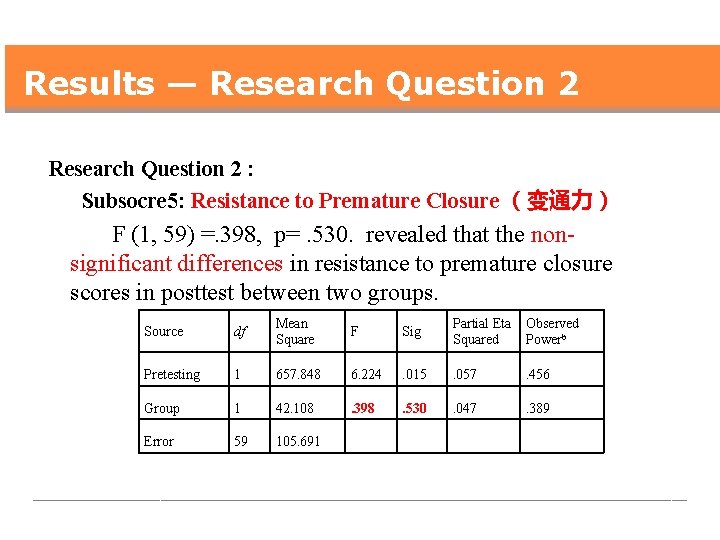
Results — Research Question 2 : Subsocre 5: Resistance to Premature Closure (变通力) F (1, 59) =. 398, p=. 530. revealed that the nonsignificant differences in resistance to premature closure scores in posttest between two groups. Source df Mean Square F Sig Partial Eta Squared Observed Powerb Pretesting 1 657. 848 6. 224 . 015 . 057 . 456 Group 1 42. 108 . 398 . 530 . 047 . 389 Error 59 105. 691
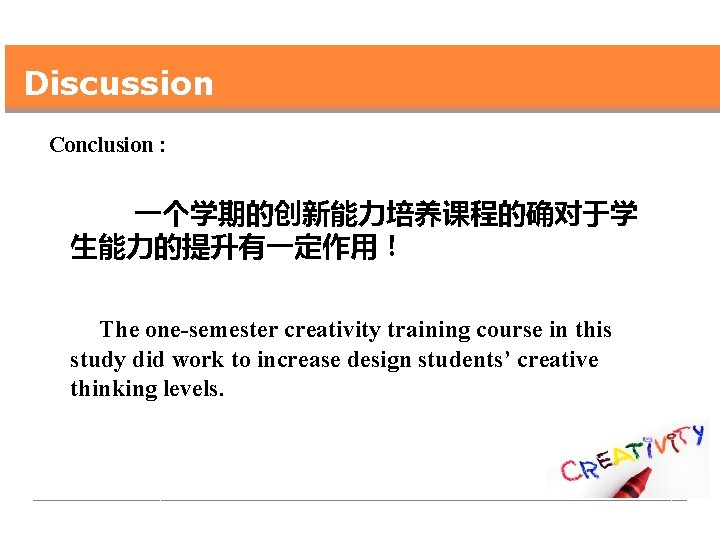
Discussion Conclusion : 一个学期的创新能力培养课程的确对于学 生能力的提升有一定作用! The one-semester creativity training course in this study did work to increase design students’ creative thinking levels.
Thank You !